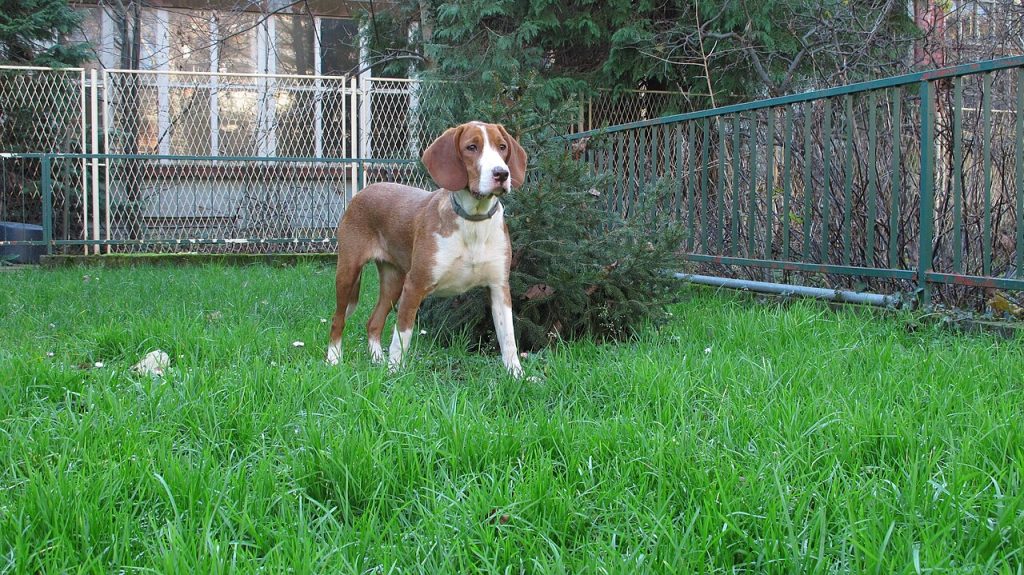
The Dog of Posavaz is a medium-sized Croatian hunting dog, bred for centuries in the Save River valley to track hares, foxes and wild boars with a sonorous and unmistakable voice. Little known outside the Balkans, it is a hardy, docile and family-friendly hound with a striking wheat-red coat dotted with white. If you’re looking for an athletic, well-balanced companion with a prodigious sense of smell, this rare breed deserves a thorough introduction.
Is the Hound of Posavaz for you?

The Posavaz Hound is not a dog for any household. It is, above all, a working dog: it needs to move, smell and expend energy, and it returns that demand with enormous loyalty and sweetness. Before you fall in love with its pretty red coat, you should honestly assess whether your pace of life fits with that of a dog bred to spend the day in the mountains.
Points in favour
- A docile character, balanced and not aggressive.
- Very close and affectionate with his family.
- Rustic, healthy and easy to maintain.
- Short coat that barely needs grooming.
- He learns easily if you motivate him well.
- Resilient and tireless for outdoor activities.
Points to Consider
- He needs plenty of daily exercise; he’s not sedentary.
- Strong voice: tends to bark and howl.
- Strong hunting instinct; unreliable loose.
- He gets bored and frustrated if he spends hours alone.
- Rare breed: difficult to find outside the Balkans.
- It’s not the best choice for small apartments.
Character and temperament
The breed standard summarizes its temperament with three traits: Docile, neither nervous nor aggressive and of a moderately lively character. It’s a balanced dog, combining calmness inside the house with total surrender as soon as it steps onto the field. His most striking trait is attachment: The Hound of the Baskervilles bonds intensely with its master and enjoys human company, to the point that prolonged solitude does not sit well with it.
Like a good hound, he lives through his nose. It’s a born tracker with a clear, melodious voice that used to alert the hunter to the position of prey. That vocalization is part of its essence: It is not a silent dog, and whoever adopts it must assume that it will express with the voice both enthusiasm and boredom. Instead, it is sensitive, attentive, and surprisingly affectionate for a working breed.
Coexistence: children, other pets, flat and loneliness

With children:‘s docile nature and family attachment make it a good companion for homes with children, as long as they learn to respect their rest times.
With other dogs: was bred to work in packs, so it usually gets along well with other dogs and appreciates canine companionship.
With cats and small animals: needs to be cautious here. His hunting instinct is very strong and he can see a cat, a rabbit or a chicken as prey. Coexistence is possible if he grows up with them from a puppy, but you should never trust completely.
On the floor and in the solitude: can live on the floor only if you guarantee it plenty of exercise, but it prefers a house with a garden or the countryside. And, above all, it does not tolerate spending long hours alone: barking, howling and destructive behaviors appear. It is a dog for present and active families.
Education and training
The standard itself points out that it is an easily trained breed, and its strong bond with its owner plays to its advantage. It learns quickly, responds well to positive reinforcement, and enjoys pleasing. The challenge is not in its intelligence, but in its sense of smell: when it catches an interesting trail, it can completely disconnect from your commands and follow it without looking back.
That’s why the absolute priority in their education is the call. It’s best to work on it from a puppy, with high-value prizes and in controlled environments, and be realistic: Until you have a very solid call, it’s wise not to release it into open areas without a fence. Add to this extensive socialization, clear routines, and a lot of playful olfactory work, and you have a happy, obedient dog. Harsh methods are counterproductive with such a sensitive and attached dog.
Exercise and activity
This is the critical point of the breed. The Posavaz Hound was selected for its excellent endurance for whole days of hunting on difficult terrain, and that machinery needs gasoline daily. A minimum of one to two hours of real physical activity – long walks, running, hiking, dog sports – is essential for it to be balanced.
In addition to physical exercise, it appreciates mental stimulation. Smelling games, searching for hidden food, and sports tracking (mantrailing) take advantage of its greatest talent and tire it as much as a run.
Care: fur and hygiene

Its hair is short, hard, thick and shiny, about 2 to 3 cm long, slightly longer at the back of the thighs, the belly and the lower face of the tail.
The care you must not neglect is the ears. Because they are hanging and tightly attached to the head, they are poorly ventilated and retain moisture, which favors otitis. Check and clean them regularly, especially after going out or getting wet. Complete the routine with nail trimming when necessary, frequent dental hygiene and a skin check after each day between weeds, in case it brings ticks or spikes.
Foodstuffs
As an active and muscular dog, it needs a quality diet with a good intake of animal protein that supports its muscle mass and energy.
It is advisable to monitor the weight, since an overweight dog loses agility and suffers more in the joints. In deep-chested dogs like this it is prudent to avoid intense exercise just before or after eating, as a precautionary measure against gastric dilation. Always have fresh water available, especially on field days.
Health and life expectancy
The Posavaz Hound is a rustic and functional breed, with no serious hereditary diseases specifically documented for it. Its work-oriented selection and absence of morphological exaggerations have preserved remarkable robustness.
This does not mean that he is free from risks common to dogs of his type. Its droopy ears make it prone to ear infections, and its outdoor life requires keeping up with internal and external deworming. As with any medium-sized breed, it’s best to take care of your joints throughout your life. Regular veterinary checkups, daily vaccinations, and weight control are the best prescriptions for healthy old age.
Physical appearance
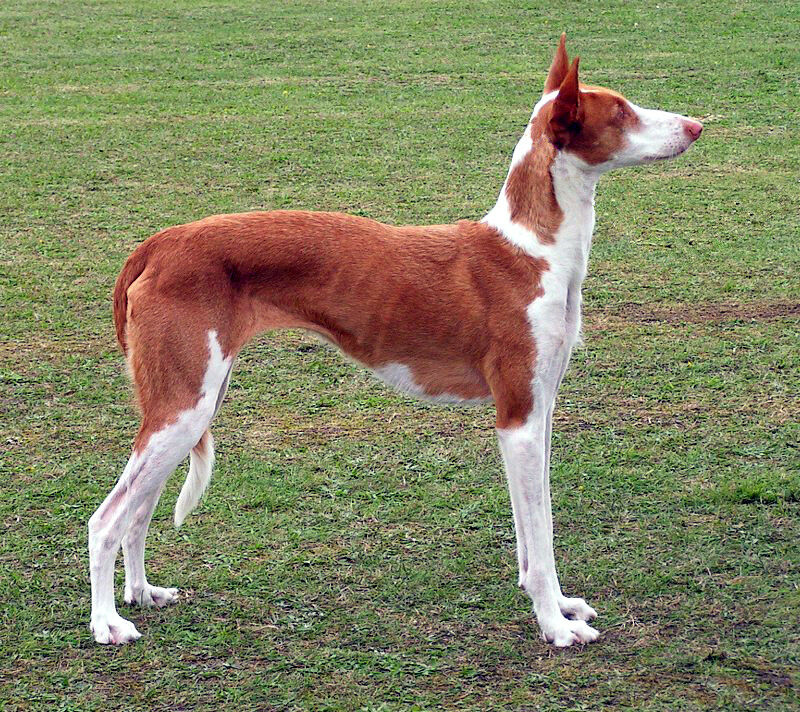
The Posavaz Hound is a dog of medium size and strong build, with a rectangular silhouette body in which the length slightly exceeds the height at the cross.
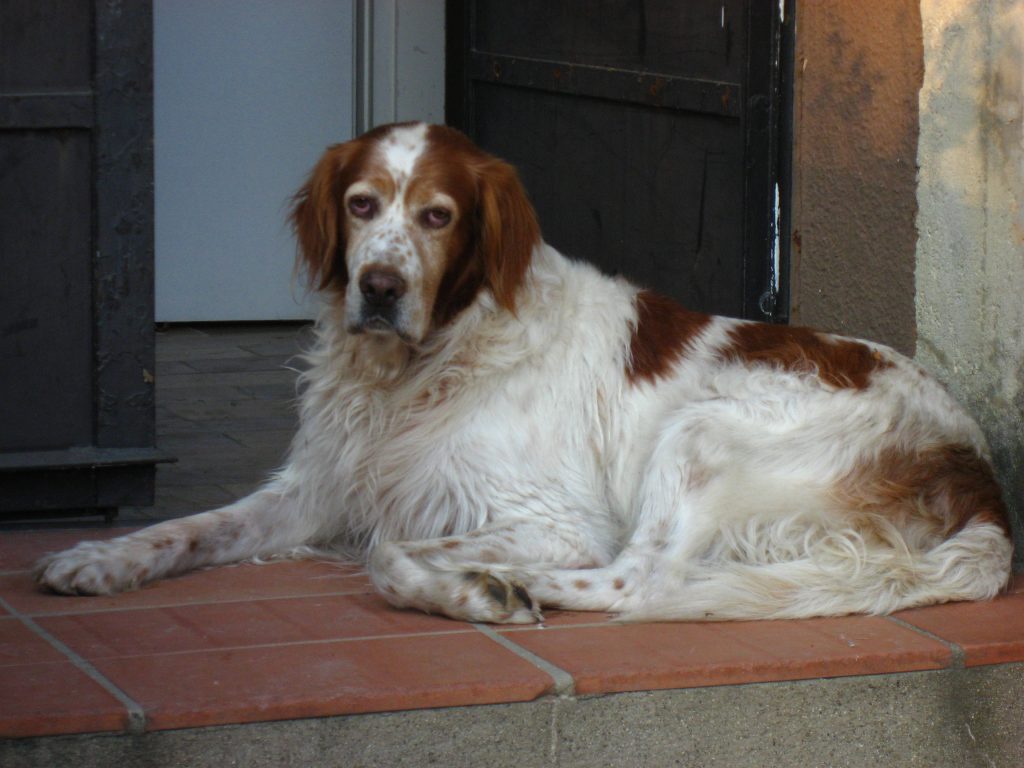
Its most characteristic feature is the colour: a reddish-brown coat of wheat in all its shades, with well-defined white markings on the head (in the form of a cord or strip), the neck (as a collar), the fore-breast, the belly, the lower parts of the limbs and the tip of the tail. The white spots should not exceed one third of the body surface. The head is proportionate, with slightly divergent lines, well-developed stop and middle insertion ears, dropped and glued to the cheeks. The tail, medium in length and shaped like a sabre, is carried below the upper line. Taken together, they convey strength, harmony, and a gentle expression.
Origin and history
The Posavaz Hound – posavski gonič in Croatian, meaning the “tracking dog of the Save valley” – is a old breed of hound originating in Croatia, developed in the Posavina region, southeast of Zagreb.
The earliest known depiction appears in a 1474 fresco, “The Reverence of the Three Kings”, in the cemetery chapel of Beram (Istria), where a dark wheat-colored dog with drooping ears is seen. It is followed by a 16th-century altarpiece in the Church of Our Lady of the Angels in Veli Lošinj. In texts, the bishop of Đakovo, Petar Bakić, describes it in 1719 indicating that its offspring was already known in the XIV century, and Franjo Bertić mentions it again in 1854. Save Valley dogs were sold as boskini in 19th century Croatia. The genealogical record began in 1929, and the FCI published its first standard on 8 April 1955, with the number 154; the definitive name was clarified in 1969. It is classified in Group 6 (hound-type, tracking and similar dogs), Section 1.2, with proof of work.
Curiosities
- A name that is a geography:“Posavaz” comes from Posavina, the county on the banks of the Save River.
- More than five centuries in art: his type appears portrayed in Croatian frescoes as early as 1474, long before the modern concept of race existed.
- A voice with a function:‘s melodic barking is not a whim, but a working tool for the hunter to follow the dog at a distance by sound.
- Rare outside the Balkans: is very popular as a hunting dog in Croatia and neighboring countries, but very rare in the rest of the world, where it is promoted as an exotic breed for those looking for a unique companion.
- The A color with strict rules: standard expressly prohibits dark brown or chocolate tones and limits white to one-third of the body.
If you’re attracted to this Croatian hound but want to compare with similar-looking breeds, check out the Beagle, another medium-sized, vocal hound; the Basset Hound, a hound with a prodigious sense of smell and droopy ears; the Bloodhound, the quintessential tracker; or the Pointer, another classic hunting dog with great stamina.
Frequently Asked Questions about the Posavaz Hound
Is the Posavaz Hound a good dog to live in a flat?
It is not its ideal environment. The Posavaz Hound is a hunting dog with a lot of stamina and need to run and sniff. It can adapt to a floor if you guarantee it several hours daily of intense exercise in the open air, but it feels much more comfortable in a house with a garden or in the countryside. Without physical and mental relaxation it tends to get bored and bark.
Does the Hound of Posavaz bark or howl a lot?
Yes, it tends to use the voice. The standard describes a clear, melodious voice designed to warn the hunter when he’s following a trail. At home that same voice appears if he’s bored, if he senses an interesting smell, or if he spends too much time alone. With enough exercise and education, it’s controlled, but it’s a vocal breed by nature.
Does he get along with children and other dogs?
In general, yes. It is a docile dog, not aggressive and very attached to its family, so it usually lives well with children who treat it with respect. Being a pack dog, it tolerates the company of other dogs well. With cats and small animals you have to be careful because of its strong hunting instinct.
How much exercise do you need a day?
It is an athletic dog bred for long days of hunting, so it needs at least one or two hours of daily activity: long walks, running, sniffing games or canine sport. A Posavaz Hound that only makes short laps around the apple will accumulate energy and frustration.
Is it easy to train?
The standard describes it as a breed that is easily trained and is very attached to its master, which helps. It learns quickly with positive reinforcement. The difficulty is not intelligence, but smell: when it catches a trail it can disconnect from your commands, so it is advisable to work hard on the call and not release it into unfenced areas until you have it very reliable.
What care does your fur need?
Very few. It has short, hard and thick hair, 2 to 3 cm, which only requires a weekly brushing to remove the dead hair and punctual baths when it gets dirty.
How long does a Posavaz Hound live?
It is a rustic and healthy breed, with no specifically documented serious hereditary diseases. Its life expectancy is usually between 12 and 14 years, favored by its functional selection for work and not being a breed subjected to fashions or morphological exaggerations.
How is it different from the Beagle or other hounds?
The Posavaz Hound is taller and longer-bodied than the Beagle (measuring between 47 and 56 cm at the cross), with a single pattern of wheat-red color and white spots, while the Beagle is tricolored and more compact.