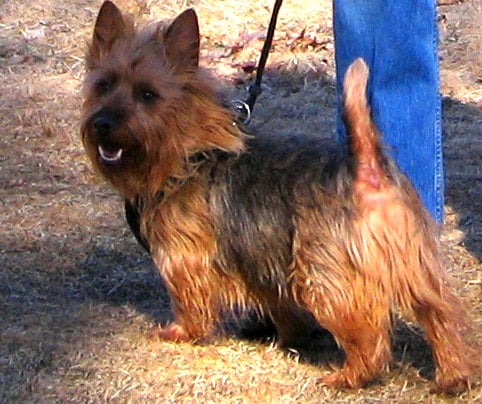
The Terrier Australiano is one of the smallest working terriers in the world: a sturdy, brave, short-legged dog that fits on any floor but retains intact the prowler character with which it was forged on Australian farms. It weighs only about 20 pounds [6.5 kg] and measures about 10 inches [25 cm] at the withers, but its confidence, loyalty, and energy are much more than its size suggests. If you’re looking for a small, alert companion with plenty of personality, this breed deserves your attention.
Is the Australian Terrier for you?
Before you fall in love with that hairy face, let’s be clear. The Australian Terrier is an easy dog to keep in many respects and very adaptable, but it’s still a pure breed terrier: independent, determined and with a hunting instinct. Here’s an honest summary of its pros and cons.
In favour .
- Small and manageable, ideal for a flat or a house with a garden.
- Low-maintenance coat: no need for hairdressing or constant haircuts.
- Very loyal and attached to his family; excellent companion dog.
- Smart and quick to learn when the education is positive.
- Robust, durable and generally long-lived and healthy.
- He’s a good alarm dog. He warns you of anything that happens.
To be taken into account
- Strong hunting instinct: after rodents, cats or birds it will shoot out.
- He can be a barker if you don’t teach him to control it.
- Stubborn and independent; he needs a consistent leader.
- He tends to dig in the garden out of pure terrier instinct.
- It may be dominant with other dogs of the same sex.
- He’s not a dog to be left alone for many hours every day.
Character and temperament

The breed standard defines the Australian Terrier as a lively, alert and with the natural aggressiveness of a rat and hedge hunter dog. It is a description that portrays it as full-bodied: we are before a small dog but with a large character, self-confident and always ready for action. Nothing escapes him; he observes, evaluates and reacts with a speed that betrays his past work on the farm.
It’s another thing with his family. The Australian Terrier is deeply loyal and affectionate, and tends to form a very close bond with its people. He likes to be involved in the home life, following you from room to room and lying next to you when things calm down. That devotion, coupled with his intelligence, makes him an excellent companion for anyone looking for a small dog with presence and temperament, not a mere lap dog.
As a good terrier, he also has his stubborn side. He’s independent, and if you let him, he’ll try to make the decisions. It’s not aggression: it’s security and character. With consistency and clear rules from a puppy, that firmness can be channeled smoothly and you get a dog that’s balanced, brave and a lot of fun to have around.
Coexistence: children, other pets, flat and loneliness
The Australian Terrier adapts to almost any household, but it’s worth knowing its nuances according to context:
- With children: usually gets along well with children in the house, especially if you grow up with them. Its compact size and strength help, but it is advisable to teach the youngest to respect the dog and supervise the game so that no one goes over the line.
- With other dogs: is generally sociable, although it can be dominant or defiant with dogs of the same sex.
- If you’re raised with a cat, you can accept it as part of the family, but rodents, rabbits or small birds are interpreted as prey.
- On the floor: is perfectly suited to living in an apartment as long as it has its daily walks and stimulation.
- In the face of loneliness: is very attached to his people and does not do well all day alone. If he spends too many hours without company he may get bored, bark or develop behaviors such as digging or destroying.
Education and training

The Australian Terrier is an intelligent dog with a very good willingness to learn. In Stanley Coren’s canine intelligence classification it ranks one place above average in obedience and work, which translates into a dog that picks up quickly what you ask of it… when it’s interested. And that’s the key: it needs motivation.
Positive reinforcement is the way. Rewards, play, and praise work infinitely better than toughness, which only gets a terrier to close in on the band. The sessions should be short, dynamic, and varied, because it gets bored with repetition. If you turn training into a game, you’ll have all of its energy and desire to please in your favor.
It is good to set the rules from day one and keep them without exceptions; this dog immediately detects any inconsistency and takes advantage of it. Two areas deserve priority attention: The control of barking, to warn without becoming a permanent alarm, and the call (come when called), essential because its chase instinct can make it ignore everything else when it sees prey. Early socialization with people, dogs, and environments completes the foundation of a balanced adult.
Exercise and activity
Don’t be fooled by its size: the Australian Terrier is an active dog that needs to expend energy daily. It doesn’t require the marathons of a large sporting dog, but it does require a couple of good walks, playtime and, above all, mental stimulation. A boring terrier is a trouble-seeking terrier.
He loves games that appeal to his instinct: chasing a ball, looking for hidden objects, clever toys, or any activity that makes him use his head. Disciplines like agility or tracking go like rings on his finger and also strengthen your bond. If you have a garden, he will enjoy patrolling it, although keep in mind that he will also want to dig.
With his exercise and mental needs met, the Australian Terrier becomes a calm, contented indoor dog. It is precisely this balance between activity and rest that makes him so pleasant to mingle with.
Care: fur and hygiene

One of the great advantages of this breed is its ease of maintenance. The Australian Terrier wears a medium-length double coat, with a rough, waterproof outer layer and a softer, insulating inner one. This working hair is designed to protect it from the elements and, unlike many exhibition terriers, it is not cut or combed into elaborate shapes: You look for the natural, rustic look.
In practice, a weekly brushing(a couple of times a week if you want to keep it spotless) is enough to remove dead hair and avoid tangles. It’s a little hairy. To preserve the characteristic rough texture, breeders resort to stripping or manual pulling of dead hair a couple of times a year, instead of machine cutting, which softens the coat; for a companion pet it is not essential, but helps to keep its fur in condition.
Bathing should be punctual, only when it is really dirty, because washing it excessively dries the skin and reduces the impermeability of the hair. The rest of the hygiene is the usual routine: checking and cleaning the ears (it is prone to ear infections), cutting nails regularly and taking care of dental hygiene with frequent brushing.
Foodstuffs
As a small and active dog, the Australian Terrier needs a complete and balanced diet, adapted to its age, weight and activity level. A quality feed or a well-formulated diet provides it with everything it requires; the important thing is to respect the recommended amounts and divide them into two daily intakes in the adult.
Weight control is a point to keep a close eye on in this breed. The Australian Terrier has a predisposition to diabetes, and being overweight is an added risk factor for both the disease and its joints. Measure rations well, moderate rewards (best to use part of your daily ration for training) and avoid human food scraps. Fresh water always available and regular checkups with the veterinarian complete a sensible dietary routine.
Health and life expectancy
The Australian Terrier is, as a whole, a robust and healthy dog, the result of its origin as a work animal little “manufactured” genetically.
- Diabetes mellitus is characterized by: is one of the most reported conditions in the breed; weight control and diet are key to preventing it.
- Dislocation of the patella: common in small dogs, may range from mild to require surgery.
- Infections of the ear and eye problems like cataracts.
- Skin and subcutaneous tissue infections(including allergy to flea bites).
- Cranial cruciate ligament rupture and hypothyroidism.
- A rare autoimmune disease of the Vogt-Koyanagi-Harada type, affecting the eyes and skin.
As for life expectancy, health surveys place its median around 11-12 years, and it is not uncommon for well-cared-for specimens to reach 14-15. Interestingly, females usually live about a year longer than males. The leading causes of death on record are old age, cancer and diabetes, confirming the image of a breed that, with good care, reaches old age in good shape. Going to a responsible breeder who does health checks on the breeders is the best guarantee of starting.
Physical appearance
The Australian Terrier is a small dog, with a slightly elongated body and compact and strong appearance. It has short but strong limbs, a muscular constitution for its size and an upright and attentive posture that conveys alertness and safety. The female measures about 25 cm at the cross and weighs about 6.5 kg; the females are slightly smaller, around 22.5-23 cm and about 6 kg.
The head is long and strong, with small, erect, pointed ears, and dark, small, vivid eyes that reflect intelligence. One of its hallmarks is the softer beet or cabbage hair that crowns the head, lighter in tone than the rest of the body, and the longer hairline around the neck.
The coat is rough and of medium length, shorter at the snout, lower legs and feet. In terms of color, the most typical are the blue and fire(blue, bluish gray or silver gray on the body, with fire-colored marks on the face, ears, legs and lower parts) and the solid red, in its variants of intense red to more sandy tones. The standard describes fire as a clear chestnut, “never sandy”.
Origin and history
The history of the Australian Terrier dates back to the early 19th century, when British families immigrating to Australia took their hard-haired terriers with them. In this new and demanding environment, these dogs were crossed with each other and with other British breeds to produce a terrier adapted to the needs of the settlers: control rats and mice, deal with vermin and even snakes, sound the alarm and accompany the family.
Several British terrier breeds were involved in its development. The Australian Terrier shares ancestors with the Cairn Terrier, the Shorthaired Skye Terrier and the Dandie Dinmont Terrier, and blood from the Yorkshire Terrier and Irish Terrier was also incorporated into the breed’s formation. From this mixture came a small, hardy and multi-purpose dog, known at first as Rough Coated Terrier(“rough-haired terrier”).
Breed selection began around 1820. It was officially recognized in 1850 and renamed the Australian Terrier in 1892. Its debut at a dog show came in 1906, in Melbourne, and around the same time it began to be shown also in Great Britain. The British canine societies recognized it starting in the 1930s, and the American did so in 1960. It also has the honour of being the first breed developed in Australia to be recognised and exhibited in its home country.
Curiosities
- It is one of the smallest working terriers in the world, and yet it was bred for a wide variety of farm work.
- His original name, Rough Coated Terrier, was a direct reference to his characteristically rough hair.
- It is often confused with a large Yorkshire Terrier, and it is no accident: the Yorkshire is among its ancestors.
- Not to be confused with the Silky Terrier, a distinct and related breed with a long silky coat.
- It was the first Australian native breed officially recognized and exhibited on its land.
- On the farm, he not only hunted rodents but also served as an alarm dog and a loyal companion, a true small-sized all-terrain vehicle.
If you are interested in the world of small, brave terriers, you will enjoy exploring other breeds in the same family and with a shared history: the Yorkshire Terrier, one of its direct ancestors; the Cairn Terrier, with which it shares British ancestry; the Silky Terrier, its Australian silky-haired relative; and the Norwich Terrier, another small working terrier with an equally large character.
Frequently Asked Questions About the Australian Terrier
Is the Australian Terrier a good dog to live on the floor?
Yes. Its small size makes it perfectly suited for apartments, provided it receives its daily walks and sufficient mental stimulation. The only point to work is the tendency to bark, which should be controlled from puppyhood for a good coexistence in the community.
How long does an Australian Terrier live?
Their life expectancy is on average around 11-12 years, and with good care many specimens reach 14-15.
Do you get along with children and other pets?
It usually lives very well with the children of the house, especially if it grows up with them, always with respect and supervision. With other dogs it is sociable, although it can be dominant with those of the same sex. With cats it can live if it is raised alongside them, but its hunting instinct makes it hardly compatible with rodents, rabbits or birds.
How much hair does it shed and how much care does its coat need?
It lays down little hair. Its double, rough coat is low maintenance: a weekly brushing and occasional bathing is sufficient. It does not need hairdressing or trimming; to maintain the rough texture, breeders resort to stripping or manual tearing a couple of times a year.
Is it easy to educate?
He’s intelligent and quick learner, above average in obedience, but he’s independent and stubborn, so he needs positive reinforcement, short sessions, and consistent rules.
What is the size and weight of the Australian Terrier?
It is a small dog: the males measure about 25 cm at the cross and weigh about 6,5 kg, while the females are somewhat smaller, around 22,5-23 cm and about 6 kg.
What health problems does this breed have?
It is a generally healthy breed, but has some predisposition to diabetes mellitus, kneecap dislocation, ear infections, cataracts, allergic dermatitis and hypothyroidism, among others.
Can you stay alone for many hours?
This is not ideal. The Australian Terrier is very attached to its family and does not tolerate prolonged loneliness. If it spends too many hours alone daily, it may become bored and develop behaviors such as excessive barking, digging, or destroying. It works much better in homes where it has company most of the day.