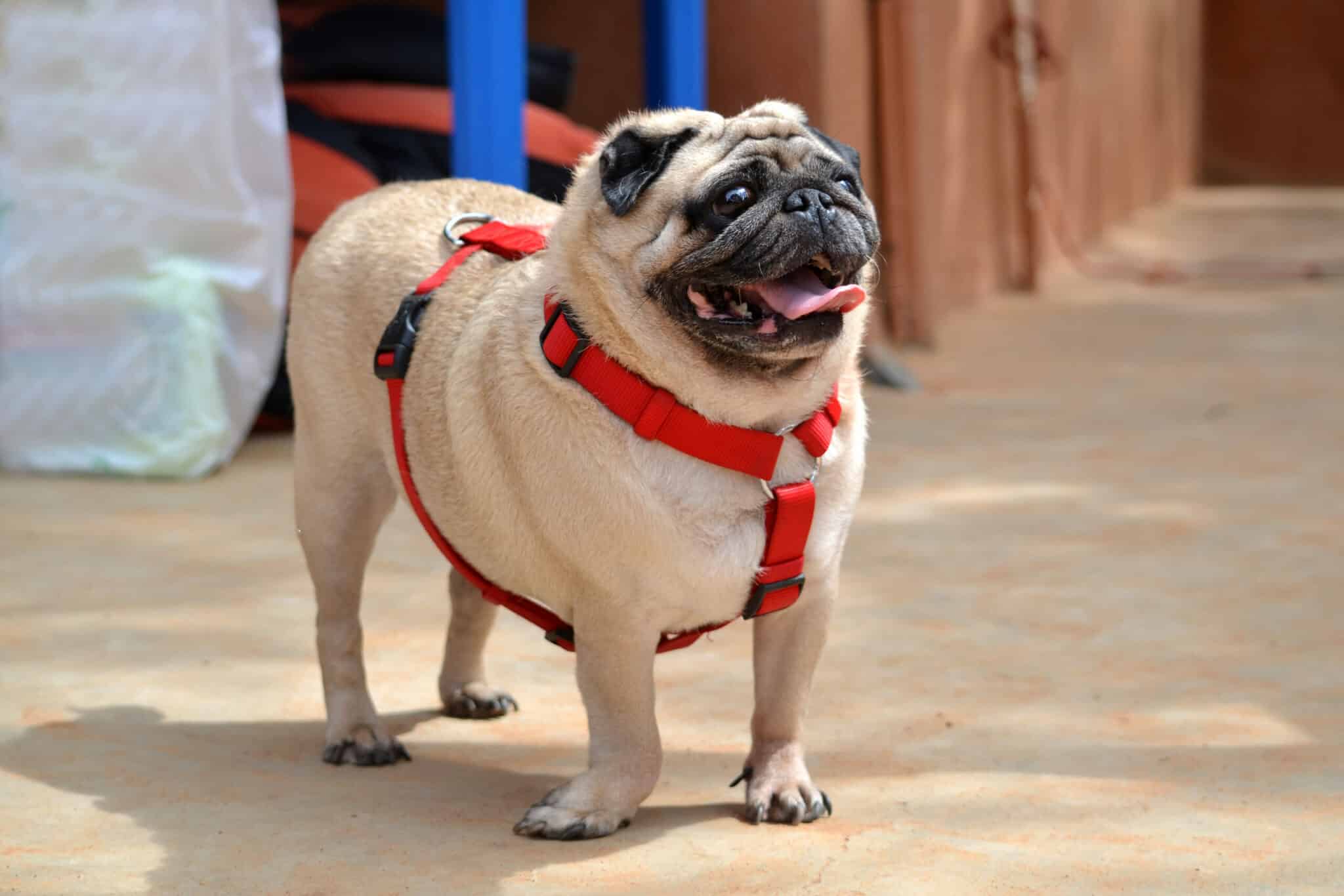
The Carlino(known internationally as Pug and called doguillo by the FCI) is a small, compact, wrinkly-faced dog that was born for one mission: to keep you company. Behind that serious expression and those huge eyes is a sociable, clownish companion deeply attached to his family. It is one of the most popular companion breeds in the world, but also one of the most demanding in care for its brachycephalic morphology. Here is Carlino’s honest and complete guide: the good, the delicate and everything you need to know before you live with one.
Is the Carlino for you?
The Carlino is an apartment dog par excellence: small, quiet at home and happy to be around its people. But its crushed face (brachycephaly) brings a series of health problems that you should assume with your eyes open. Before you decide, weigh these two columns.
In favour .
- Loving and very affectionate: he lives to be with his family.
- Small size, ideal for flats and city.
- Sociable and unaggressive, good with children and other dogs.
- Short hair that barely needs a hairdresser.
- Moderate exercise needs; does not require long walks.
- Cheerful and clownish, with a lot of personality.
Against
- Breathing problems due to his flat nose (brachycephaly).
- He doesn’t tolerate heat or intense exercise.
- High tendency to obesity.
- Delicate eyes, prone to injury.
- He loses a lot of hair even though he’s short.
- Facial folds that need to be cleaned often.
Character and temperament
The American Kennel Club summarizes the Carlino with a Latin motto: multum in parvo, “too much in too little” or “too much dog in too little space”. And it’s an accurate description. Under that body often lives a huge, balanced, charming character with a sense of humor that hooks. The Carlino is first and foremost a companion dog: He wasn’t raised to hunt or herd or watch, but to accompany, and that shows in every gesture.
They are intuitive dogs, sensitive to the mood of their owners and eager to please. They are called “shadows” because they follow their person from room to room, seeking attention and constant contact.
In day-to-day life, they are playful, lively as puppies and become calmer with age; from the age of five or six they enjoy both the couch and the walk. They’re not aggressive if they’re well socialized, although they’re somewhat stubborn: They have their own agenda and they don’t always go to the first one. Because of their size, they do not serve as guard dogs, but they do warn by barking when strangers approach, so they function as discreet “alarm dogs”.
Coexistence: children, other pets, flat and loneliness
Few breeds are as well adapted to domestic life as the Carlino.
- With children: is excellent, its massive structure and its patience make it tolerate play well, and its size prevents accidents from excessive force, always with supervision and teaching the child to respect their rest times.
- With other dogs: is very sociable, getting along well even with much larger dogs than himself.
- With other pets: does not have a marked hunting instinct, so it usually coexists smoothly with cats and other domestic animals.
- The On the floor: is its ideal habitat, small, quiet indoors, with no need for much space.
- In the face of loneliness: is its weak point, the Carlino needs company and can develop separation anxiety if left alone for too many hours.
Education and training
The Carlino is intelligent in its own way, but it is not the most obedient dog in the world: in the well-known classification of Stanley Coren on canine intelligence of work and obedience it occupied a middle-low position. The explanation is not a lack of ability, but of motivation: the Carlino does things when it is compensated, not when it is simply ordered.
The key is in the positive reinforcement. Rewards, play and praise work infinitely better than imposition. The sessions should be short, fun and very constant, because their stubbornness is fought with patience and repetition, never with harshness. Take advantage of their desire to please and their gluttony: few dogs are so motivated by food (be careful not to overdo it, because of their tendency to overweight).
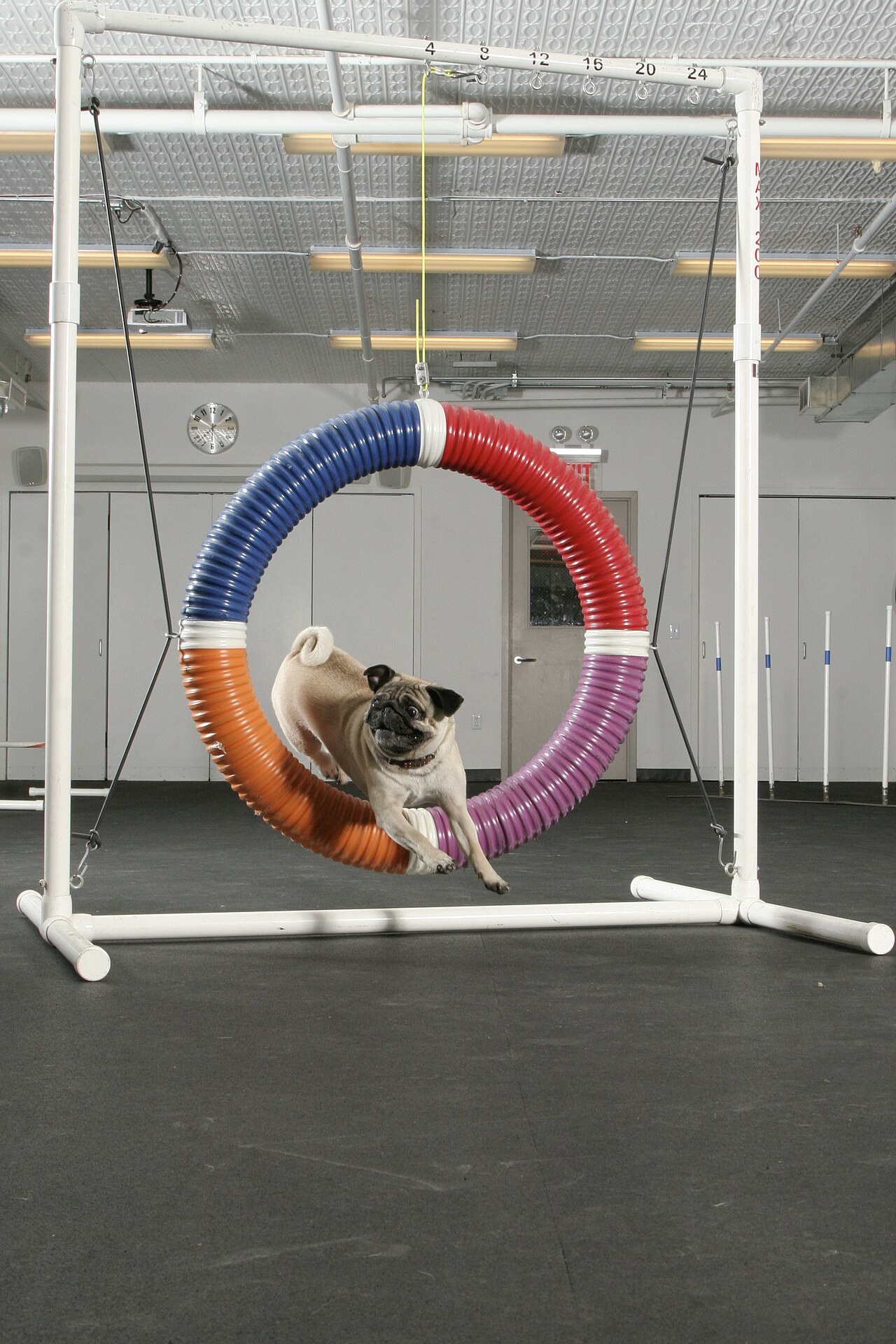
Priority learning is control of sphincters and early socialization, and even though it’s not a sporty dog, it enjoys olfactory games, basic obedience, and even agility tailored to its pace, as long as heat and effort are kept under control.
Exercise and activity
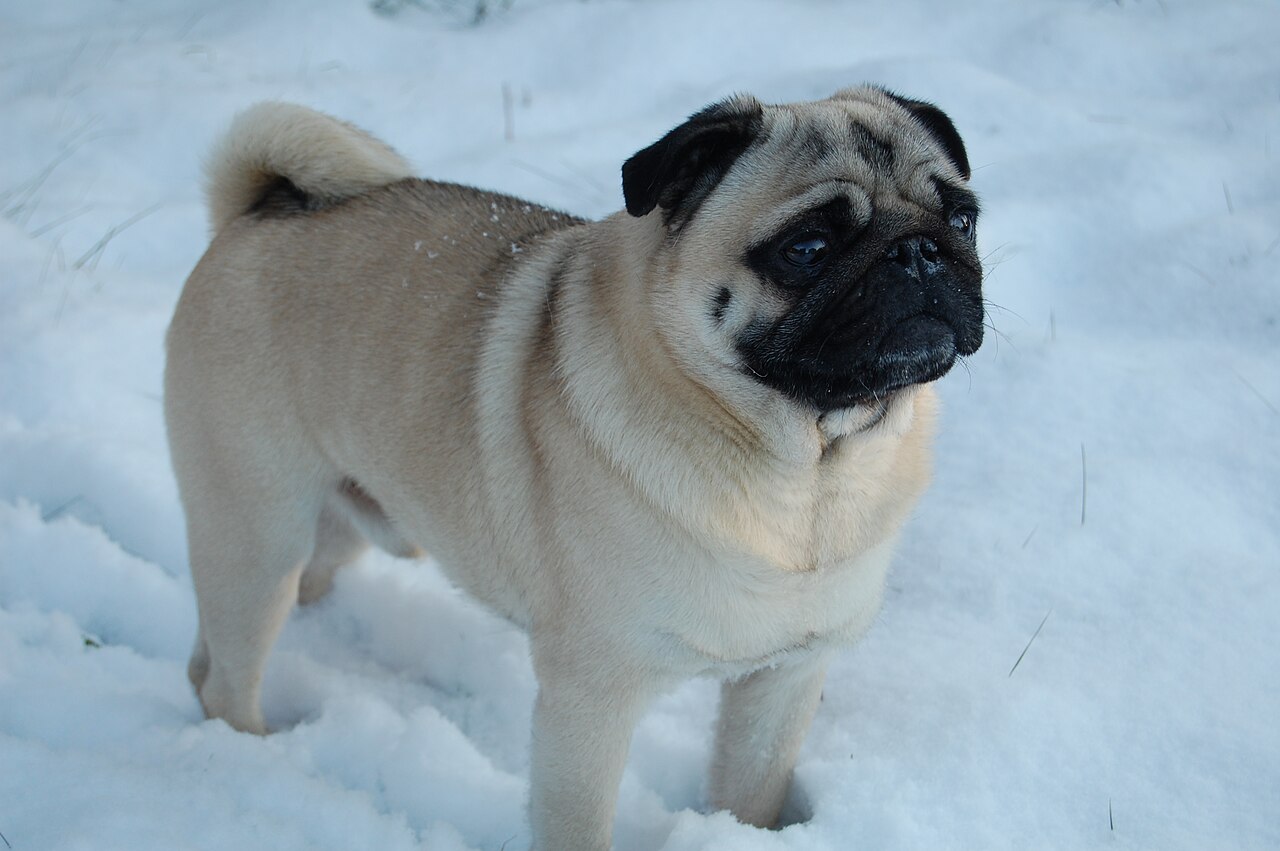
Here we have to be very clear: the Carlino needs moderate exercise, but it cannot make intense efforts. Its respiratory system, conditioned by brachycephaly, works similarly to that of an asthmatic person. Forcing it to run a lot or in hot hours is dangerous and can have serious consequences.
A healthy Carlino is capable of running and jumping several times its own height, but the golden rule is prudence. Several short walks a day, gentle play at home and mental stimulation are more than enough.
And an important nuance about weight: never try to slim an obese Carlino by increasing exercise, because his respiratory system wouldn’t support it. Weight control is done in the feeder, adjusting rations and rewards, not crushing him on walks.
Care: fur and hygiene
Despite its short hair, the Carlino is a higher maintenance dog than it looks, especially for the details of its face.
- Facial folds: should be cleaned frequently (towels or a soft cloth and dried thoroughly) to prevent dermatitis and infections of the skin folds.
- Ojos: being large and prominent, they are delicate and prone to rubbing, ulcers and dryness.
- Pelo: short, thin and shiny, but quite loose. A weekly brushing (more frequent in mud) controls hair at home and keeps the coat healthy.
- Ears, teeth and nails: periodic ear checks and cleanings, regular dental hygiene to prevent tartar and toenail clipping when needed.
- Calor: more than a cosmetic is safety in the summer, shade, fresh water and no exercise in the hottest hours.
Foodstuffs
The feeding of the Carlino has an absolute protagonist: the control of rations. The breed has one of the highest rates of overweight in the entire canine world; studies point to a genetic predisposition and that obesity is one of the most diagnosed disorders in these dogs.
Some practical guidelines:
- It provides quality and complete food, adapted to their age, size and activity level.
- Measure the daily ration and divide it into two portions; do not leave food on the table.
- He moderates the prizes a lot: the Carlino is an enthusiastic eater and “fatten with the look”.
- Monitor your weight regularly and adjust your diet before the problem sets in.
- Make sure he always has fresh water, especially in hot weather.
Keeping a Carlino at its ideal weight is not just aesthetic: it reduces the burden on its already compromised respiratory system and directly improves its quality and life expectancy.
Health and life expectancy
The Carlino is a brachycephalic breed (rounded head, very short snout and prominent eyes), and from this morphology derive most of its health problems.
- If you have any other medical conditions, please contact your doctor. the short nose and deformed airways cause difficulty in breathing, snoring, loud panting and, in severe cases, collapse.
- Heat intolerance: as they breathe worse, they misregulate their temperature and are very sensitive to heat stroke.
- Eye problems: bulging eyes exposed to corneal ulcers, proptosis, dry eye and corneal pigmentation.
- Obesidad: British studies place them about three times more likely to be obese than the average canine.
- Half- vertebrates and their tails:‘s characteristic curly tail is due to malformed vertebrae; in some cases this alteration is widespread and may be associated with spinal problems such as spina bifida.
- It is not recommended to use this medicinal product if the following conditions are observed: inflammatory and severe neurological disease affecting approximately 1-2% of specimens.
- Hip dysplasia and demodicosis: the breed shows a notable prevalence of hip dysplasia and a higher predisposition to demodicosis than average.
- Births by cesarean section: due to the size of the head of the pups relative to the birth canal, many females require C-section.
About the life expectancy it’s best to be honest: Although a range of about 12 to 15 years is traditionally cited, recent veterinary studies in the UK have found significantly lower medians (around 7.65 years in one of them and 11.6 in another), precisely because of the severity of brachycephalic problems. The good news is that a responsible breeder who selects slightly longer snout, open nostrils, and less prominent eyes, along with an owner who controls weight and monitors health, makes a huge difference. Concern about these problems has even driven a stream of “Retro Pugs” bred to have longer noses and less wrinkled faces.
Physical appearance
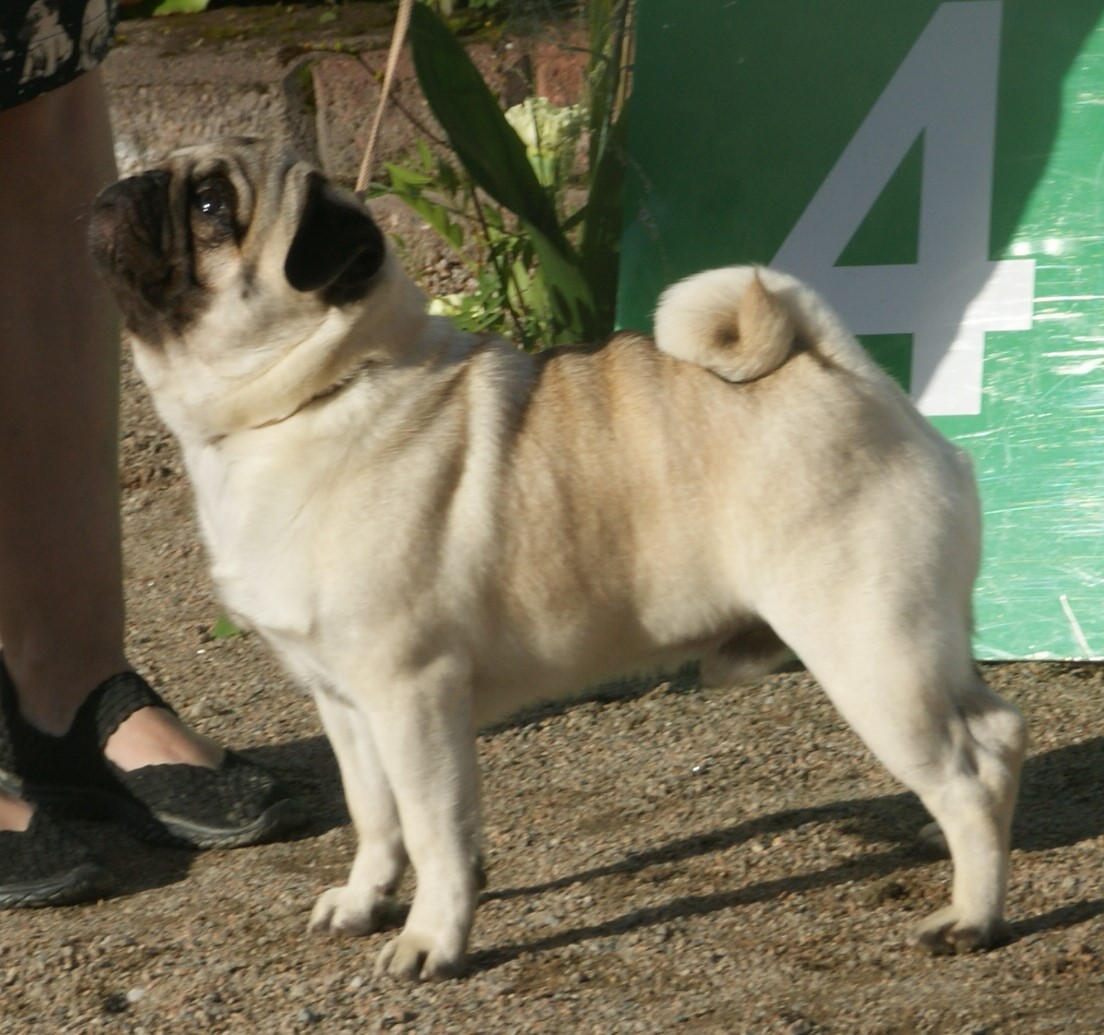
The Carlino is a small, short, square looking, compact and surprisingly muscular dog for its size.
In terms of reference measurements, it usually moves around 25-33 cm in height at the withers, with an ideal weight according to the FCI standard of about 6.3 to 8.1 kg, similar in males and females.
The head is large, rounded and covered in folds, with a short, square snout that gives the face its unmistakable flat appearance. The eyes are large, dark and expressive. The ears, small and thin, come in two forms: “pink” (smaller, folded backwards) and “button” (folded forward), the latter being the preferred in the contest. The tail, one of its hallmarks, curls tightly around the hip, ideally in a double curl.
The hair is short, fine, smooth, soft and shiny. The accepted colors are lions (in its variants silver and apricot) and black; in the light specimens highlight the black mask of the face and a dark line that runs along the back from the occiput to the tail.
Origin and history
The Carlino has a historical origin in China, where it is generally accepted that it was born, and a later development linked to the United Kingdom, which acted as the sponsor country of the breed. Their ancestors were Chinese imperial court dogs, such as the Lo-sze, bred for centuries as companions of ruling families. The emperors held them in the highest esteem: surrounded by luxury and guarded by soldiers. Later the breed spread throughout Asia, and in Tibet Buddhist monks also kept them as pets in their monasteries.
Starting in the 16th century, these dogs were brought to Europe by the Dutch trade, and they soon conquered the courts of the continent. According to tradition, a Carline named Pompey saved the life of the Prince of Orange by alerting him to the arrival of assassins, making the breed the official dog of the House of Orange. They traveled with William III and Mary II to the throne of England, posed for Goya’s paintings in Spain and rode in carriages in Italy.
The definitive boost came in 19th-century England under the patronage of the breed’s passionate Queen Victoria, who raised numerous specimens herself and preferred the apricot and maroon shades. His hobby was passed on to other members of the royal family and helped drive the birth of the Kennel Club. The appearance of the modern Carlino ended around 1860, when new specimens with shorter legs and flatter noses arrived in Europe. The American Kennel Club recognized the breed in 1885.
As for its name, “carlino” comes from France: it is attributed to Carlo Antonio Bertinazzi, a famous 18th-century Italian actor nicknamed Carlin, whose black mask of Harlequin recalled the antiface characteristic of these dogs.
Curiosities
- The FCI officially calls it “doguillo”, although in Spanish the name “carlino” has been imposed and in the Anglo-Saxon world, “pug”.
- His official motto, multum in parvo(“much in little”), perfectly sums up his great personality in a tiny body.
- Before marrying Napoleon, Josephine used her Carlino Fortune to carry hidden messages to her family while she was imprisoned.
- In the 18th century, the Order of the Carline (Mops-Orden) existed in Germany, a society that adopted the dog as a symbol of loyalty.
- The Carlins of ancient paintings had longer legs and snout than today’s; the extremely flat face is relatively recent.
- The breed was so iconic in an advertising campaign in India that it skyrocketed puppy sales within months.
- He has starred in film and television: from the likable Frank of “Men in Black” to appearances in numerous series.
If you are attracted to the Carlino, you are probably also interested in other small companion, flat-faced breeds with which it shares a history or character. Check out the Bulldog Francés, the Bulldog Inglés, the Pekinés(another ancient Chinese court dog) and the Boston Terrier, known precisely as the “American Knight”.
Frequently asked questions about the Carlino
Is the Carlino a good dog for the floor?
Yes, it’s one of the best breeds to live on the floor: small, quiet indoors and with no need for much space.
How long does a Carlino live?
Traditionally a range of about 12 to 15 years is cited, but recent veterinary studies have found lower medians due to their brachycephalic problems.
Why does the Carlino snore and breathe loudly?
For their brachycephalic morphology: short snout and deformed airways make it difficult to breathe.
How much exercise does a Carlino need?
Moderate exercise: several short walks a day and gentle play are sufficient. You cannot do strenuous exercises or exercise in heat, because your respiratory system is easily affected.
Does the Carlino shed a lot of hair?
A weekly brushing (more frequent in moulting seasons) helps to control loose hair at home.
Is the Carlino good with children and other dogs?
Very good. It is patient and robust with children and very sociable with other dogs, even larger ones. Early socialization and supervision with the youngest are always recommended.
Why do Pugs get so fat?
They have a genetic predisposition to be overweight and are very voracious eaters. Obesity is one of their most common disorders, so you have to measure rations and moderate rewards. Weight control is done in the feeder, not by increasing exercise.
Can the Carlino stay alone for many hours?
It’s not ideal. It’s a “shadow” dog, very attached to its family, and can develop separation anxiety if it spends too much time alone. It needs companionship and is an active part of home life.