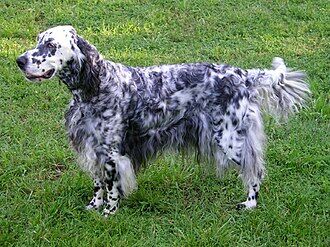
The English Setter is an elegant, sweet and seemingly tireless show dog bred for centuries in England to track birds of prey with a high sense of smell. It combines an athletic physique covered in spotted white hair (the characteristic “belton”) with a caring and sociable character that makes it an excellent family companion. He’s not a dog to live by: He needs exercise, space and companionship. If you’re looking for a sensitive, gentle, energetic dog, the English Setter deserves your full attention.
Is the English Setter for you?
Before you fall in love with his image, be honest: the English Setter is a hunting dog with a lot of energy and remarkable sensitivity. He shines in active homes and shuts down in apartments where he spends hours alone. These are his pros and cons at a glance.
In favour .
- Sweet, kind and very sociable character, “a gentleman by nature”.
- He loves children and welcomes visitors.
- Smart and willing to learn with positive reinforcement.
- Resilient and indefatigable: ideal companion for sports and mountains.
- Unmistakable beauty with its mottled fur and silky fringes.
To be taken into account
- He needs plenty of daily exercise; bored, he becomes destructive.
- He suffers from loneliness: he is not a dog to be left alone for many hours.
- His hunting instinct easily distracts him outdoors.
- The coat of the exposure lines requires frequent brushing.
- Very sensitive: the hard corrections block it.
Character and temperament

If I had to sum up the English Setter in one word, it would be “kind”. His standard of temperament is often described as that of a true gentleman: Sweet, balanced and deeply people-oriented. It is an intensely friendly, good natured dog that enjoys the company of humans and other dogs. It is not a one-owner dog; on the contrary, it loves visitors and gets along especially well with children.
This sociability has a counterpart: the English Setter needs almost constant attention and companionship. It is energetic and active when outdoors, but indoors it tends to relax and transform into a quiet dog that loves to lie next to you. That double-faced, tireless athlete on the field and stuffed on the couch is one of its greatest charms.
It is also worth knowing that it can have character. Specimens from work lines are usually more stubborn and mischievous, with a strong search instinct. And, above all, it is a very sensitive dog: it responds fatally to screams and sudden corrections, which turn it off or make it nervous. With affection and patience, on the other hand, it does its best.
Coexistence: children, other pets, flat and loneliness
- With children: excellent. It is one of the most suitable dogs for families with small children, patient and playful. As with any large and moving dog, it is advisable to supervise the games with the smallest to avoid pushing.
- With other dogs: very good. It is gregarious and enjoys canine company; an English Setter should not show aggression towards other dogs.
- With other pets: is a bird dog with a highly developed sense of smell and sampling, so coexistence with birds, rabbits or small rodents can be tricky. With cats it usually adapts if they grow together.
- On the floor: possible, but demanding. He can live in an apartment as long as he gets his two long hours of daily exercise; without that outlet, a flat is too small for him.
- Soledad: its weak point. It is a dog that suffers from being alone for many hours and can develop separation anxiety or destructive behaviors. It is not the right breed if you spend the whole day away from home.
Education and training
The English Setter is an intelligent dog. In Stanley Coren’s classification of dog intelligence it ranks 37th, which puts it above average in obedience and work. It can learn virtually any task another breed does, with the exception of herding, which it does not carry in the blood.
That said, it’s not always easy to train, and not because of a lack of ability but because of its instinct. As soon as it goes outside and catches an interesting scent, its attention literally flies to the birds and it has terrible trouble concentrating. The key is to start early, work in environments with few distractions and gradually increase the difficulty.
Because of their sensitivity, methods based on positive reinforcement (rewards, play, and praise) are by far the most effective. Hard corrections are counterproductive: they sink them. Patience, constancy, and short, fun sessions are the recipe for a well-behaved English Setter. Good early socialization, with people, noises, and other animals, round out their excellent character.
Exercise and activity

The English Setter is a hunting dog designed to cover large areas of land systematically and tirelessly, with its head held high looking for the aerial trail of birds.
About two hours of exercise a day is recommended, and it’s not just for a leisurely walk: it needs to run, explore, and smell. Open spaces where it can gallop are its paradise. Without enough physical and mental activity, this dog accumulates frustration that eventually comes out in the form of barking, running away, and wrecking.
It’s an excellent companion for active people: hiking, running, canicross or, of course, hunting. He also enjoys smelling and searching games that tap into his natural gift. Of course, in open and unfenced areas, it is good to keep your instinct in mind: As soon as it detects a bird it can “turn on” and ignore the call, so the call recovery should be very well worked.
Care: fur and hygiene
The coat of the English Setter is one of its great attractions and also one of its main care. The body hair is of short to medium length, smooth and silky texture, while on the ears, neck, chest, back of the legs and tail it wears the famous long silky fringes (the “feathering”).
Exhibition specimens have a more abundant and floating coat that requires frequent brushing to avoid knots and tangles, especially in the fringes.
As a general routine, it is advisable to brush it several times a week to keep the hair healthy and check the ears, which when falling and hairy retain moisture and can become infected.
Foodstuffs
As a medium-sized, active dog, the English Setter needs a quality diet tailored to its actual energy expenditure. A sporting or hunting specimen burns many more calories than one who lives as a quiet companion, and the ration should reflect this.
In deep-breasted breeds such as this, it is a sensible precaution to reduce the risk of gastric torsion, and it is also advisable to prevent him from doing strenuous exercise just before or after eating.
Some of the breed have food sensitivities and skin problems, so if you notice itching, digestive discomfort or a dull coat, it’s worth checking your diet with your vet.
Health and life expectancy
The life expectancy of the English Setter is around 10 to 13 years. A British study from 2024 calculated an average longevity of 13.1 years, slightly higher than the average of purebred dogs, while an Italian study from the same year placed it at around 10 years; the usual fork that is handled is around those figures.
Like all races, it has a predisposition to certain problems that you should know about:
- Congenital deafness: A study by Louisiana State University (2010) detected some degree of deafness in around 12% of the tested specimens, something associated with the very white layers.
- Thyroid problems: autoimmune thyroiditis and hypothyroidism occur with some frequency in the breed.
- Hip and elbow dysplasia: defective development of these joints, common in medium and large active dogs.
- Allergies and atopic dermatitis: is predisposed to skin problems and food sensitivities.
- Tail injuries: moving it constantly with so much energy, it’s not uncommon for it to hit and hurt its tip.
Choosing a responsible breeder who performs ear, hip and thyroid tests greatly reduces these risks. Regular veterinary checkups, vaccinations and daily deworming complete a long and healthy life.
Physical appearance

The English Setter is a medium-sized dog with an elegant and harmonious appearance. The males measure approximately 65-69 cm at the withers and the females between 61-65 cm. The weight ranges roughly between 29-36 kg in males and 25-30 kg in females, although working lines are usually somewhat lighter and thinner than exposure lines.
The head is elongated and slightly vaulted, with a well-deep snout and a marked chisel under the eyes. These are dark, large and friendly-looking, almost melancholy, one of the breed’s most endearing traits. The ears, covered with fine, silky hair, fall into an elegant fold at eye level. The neck is long and muscular, and the body, of moderate length and powerful hindquarters, transmits resistance. The tail is carried in line with the back, in the shape of a scimitar, and never screwed upwards.
Its hallmark is the cloak: white base dotted with coloured spots (ticking). The combinations are called “belton”: blue belton (white and black), orange belton (white and orange), lemon belton (lighter orange with lighter nose), liver belton (white and liver) and tricolor (blue or liver belton with fire marks on face, chest and legs). The spotting should be distributed throughout the body and not form large spots.
Origin and history
The English Setter is an English breed with very ancient roots. The term “setting dog” was already used more than four centuries ago to describe these show dogs, and there are artworks from the 15th century in which setter-type dogs are recognized. It is believed that the breed was born from crosses between the Spanish pointer, a large water spaniel and the English springer spaniel, a combination that gave an excellent bird dog for open terrain.
The setters worked tracking birds in the moors: They detected prey by smell and stood motionless, squatting, “marking” their position. From this gesture of staying “set” (fixed) comes its name. First the hunter released falcons or threw a net; later, with the advent of firearms in the 17th century, the setter began to indicate the piece for the hunter to shoot.
The modern English Setter owes its appearance to Edward Laverack (1800-1877), a keen hunter who, from a pair of dogs called Ponto and Old Moll acquired around 1826, developed his own strain with a well-kept (and inbred) breed for half a century. His friend Richard Purcell Llewellin (1840-1925) continued the work starting from Laverack’s best dogs and crossing them with other lines, creating a somewhat smaller but exceptional breed for field work. Hence, even today, it is still referred to as “setter Laverack” or “setter Llewellin”. The breed’s first club, the English Setter Club, was founded in 1890.
Curiosities
- The name “setter” comes from the English “to set”: the dog remains fixed, almost lying down, when detecting prey, instead of going after it.
- “Belton”, the term for its mottling, is the name of a town in northern England, coined by Laverack himself.
- The first dog registered by the American Kennel Club, with the number 1, was an English Setter named “Adonis”, born in 1875.
- In the United Kingdom it is listed as a Vulnerable Native Breed due to the low number of registered puppies, despite its beauty and character.
- In Italy it is still highly prized as a hunting dog, where for years it was one of the most numerous.
- It won Crufts’ Best in Show in 1964, 1977 and 1988, and a puppy of the breed achieved Westminster’s Best in Show in 1938 at just 11 months and in its first exhibition.
If you’re drawn to the world of show dogs and stylish hunters, you’ll be interested in comparing the English Setter to its relatives and related breeds. Check out the Gordon Setter, the sturdiest of the setter family; the Setter Irlandés, unmistakably red-coated; the English Springer Spaniel, one of the breeds that contributed to its origin; and the classic Pointer, another large open-ground show dog.
Frequently Asked Questions about the English Setter
Is the English Setter a good family dog?
Yes, it is one of the most recommended dogs for active families. It has a sweet and friendly nature, adores children and welcomes visitors with delight. Its only serious requirement is exercise: it needs a family that can give it activity and company.
How much exercise does an English Setter need?
A lot. About two hours a day of exercise is recommended, ideally with running and exploring in open spaces, not just quiet walks. It’s an untiring hunting dog and without enough outlet it can become destructive.
Can he live in a flat?
It can adapt to a floor as long as it gets its two long hours of daily exercise. Indoors it is quiet, but it does not tolerate being alone for many hours, so it is not the best option if you spend the whole day outside.
How long does an English Setter live?
Their life expectancy is around 10 to 13 years. A British study from 2024 calculated an average of 13.1 years. With good care, proper nutrition and regular veterinary checkups you can reach the high end of that range.
Is it hard to train?
It is intelligent and learns well, but its strong hunting instinct easily distracts it outdoors. It works very well with positive reinforcement and badly with harsh corrections, as it is very sensitive. It is advisable to start early and be patient.
Does he shed a lot of hair and have trouble maintaining his coat?
Its silky hair with fringes requires brushing several times a week, especially on exhibition specimens, which have the most abundant mantle.
What health problems does the breed have?
The most relevant are congenital deafness (associated with very white layers), thyroid problems, hip and elbow dysplasia, and allergies or atopic dermatitis.
Do you get along with other animals?
With other dogs it is very sociable. With cats it usually coexists well if they grow together. However, due to its instinct as a bird dog, caution is warranted with birds, rabbits or small rodents.