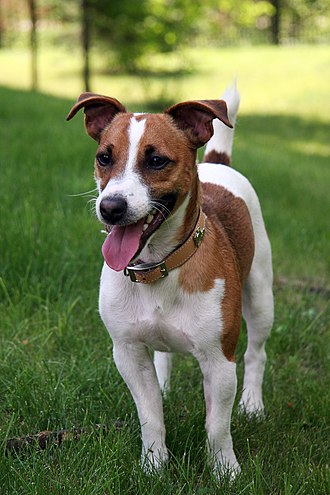
The Jack Russell Terrier is a small, white dog with endless energy that was born to hunt foxes in the English countryside and now conquers homes halfway around the world. Don’t be fooled by its size: Inside that compact body, there’s an athlete who’s brave, brilliant and has a huge personality. Before you fall in love with his face, you should know that the Jack Russell Terrier needs activity, a busy head and an owner who knows where the shots go.
Is that the Jack Russell Terrier for you?

The Jack Russell Terrier is a wonderful breed, but it’s not for everyone. It fits nicely with active people and families who enjoy making it think and move; instead, it frustrates those looking for a quiet couch dog. Before you decide, look honestly at these two columns.
In favour .
- Small in size and manageable, fits on floors if exercised properly.
- Remarkable intelligence: he learns fast and excels in dog sports.
- Robust health and one of the longest life expectancies among the races.
- Simple coat maintenance, especially on the smooth hair variety.
- Brave, funny and very close to his family.
Against
- High energy: boring, barking, digging and destroying.
- Strong hunting instinct for rodents, cats and small animals.
- Tendency to bark and scratch if not channeled.
- Stubborn and independent; not ideal for first-time owners.
- He needs clear boundaries and daily mental stimulation.
Character and temperament
If we had to summarize the Jack Russell Terrier in three words, it would be lively, brave and tireless. The breed standard describes it as an alert and active terrier, with sharp and intelligent expression, fearless and at the same time friendly and confident. Behind that description is a dog that lives life to the fullest: runs, jumps, investigates every corner and rarely slows down of its own volition.
It’s a dog deeply attached to its people, affectionate and participatory, that wants to be in the middle of everything that happens at home. But his past as a hunter leaves its mark: is independent, determined and, at times, stubborn. He doesn’t obey “because I do”; he needs to understand that you are worth listening to. That combination of intelligence and strong character makes it fascinating for those who enjoy working with their dog, and exhausting for those who expected a submissive companion.
The Jack Russell is also a vocal dog. Barking was part of its job: it warned where the prey was underground. Therefore, without proper education and sufficient activity, it can become an enthusiastic barker. Well guided, however, it is one of the most cheerful and loyal companions that exist.
Coexistence: children, other pets, flat and loneliness
- With children: gets along well with older, active children who know how to respect it, but it is not the best choice for homes with babies or very young children, because it does not tolerate pulling or rough play and is a short wick dog.
- With other dogs: can coexist smoothly if well socialized, although its determined nature sometimes leads it to “pull a pulse” at much larger dogs without measuring consequences.
- With cats and small animals: here is its big weakness. Its hunting instinct is very powerful; with cats it can work if they grow together, but rabbits, hamsters, ferrets or birds are usually incompatible.
- On the floor: is possible, as long as you are guaranteed several long walks and daily play. A tired Jack Russell is a happy Jack Russell; one bored on a floor is a ticking time bomb.
- In the face of loneliness: has a hard time spending many hours alone. Boredom and lack of physical expenditure lead to barking, wrecking and holes in the garden. He needs company and routine.
Education and training
The jack russell terrier is so smart that he learns almost anything… including how to get away with it. his education should be steady, consistent and patient, based on positive reinforcement and short but frequent sessions that keep his mind hooked. punishment and harshness only get a suspicious dog or more stubborn.
Early socialization is key: The sooner you get to know different people, dogs, noises and environments, the better you’ll manage your impulsivity as an adult. Obedience classes are highly recommended because they channel your energy and reinforce your role as a guide. It is especially helpful to work on the call and self-control, since as soon as you detect an interesting trace you can disconnect from the world and get fired up.
It’s not a dog for first-time owners who don’t want to get involved. Taking advantage of its natural tendency to jump, crawl, chase and dig makes training a game for both. Ignoring those needs, instead, opens the door to the annoying behaviors that have earned it the reputation of “earthquake”.
Exercise and activity

There are no shortcuts here: the Jack Russell Terrier needs a lot exercise, and it is not good only with quiet walks. We are talking about a dog bred to work for hours in the field, with a resistance that is surprising for its size. The ideal is to combine several daily walks with running moments, search and bring games, and activities that make him think.
Its agility, speed and enthusiasm make it a phenomenon in agility, flyball, obedience and olfactory games. Dedicating 30-60 long minutes of intense activity a day, plus mental stimulation, marks the difference between a balanced companion and a nervous and ungovernable dog.
Mental expenditure counts just as much as physical expenditure. Interactive toys, hidden prize games, and little training challenges tire a Jack Russell just as much as a good race. A bored dog seeks his own entertainment, and you’re almost never going to like the one he chooses.
Care: fur and hygiene
The maintenance of the coat depends on the variety. The Jack Russell of straight hair is the simplest: With a weekly brushing, it’s enough to remove dead hair and keep it clean. The hard hair and broken hair varieties require somewhat more work and, in exposure dogs, the stripping technique or manual pulling of dead hair, which is done in spring and late summer so that the coat retains its rough and protective texture.
Jack Russell’s hair is water-resistant, a legacy of his work entering burrows and wet areas. He sheds his hair moderately throughout the year, so regular brushing helps keep it under control at home. He doesn’t need frequent baths; bathing him when he gets really dirty is enough.
The rest of the hygiene is the usual of any dog: checking and cleaning the ears, cutting the nails when necessary and, very important for its strong jaw, take care of dental hygiene with brushing or specific products to prevent tartar.
Foodstuffs
Being a small but very active dog, the Jack Russell Terrier needs a quality, complete and balanced diet, adjusted to its actual level of energy expenditure. A sporty specimen burns much more than a sedentary one, and the ration should reflect this. The most sensible thing is to choose a good feed or diet adapted to its age (puppy, adult, senior) and divide the food into two daily servings.
The great enemy of this race is the overweight. They are voracious and very persuasive dogs begging for food, and a few extra pounds punish their joints, especially knees that already have a predisposition to problems. It is advisable to control the rations, weigh it from time to time and use the prizes with your head, deducting them from the daily meal. Fresh water is always available, and it’s best to avoid strenuous exercise right after eating.
Health and life expectancy
The Jack Russell Terrier is, as a whole, a healthy and long-lived dog. In fact, British studies place it among the longest-living breeds: a 2022 study calculated an average of about 12 years and 9 months, and another from 2024 raised it to 13.3 years, above the average of other breeds and crosses.
This does not mean that it is free from problems. Among the conditions described quite frequently in the breed are:
- Dislocation of the patella: the kneecap moves out of place; in mild cases it is transient, but severe cases may require surgery.
- Primary lens dislocation: an inherited eye disorder associated with a mutation in the ADAMTS17 gene, which can affect vision.
- Sordera and legg-Calvé-Perthes disease, also known as Legg-Calvé-Perthes, a degenerative hip problem.
- Ictiosis(a skin disorder linked to the TGM1 gene) and follicular dysplasia of the black hair.
- Severe combined immunodeficiency (SCID): a rare genetic disorder (present in less than 1.1% of individuals) for which a DNA test is available.
The best guarantee is to go to responsible breeders who do health checks on the breeders, keep up-to-date with veterinary visits and vaccinations, and care for their weight and teeth throughout their lives.
Physical appearance

The Jack Russell Terrier is a small, compact and well-proportioned dog, longer than tall, which transmits agility and strength despite its small size. Its height at the withers is around 25-30 cm and its weight is usually between 5 and 7 kg, although some standards slightly extend these margins. The body must be balanced: The depth of the chest and the length of the legs maintain a characteristic proportion reminiscent of its function as a hunter capable of entering burrows.
The predominant color is the white– it should cover more than half of the body – with black, brown, cinnamon or fire spots, spread mostly over the head and base of the tail. The head is of moderate width, with a marked but not exaggerated stop, black truffle and almond-shaped eyes, dark and full of life and intelligence. The ears are small, V-shaped and sloping forward. The coat can be smooth, hard or broken (a mixture of both), always dense and weather resistant.
Origin and history
The history of the Jack Russell Terrier begins in nineteenth-century England and owes its name to the Reverend John “Jack” Russell(1795-1883), a pastor in the county of Devon and a passionate fox hunter. Legend has it that, as a student at Oxford, back in 1819, he bought a small white and fiery terrier called Trump from a milkman, which had just the kind of dog he dreamed of: Brave enough to corner the fox underground and white enough not to mistake it for prey.
Starting with Trump, Russell developed a line of working terriers prized for their courage and resilience. Interestingly, what he was looking for was suitability for the job, not a uniform look, so he never left a closed standard. He was one of the founding members of the Fox Terrier Club in 1875, and from those dogs of the 19th century descended both the modern Fox Terrier and the Jack Russell we know today.
After his death, various amateurs continued his lines, and figures such as Arthur Blake Heinemann drafted the first standards. But it was Australia that gave the final push: The Jack Russell Terrier Club of Australia, founded in 1972, set a formal standard that served as the basis for international recognition. The International Kennel Federation (FCI) officially recognized the breed on October 25, 2000, the United Kennel Club did so in 2001 and the American Kennel Club in 2012, under the name “Russell Terrier”. It should not be confused with two close relatives: The Parson Russell Terrier, with longer legs, and the Russell Terrier, smaller.
Curiosities
- A Jack Russell named Bothie, from explorers Ranulph and Ginny Fiennes, became in 1982 the first dog to tread the two poles, North and South, during the Transglobe expedition.
- In 2007, a Jack Russell named George saved five children from attack by two pit bulls in New Zealand; he died in the attempt and was posthumously awarded the PDSA Gold Medal, the animal equivalent of a major award.
- During the Ukrainian war he became famous Patron, a Jack Russell trained to detect explosives with the country’s Emergency Service.
- He is a film and television star: Eddie in the series Frasier, Uggie in the Oscar-winning The Artist, the protagonist of Wishbone or Max in the Pets (the secret life of pets) saga .
- Even the world of video games has its favorite Jack Russell: K.K. Slider, the musician from the Animal Crossing series, is of this breed.
- Barking and digging are not “mania”, but highly valued work skills at their origin: they warned of the dam and allowed him to dig to get to it.
If you’re attracted to the character of the Jack Russell, you might want to get to know other breeds in the terrier family and fellow hunter-gatherers. Check out the Wire Fox Terrier, with whom he shares roots; the sociable Border Terrier; the unmistakable West Highland White Terrier; or the rustic and brave Cairn Terrier. They all share that hooking terrier spark.
Frequently Asked Questions about the Jack Russell Terrier
Is the Jack Russell Terrier a good dog for beginners?
It is not the best choice for first-time owners. Its intelligence, energy and independent character require experience, perseverance and a lot of daily dedication. For an active and willing to get involved, it is an extraordinary companion.
How much exercise do you need a day?
Ideally, several walks should be combined with 30-60 minutes of intense activity (running, playing, dog sports) plus mental stimulation.
Can you have a Jack Russell on one floor?
Yes, as long as he’s guaranteed long walks and daily play size is no problem, what he needs is activity a well-exercised Jack Russell rests peacefully at home
Do you get along with children and other pets?
With older and respectful children it usually goes well; it is not ideal with babies. With other dogs it coexists if it is socialized, but its strong hunting instinct makes it poorly compatible with rodents, rabbits or birds, and with cats only if they grow up together.
How long does a Jack Russell Terrier live?
It is a very long-lived breed. British studies estimate an average lifespan of between 12 years and 9 months and 13.3 years, placing it among the longest-lived breeds, and with good care many specimens exceed that figure.
Do you bark and dig a lot?
You can, because barking and digging were part of their hunting job, and with enough exercise, mental stimulation and education, these behaviors are controlled; without them, they shoot.
What care does your fur need?
The smooth-haired only needs a weekly brushing. The hard-haired and broken-haired varieties require more maintenance and, in exposed dogs, the stripping technique.
What’s the difference between Jack Russell, Parson Russell and Russell Terrier?
They share a common origin, but differ primarily in size: the Parson Russell Terrier is taller and longer-legged, while the Russell Terrier (sometimes called the English) is smaller.