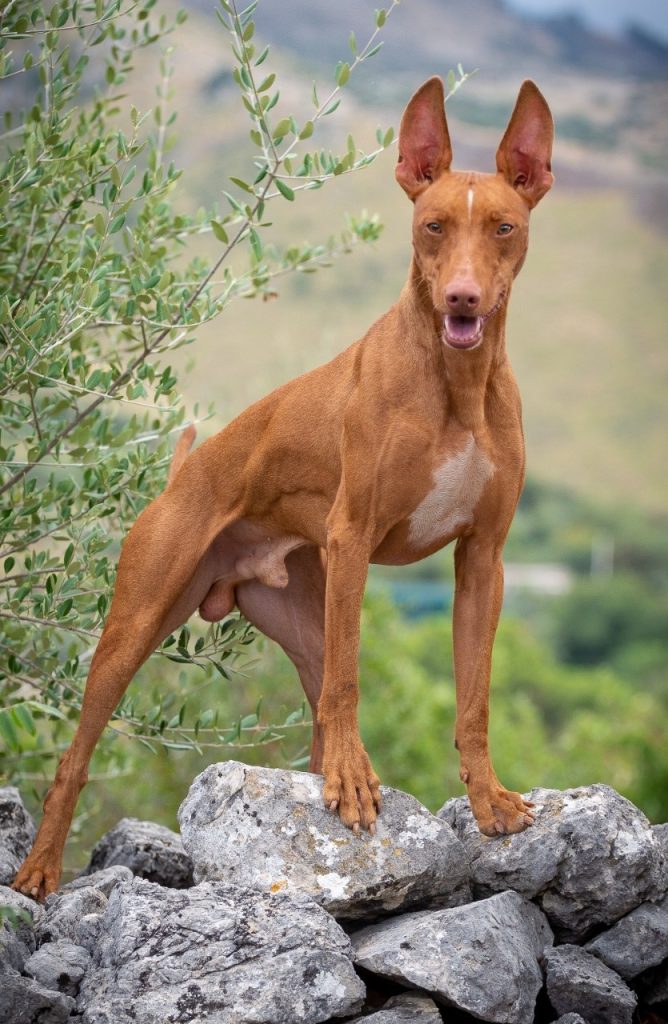
The Cirnecus of the Etna is a small, lightweight Sicilian pod with huge ears that has been hunting rabbits for thousands of years among the solidified lava of the volcano that gives it its name. Elegant as a miniature greyhound but with the sober head of a primitive dog, it’s a rare breed outside of Italy, healthy, clean and surprisingly easy to keep at home… as long as you accept that you’re looking at an independent hunter and not a dog of blind obedience. If you’re looking for an athletic companion, discreet on the floor and with very little maintenance, the Etna Circus deserves more reading.
Is the Etna Circus for you?
Before you fall in love with those ears, you might want to be honest about what it’s like living with a Sicilian pudding. The Etna Cirnecus is a functional hunting dog, not a decorative stuffed animal: It has a very strong prey instinct and an independence inherited from generations hunting only in volcanic terrain. In return, it’s one of the cleanest, healthiest, and easiest-to-maintain manageable-sized dogs in existence. Here’s the unadorned balance sheet.
It suits you if…
- You want a medium-sized, athletic, very discreet dog in the house.
- You like exercise: long walks, running, hiking or dog sports.
- You’re looking for minimal upkeep: short hair, almost odorless and low mucus.
- You value a rustic, long-lived breed with few hereditary problems.
- You embrace an independent character and know how to motivate rather than impose.
- You’ve got a fenced-in garden or you’re always on a leash in the open.
Think about it if…
- You expect immediate and absolute obedience: here patience is at stake.
- You live with rabbits, hamsters, birds or other small animals loose.
- You can’t guarantee a secure fence or a leash outdoors unlocked.
- You live in a cold climate with no means of shelter.
- You spend many hours outdoors every day with no companionship or encouragement.
- You want a breed that’s easy to find: in Spain it’s a very minority.
Character and temperament

The Etna Cirnecus combines two souls. On the one hand, it is a friendly, affectionate, family-oriented dog, able to lie in the sun for hours glued to you; on the other hand, as soon as it detects a trail or a quick movement, the ancient hunter turns on and stops hearing you. This independence is not stubbornness or lack of intelligence: It’s exactly what the race needed to work alone, away from the hunter, on the steep slopes of Etna.
He’s an alert, observant and sensitive dog. He reads the atmosphere of the house very well and is disturbed by screaming, punishments or tension. It is neither a compulsive barker nor a watchdog – it may warn, but its suspicion of strangers dissipates quickly – so as a defense dog it is useless. What it does offer is a cheerful, balanced and uncomplicated company: The typical dog that’s where you are without overwhelming.
His energy level is high when it comes to activity and very low when it comes to rest. Well exercised, at home he is quiet and elegant. Without enough exercise, his curious mind seeks entertainment on its own and escapism or restlessness may appear.
Coexistence: children, other pets, flat and loneliness

With children: is a good companion for families with children who already know how to treat a dog. It is playful and patient, but its fine structure and its sensitivity demand respect: no pulling of the ears or abrupt play. Quiet presentations and supervision with the youngest are the norm, as with any breed.
With other dogs: usually gets along well and enjoys canine company, especially if it has been socialized as a puppy.
Other small pets: here is its great limitation. We are talking about a hunter of rabbits and hares with a powerful prey instinct. Cats, rabbits, ferrets, rodents or loose birds can activate the chase. Coexistence with a house cat is possible if they grow together and are well managed, but should never be taken for granted with small animals.
On the floor: adapts surprisingly well. It is clean, almost odorless, takes up little space and is quiet inside. The condition is non-negotiable: real daily exercise. A well-walked Cirneco is an exemplary floor dog.
Soledad: is attached and grateful for company. It tolerates reasonable periods only if it is tired and has a comfortable and warm place, but it is not a race for empty houses ten hours a day. Boredom and prolonged loneliness favor anxiety and escapism.
Education and training
Raising an Etna Circus is an exercise in patience and psychology, not strength. It’s intelligent and it learns fast, but its independence always makes it ask, “What does this bring to me?” The answer to that question is the key to everything: positive reinforcement, palatable rewards, play and short, fun sessions. Hard or repetitive training turns it off and disconnects it.
The call (recall) is the critical point. Because of its prey instinct and its speed, a Cirneco that sees a rabbit go out won’t come back because you ask it politely. That’s why it works the call from a puppy, with a lot of reward, and yet it assumes that in open spaces without fences the prudent thing is the long leash. It’s not disobedience: it’s genetic.
The early socialization– people, dogs, noises, environments, car – marks the difference between a confident adult and a reserved one. Because of its sensitivity, everything is built from trust.
Exercise and activity
Don’t be fooled by how calm he looks on the couch: this is a dog of endurance and speed bred to move through rough terrain for hours. He needs consistent daily exercise: at least one or two good long walks plus opportunities to run and sniff. He loves galloping, hiking, running and any activity that combines body and smell.
The volcanic terrain of Etna explains its agility: It climbs, jumps and moves with feline ease. Take advantage of that. A secure, high fence (jumps and digs better than it looks) turns the garden into your gym. In open spaces without closing, long strap always: Your recall doesn’t compete with a rabbit. Mentally, smelling games, tracking and searching work satisfy him as much as physical exercise.
Care: fur and hygiene

If there is a low-maintenance breed, it is this one. The coat of the Etna Cirnecus is short, thin and attached to the body, with no woolly undercoat, so the coat is scarce and the dog smell almost non-existent.
The rest of the hygiene is the basic routine of any dog: checking and cleaning those large upright ears (which are well ventilated, but should be monitored), cutting the nails regularly and taking care of dental hygiene with proper brushing or biters.
The point to consider is not the hair, but the temperature. With such little body fat and such a thin coat, the Cirneco tolerates cold and humidity poorly. In winter it appreciates a coat for walks and a warm and sheltered bed at home. In summer, however, it enjoys the warmth that reminds it of its native Sicily, always with shade and water.
Foodstuffs
The Etna Cirneco is a frugal and efficient dog: it does a lot with relatively little food, a heritage of centuries of rusticity on hard ground. It needs a complete and balanced diet, adjusted to its age, weight and actual activity level. A sporty specimen will spend more than a sedentary one, but in general it is not a breed prone to overeating.
The important thing is to watch the physical condition: For its athletic type, it should be stylized, with the waist marked and the last ribs insinuating; overweight feels especially bad for such a lightweight structure. Divide the ration into two servings, avoid strenuous exercise just before and after eating, and always keep fresh water available, especially after activity. When in doubt about quantities or type of diet, your veterinarian is the best person to guide you.
Health and life expectancy
One of the great virtues of this breed is its health. Being an indigenous dog bred for centuries for its functionality, without extreme aesthetic selections, the Etna Cirneco is rustic, robust and with a fairly healthy genetic base.
It doesn’t have a long list of associated hereditary diseases, which is exceptional. As with any breed, the recommendation is to go to responsible breeders who take care of the genetic diversity and health of the breeders. His physique makes it wise to watch the logical: care for the joints in the growing puppy, protect the thin skin from cuts in rough terrain and, above all, manage thermoregulation well, since cold is its greatest weak point. Regular veterinary checks, vaccination, deworming and dental checks complete a long and healthy life.
Physical appearance
The Etna Cirnecus is the definition of functional elegance. It is a medium-sized, lightly built, clean-lined dog, with an air reminiscent of the greyhounds and dogs of ancient Egyptian paintings. The males measure between 46 and 50 cm cross and weigh 10 to 12 kg; the females measure between 42 and 46 cm weigh 8 to 10 kg.
Its unmistakable hallmark is the ears: large, triangular, erect and highly mobile, implanted high, which look like a permanent antenna. The head is elongated and narrow, with a sharp snout, the stop slightly marked and the light-toned truffle, according to the color of the mantle.
The body is smooth and athletic, with a straight back, not too deep chest and strong, well-muscled limbs that betray the jumper and climber he is. The tail, of low insertion and uniform thickness, completes the silhouette.
Origin and history
Few dogs can boast a history so ancient and so linked to a particular landscape. The Etna Cirneco is an autochthonous pond of Sicilia, where for millennia rabbits have been hunted on the solidified lava slopes of Etna volcano. It belongs to the group of Mediterranean dogs of the Podenco type, genetically related to the Kelb tal-Fenek (Pharaonic podenk) of Malta, the Podenco Ibicenco and the Italian hounds.
Their presence on the island is documented since antiquity: Dogs with their silhouette appear in sicilian coins minted between the 5th and 3rd centuries BC, and there is a statuette found near Syracuse that has been dated to around 4000 BC. C. For a long time it was thought to be a “primitive” dog brought from Egypt or Phoenicia; modern genetic studies have nuanced this romantic idea and place it closer to other European hunting dogs than previously thought. Its own name, cinnamon, derives from the Latin cyclamen, in reference to North African Cyrenaica, and came to designate the small ponds of the islands of the Mediterranean.
The modern race has names of its own. In 1932, the veterinarian Maurizio Migneco, from Adrano (on the slopes of Mount Etna), published a description of the dog. That text caught the attention of Baroness Agata Paternò Castello, who in 1934 began raising them seriously to save the breed. The Ente Nazionale della Cinofilia Italiana recognized it in 1939, with a standard drafted by the cynologist Giuseppe Solaro, and the Fédération Cynologique Internationale accepted it definitively in 1956. Today it is still a rare breed: in Italy only between one hundred and one hundred and fifty puppies are registered per year, and their registration is usually conditional on passing a fieldwork test.
Curiosities
- The dog from the volcano:‘s name links cinnamon(podenco) to Mount Etna, and local legend has it that these dogs guarded a temple dedicated to the god Adranos, near which hundreds of them lived.
- Other, not further worked than hot-rolled generations hunting on sharp volcanic rock have given him hard pads and almost feline agility for climbing and jumping.
- Hunting by sight and smell: unlike pure greyhounds, which hunt by sight, the Cirneco combines a very fine sense of smell with its speed, making it very complete at tracking rabbits.
- Almost odorless: is one of the dogs that smells the least like a dog, a huge advantage for home life.
- Recent international recognition: although millenary, was not admitted to the American Kennel Club (AKC) until 2015, proof of how little widespread it is outside Italy.
- Canine numismatics: is one of the few dogs whose image appears on ancient coins, which has allowed its historical trace to be traced through archaeology.
If you are attracted to the Etna Cirneco for its blend of elegance, athleticism and independent character, you will probably enjoy meeting other breeds with a similar profile. We recommend you to take a look at the Whippet, another light and home runner; the Greyhound, the greyhound par excellence; the versatile Vizsla, an energetic and affectionate hunting dog; and the Pointer, another field athlete with great smell.
Frequently Asked Questions about the Etna Circus
Is the Etna Cirneco a good dog to live on the floor?
Yes, surprisingly well. It’s clean, almost odorless, takes up little space and is very quiet inside. The only non-negotiable condition is to give it real daily exercise: long walks and opportunities to run. A well-exercised Cirneco is an exemplary floor dog.
How long does an Etna cirnecus live?
Its life expectancy is 12 to 14 years, and it is a rustic and very healthy breed without a long list of hereditary diseases, so with good care many specimens reach full health into old age.
Do you get along with cats and other small pets?
The Cirneco is a rabbit hunter with a strong prey instinct, so cats, rodents, rabbits or loose birds can activate the chase.
Is it easy to educate?
It is intelligent and learns quickly, but independent: it needs positive reinforcement, rewards and short, fun sessions, never harsh methods. The critical point is the call, since its hunting instinct weighs more than obedience in open spaces.
How much exercise do you need?
Enough. It is a dog of endurance and speed bred to move through rough terrain. It needs at least one or two long walks daily plus opportunities to run and sniff. It enjoys hiking, coursing, agility and canicross, and appreciates both physical exercise and sniffing games.
Do you lose a lot of hair or do you need a lot of hair?
No. It has short, fine hair with no undercoat, so it changes little and smells very little. A weekly brushing with a rubber glove is enough, and it only needs a bath when it gets really dirty. It’s one of the least maintenance breeds out there.
Do you need a coat?
Yes, the cold is its greatest weakness. With so little body fat and such a thin coat, it tolerates the cold and humidity poorly. In winter it appreciates a coat for walks and a warm and sheltered bed at home. Instead it enjoys the warmth, always with shade and water available.
Is it an easy breed to find in Spain?
No. The Etna Cirneco is a rare breed even in Italy, where there are barely between a hundred and a hundred and fifty pups a year. Outside its native island it is a very minority, so you will have to look for specialized breeders and probably assume a waiting list.