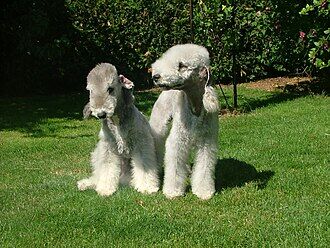
The Bedlington Terrier is an unmistakable English terrier: With its curly, trimmed fur and its pointed head, it resembles a little lamb so much that it’s hard to believe that inside it beats the heart of a tireless hunter. Born in the mines of northeast England, it combines a sweet appearance with a courageous, agile and surprisingly athletic temperament. In this comprehensive guide, you’ll find everything you need to know about the Bedlington Terrier before sharing your life with one.
Is the Bedlington Terrier for you?
The Bedlington Terrier is a two-faced breed: on the outside it looks like a gentle stuffed animal and on the inside it retains the instincts of a working terrier. That mixture makes it fascinating, but it also requires an owner to understand which dog he is dealing with.
In favour .
- It sheds very little hair and is considered a hypoallergenic breed, ideal for sensitive people.
- Huge attachment and affection for his family; the AKC and ASPCA describe him as gentle and good with children.
- Medium size and manageable, comfortable both in the home with garden and on the floor.
- Athletic and resistant: enjoys exercise, water and even snow.
- Long life expectancy compared to similarly sized breeds.
- Smart and with little body odor when kept in good condition.
To be taken into account
- Their coat requires periodic haircuts; maintaining the “exposure cut” is difficult and expensive.
- Strong hunting instinct: can shoot after cats, rabbits or small rodents.
- Stubborn and stubborn; needs discipline with patience and constancy.
- He may be jealous or quarrelsome with dominant dogs.
- Genetic predisposition to copper toxicity, a serious liver disease.
- He’s excitable and nervous if he’s not given enough activity.
Character and temperament

To say that the Bedlington Terrier is “a wolf in sheep’s clothing” is not just a pretty phrase: it describes its character quite accurately. Its tender appearance conceals an alert, courageous and fearless terrier, capable of facing much larger prey without a shred of fear.
In day-to-day life, however, it is an affectionate and demonstrative companion. With its people it is loyal, sociable and calm indoors; both the American Kennel Club and the ASPCA describe it as a soft and gentle breed, recommended for children. It is playful and cheerful, but can also be excitable and a nervous point if it does not receive the stimulation it needs.
Their terrier side comes out when there’s something to chase. He retains a keen hunting instinct for small animals and, from the Whippet blood running through his veins, tends to rush into the race. He’s also tenacious to the core: Once he gets into an idea, “I’d rather die than give in”. He usually gets along well with other dogs, but he should be watched for dominant temperament, for if challenged, he may turn into a fierce fighter. In terms of intelligence, he ranks a respectable 40th in Stanley Coren’s well-known ranking.
Coexistence: children, other pets, flat and loneliness
- With children: is one of its best facets: affectionate, patient and playful, it is usually an excellent companion for the little ones, always with the supervision and mutual respect that any dog requires.
- With other dogs: is generally well understood, but can show jealousy and does not tolerate dominant dogs well.
- With cats and small animals: indoors can learn to accept other family members if he grows up with them, but his hunting instinct fires on the outside, so watch out for stranger cats, rabbits or rodents.
- On the floor:‘s medium size and good indoor behaviour make it suitable for living in an apartment, provided its daily exercise need is met.
- In the face of loneliness: is a very family-friendly dog that tolerates time alone better if it has exercise and stimulation routines, but it is not a breed to be abandoned for many hours.
Education and training
The Bedlington Terrier is intelligent and quick to learn, but its independent and stubborn nature can test patience. The formula that works is that of positive reinforcement: rewards, play, and short, motivational sessions that keep it interested.
Early socialization is the best investment. Exposing the puppy to people, other dogs, noise, and a variety of environments as a puppy helps to moderate its natural nervousness and make it more comfortable with other animals. Working the call and impulse control is especially important in a breed so given to running away after a stimulus: Because of their Whippet heritage, a Bedlington can ignore your voice if something interesting moves in the distance.
Take advantage of your waking mind by proposing challenges: olfactory games, interactive toys, fun obedience or dog sports. A Bedlington with a busy head is a happy Bedlington and much less likely to develop annoying behaviors out of boredom.
Exercise and activity

Don’t be fooled by its plush appearance: The Bedlington is a natural athlete. It’s fast, tough, and was said to be able to “keep pace with a running horse”. It needs quality daily exercise to channel its energy and keep its balance.
He loves long walks, runs, and games that test his speed. He is also an excellent swimmer, with a water prowess comparable to that of water dogs such as the Newfoundland, so he will enjoy bathing whenever it is safe. He also loves snow, where he can reach amazing speeds.
It combines physical wear and tear with mental: Sniffing, searching games and activities that arouse his terrier instinct will leave him truly satisfied. A couple of good outings a day, with moments of free running in safe, fenced areas, are usually enough to keep a Bedlington happy. Remember to keep it on a leash or in a closed enclosure in the presence of potential prey: His tendency to go off the deep end is real.
Care: fur and hygiene
The coat is undoubtedly the most demanding chapter of the breed. The coat of the Bedlington is woolly, rough and tactile, a characteristic mixture of hard and soft hairs that has earned it the nickname “paddle-haired terrier”.
He needs a weekly brushing to remove dead hair and avoid tangles, as well as regular visits to the dog barber every few weeks. The cut that gives him his lamb silhouette is not easy to maintain: Even for professionals it is difficult to maintain the correct shape, and if neglected, the appearance of the mantle deteriorates rapidly. Most families opt for a “pet cut” that is simpler and more comfortable than the strict exposure cut, in which the hair cannot protrude more than 2.5 cm from the body.
The rest of the care is the usual: checking and cleaning the ears to prevent infections, brushing the teeth frequently, cutting the nails when necessary, and keeping an eye on the eyes.
Foodstuffs
The Bedlington Terrier has no exotic dietary needs, but it is advisable to take care of the quality and quantity of its food. A complete and balanced diet, adapted to its medium size, age and activity level, is the basis for keeping it in shape. Being an athletic dog, it thanks an adequate protein intake that supports its musculature.
Divide the daily ration into two servings and adjust it according to your energy expenditure: a Bedlington who exercises a lot will need something more than a more sedentary one. Check your weight regularly, as excess pounds overload your joints and your overall health. Use rewards with your head, especially during training, so they don’t turn into excess calories.
Always have fresh water available and consult your veterinarian if you have any doubts, especially if your dog has a predisposition to liver problems.
Health and life expectancy
Overall, the Bedlington Terrier is a fairly healthy and long-lived breed. British studies place their life expectancy at around 13.5 to 13.7 years, above the average for purebred dogs and most similarly sized breeds; some specimens have loosely exceeded 18 years. The main causes of death recorded are old age, urological problems and liver diseases.
The most characteristic and worrying disease of the breed is copper toxicity(also called copper storage disease), an autosomal recessive inherited disorder, related to human Wilson’s disease, in which copper accumulates in the liver to the point of damaging it. The Bedlington is the breed most prone to this problem. It exists asymptomatically, chronically, or rapidly, and the good news is that responsible breeders perform DNA testing on their offspring and do not breed with carriers, which has greatly reduced its incidence.
Other problems to watch for are kidney, eye (epiphora, retinal dysplasia and cataracts, to which they seem more predisposed than other breeds), heart murmurs and certain reproductive disorders.
Physical appearance

The Bedlington Terrier is a medium-sized dog with an unmistakable silhouette. Males measure about 42 cm at the withers (with an admitted range of 41 to 44 cm) and females about 39 cm (between 38 and 42 cm).
The head is its most striking feature: rounded and without a stop (without the marked nasopharyngeal depression), with small, almond-shaped eyes and tightly fitting lips. The hair on the top of the skull forms the characteristic “cuppet” or topknot that, along with the cut of the mantle, gives it that unmistakable air of lamb. It has also been compared to a miniature version of the Scottish Deerhound.
The coat can come in three colors: blue (bluish gray), liver (brown) and sand, each with possible fire marks (tan points).
Origin and history
The Bedlington Terrier takes its name from Bedlington, a mining town in Northumberland County in north-east England, where it was described as “the favourite companion of the northern miners”. Before it was called that it was known as Rothbury or Rodbury Terrier (for the affection that Lord Rothbury had for them) and even as “gypsy dog”, because gypsies and poachers used it to hunt. The first mention of the name Bedlington dates from 1825, although some pedigrees trace back to 1782.
He was bred to hunt monsters: rats in the mines, rabbits, otters, ferrets, foxes and even badgers. The dog that gave the breed its name was Young Piper, owned by Joseph Ainsley, famous for his courage; he began to face badgers at just eight months old, continued hunting until he went blind and even saved a piglet from a pig by keeping the animal at bay until help arrived. It was also used, unfortunately, in the brutal dogfights of the time and in racing, until the Whippet took over as a racing dog.
The first competition with a specific class for the breed was held in 1870 in Bedlington, and the Bedlington Terrier Club was founded in 1875. In those early days it was customary to trim and dye dogs to bring them closer to the standard. The breed is closely related to the Dandie Dinmont Terrier (two litter brothers came to be exhibited, one as Dandie and another as Bedlington), and also to the Kerry Blue Terrier, the Soft Coated Wheaten Terrier, the Whippet and the Otterhound. His big moment of international glory came in 1948, when the champion Rock Ridge Night Rocket was proclaimed Best in Show at the prestigious Westminster Kennel Club show.
Curiosities
- Sheep costume:‘s resemblance to a sheep is so famous that it has come to be called “the lamb dog”.
- Water speed rider: swims as fast as it runs, with a water skill rivaling that of the Newfoundland.
- Snow lover: on ice or deep snow reaches a speed almost typical of a Husky, using the muzzle as a plow.
- Lamb with the heart of a lion: under its sweet appearance retains the courage of a hardworking terrier willing to do anything.
- Star of the cover: a descendant of champion Rock Ridge Night Rocket went on to appear on the cover of Sports Illustrated in 1960.
- Muse of artists and cinema: appears in the paintings of artist Craigie Aitchison and accompanied the protagonist of the film Sisu(2022), a Finnish miner, a perfect nod to his mining origins.
If you are attracted to the Bedlington Terrier, you may be interested in other breeds with which it shares family, history or athletic air. For its direct kinship do not miss the Kerry Blue Terrier and the Soft Coated Wheaten Terrier, both close cousins of peculiar fur. If you are seduced by its fast and running side, take a look at the Whippet, present in its lineage, and if you want another working terrier with character, discover the Lakeland Terrier.
Frequently Asked Questions about the Bedlington Terrier
Is the Bedlington Terrier hypoallergenic?
It is considered a hypoallergenic breed because it barely sheds hair and gives off very little odor.
Do you lose a lot of hair?
No, the Bedlington loses very little hair, one of the reasons for its reputation as a breed suitable for allergy sufferers.
Is he good with kids?
Yes, both the American Kennel Club and the ASPCA describe it as a gentle, gentle dog, recommended for children, affectionate and playful, usually a great family companion always with regular supervision.
Do you get along with other dogs and cats?
With other dogs it usually gets along well, although it can show jealousy and does not tolerate dominant specimens well.
How long does a Bedlington Terrier live?
Their life expectancy is around 13.5-13.7 years according to British studies, above the average of similarly sized breeds.
What is copper toxicosis?
It is an inherited disease in which copper accumulates in the liver and damages it; the Bedlington is the breed most likely to suffer from it. Responsible breeders do DNA testing and do not breed with carriers, which has significantly reduced its incidence.
Do you need a lot of exercise?
Yes. Despite its plush appearance it is an athletic, fast and tough dog. It needs long walks, moments of running and mental stimulation daily. It loves water and snow.
Why does he look like a lamb?
Because of the combination of its curly fur and velvety feel, the “copete” that forms over the head and the characteristic cut of the mantle.