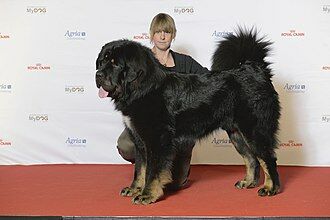
The Mastín Tibetano is one of the most imposing and ancient guard dogs in the world: a lion-haired colossus bred for centuries in the Himalayan highlands to watch over herds and monasteries. Independent, territorial and deeply loyal to its family, it’s not a breed for everyone. Here we tell you, bluntly, what it’s really like to live with a Tibetan Mastiff and if it fits you.
Is the Tibetan Mastiff for you?

Before you fall in love with the photos, be honest: the Tibetan Mastiff is a guard dog of strong character, designed to protect, not to please. He decides for himself, distrusts strangers and needs an owner with experience, space and a firm but serene hand. These boxes sum up the good and demanding nature of the breed.
In favour .
- Exceptional guardian: protective, territorial and deterrent by presence.
- Very loyal and affectionate to his family, especially those he considers “his pack”.
- Quiet and relaxed indoors; usually sleeps most of the day.
- Independent and clean: its coat does not give off the typical large dog smell.
- Sturdy and rustic, adapted to extreme cold.
To be taken into account
- Stubborn and independent – not a “book” obedient dog.
- Distrustful of strangers; needs early and constant socialization.
- Night barker: keeps watch at night and warns of any noise.
- Not suitable for flats or first-time owners.
- Huge in size and strength; very abundant in seasonal mould.
Character and temperament

To understand the Tibetan Mastiff, one must remember what it was bred for: for centuries it lived alone next to the herd or at the entrance of a monastery, making decisions on its own without any shepherd giving it orders. That independence is engraved in its character. It is a dog that thinks, evaluates the situation and acts according to its own criteria, not because you ask it to.
With his family he is surprisingly affectionate, calm and balanced. Indoors he tends to be rested, even lazy, and spends much of the day resting. That calm changes completely when a stranger appears or a strange noise: That’s where the guardian emerges. He is naturally reserved and aloof with strangers, but not a nervous dog. Its instinct leads it to mark perimeters, bark to warn and keep intruders at bay, especially at night when it is activated as a sentry.
It is intelligent, yes, but also extremely stubborn. It does not seek to please like a Labrador; it respects those who earn its trust. That is why the breed shines with calm, consistent and experienced owners, able to impose themselves without shouting or harshness. Lack of consistency or poor socialization can produce unpredictable specimens, and for its size that is no small detail.
Coexistence: children, other pets, flat and loneliness
- With children: with children in his own family is usually protective and patient, but his volume and guardian instinct demand supervision.
- With other dogs: lives well with a canine companion, especially if they grow up together; it can be dominant with dogs of the same sex.
- With other pets: being a keeper of livestock, many tolerate well the animals he considers part of “his” territory, but it all depends on socialization.
- On the floor: is not an apartment dog. It needs a spacious, well-fenced yard to patrol; locked within a few meters it becomes frustrated.
- Loneliness and neighbors: tolerates being alone better than many breeds because it is independent, but its nocturnal barking can generate conflict.
Education and training
Training a Tibetan Mastiff is an exercise in patience. It’s not a dog that repeats a command a hundred times for a treat: if it doesn’t make sense, it just doesn’t do it. Training in obedience is advisable, but you have to assume that its success is moderate and that you’ll never have a dog with a millimeter response. The goal is not submission, but safe coexistence.
The really non-negotiable thing is the early socialization. From puppyhood he must know people, noises, environments and other animals so that his natural distrust does not lead to reactivity. It works with short sessions, positive reinforcement and, above all, a lot of consistency: What is forbidden today must always be forbidden. Hardness is counterproductive; this dog responds to trust, not fear. Because of its character and strength, it is not a breed recommended for first-time owners.
Exercise and activity
Despite its size, the Tibetan Mastiff is not a hyperactive athlete. His exercise needs are moderate: All you need is one or two good walks a day and a space to patrol and monitor your air. It is a dog of endurance and vigilance, not of long runs; in fact, at short distances it can reach surprising speeds, but its natural style is that of the energy-conserving sentinel.
What it does need is mental stimulation and a purpose. Having a territory to take care of gives it balance. It avoids strenuous exercise in puppies and in the hottest hours: it’s a cold climate dog, with a double coat designed for the Himalayas, and it suffers from the heat. In summer, early and late walks.
Care: fur and hygiene
The Tibetan Mastiff’s coat is double, long and dense, with a specially marked mane or collar on the males that gives it that lionlike air. Interestingly, it requires less maintenance than it looks: a weekly brushing keeps the hair healthy most of the year, and its coat tends to repel dirt and odors, without the characteristic “big dog smell”.
The exception is the it moves.. Once a year, in late winter or early spring, it sheds its undercoat massively for several weeks; sometimes there is a second minor molt in late summer. In those seasons you’ll need to brush it daily to remove the dead hair. The rest of the hygiene is the usual: check your ears (your ear tubes are small and prone to infection), cut your nails and take care of your teeth.
Foodstuffs
The Tibetan Mastiff eats surprisingly little for its size: it is an efficient dog, heritage of its life in harsh and scarce environments.
The puppy stage is delicate: too rapid growth overloads the developing joints, so it is preferable to develop slowly and controlled with a specific feed for large breeds.
Health and life expectancy
Overall, the Tibetan Mastiff has fewer genetic problems than many giant breeds, but it is not free of them. Among the conditions described in the breed are hip and elbow dysplasia, hypothyroidism(relatively common in the breed), eye problems such as entropy, ectropion and distichiasis, progressive retinal atrophy and cataracts, in addition to skin problems and allergies, heart disorders, seizures and epilepsy. Hereditary demyelinating neuropathy (HNDN) has also been documented in some lines. His small ear canals make him prone to otitis.
Life expectancy is usually around 10 to 14 years, and some sources cite up to 16 in especially long lines, although these are high figures for a dog of this size.
Physical appearance

The Tibetan Mastiff is a large and powerful dog, with a robust structure and solemn appearance. The males measure from about 66 cm to the cross and the females from about 61 cm, with weights ranging from about 40 to 70 kg in males and from 30 to 55 kg in females.
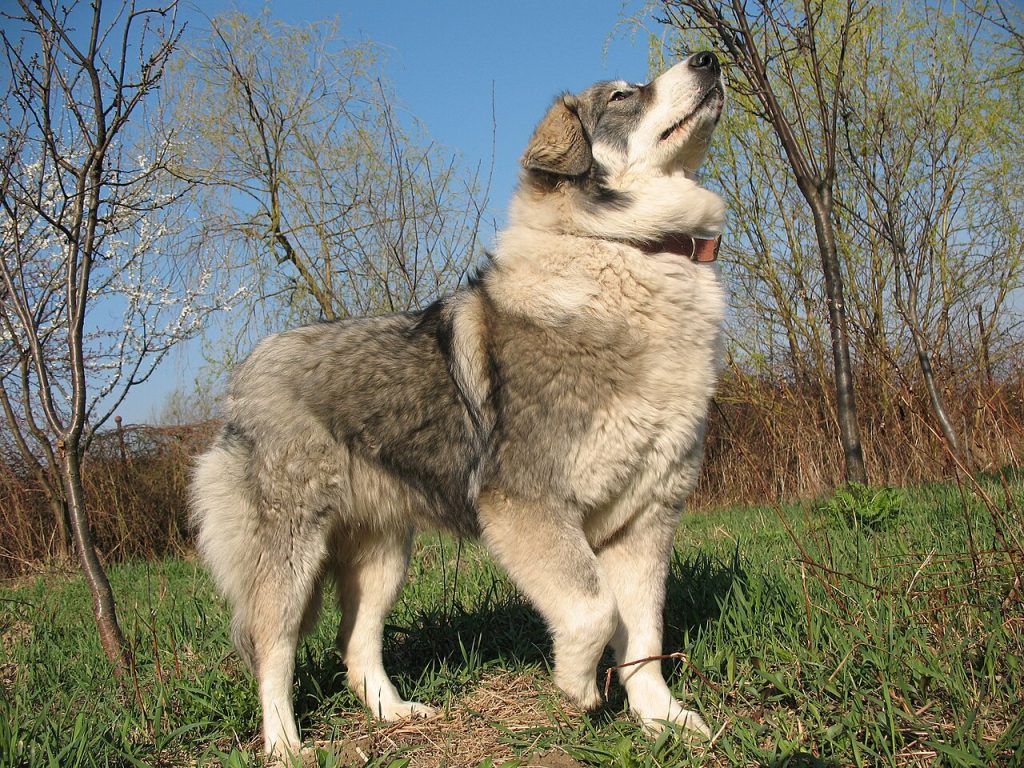
Its most recognizable feature is its broad head and abundant mane that frames the neck and shoulders, denser in males, reminiscent of that of a lion. The double coat comes in a wide variety of colors: solid black, black and fire, various shades of red – from pale golden to deep red – and bluish grey (dilute black), often with white markings on the neck, chest and legs. The tail, crowded, curls over the back. In India, two types are traditionally distinguished: “lion’s head” (smaller, with very long mane) and “tiger’s head” (larger, with shorter hair).
Origin and history
The Tibetan Mastiff – also called the Tibetan Dogo or Do-Khyi – is a very ancient breed from the high-altitude regions of the Himalayas and the Tibetan Plateau. There he fulfilled two functions: guardian of the flocks of nomadic shepherds and protector of Tibetan Buddhist monasteries, where he defended the monks from wolves, bears and leopards in the snow. The name “mastiff” was given to it by Europeans, who called almost any large dog Mastiff; perhaps it would have been more accurate to call it the Tibetan mountain dog.
The race has been shrouded in myth since ancient times: It is already mentioned in texts attributed to Aristotle and in the accounts of Marco Polo, who traveled to Asia in the 13th century. One of the first to arrive in the West was a male sent to Queen Victoria in 1847, and shortly thereafter the Prince of Wales – the future Edward VII – brought two dogs to England. By 1906 it was already on display at the Crystal Palace, although the world wars were about to extinguish the breed in Europe.
Since 1980 he has gained worldwide popularity and was recognized by the FCI and AKC, competing for the first time at the prestigious Westminster in 2008. Several DNA studies have concluded that large mountain breeds such as the Gran Pirineo, Boyer of Bern, Rottweiler, San Bernardo, and Leonberger are descended, at least in part, from the Tibetan Mastiff, making it an ancestor species of many modern-day molluscs.
Curiosities
- The most expensive dog in the world: in China reached million-dollar prices for this breed during its heyday; a male named “Hong Dong” sold for a record sum.
- Suitable for heights: survives at high altitudes thanks to higher hemoglobin levels than other dogs, a genetic adaptation (EPAS1 gene) inherited from an ancient wild canid, the same one possessed by Himalayan wolves.
- One zeal a year: unlike most dogs, females usually have a single annual heat, in the fall, so almost all puppies are born between December and January.
- No smell of dog: its coat lacks the characteristic large dog smell and tends to keep itself clean.
- In popular culture: stars in the animated film Rock Dog(the characters Bodi and Khampa) and inspired the Pokémon Mabosstiff.
If you are attracted to the Tibetan Mastiff because of its mountain guardian behavior, you may be interested in other large related or similarly functioning breeds. Check out the Gran Pirineo, also a mountain herd guardian; the towering San Bernardo; the well-balanced Boyer of Bern; or the giant, sleek Leonberger, all distant relatives of the Tibetan Dogo according to DNA studies.
Frequently Asked Questions about Tibetan Mastiff
Is the Tibetan Mastiff an aggressive dog?
It is not gratuitously aggressive, but it is a territorial guardian and distrustful of strangers. Well socialized and with an experienced owner, it is balanced and calm; the problem arises with lack of socialization or coherence, which can make it unpredictable.
Can he live in a flat?
The Tibetan Mastiff needs a spacious, well-fenced yard to patrol and watch, is uncomfortable in an apartment, and its nocturnal barking as a sentry can cause problems with neighbors.
Is he good with kids?
He is usually protective and patient with the children in his family, but because of his size and his guardian instinct, he always requires supervision.
Do you lose a lot of hair?
For most of the year it loosens a little and a weekly brushing is enough, but once a year, towards the end of winter, it has a very abundant coat of several weeks in which you will need to brush it daily.
How long does a Tibetan Mastiff live?
Usually between 10 and 14 years, a remarkable figure for a dog of his size. Some especially long lines can approach 16 years. A good breeder with health tests is the best guarantee.
Is it hard to train?
Yes, within reason. It is very intelligent but just as stubborn and independent: it does not obey “because it does”. It responds to consistency, patience and positive reinforcement, never to harshness. It is not recommended for first-time owners.
Do you need a lot of exercise?
Less than its size suggests. It takes one or two good walks a day and a space to guard. It’s a dog of endurance and vigilance, not of long runs, and suffers from heat from its cold weather coat.
Is this a dog suitable for beginners?
No, their independence, their strength, their guarding instinct and their stubbornness make them a demanding breed.