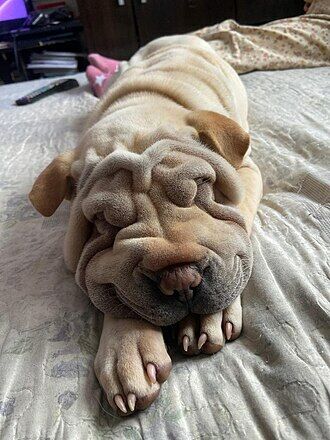
The Shar Pei is one of the most recognizable dogs in the world: That wrinkled skin, the serious-looking face and the blue tongue make him unmistakable. Beneath that peculiar appearance is a dog of Chinese origin, ancient, independent and deeply loyal to his family. Before you fall in love with its folds, you should know what the Shar Pei really is like, what it needs, and why its health deserves special attention.
Is that Shar Pei for you?
The Shar Pei is not a dog for everyone. It is quiet indoors and very attached to its own, but also stubborn, reserved with strangers and with a list of health problems that should be kept in mind before making a decision.
In favour .
- Clean, quiet and barely barking inside the house.
- Very loyal and attached to his family; great housemate.
- Excellent natural guardian, attentive and watchful without being nervous.
- Moderate exercise needs: adapts well to a floor.
- Very short coat and easy to maintain with minimal brushing.
To be taken into account
- Independent and stubborn: Education requires patience and constancy.
- Reserved or suspicious of strangers and other dogs.
- Delicate health: skin, eyes, ears and Shar Pei’s family fever.
- Folds need drying and regular hygiene to prevent infection.
- It’s poorly heat-tolerant because of its construction and wrinkles.
Character and temperament

The Shar Pei has a character that surprises anyone who only looks at its appearance. He ‘s not an effusive dog or a clown: is serene, observant and dignified, with an independence more reminiscent of that of a cat than of a clingy dog. That calm, however, hides an enormous bond with his family. Inside the house, he seeks to be close to his family, follows them from room to room, and shows affection, though in his own way, without overwhelming them.
With strangers, the record changes. The Shar Pei is naturally reserved and suspicious, the fruit of centuries of work as a guardian. It is not usually a dog that jumps to greet everyone; it observes, evaluates, and keeps its distance until it decides that someone is trustworthy. That attitude makes him an excellent and discreet guard: He warns me when something doesn’t fit, but he’s not a compulsive barker.
It’s an intelligent dog with its own criteria, which translates into a remarkable stubbornness. The Shar Pei thinks before he obeys and decides if the order suits him, so don’t expect immediate docility from a retriever. Well socialized is balanced and self-assured; poorly socialized can become territorial or overly suspicious. That’s why their temperament is built, in large part, in the first few months of life.
Coexistence: children, other pets, flat and loneliness
- With children: can be a good companion for families with older children who understand that it is not a dog of constant groping.
- With other dogs: tends to be dominant and intolerant of dogs of the same sex. Early and abundant socialization is key for him to coexist with other dogs without tension.
- With other pets: if raised with cats or other animals usually accepts them, but its territorial and prey instinct advises gradual and well-managed introductions.
- On the floor: adapts very well to apartment life. It’s clean, quiet and barks little, as long as it covers your daily walks.
- In the face of loneliness: is more independent than many breeds and tolerates being alone for reasonable periods, but it should not spend the whole day isolated: it needs to be part of family life.
Education and training
Educating a Shar Pei is an exercise in patience and consistency. He is intelligent and learns quickly what interests him, but his independence makes him question orders that bring him nothing. Methods based on positive reinforcement – rewards, play, kind voice – work infinitely better than harshness, which with this breed only generates blockage or distrust.
The absolute priority is early socialization. A Shar Pei puppy must know people, dogs, noises, environments and varied situations from the moment he arrives at home, because his natural tendency to reserve and territoriality is greatly tempered by good early experiences. Training sessions should be short, motivating and always end on a positive note: Boring a Shar Pei is the surest way to disconnect him.
It is advisable to establish clear and stable rules from the first day. This breed respects those who transmit security and serene leadership, not those who shout. It works attention, call and impulse control, and strengthens tolerance to manipulation: as you will have to clean its folds and check its eyes and ears, accustoming it from a puppy to being touched will make your life easier.
Exercise and activity
The Shar Pei has moderate exercise needs. It is not a hyperactive dog or an endurance athlete: just a couple of daily walks of good duration and some play to keep it fit and mentally satisfied. That moderation is precisely what makes it so compatible with urban life and flats.
Its compact body, relatively short snout, and abundant skin make it poorly regulate temperature, so in summer walks should be in the early and late hours of the day, avoiding central hours.
Beyond physical exercise, he appreciates mental stimulation: olfactory games, interactive toys, and small obedience challenges keep his mind active. A bored Shar Pei may become headstrong or develop undesirable behaviors, while a well-stimulated one is a balanced and relaxed companion.
Care: fur and hygiene

The coat of the Shar Pei is one of the easiest to maintain: very short, rough and attached to the body. In fact, its name means “sandskin” precisely because of that scratchy texture. A weekly brushing with a glove or bristle brush is enough to remove the dead hair; it loosens little compared to other breeds and does not need a hairdresser.
The wrinkles on the face, neck and cross accumulate moisture, dirt and debris that can lead to irritation, bad smell and fungal or bacterial infections. They should be checked and dried regularly, especially after bathing or after the dog gets wet, paying special attention to the deeper folds.
The ears deserve constant monitoring: the Shar Pei’s ear canal is very narrow and poorly ventilated, which makes it prone to otitis, so it is advisable to check and clean them often.
Foodstuffs
Since the Shar Pei is a medium-sized dog with a tendency to gain weight if neglected, it is advisable to control rations and avoid overweight, which punishes its joints and aggravates any health problems.
Many of the breed have sensitive skin and are prone to allergies and dermatitis, so high-quality diets, with well-defined proteins and no excess additives, usually suit them better. If recurrent skin problems occur, a specific or hypoallergenic diet should be discussed with the veterinarian. Proper intake of fatty acids also helps to keep the skin and coat in good condition.
Divide your food into two portions a day, make sure fresh water is always available, and avoid strenuous exercise right after eating.
Health and life expectancy
The health of the Shar Pei is the most delicate point and the aspect that must weigh the most before adopting one. Its life expectancy is around 8 to 12 years; a British study in 2024 placed the average around 10.6 years, slightly below the average of purebred dogs.
The most characteristic condition is shar Pei family fever(FSF), a hereditary disorder that runs with recurrent episodes of fever and inflammation, especially of the corvettes.
eye problems are common, especially entropy: Excess skin causes the eyelids to curve inward and the eyelashes to rub against the eye, causing irritation and, if left untreated, serious damage; this is usually corrected with surgery. The breed is also prone to glaucoma. On the skin, atopic dermatitis, cutaneous mucinosis, demodicosis and irritation of the folds are noted. Added to this are chronic otitis due to narrow ear canals, hypothyroidism, vitamin B12 deficiency, elbow dysplasia, and hiatal hernia. Choosing a serious breeder who performs health tests greatly reduces these risks.
Physical appearance

The Shar Pei is a medium-sized, compact and square-looking dog, measuring between 44 and 51 cm at the withers and weighing, depending on the line, around 18 to 25 kg. Its silhouette conveys strength and balance, with a broad chest, a straight back and a thick tail at the base that curls high over the group, a typical trait of the spitz type dogs with which it is related.
His three hallmarks are unmistakable: the wrinkled skin, the wide head with its “grandma face” and bulging snout, and the blue-black tongue. The folds are very abundant in the puppy, which seems literally wrapped in excess skin; as it grows, the skin stretches and the canonical thing is that in the adult the wrinkles are concentrated on the head, neck and cross. The ears are very small, triangular and attached to the head, and the eyes are sunk between the folds.
The coat is very short and rough, “brushed”, and all solid colors except white are accepted; the most common are black, red, lions and cream. There are two recognizable types: the western or “meat-mouth”, with a more fleshy snout and marked wrinkles, and the traditional or “bone-mouth”, more stylized and with less skin, which is preserved mainly in Hong Kong. The so-called “minipei” is not an official variety, but the result of poorly developed specimens.
Origin and history
The Shar Pei comes from southern China and is a very old breed: There are references to very similar dogs from the time of the Han Dynasty, over two thousand years ago. Genetic studies point to it as a basal breed, predating most modern breeds, and it is closely related to the Chow Chow, with which it shares that unique blue tongue. It was traditionally employed as a property and grave guard, farm and defense dog, and also in fights, before becoming the household companion we know today.
His recent story is dramatic. The political turmoil in 20th-century China, which viewed pets as a bourgeois luxury, brought the Shar Pei to the brink of extinction. In 1973, Hong Kong businessman Matgo Law launched an international appeal to save the breed, and in 1978 the Guinness Book of Records listed it as the rarest dog in the world, with only about 60 registered.
The American Kennel Club officially recognized the breed in 1992.[1] According to the FCI, the Shar Pei is classified in Group 2 (molosoid type dogs), under the standard number 309.
Curiosities
- Their name, “shar pei”, literally means “sandskin”, because of the rough, scratchy texture of their very short fur.
- It shares with the Chow Chow the rare blue-black tongue, a trait they share that is present in very few breeds in the world.
- In Chinese tradition, the wrinkles on the forehead are a reminder of the character of longevity and are compared to a dragon’s claw.
- The Chinese standard describes the breed with poetic metaphors: grandmother’s face, frog-mouthed snout, water buffalo neck, horseshoe and wire tail.
- He officially became the Guinness World Record holder for the rarest dog breed on the planet in the late 1970s.
- Puppies have many more wrinkles than adults – the “excess” skin stretches as they grow.
If you are attracted to the Shar Pei because of its Oriental origin and independent nature, you may be interested in other breeds with which it shares a family or history. Its closest relative is Chow Chow, with whom it shares the bluish tongue; the sleek Shiba Inu, the towering Akita, and the hardy Alaskan Malamute also belong to the same spitz gene group . Comparing their characters will help you decide which dog fits you best.
Frequently Asked Questions about Shar Pei
Is the Shar Pei an aggressive dog?
It is not aggressive by nature, but is reserved and territorial. Well socialized from puppyhood it is balanced and calm with its family; without socialization it may become distrustful of strangers and intolerant of other dogs of the same sex.
How long does a Shar Pei live?
Their life expectancy is around 8 to 12 years. A British study in 2024 placed the average at around 10.6 years, somewhat below the average of the rest of the breeds, largely due to their characteristic health problems.
Does Shar Pei shed a lot of hair?
It sheds little hair compared to other breeds. Its coat is very short and rough, and a weekly brushing is enough to maintain it.
Is it a good breed for families with children?
Relationships with young children should always be monitored and children should be taught to deal with it calmly.
What’s the Shar Pei family fever?
It is a hereditary disorder of the breed that causes recurrent episodes of fever and inflammation of the corvettes.
How much exercise does a Shar Pei need?
It has moderate needs: a couple of daily walks and some play are sufficient. Exercise in hot hours should be avoided, because it does not regulate the temperature well and is sensitive to heatstrokes.
Is there a Shar Pei mini or toy?
It is not an official variety. The so-called “minipei” is usually the result of poorly developed specimens or selective crosses not recognized by the standards.
Why does Shar Pei have a blue tongue?
It is a genetic trait of the breed, which it shares with its close relative the Chow Chow. The blue-black tongue is part of the standard and is one of its most curious identity signs.