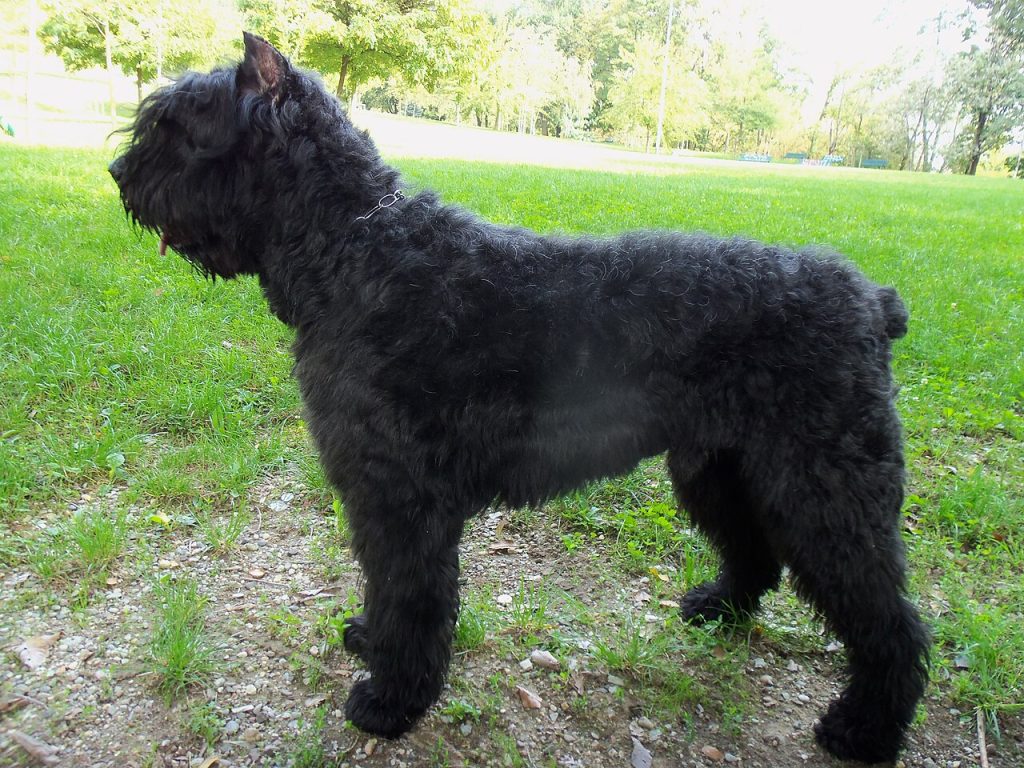
The Boyer of Flanders is one of those dogs that just by looking at it, a rustic mole with tangled hair, thick beard and serene gaze that hides a tireless worker and a guardian devoted to his family. Born in the fields of Flanders to drive cows, pull carts and watch the farm, today he is above all a loyal and protective companion. Before you fall in love with his image, you should know that the Boyer de Flanders demands space, exercise, a steady hand and a real commitment to his fur. Here’s the complete guide to deciding with your head.
Is the Boyer of Flanders for you?
The Flanders Boyer is a large, strong and hardworking dog. It’s not aggressive or nervous, but it’s also not a decorative stuffed animal: It needs an owner present, with time to educate, exercise, and maintain its characteristic coat. It fits wonderfully in active families with a garden and prior experience with dogs of character; it fits poorly in those looking for a low-maintenance dog or spending many hours outside the home.

In favour .
- Natural guardian, balanced and reliable, without falling into gratuitous aggression.
- Very intelligent and quick learner: brilliant in obedience and canine sports.
- Deeply loyal and affectionate to his family, tolerant of the children at home.
- Fur that releases little hair into the environment (retains it in its own coat).
- Versatile: herding, chariot, tracking, defense, therapy… it’s worth almost anything.
To be taken into account
- Demanding coat: frequent brushing and periodic trimming or shedding.
- He needs plenty of daily exercise and mental stimulation; he is bored with routine.
- Distrustful of strangers: Early socialization is nonnegotiable.
- Remarkable size and strength; not a dog for insecure hands or small floors.
- It matures slowly (2-3 years) and drags slugs and mud on the beard.
Character and temperament
If we had to sum up the character of the Boyer of Flanders in one word, it would be calm down. It is a dog of stable temperament, rational and equitable, neither shy nor aggressive. That serenity does not mean passivity: Behind the beard is an awakened mind, capable of evaluating situations and acting on its own when deemed necessary. For some reason, it was used for generations as a versatile farm dog, able to go from herding cattle to guarding without losing his temper.
To his family he is loyal to the core and surprisingly sensitive. He enjoys participating in family life and develops a close bond with his people. To strangers, however, he is reserved and vigilant by nature: He doesn’t need to be taught how to protect his own, he takes it seriously. That very quality requires serious socialization work, for a distrustful and badly accustomed Boyer can become overly suspicious.
His intelligence is high, and he is accompanied by a certain pride. He learns quickly, but he soon gets tired of mechanical repetition: forcing the same order twenty times in a row is the best way to disconnect him. Whoever understands this and poses varied challenges to him finds a brilliant and collaborative companion.
Coexistence: children, other pets, flat and loneliness
With children: The Flanders Boyer is usually patient and protective with the little ones in his family, whom he tends to “watch” with his shepherding instinct.
With other pets: gets along well with other dogs and animals if he grows up with them from a puppy. His herding instinct may cause him to try to “group” other animals, something that is channeled with education.
Floor and solitude: is not the ideal dog for a small flat. It appreciates a house with a garden where to stretch its legs, although it can live on the floor if given a lot of exercise. It does not tolerate prolonged solitude: it is a family dog that needs company and participation.

Education and training
Educating a Flanders Boyer is a thankful task as long as it’s done right. He’s one of the fastest dogs to pick up a new order, so the challenge is not to learn, but to keep him interested and make the rules clear from the start. Consistency is key: A Boyero needs to know what is expected of him and what behaviors are not tolerated; when the owner is ambiguous or changes the rules, the dog can make the decisions himself, and with his character that doesn’t matter.
Positive reinforcement works much better than hardness. Reward him with food, play and a kind voice, and run away from the cheeky repetition: As you learn at first, it’s best to go ahead and vary the exercises before you get bored. Basic obedience should begin as a puppy, along with intense socialization that exposes him to people, dogs, noises and different environments. That early investment is what makes the difference between a confident adult and a suspicious one.
It is worth remembering that the Boyero matures slowly, both physically and mentally, until the age of two or three.
Exercise and activity
We’re dealing with a dog bred to work from sunrise to sunset, and it shows. The Flanders Boyer needs plenty of daily exercise: long walks, runs, games and, above all, tasks that occupy his head. A couple of short walks to the apple is not enough for him. Without adequate physical and mental discharge, his energy and intelligence turn against him in the form of boredom and mischief.
He is a versatile athlete who excels in a multitude of disciplines: agility, obedience, carting(chariot shooting), tracking, herding, Schutzhund/IGP and exhibition. These activities not only keep him fit, but also strengthen the bond with his owner and satisfy his need to “have a job”.
Care: fur and hygiene
The coat of the Boyer of Flanders is its hallmark and, at the same time, its most demanding. It has a double coat: a woolly and insulating inner layer, and a rough, abundant and slightly wavy outer one, topped by the unmistakable beard and mustache.
The ideal routine includes thoroughly brushed several times a week to untie knots and remove dead hair that the coat retains (which is why it seems to “not let go of hair”, although it does lose it). In addition, the coat needs periodic cuttings every few weeks– orientally every 6 to 8 weeks, and more often in exposure dogs – by stripping or scissor/machine as appropriate. The beard collects water, slime, and food debris, so it should be cleaned frequently. Complementary hygiene ears checking, nail trimming and dental care common to any breed.

Foodstuffs
As a large, muscular dog, the Flanders Boyer needs a quality diet, balanced and adjusted to its size, age and activity level. A working adult burns much more energy than one who lives a quiet life, so rations must be adapted to keep it at its ideal weight, without overweight that punishes joints and heart.
In large breeds and deep-chested breeds, precautions should be taken against gastric torsion(dilatation-volvulus): Split your food into two portions instead of just one big one, avoid strenuous exercise just before and after eating, and don’t let me eat anxiously. During growth, a large breed puppy should be fed a specific feed that promotes slow bone and joint development. If you have any questions about quantities or type of diet, it is wise to consult your veterinarian.
Health and life expectancy
The Flanders Boyer is, in general terms, a fairly healthy breed and not prone to very specific ailments. Still, like a good big dog, he shares some predispositions that should be watched for. The best known is hypoplasia of the hip, a common joint problem in large breeds that is best controlled with good breeders, proper weight and sensible exercise. It is also susceptible to the aforementioned gastric torsion, a veterinary emergency requiring immediate attention. Occasionally , eye problems like cataracts can occur .
As for longevity, a British study from 2024 placed the average lifespan of the breed around 11 years, a figure consistent with that of many large dogs (usually between 10 and 12 years). Good nutrition, regular exercise, regular veterinary checkups, and the choice of responsible breeders who perform health tests are the best tools for your Boyero to grow up fit and healthy.
Physical appearance
The Boyer de Flanders is a robust and compact dog that transmits power without falling into heaviness or clumsiness. Its silhouette is almost square and its musculature, evident under the abundant coat.
Males measure approximately between 62 and 68 cm to the cross and females slightly less, around 59 to 65 cm. The weight is around 35 to 45 kg in males and is somewhat lower in females, although larger specimens can exceed these figures. The coat, double and rough, supports several colors: Lion’s mane, black, grey and the so-called “salt and pepper”. Traditionally, their ears and tail were cut off, but this practice is now obsolete and banned in many countries – in their native Flanders, for example, since 2006 – so that it is increasingly common to see them with their natural ears and tail.
Origin and history
The Boyer de Flanders has its roots in the region of Flanders, riding between northern Belgium and France. Its French name, flanders bouvier, literally means “Boyer of Flanders”, that is, a driving dog of oxen and cows; in Flemish it was also known as Call yourself a koehond.(Flemish cowboy dog) and, with rustic affection, – What is it ?(“dirty beard”).
Among the earliest breeders of these dogs are the monks of Ter Duinen Abbey, who are said to have crossed imported specimens – such as Irish hare and Scottish greyhounds – with local farm dogs to produce a tough, strong and solid-character worker. The result was a versatile dog capable of driving cattle, guarding the farm, and even pulling loaded wagons, withstanding the harsh flamenco climate thanks to its dense coat. The advent of the automobile and motorized transportation made much of his original work obsolete.
Until the beginning of the 20th century the breed was not unified and several regional variants coexisted, which slowed its development. The Primera Guerra Mundial almost wiped it off the map: Flanders was one of the major theaters of the conflict and many of these dogs were used for military purposes. Nic, a trench dog who raided exhibitions after the war and is considered the founder of the modern Flanders Boyer, comes from that era. In 1936 a Franco-Belgian commission set a unified standard, although World War II again endangered the breed. The FCI finally adopted its standard in 1965, framing the Flanders Boyero in the Group 1 (shepherd and buffalo dogs).
Curiosities
- A president and his Boyero: Lucky, a female Boyer of Flanders, lived in the White House as a pet of President Ronald Reagan and First Lady Nancy Reagan.
- “Dirty Beard” with honor: his Flemish nickname – What is it ?(“dirty beard”) humorously alludes to that beard that gathers everything… and that awakens so much affection.
- The Nic, a messenger and tracker dog during the Great War, is considered the father of the modern breed.
- From the farm to cinema and literature: is often identified with the faithful The Dog of Flanders Patrasche with this breed, quite a symbol of loyalty.
- Apparently “doesn’t change”:‘s coat retains dead hair, which is why it is considered to have little hair loss to the environment, although it does lose it like any other dog.
- Late maturity: does not reach its physical and mental fullness until 2-3 years of age, so it lives a long “adolescence”.
If you are attracted to the Flanders Boyer for its mix of working dog, guard and loyal companion, you may be interested in other breeds with a similar spirit. Check out the Pastor Alemán, another great versatile working and protective; the tireless Border Collie, king of herding and intelligence; the imposing Rottweiler, boyer and guardian of ancient roots; or the active Pastor Australiano, ideal for sports families.
Frequently asked questions about the Flanders Boyer
Is the Flanders Boyer a good family dog?
Yes, it is a loyal, balanced and protective dog that is very attached to its people and is usually patient with the children at home. It needs, of course, early socialization, consistent education and a family that gives it exercise and company.
How much exercise does a Boyer of Flanders need?
It is a working dog that requires plenty of daily exercise – long walks, runs, and play – in addition to mental stimulation. It marvels at dog sports such as agility, obedience, cart pulling, or trawling to channel its energy.
Does the Boyer of Flanders shed a lot of hair?
It releases relatively little to the environment because its double coat retains dead hair, but precisely because of this it is easily shed. It needs thorough brushing several times a week and periodic trimming to keep the coat healthy.
How tall and how much does a Boyer of Flanders weigh?
The males measure approximately 62-68 cm at the withers and the females slightly less (about 59-65 cm).
How long does a Boyer of Flanders live?
Their average life expectancy is around 11 years, within the usual range of large breeds (about 10 to 12 years).
Is he an aggressive or dangerous dog?
Not by nature. The Flanders Boyer is of stable temperament, neither shy nor aggressive, although he is suspicious of strangers and very protective of his family. With proper socialization and education he is a reliable guardian and not conflicted.
Can he live in a flat?
It is not ideal for its size and need for activity. It can adapt to a floor if it receives a lot of daily exercise and company, but it enjoys much more a house with a garden where to move freely.
Where did the Boyer of Flanders come from?
From the region of Flanders, between northern Belgium and France, it was bred as a multi-purpose farm dog for driving cattle, guarding and pulling wagons, and the FCI classifies it in Group 1 of herding and herding dogs.