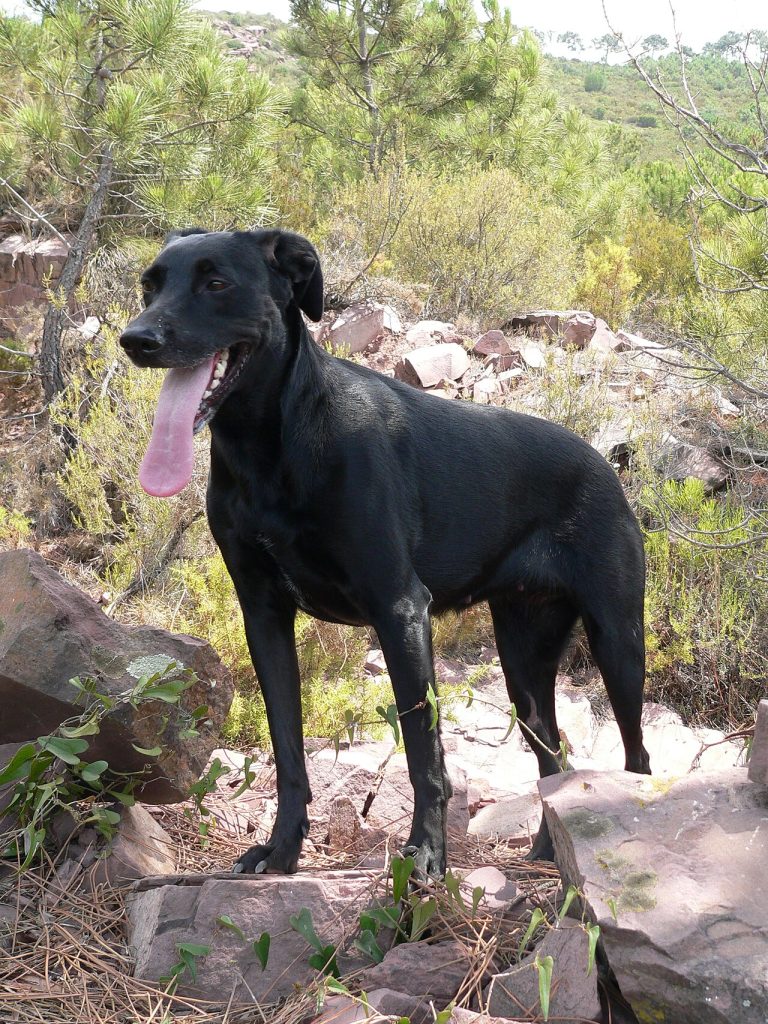
The Pastor Mallorquín, known on its island as Like a beast ., is a large and sober black shepherd dog, bred for centuries on the estates of Mallorca to guide livestock and guard the house. He’s not a lounge dog or a companion for anyone: The Mallorcan Shepherd distributes his loyalty with droppers, decides for himself and needs an owner who earns his respect with work, exercise and fair treatment. In return, he gives you a loyalty they won’t forget. In this guide you’ll find everything that matters before you live with one: character, coexistence, education, exercise, care, health, appearance and history.
Is the Majorcan Shepherd for you?
Before falling in love with its black and athletic imprint, it is advisable to be honest: the Mallorcan Shepherd is a rustic breed, independent and very attached to a single owner. It works wonderfully in the environment for which it was raised (field, space, work) and is frustrated on the contrary.
It’s a good fit if…
- You live in a house with land, farm or country nearby, and you can give it real daily exercise.
- You’re looking for a serious, deterrent guardian, tied to his family.
- You have experience with dogs and you know how to lead without yelling or harshness.
- You value an independent dog who doesn’t need to be attached to you all day.
- You can spend time socializing and educating them from puppyhood.
Think about it if…
- You live in a small apartment with no easy access to open spaces.
- Either it’s your first dog or you’re looking for an obedient, compliant dog.
- You get a lot of visitors or strangers every day at home.
- You’re out for hours and you can’t meet his need for exercise.
- You want a dog who’s sociable with everyone from minute one.
Character and temperament

The Mallorcan Shepherd is, first and foremost, a working dog with his own head. Its intelligence and faithfulness allow it to move from herding to guarding and defending without shedding its hair, but that same character explains why it is not a dog for everyone. He is affectionate and deeply loyal to the person he considers his friend, though that appreciation must be earned: It’s won by treating them well and sharing lots of physical activity, not by easy rewards.
He is suspicious of strangers and is always attentive and vigilant; nothing that happens around him goes unnoticed. One of its rarities most often mentioned by those who know it is that it tends not to accept orders from those it does not recognize as its master, and often takes too long to obey even this one. It’s not free stubbornness: It’s a dog used to making decisions alone in the woods, bred to resolve, not to wait for instructions. One who understands this and respects his independence obtains a companion who is balanced, sober, and of unwavering loyalty.
Coexistence: children, other pets, flat and loneliness
With children. The Mallorcan Shepherd is usually affectionate with the children of his family and quite patient with them. As with any large and territorial dog, coexistence must be built with supervision, respect and clear rules by both parties; its corpulence alone advises prudence with the smallest.
With other pets. is well socialized since puppyhood, cohabits with the animals with which it is reared.
On the floor. is not its ideal habitat. It is a breed accustomed to being outdoors, which needs space and a lot of exercise; locking it in a few meters without an outlet is the recipe for a frustrated dog. If there is no farm, it is necessary to compensate with long and demanding outings every day.
Soledad.‘s independence plays to its advantage: it tolerates loneliness better than many sticky breeds, especially if it has a yard or terrain to stay.
Education and training
Training a Mallorcan Shepherd is an exercise in patience and consistency rather than mechanical repetition. It is very intelligent and learns quickly what it finds useful, but its independence makes it rarely obey “because it does”. Leadership is built with calmness, firmness and, above all, with dedicated time: this breed needs time to be dedicated to its education as much as to its exercise.
The practical keys:
- Early socialization and abundant: people, dogs, noises and different environments during the puppy stage, to soften their natural distrust.
- Positive reinforcement and fair treatment: the harshness with this dog is counterproductive; it closes in a band.
- Stable standards: a dog that decides on its own needs clear and consistent boundaries from day one.
- Bond before obedience: first has to recognize you as a reference; obedience comes later and more solidly.
Exercise and activity

Here is the non-negotiable point. The Mallorcan Shepherd requires a lot of physical exercise: it is a dog of endurance, bred to move through difficult terrain under the Mallorcan sun all day long. A couple of short walks are not enough for it. It needs long outings, walks through the countryside, controlled running and, if possible, a task that occupies its mind.
Exercise is not a whim with this breed: It’s the best educational and bonding tool you have. In fact, one way to earn her affection is to get her to exercise a lot. A well-groomed Mallorcan Shepherd is calm and balanced at home; one who is bored and without physical expense channels that energy into obsessive surveillance, barking or destructive behavior. If you can’t guarantee that daily activity level, this is not your breed.
Care: fur and hygiene

The maintenance of the Mallorcan Shepherd is simple, one of the advantages of the rustic breeds.
- Short hair: adhered to the skin, between 1.5 and 3 cm. It is the most widespread variety and the easiest to maintain.
- Long hair: slightly undulating, soft and fairly thick, very moisture resistant, heritage of its outdoor life.
In both cases, it is enough to brush once a week to remove the dead hair (something more frequent in moles) and bathe only when really needed, so as not to spoil the natural protection of the mantle. The rest is the basic hygiene of any large dog: ears checked and cleaned, nail growth control and dental hygiene. As an outdoor dog, it is advisable to watch for pads and possible parasites after field trips.
Foodstuffs
As a good dog of large size and very active, the Mallorcan Shepherd needs a quality diet, balanced and adjusted to its actual expenditure. A field specimen that works or exercises several hours a day does not eat the same as one with less activity, so the ration must be adapted to its level of movement, age and physical condition, avoiding both thinness and overweight.
General recommendations for the breed:
- Divide the food into two servings a day instead of a single; in large, deep-chested breeds it is a prudent measure against gastric dilation.
- Avoid strenuous exercise just before and after of the main meals.
- Think quality or supervised diet by the veterinarian, with the protein and energy input of a sport dog.
- Water always available and fresh, especially important for the warm climate in which this breed usually lives.
- Watch the weight: excess punishes the joints of a large dog and reduces quality of life.
Health and life expectancy
The Mallorcan Shepherd is a rustic and resistant breed, the result of centuries of natural and functional selection in a demanding environment. This rusticity results in a generally robust health, without the long list of hereditary problems of other more manipulated breeds.
Still, it shares the precautions of large, active dogs. The hip and elbow dysplasia is the point to watch in any breed of its size, so it is advisable to start from breeders who control the breeders. Its size and chest also advise the prevention measures against the gastric dilation-torsion already mentioned. For their outdoor life, external and internal parasites prevention and a daily vaccination schedule are basic. With regular veterinary checkups, proper exercise, and controlled weight, it is a dog that enjoys a long, healthy life.
Physical appearance
The Mallorcan Shepherd is a large, sober and athletic dog, with elegant lines and nothing heavy. The males measure between 66 and 72 cm at the cross and the females between 63 and 68 cm, with a weight of around 40 kg in the largest specimens.
The defining colour of the breed is the black: the black coat is the only one unreservedly recognised by the standard, whilst the white is allowed only on the chest, often in the form of a small “tie”.
The head is massive but not heavy, with the long, strong snout, never finished at the tip, and the black truffle. The eyes are small, honey colored, slightly oblique, lively and very expressive, with that intelligent look and somewhat melancholy so characteristic of the breed. The tail, which is horizontally inserted and thicker at the base, is not cut and reaches the corvettes without touching the ground. The set is that of a functional dog, made for field work.
Origin and history
The Mallorcan Shepherd is a Spanish breed originating from Mallorca, where it was traditionally employed as a herd guardian and herding dog for all types of livestock – including birds – and as a guard and defender of possession houses. The exact time of his arrival on the island is unknown; some hypotheses link him to the conquest of King James I in the 13th century or to the years immediately following. What is certain is that, over the centuries, shepherds and Mallorcan forvillers have been fixing in it very own characteristics, different not only from other island dogs, but also from its neighbors in the Mediterranean.
The modern recovery of the breed began in the 1970s, when its selection and controlled breeding began. In 1980 the standard was drawn up to fix its characteristics and have a valid reference, a work promoted by the Club del Ca de Bestiar that was key to its survival. The breed prototype was accepted by the Royal Central Society for the Promotion of Canine Breeds of Spain and recognized by the International Canine Federation (FCI) on September 13, 1982, with the number 321, within Group 1, Section 1a, Shepherd Dogs.
Curiosities
- Its traditional name, Like a beast ., literally means “cattle dog” in Mallorcan, and perfectly describes its historical function.
- In the FCI it appears with the French name Majorcan sheepdog(Mallorca shepherd dog), with the standard number 321.
- It is one of the recognized native breeds of the Balearic Islands, a symbol of the Mallorcan countryside.
- According to breeders’ tradition, dark brown spots on the palate and gums are considered a sign of racial purity.
- It was close to disappearing in the mid-20th century and its current existence is largely due to restoration work begun in the 1970s.
If you are attracted to the profile of the Mallorcan Shepherd – a large, loyal and independent shepherd-guardian – you may be interested in other breeds of similar character. Compare it with the Pastor Alemán, another large versatile shepherd dog; with the Border Collie if you are more shepherding and mindful; with the Cane Corso as a guardian of imposing presence; or with the Rottweiler, another faithful and territorial guardian.
Frequently asked questions about the Mallorcan Shepherd
Is the Mallorcan Shepherd a good guard dog?
Yes. In addition to its origin as a shepherd dog, its intelligence and fidelity allow it to develop surveillance and defense tasks. It is suspicious of strangers and always attentive, which makes it a serious and deterrent guard for its family.
Is it suitable for living in a flat?
It is not ideal. It is a large breed, used to being outdoors and requires a lot of physical exercise. It can adapt to urban life only if it is guaranteed long and demanding daily outings, but it works much better in a house with land or near the countryside.
Do you get along with the kids?
As with any large, territorial dog, coexistence must be based on supervision, mutual respect, and clear rules.
Is it hard to educate?
It is very intelligent, but also very independent: it tends not to accept orders from those it does not recognize as its master and sometimes takes time to obey even this one. It needs early socialization, positive reinforcement, consistency and an owner who earns its respect.
How much exercise do you need?
It is an endurance dog that needs daily, intense physical activity: long walks, camping, and controlled running. Exercise is also one of the best ways to gain their appreciation and keep them balanced at home.
What color is the Mallorcan Shepherd?
The characteristic and only colour fully recognised by the standard is black, whilst white is allowed only on the chest.
How long does a Mallorcan Shepherd live?
Its life expectancy is around 11-13 years, the usual for a dog of its size. It is a rustic and resistant breed, and with good care, exercise and controlled weight enjoys a long and healthy life.
Why is it called Beast Ca?
Like a beast . means “cattle dog” in Mallorcan and is its traditional name.