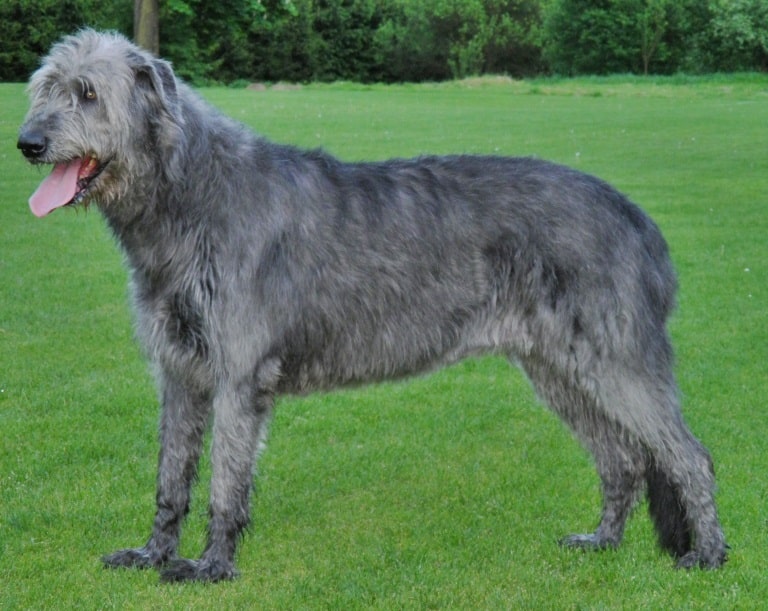
The Irish Lebrel (Irish Wolfhound, in Gaelic Cú Faoil) is one of the tallest dogs in the world and, at the same time, one of the most calm and affectionate that exists. Born in Ireland to hunt wolves and deer, today he is the quintessential “gentle giant”: A calm, loyal companion deeply attached to his family. His size commands, but his character disarms. Before falling in love with his image, it is good to understand what it is like to live with a dog of this size and life, unfortunately, short.
Is the Irish Lebrel for you?

The Irish Greyhound is not a breed for everyone, and that has to be said bluntly. It’s a huge dog, it needs space, it literally takes up space on the couch and it has one of the shortest life expectancies in the canine world. In return, it offers a serene, discreet and loyal company that few races match. The decision to share your life with one should be as emotional as it is rational.
In favour .
- Quiet, balanced and very affectionate in the house.
- It barely barks and is rarely destructive if given company.
- Excellent with children and usually with other dogs.
- Its mere presence is a deterrent: few intruders come near a dog of this size.
- He does not need strenuous exercise; he just needs daily walks and some space to run.
To be taken into account
- Short life expectancy (about 6-10 years): you have to take mourning early.
- Predisposition to serious health problems (heart, bones, twisted stomach).
- He needs space: a small floor is not enough.
- High expenditure on food, veterinary and medication for his size.
- Strong hunting instinct: can chase small animals.
Character and temperament
If there’s one word that defines the Irish Hound, it’s “quiet”. Despite its enormous size, it’s an introverted, intelligent, reserved dog that behaves surprisingly calmly indoors. It’s rarely noisy or destructive; most commonly found lying around, occupying half a room, watching its people with those dark, serene eyes.
Its historical motto sums it up better than any token: “gentle when stroked, fierce when provoked”(“docile when caressed, fierce when provoked”). It is a dog deeply attached to its family, which creates strong bonds with people and animals with which it grows up.
Do not expect him to be a classic guard. His nobility is such that he usually receives strangers with kindness, so as a warning dog he is unreliable. Of course, his size imposes itself and, when he perceives a real danger for his own, he does not wrinkle. But his natural role is that of a loyal companion, not that of a defense dog.
Coexistence: children, other pets, flat and loneliness
- With children: is one of the most patient and tolerant dogs in existence, and is usually an excellent companion for the smallest. The only nuance is the size: an adult can accidentally pull a small child with a simple tail movement, so supervision is mandatory.
- With other dogs: is well socialized, gets along great with other dogs, especially if they’ve been raised together.
- With other pets: is a hunting hare with a high chase instinct, so cats, rabbits or other small animals can activate their hunting impulse.
- Although On the floor: is quiet and sleeps almost all day, its volume makes it hardly compatible with small dwellings.
- In the face of loneliness: is its weak point. It is not a dog to spend many hours alone. It needs to be part of family life; prolonged loneliness takes an emotional toll on it.
Education and training
The Irish hare is intelligent, but it is not a dog of competitive obedience. Its learning ability is average and it retains the independence of hare, a breed bred for centuries to hunt by making its own decisions away from the hunter. That means it does not seek to please unconditionally: its cooperation must be earned, not demanded.
The key lies in positive reinforcement, patience and consistency. It is a sensitive dog that does not respond well to harsh methods or shouts; on the contrary, that only retreats it. Early socialization is essential, especially for it to learn to relate to people, other dogs and varied environments from puppyhood.
It is advisable to work from the beginning the call and self-control, knowing that their instinct of pursuit can be carried ahead of any order when a moving prey appears. That is why many homeowners choose to let loose only in fenced and safe areas. And given his size, teaching him good manners from a puppy (not jumping, walking without pulling on the leash) is not a whim, it’s a necessity: A 60-kg adult who doesn’t follow the rules is hard to handle.
Exercise and activity

One of the great surprises of the Irish Lebrel is that it needs less exercise than its size suggests. At home it is a true “sofa-dependent”: quiet, sleepy and not demanding.
That said, he’s still a greyhound, and he really enjoys being able to gallop in the open. A good periodic run in a safe space feels wonderful to him and satisfies his hunter-by-sight nature. What should be avoided at all costs is vigorous or strenuous exercise during the growth phase: giant puppies have very delicate forming joints and bones, and forcing them can cause lifelong problems.
Balance is the key word: moderate and regular exercise, no excess in the puppy, and always avoiding exertion right after meals to reduce the risk of gastric torsion.
Care: fur and hygiene
The coat of the Irish Lebrel is rough and hard, of medium length, especially porous over the eyes and beard, which gives it that noble air and somewhat uncombed so characteristic.
Exhibition specimens undergo a stripping(manual pulling of dead hair) a couple of times a year to preserve the correct texture of the coat, but for a companion dog it is not essential.
The rest of the care is the usual, adapted to their size: checking and cleaning the ears, watching the eyes, cutting the nails regularly and maintaining good dental hygiene.
Foodstuffs
Feeding a giant has its science. Like all dogs, the Irish Greyhound is omnivorous and needs a balanced diet with the right proportion of animal protein and other nutrients. The quality of the food matters, and the quantity must be adjusted to its size, age and activity level to avoid both malnutrition and overweight, which severely punishes joints that already bear considerable weight.
The puppy stage is especially delicate. Too fast growth is counterproductive in giant breeds, so puppy feeding should be formulated for slow and controlled development of bones and joints. Here it is best to follow the guidelines of the breeder and the veterinarian.
There is one detail that is not optional in this breed: the prevention of gastric torsion. It is recommended to divide the food into several servings per day instead of a single copious ration, avoid exercise just before and after eating and, traditionally, feed it on an elevated surface.
Health and life expectancy
We have to be honest: Health is the great Achilles’ heel of the Irish hare. As with many giant breeds, their life expectancy is short. Estimates vary widely depending on the study, but a British study from 2024 placed the average around 9.9 years, compared to almost 12.7 years for purebred dogs; other studies place it below. In practice, the realistic life expectancy is about 6 to 10 years, hopefully.
The most frequently documented diseases in the breed are:
- Dilated cardiomyopathy (DCM): a condition of the heart muscle with a very high incidence in the breed (studies report between 12% and more than 40% of individuals) and with a likely hereditary component.
- Skin and subcutaneous tissue: The Irish Lebrel has a much higher risk of this type of bone tumour than all dogs.
- Gastric torsion/dilatation (GDV) is defined as: a potentially life-threatening veterinary emergency, common in large, deep-chested dogs.
- Osteochondrosis and hip dysplasia: locomotor system problems linked to rapid growth and large size.
- Otros: progressive retinal atrophy and von Willebrand disease (a bleeding disorder) are also cited in the breed.
The best defense is to go to a responsible breeder who performs health (especially cardiac) tests on the breeders, maintains regular veterinary checks, takes care of feeding and weight, and is very attentive to any signs of gastric torsion, requiring immediate action.
Physical appearance

The Irish Greyhound shares with the Great Dane the title of the tallest dog in the world. According to the FCI standard, the desirable height is between 81 and 86 cm at the withers, with a minimum of 79 cm in males and 71 cm in females. In terms of weight, males start at about 54.5 kg (and can easily exceed 60 kg in large specimens) and females at about 40.5 kg. It is a more massive dog than the Scottish Leatherback (Deerhound), but less heavy than the Great Dane.
Its silhouette is that of a large-scale hare: body that should appear longer than tall, long and muscular neck, deep and well-developed chest, slightly arched upper line and long and curved tail. The head is elongated, with similar-length skull and snout, dark almond-shaped eyes, and small rose-shaped ears. Everything about it conveys the idea of a dog capable of reaching and knocking down a wolf.
The hair is hard and rough, and is allowed in a wide range of colors: gray, brindle, lionskin, red, black, pure white or any of the Deerhound’s own colors.
Origin and history
The history of the Irish Greyhound goes back to ancient times. Already in the year 391 the Roman consul Quintus Aurelius Symmachus mentioned having received seven large dogs (“canes Scotici”) from the islands, which caused astonishment in Rome. The Gaelic people of Ireland called them Cú Faoil, literally “wolf dog”, and used them to hunt wolves, deer and other large prey. These dogs have been mentioned in Irish law and literature since the 6th century, and are intertwined with Celtic mythology: The hero Cú Chulainn (“the hound of Culann”) owes his name to having killed a blacksmith’s fierce guard dog.
Interestingly, zoological studies suggest that the giant dog we imagine today is relatively modern: The bones found indicate that the dog in the ancient stories was no older than a German shepherd. The breed became so popular that for centuries numerous specimens were exported to European royal houses, to the point that in 1652 Oliver Cromwell had to ban its export so that enough were left in Ireland to control the wolves.
With the disappearance of the wolf (the last in Ireland was killed in 1786), the hare lost its function and was on the brink of extinction. Their salvation came from the hand of Captain George Augustus Graham, who from 1862 set out to rebuild the breed by crossing the few remaining specimens with Scottish Greyhound, Great Dane and other breeds. In 1885 he founded the Irish Wolfhound Club and set the standard. The modern Irish Lebrel is therefore a reconstruction: It retains the look of the original dog, even if its genetics have been enriched along the way. In 1902 he was appointed official mascot of the Irish Guards regiment, a role he still holds.
Curiosities
- It shares with the Great Dane the record for the world’s tallest breed, although the Dane may appear taller for having the shortest back.
- Its Gaelic name, Cú Faoil, literally means “wolf dog”, in reference to its original function.
- It has been the official mascot of the Irish Guards since 1902, and a specimen of the breed parades with the regiment in solemn acts.
- The Irish Lebrel as we know it today was extinct as a functional breed and was “re-created” in the 19th century from crosses.
- It is a sighthound, that is, a dog that hunts primarily by sight rather than smell.
- His most affectionate nickname, “gentle giant”, perfectly sums up the contrast between his imposing physique and his sweet character.
If you are attracted to the elegant build and character of large hares, you may be interested in learning about their closest relative, the Greyhound, as well as the Galgo Afgano, another sighthound of large size and spectacular beauty. For its direct kinship in the reconstruction of the race and for sharing the height record, the Gran Danés cannot be missed. And if what you’re falling in love with is Irish heritage, check out the stylish Setter Irlandés.
Frequently Asked Questions about the Irish Greyhound
How long does an Irish Greyhound live?
It is one of the longest-lived breeds in stature but shortest in life. Realistically, it has a lifespan of about 6 to 10 years; a British study in 2024 placed the average at around 9.9 years.
Is he a good family dog with kids?
Yes. It is patient, affectionate and very tolerant, which makes it an excellent family companion. The only concern is its size: it can accidentally pull a small child, so the interaction must be monitored.
How much exercise do you need?
Less than it looks. With 20 to 40 minutes of daily activity, spread out over walks and some free running, he has enough. At home he is quiet and sleepy. Of course, you should avoid intense exercise during growth.
Does it serve as a guard dog?
It is too noble and friendly to strangers to be a good warning or defense dog, yet its enormous size is a deterrent on its own, and it defends its own if it perceives real danger.
Can he live in a flat?
Although its quiet character would make it possible, its volume makes it hardly compatible with small dwellings.
What health problems do you have?
The most common are dilated cardiomyopathy, bone cancer (osteosarcoma), gastric torsion, osteochondrosis and hip dysplasia. Progressive retinal atrophy and von Willebrand disease are also mentioned.
You lose a lot of hair and it’s hard to maintain?
Not too much. Their rough and hard hair is kept well with a weekly brushing. Exhibition dogs undergo stripping a couple of times a year, but for a companion dog it is not essential.
Why do they call him “gentle giant”?
Because of the contrast between its imposing physique, one of the tallest in the canine world, and its sweet, serene and affectionate character, its historical motto says it all: docile when caressed, fierce when provoked.