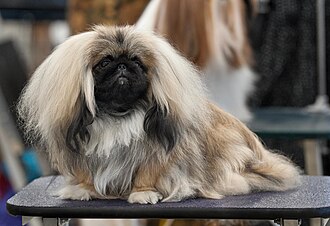
The Pequinés is a small, millenary companion dog of enormous character: He was born within the walls of the Forbidden City as the exclusive pet of Chinese emperors. Beneath its lion’s mane is a loyal, courageous, and deeply independent companion, more like a little lion than a docile lap dog. If you’re looking for a quiet indoor dog with its own personality and aristocratic air, the Pekingese has a lot to offer, provided you take care of its coat and the health precautions its flat face demands.
Is Pekingese for you?
Before you fall in love with his image, you should know what you are committing to. The Pekingese is a dog of low energy and great character: it fits wonderfully with those who want a homey and dignified companion, but not so much with those who are looking for a submissive dog, sportsman or outdoorsman. These are its great lights and shadows.
In favour .
- Small in size, ideal for flats and urban living.
- Minimal exercise needs; very adaptable to home rhythm.
- Loyal and very close to his family; excellent company.
- Good “alarm bell”: warns of strangers without being a compulsive barker.
- Quiet and quiet inside, with an unmistakably elegant demeanor.
To be taken into account
- Demanding coat: almost daily brushing and periodic hairdressing.
- Flat face (brachycephalus): risk of respiratory and heat stroke.
- Big, protruding eyes, prone to sores and ulcers.
- Stubborn and independent: education requires patience.
- Not the best dog for very young children or abruptness.
Character and temperament
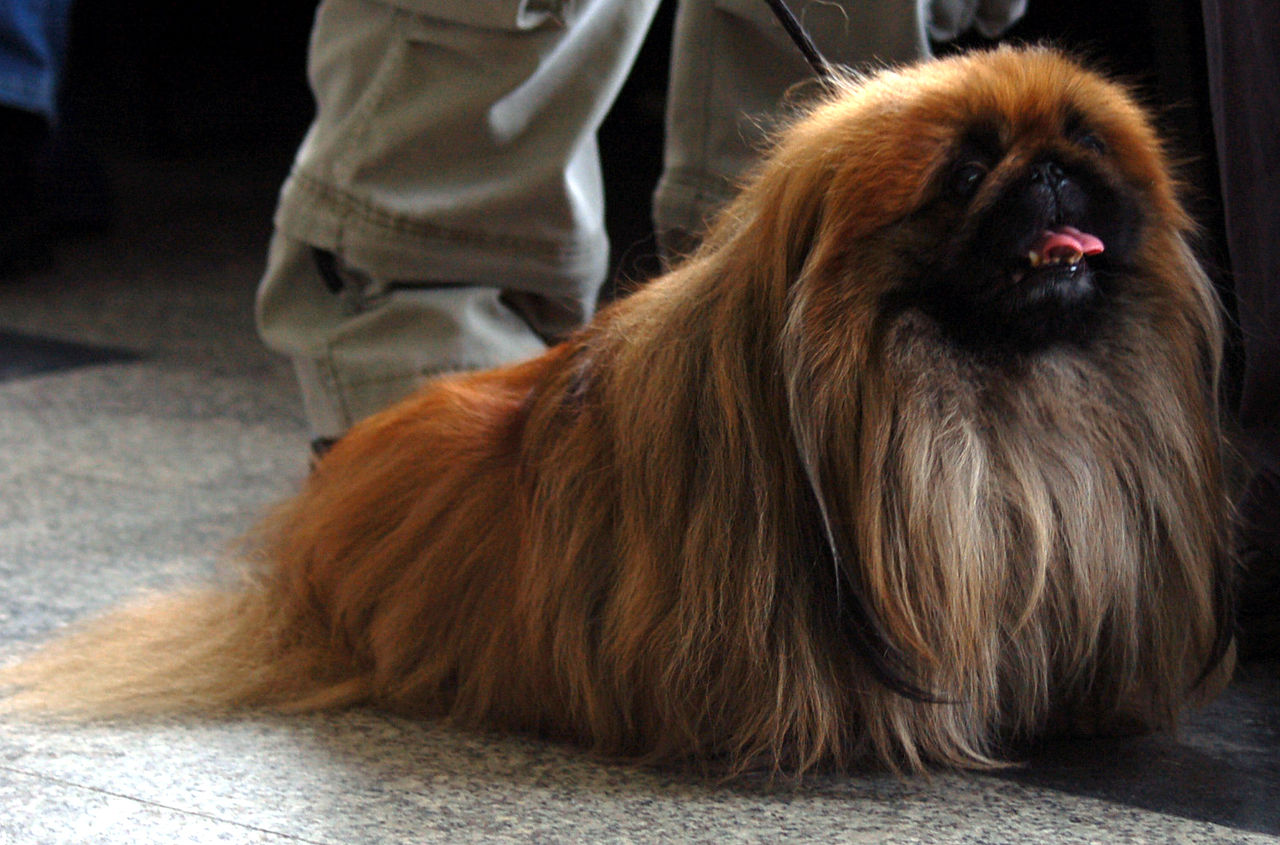
There is a classic saying among breeders: the Pekingese “believes himself a lion with a dog’s body”. And they are not misguided. It is a self-confident animal, proud and with almost feline dignity. It is not one of those who chase balls without stopping or seek to please at any cost; rather, it decides when and how it relates, and expects to be respected.
With his family he is affectionate, sensitive and extremely loyal. He usually chooses one or two favorite people whom he follows around the house and with whom he loves to rest. This devotion coexists with a marked independence: he tolerates moments alone better than many small breeds, although, like any dog, he should not spend whole days isolated.
He’s an excellent warning dog. It does not bark at everything, but it warns immediately when something seems suspicious, making it a discreet interior guard. His courage, of course, sometimes plays tricks on him: It does not shy away from dogs much older than itself, and can confront a German Shepherd or a Mastiff without measuring consequences, so it should be supervised in dog encounters. On Stanley Coren’s well-known obedience scale, he ranks low (around 73), but that doesn’t reflect lack of intelligence, but his stubborn, independent nature: It’s one thing for him to understand exactly what you’re asking; it’s another to decide to do it.
Coexistence: children, other pets, flat and loneliness
- With children: is best with older children who understand how to treat it. It’s small, with delicate bones and no tolerance for roughness; it’s not a dog for hair pulling or rough play. With respect, it’s a great companion.
- With other pets: can get along well with dogs and cats, especially if it socializes from a puppy.
- The On the floor: is practically the ideal floor dog. Small, quiet indoors and with low exercise needs, it adapts smoothly to apartments and city life.
- In the face of loneliness: tolerates loneliness better than many companion breeds, but is still an attached dog.
- Clima: key point. Its double coat and flat face make it very sensitive to heat; in summer it needs shade, coolness and water, and never exertion in the hottest hours.
Education and training
Educating a Pekingese is an exercise in patience and perseverance rather than endless repetition. They are intelligent, but independent and uninterested in obeying “because they do”, so training based on commands and corrections often crashes against their stubbornness. What works is positive reinforcement: rewards, a kind voice, and short, entertaining sessions that compensate them for following through.
Early socialization is the best investment. Exposing a puppy to people, noises, other dogs and different situations prevents its natural security from leading to territoriality or excessive warning barking. It is also advisable to get it used from a young age to manipulation (brushing, cleaning of eyes and folds, checking of ears), because they will be routines for life.
Learning cleanliness may be a little slower than in other breeds; routine, predictability, and not scolding accidents accelerate the process. And a word of advice: as adorable as he is, don’t let him have it all. The Pekingese who learns to run the house can become capricious and defensive. Clear and loving boundaries from the start.
Exercise and activity
Here is one of its great advantages and, at the same time, one of its greatest precautions. The Pekingese needs very little exercise: a couple of short, quiet walks a day and some play at home are enough to keep it fit and happy. It rarely tolerates more than about 30 minutes of continuous activity.
The reason is not just his leisurely nature, but his anatomy: being a brachycephalic (very short-nosed) dog, it has more difficulty breathing than a long-nosed dog. That’s why you have to keep a close eye on it during exercise, especially in the heat. If he starts panting loudly or snoring when breathing, stop immediately, take him to a cool place, and let him regain his breathing before continuing, always with water on hand. Heat and intense exertion are literally a bad combination for this breed.
Care: fur and hygiene
The coat of the Pekingese is spectacular, but demands work. It has two layers: a long, abundant and smooth outer hair, with a prominent mane around the neck and shoulders, and a dense and woolly inner undercoat. To avoid knots and tangles it needs to be thoroughly brushed almost daily, paying special attention to the friction zones (behind the ears, armpits and English).
Beyond the brush, there are race-specific routines:
- Facial folds: Clean them often and keep them dry to prevent dermatitis and facial skin irritation.
- Ojos: checks and cleans them daily; its large, protruding eyes accumulate scabs and are sensitive to any touch.
- Rear area (‘pants’): the long hair on the back gets dirty easily; it must be kept clean and well trimmed.
- Peluquería: a visit every 8-12 weeks helps maintain the coat. If it is not an exhibition dog, a puppy cut makes daily maintenance much easier.
- Calor: is never shaved at zero thinking that it will pass less heat; its coat also insulates.
Foodstuffs
Like a good little dog, the Pekingese needs little food, but quality and well-distributed. A complete and balanced diet is recommended for small breeds, adjusting the ration to their weight, age and activity level. Being an inactive dog, it is very easy to get overweight, and every extra gram punishes its joints, its heart, and, above all, its already compromised breathing.
It is advisable to divide the food into two daily servings, control the prizes and avoid leftovers from the table. Its flat snout makes some specimens eat somewhat ostentatiously; food with appropriate croquette to its mouth and stable feeders help. And, given its sensitivity to heat, fresh water always available is not a luxury, it is a necessity.
Health and life expectancy

The life expectancy of the Pekingese is around 12-14 years. A large British study in 2024 placed their average longevity at around 13 years, above the average for purebred dogs, whereas previous surveys lowered it to around 11-12.
Its main health challenge stems from its anatomy. It is a brachycephalic breed, and selection towards increasingly flattened faces can lead to brachycephalic syndrome(narrow airway respiratory distress), with snoring, strain fatigue and, in severe cases, serious problems. Hence its poor tolerance to exercise and heat, and a real risk of heat stroke.
Other points to watch:
- Ojos: their large, prominent eyes are delicate; corneal ulcers, dry eye (dry keratoconjunctivitis) and, in some lines, progressive retinal atrophy are common.
- Piel: facial folds and wet areas can develop dermatitis and hot spots if not kept clean and dry.
- Traumatismos: being such a small dog, falls and bumps are a major cause of injury; be careful with jumps and abrupt handling.
- Corazón: is recommended for veterinary monitoring of cardiac function throughout life.
Concern about these problems led canine clubs such as the British to modify the breed standard in 2008 to favor a more obvious snout and better breathing.
Physical appearance

The Pekingese is a small but massive dog, clearly longer than tall, with a rectangular profile and glued to the ground. It weighs between 3.2 and 6.4 kg and measures about 15 to 23 cm at the withers; standards disqualify specimens that exceed a certain weight.
The head is large for its size, wide and fairly flat above, with the face covered in folds. The eyes are large, dark and bright, well spaced and somewhat prominent. The snout is wide, short and flattened, with a black nose and open holes. The ears, heart-shaped, hang glued to the face covered in long hair. The neck is short and robust, the chest broad and the back straight; the front legs are short and strongly bony, slightly arched.
Its hallmark is the cloak: double, with long, smooth outer hair, a marked mane on the neck and shoulders, and “feathers” of longer hair on the ears, tail, back of the legs and feet. The tail, very crowded, carries it curled up on its back. The colours allowed are very varied: gold, red and sable predominate, but cream, black, white, lionskin, black and fire and even grayish tones also appear. Many specimens have a characteristic black mask on their face. There is also a historical variety in miniature, the so-called Pekingese “sleeve” or sleeve.
Origin and history
The Pekingese is one of the oldest companion breeds in existence. Its roots go back to the small dogs of the Tibetan environment and the Chinese imperial court, where it appears documented more than a thousand years ago, in the middle of the Tang dynasty.
It was literally an emperor’s dog. It lived in the imperial palace like a living jewel, bred exclusively for royalty and high nobility, with its export prohibited. The protocol around it was extreme: Disrespecting one of these dogs could bring harsh punishments, and stealing or damaging an imperial specimen paid dearly. For Chinese culture, this “lion dog” was linked to Buddhism and the symbolism of the guardian lion.
His departure from China was as abrupt as it was historic. In 1860, during the Second Opium War, Anglo-French troops looted and burned the Old Summer Palace in Beijing. Among the booty were several Pekingese; one of them was taken to England and presented to Queen Victoria, who christened him “Looty”. Decades later, Empress Dowager Cixi gave specimens to prominent Western figures, and the breed gradually gained popularity in Europe and the United States in the early 20th century, becoming the well-known companion dog it is today.
Curiosities
- The lion dog. A Chinese legend says that it was born of love between a lion, who gave up his size, and a small monkey: hence its value as a beast in a tiny body.
- Looty, the dog of Queen Victoria. The first Pekingese who survived the voyage to England ended up in the hands of Queen Victoria, who named him after arriving as part of the spoils of 1860.
- Survivor of the Titanic. A Pekingese named “Sun Yat Sen” was one of the very few dogs to survive the sinking of the Titanic in 1912.
- The smallest specimens were carried inside the wide sleeves of the suits of the imperial court; hence the name Beijing sleeve.
- His characteristic gait. The rocking of their gait, that “rolling” gait, is thought to have been enhanced with the calf so that the palace dogs would not stray too far.
- A winner at Westminster. In 2021, a Pekingese named Wasabi won the “Best in Show” of the prestigious Westminster competition, the fourth time the breed has taken that title.
If you are attracted to the Pekingese, you will surely enjoy meeting other companion breeds with similar history and character. We recommend that you take a look at the Shih Tzu, another small dog of Asian origin that shares a flat face and porte regio; the Japanese Chin, its closest relative within oriental toy dogs; the Lhasa Apso, also linked to temples and palaces in Asia; and the Pug(Carlino), another companion brachycephalic with a lot of personality.
Frequently Asked Questions About Pekingese
Does the Pekingese bark a lot?
It is not a compulsive barker, but it is a good warning dog: it alerts immediately when a stranger appears or something is suspicious.
How long does a Pekingese live?
Their life expectancy is around 12-14 years. A British study from 2024 placed their average longevity at around 13 years, above the average of purebred dogs. Good care and weight control help to reach the high end of that range.
Is it a good breed to live on a flat?
Yes, it is almost the ideal floor dog: small, quiet indoors and with very low exercise needs. You just have to be careful that the environment is not too hot, because it is very sensitive to heat.
How much exercise do you need?
Very little. A couple of short walks and some play at home are enough for him. Being brachycephalic, he rarely tolerates more than about 30 minutes of continuous activity and you have to watch his breathing, especially if it’s hot.
Does it lose a lot of hair and cost a lot to take care of it?
It has a double coat, is mute and easily tangled, so it needs thorough brushing almost daily and periodic visits to the hairdresser.
Do you get along with children and other pets?
It can get along well with other dogs and cats if socialized from a puppy, although its dominant character demands calm presentations.
Do you have any health problems because of your flat face?
As a brachycephalic breed, it may suffer from breathing difficulties (brachycephalic syndrome), heat intolerance, and eye problems because of its large eyes.
Is it hard to educate?
It’s intelligent but stubborn and independent, so it requires patience. Positive reinforcement works very well with short sessions and rewards, and early socialization. It doesn’t respond well to harsh methods or unmotivated repetition.