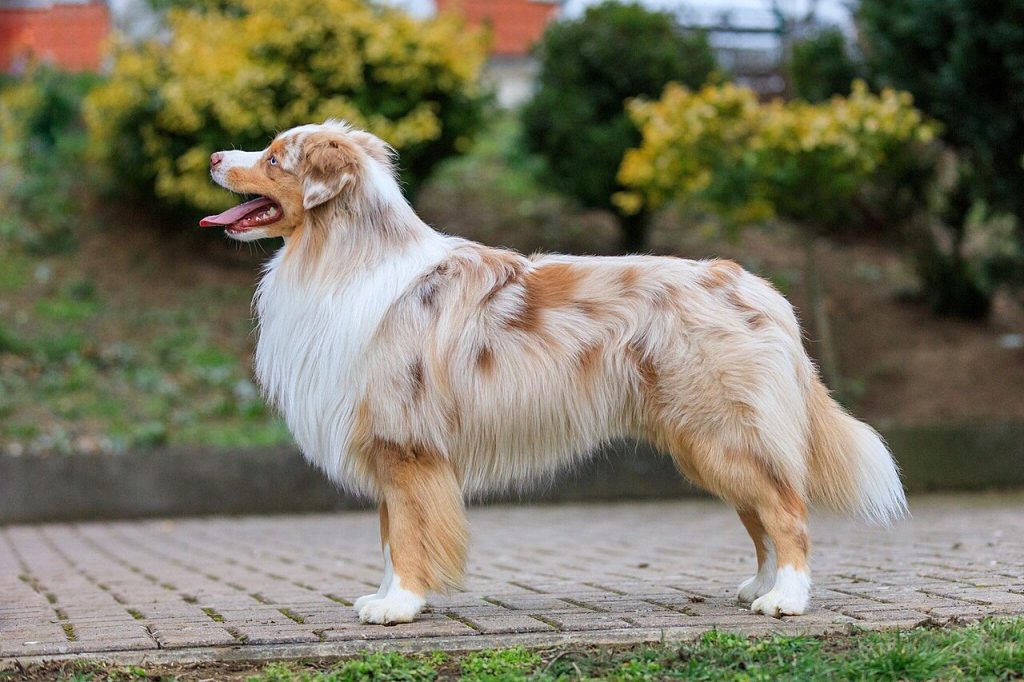
The Pastor Americano Miniatura is a small, alert herding dog with almost inexhaustible energy, bringing together almost all the virtues of the Australian Shepherd in a much more manageable format. Born in the United States from small Australian specimens, today it is one of the fastest growing companion and sport dog breeds: intelligent, docile, hypersensitive to his family and capable of learning almost anything. If you’re looking for a quiet, lazy city dog, this is not your candidate. If you’re looking for a brilliant companion to do agility, obedience or long mountain routes with, the Miniature American Shepherd may be just what you need.
Is the Miniature American Shepherd for you?
Before you fall in love with his stuffed face and his eyes, often blue or disparate, you should be honest: The Miniature American Shepherd is a small-bodied working dog. He needs to do things. It fits wonderfully with active people, families who enjoy the outdoors and dog sports enthusiasts; it is frustrated in the hands of those who were expecting a couch dog. Here’s your quick balance.
Points in favour
- Very smart and easy to train: it learns commands at high speed.
- Comfortable size for home, car and travel, with big dog spirit.
- Extremely loyal and attached to his family; excellent active companion dog.
- He excels in agility, obedience, flyball, freestyle and shepherding.
- Good life expectancy (13-15 years) and very attractive appearance.
Points to Consider
- High energy: Without daily exercise and mental stimulation, you get bored and misbehave.
- Shepherding instinct: may try to “catch” children, pets or runners.
- The double coat loosens hair and needs regular brushing.
- It may be suspicious of strangers; it requires early socialization.
- Predisposition to eye problems and sensitivity to drugs (MDR1 gene).

Character and temperament
If we had to sum up the Miniature American Shepherd in one word, it would be i ‘m awake .. It’s a dog that observes, processes, and anticipates. It lives dependent on its family, reads human body language with amazing ease, and genuinely enjoys having a job to do, whether it’s bringing in the ball, learning a new trick, or guarding the door.
He is docile and eager to please, which makes him an easy and grateful trainee. At the same time it retains the reserved character of many herding dogs: With its people it is effusive and affectionate, but with strangers it can be cautious or even vigilant until it decides there is no threat. He’s not an aggressive dog by nature, but he’s a good warning dog: It barks when something changes in its territory.
That same sensitivity has a B-side: they are an emotionally connected breed that accuses stress, sudden changes, and harsh methods. A well-managed Miniature Shepherd is balanced, cheerful, and stable; a poorly managed or under-stimulated one may become nervous, reactive, or develop repetitive behaviors.
Coexistence: children, other pets, flat and loneliness
With children: is a great playmate for active children, as long as it is supervised. Its shepherding instinct can lead it to “catch” the little ones by circling or nibbling on their heels when they run; it is not aggression, but work, but it should be redirected from puppyhood so that it does not become an annoying habit.
With other pets: is well socialized and gets along well with other dogs and usually gets along well with cats he has grown up with.
On the floor:‘s small size makes it suitable for apartment living, with one non-negotiable condition: cover its daily exercise and mental stimulation needs. A tired and satisfied Miniature American Shepherd is quiet at home; a bored one will seek entertainment in its own way, usually by destroying something or barking.
Soledad: is a very close-knit breed that has a hard time with prolonged loneliness. It’s not a dog to spend ten hours alone a day. If you work outside for many hours, you’ll need environmental enrichment, walks or company to avoid separation anxiety.

Education and training
Few breeds are as rewarding to train. The Miniature American Shepherd is so intelligent and so eager to collaborate that most of the basic exercises are internalized in very few sessions. This is a blessing and a warning at the same time: he learns as quickly what you teach him on purpose as the maniacs you allow him to do unintentionally.
The key is the positive reinforcement. It’s a soft dog, very attentive to your tone and mood; coercive methods turn it off and make it insecure. With rewards, play and short and varied sessions, you’ll get an enthusiastic collaborator who wants to keep working.
Two priorities since I was a puppy: socializing(people, dogs, noises, environments, to soften your natural reserve with strangers) and impulse control(teach you to wait, to stay calm and not chase everything that moves). Add mental stimulation – smell games, dispenser toys, tricks, sports – because in this breed the brain is as tired as the legs, and a mentally satiated dog is an easy dog.
Exercise and activity
There are no shortcuts here: it is a high energy breed that needs frequent exercise and mental stimulation to be balanced. As a reference, think of a minimum of one to two hours of daily activity, combining walking, free running and head work.
He loves dog sports and that’s where he shines the most: agility, competitive obedience, flyball, canine freestyle, disc dog and, of course, herding. You don’t need to compete; just incorporate purposeful play into your routine. A simple “search” session with hidden prizes, a few tricks or bringing a frisbee leave you much more satisfied than a monotonous walk.
Beware of confusing energy with hyperactivity: A well-exercised Miniature Shepherd knows how to shut down and rest.

Care: fur and hygiene
The Miniature American Shepherd wears a medium-length double coat, with a weather-resistant outer coat and a dense undercoat.
The maintenance is moderate. Brushing a couple of times a week keeps the hair clean, without knots and distributes the natural grease that gives it shine. During the seasonal mowing, in spring and autumn, the fall is shot and it is advisable to brush daily to control loose hair at home. Bath only when they are really dirty, so as not to dry out the skin.
Complete the routine the basics of any dog: check and clean ears, cut nails when they hit the ground and take care of dental hygiene with brushing or alternatives.
Foodstuffs
As a small but very active dog, the Miniature American Shepherd needs high-quality, high-protein food tailored to its actual activity level. A sporting specimen consumes significantly more energy than one that only walks, so the ration must be adapted to each dog and each stage of life.
Divide food into two daily servings in the adult (more frequent in the puppy) and monitor weight regularly: Because of its compact size, a few extra grams are immediately noticeable and overload joints already sensitive to dysplasia. It exploits its appetite and its brain by using some of its daily rations as training rewards or in toy dispensers, which also provide it with enrichment. Water always clean and available, especially after exercise.
Health and life expectancy
With proper care, the Miniature American Shepherd enjoys a long and healthy life expectancy of 13 to 15 years. That said, as a young breed derived from a specific genetic heritage, it carries some predispositions that should be known and that responsible breeders control through testing.
- Eye problems: progressive retinal atrophy (PRA-prcd), hereditary cataracts, coloboma of the iris and microphthalmia.
- MDR1 gene (resistance to drugs): as in other shepherds, some specimens have a mutation that makes them very sensitive to certain medicines; it is essential to do the test and always tell the veterinarian.
- Dysplasia of the hip: present in the breed is controlled by selecting breeders with healthy hips.
- Degenerative myelopathy: is a late-onset neurological disease with a known genetic basis.
The best prevention is twofold: acquiring the puppy from a breeder who does genetic and eye testing of the parents, and maintaining periodic veterinary checkups.
Physical appearance
The Miniature American Shepherd is a small dog, slightly longer than tall, with a balanced and hardy structure that conveys agility and working ability.
The tail may be naturally long, a natural rib or be amputated to a length not exceeding about 8 cm, depending on the regulations of each country.
The recognized colors are tricolor, blue merle, red merle and red or liver. Merle patterns do not require a specific amount of mottling. Fire marks around the eyes, face, legs, chest and other areas are allowed, and white marks limited to the muzzle, cheeks, neck, chest and extremities; an excess of white outside the allowed areas may disqualify in exposure.
Origin and history
The history of this breed is recent and quite convoluted. It all started in United States in the late 1960s, when some breeders began to select specimens of Australian Shepherd of especially small size in search of a compact herding dog.
For decades it was known as Pastor Australiano Miniatura, a name that generated friction with Standard Australian Shepherd clubs. In 1993, pressures from the American Kennel Club led to its renaming as the North American Shepherd, and over the following years numerous clubs emerged, reorganized and disappeared that tried to agree on the course of the emerging breed. Eventually, working in team with the AKC, the name and breed of the Miniature American Shepherd was born.
Official recognition came in two key milestones: the It was recognized by the American Kennel Club on July 1, 2015., as its 186th breed, and in in September 2019, the International Federation of Cinology (FCI) was established. officially accepted it.
Curiosities
- It began as the Miniature Australian Shepherd, despite being a developed entirely in the United States breed: the original “Australian” was already, in fact, an American dog.
- It is commonly abbreviated as MAS(Miniature American Shepherd).
- He is a star of dog sports: he excels in agility, obedience, flyball, freestyle and, of course, in the shepherding tests from which he comes.
- Their striking blue or disparate eyes are not a defect but a trait perfectly accepted by the breed’s standard.
- Despite its pocket size, it retains its shepherd instinct intact – do not be surprised if it tries to gather the family in the living room.
If you are attracted to the profile of the Miniature Shepherd, you will surely enjoy meeting his relatives and other equally intelligent and active herding breeds. We recommend that you take a look at the Pastor Australiano, its older brother and direct origin; the Border Collie, the world reference in intelligence and shepherding; the popular Welsh Corgi Pembroke, another small shepherd with great character; and the sleek Shepherd of the Shetland Islands, equally alert and manageable.
Frequently Asked Questions About the Miniature American Shepherd
Is the Miniature American Shepherd the same as the Miniature Australian Shepherd?
They share origin and many specimens, but are not exactly the same from an official point of view. The Miniature American Shepherd is the name that the AKC and the FCI recognize since 2015 and 2019; “Miniature Australian Shepherd” is the historical designation and the one still used by some alternative clubs.
How tall and how much does a Miniature American Shepherd weigh?
The standard fixes a height of 36 to 46 cm in males and 33 to 43 cm in females.
Is he a good dog to live on?
Yes, as long as you meet its demand for daily exercise and mental stimulation. Its size is perfect for an apartment, but its energy is high: without enough activity it gets bored, barks and can become destructive.
How much exercise do you need?
It is a high-energy breed that needs at least one to two hours of daily activity combining walking, running and mental work.
Do you get along with children and other pets?
Yes, a well-socialized dog is affectionate with children and gets along well with other dogs and cats. One must take into account its herding instinct, which can lead it to “catch” runners by biting their heels; it is corrected by redirecting it from puppyhood and supervising play.
Does it lose a lot of hair?
It has a double coat and loose hair, with more intense moults in spring and autumn. A brushing twice a week (daily in moult season), punctual baths and regular care of ears, nails and teeth are enough to keep it in shape.
What health problems does the breed have?
The most well-known predispositions are ocular (progressive retinal atrophy, hereditary cataracts, iris coloboma, microphthalmia), drug sensitivity due to the MDR1 gene, hip dysplasia and degenerative myelopathy.
How long does a miniature American Shepherd live?
Their life expectancy is 13 to 15 years, a high figure that is favored by good nutrition, adequate exercise, weight control, and regular veterinary checkups.