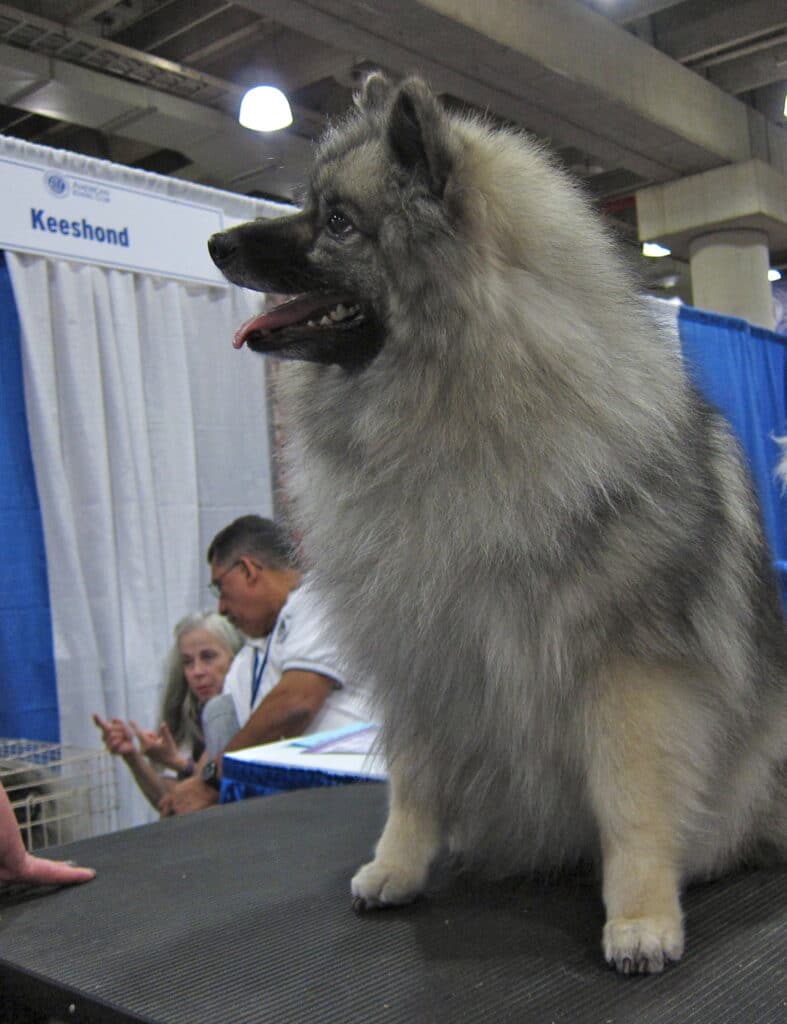
The Keeshond is a medium-sized Spitz-type dog with a silver-gray double coat and that unmistakable “smile” framed by so-called glasses. Originally from the Netherlands, where he watched the canal barges, the Keeshond is first and foremost a family companion: affectionate to the clingy, alert, warning bark and deeply attached to his people. If you’re looking for a dog that follows you from room to room and participates in home life, this breed interests you.
Is the Keeshond for you?

Before you fall in love with his teddy bear face, be honest: the Keeshond is a dog with a strong personality wrapped in a manageable body. His greatest virtue and his greatest demand are the same thing, the need to be with you. Here’s the cold summary.
In favour .
- Exceptional companion: loyal, affectionate and very close to his family.
- Comfortable medium size, floor-worthy if given company and exercise.
- Very intelligent and willing to please: he learns fast and enjoys training.
- Great with kids and usually sociable with other dogs.
- Excellent warning dog: warns of anything new without being aggressive.
- Coat resistant to cold and rain; well adapted to cold climates.
To be taken into account
- He tends to be a “velcro dog”: he’s bad with prolonged loneliness.
- Barking by nature; unmanaged, it can become annoying.
- Double coat that lets loose a lot of hair in the seasonal seedlings.
- It needs regular brushing and should never be shaved.
- The intense heat affects him more than the cold.
- Their intelligence demands stimulation: bored, they can do mischief.
Character and temperament
If we had to define the Keeshond in one word it would be linked. This breed develops an intense attachment to its people, so much so that in English they are affectionately called “velcro dogs” or “the shadow of their owner”. A Keeshond will rather sit and wait behind a locked door than stay with strangers in another room. He’s not an independent dog or distant: He wants to be a part of everything you do.
He’s playful, quick-witted and has a remarkable jumping ability. But what most surprises those who live with one is their sensitivity. They are intuitive and empathetic dogs, sensing the mood of the home and reacting to it, which is why they are often used as therapy and comfort dogs. The most well-known case is that of Tikva, a Keeshond who was at Ground Zero after the 9/11 attacks helping to comfort rescue teams.
In terms of intelligence, the Keeshond ranks 18th in Stanley Coren’s The Intelligence of Dogs ranking, within the group of excellent work intelligence and obedience. He learns very quickly, which is a blessing and a warning: He also learns quickly what we didn’t want to teach him. He is alert, observant, and suspicious of strangers at first, making him a reliable alarm dog. He ‘s not an aggressive guard dog . Warn, do not attack.
Coexistence: children, other pets, flat and loneliness
The Keeshond is, above all, a family dog.
- With children: loves children and is an excellent family dog. Its medium size and balanced character make it a good playmate, always with the reasonable supervision any dog deserves.
- With other dogs: usually gets along well with other dogs and enjoys running with them.
- With other pets: usually adapts well to coexistence with other animals, especially if it grows up with them.
- On the floor:‘s medium size makes it suitable for apartment living, provided it receives daily walks and exercise.
- In the face of loneliness: here is its weak point. The Keeshond has trouble staying alone for long hours. A specimen relegated to the garden, away from its people, becomes unhappy and can become a compulsive barker. It is a household dog where it does not spend the whole day alone.
Education and training

Few breeds are as grateful to educate as the Keeshond. It combines high intelligence with a genuine desire to please, a blend that makes learning flow. In fact, their docility and fitness are such that Keeshonden have been trained as guide dogs for the blind; only their lack of size has prevented them from being used further in that role. In agility and obedience, they perform wonderfully.
The keys to harnessing that potential are simple. Always bet on the positive reinforcement: rewards, play and praise. Because it catches your mood right away, hard methods are counterproductive and only manage to close it. Start the socialization and management from puppyhood, because some may show destructive tendencies at first that are easily corrected if you work early.
The great chapter in training a Keeshond is the control of barking. It is a born barker and it is advisable to teach it from the first day to be silent to the order and not to react to every stimulus. It is not a matter of silencing its warning instinct, but of channeling it. And, given how quickly it learns, it is careful not to reinforce unintentionally behaviors that later it is difficult to remove.
Exercise and activity
The Keeshond is an active dog, but not an extreme endurance athlete. It needs daily exercise to stay fit and balanced, as it tends to gain weight easily if it leads a sedentary lifestyle. A couple of walks a day, playing moments and the possibility of running in an open space cover its needs well.
More important than quantity is moderation and company. It is advisable not to force it too much, especially a puppy, to take care of its joints, since the dislocation of the kneecap is one of the ailments to which the breed can be prone. And since he’s such a people-oriented dog, the exercise that really fills him up is the one he shares with you: A walk by your side is worth more than hours alone in the garden. Being so intelligent, it also appreciates mental exercise, olfactory games, interactive toys, and obedience sessions or tricks.
Care: fur and hygiene

The coat is the Keeshond’s hallmark and its main chapter of care, although it gives less work than its volume suggests. It’s a double layer: a long, straight, rough outer hair that rises above a woolly, dense undercoat. The recommended technique is brushed in lines(line brushing), separating the hair by layers to reach the base, regularly. A good weekly routine keeps the coat healthy and untangled.
During this period, the hair loss is spectacular and the guard hair is crushed against the body; the process usually lasts about two weeks until the new subhair begins to grow.
A golden rule: a Keeshond should never be shaved.. Its undercoat acts as a natural insulator against both cold and heat, and shaving it destroys that protective function and can damage the quality of the coat in the future. Keeping the hair in good condition is precisely what allows it to regulate its temperature. The rest of the hygiene is the usual: ear checks and cleanings, nail trimming and regular dental care.
Foodstuffs
The Keeshond has no exotic dietary requirements, but a clear tendency to gain weight, so the control of rations is the critical point.
Watch the scale and the silhouette more than the label: adjust the amount to your energy expenditure and moderate the rewards, especially if you train a lot (take them off your daily allowance). Not only does being overweight make you less agile but it puts a strain on joints that need to be protected. Fresh water is always available and, if you have any questions about quantities, special diets or feed changes, it is best to consult your veterinarian.
Health and life expectancy
The Keeshond is, in general, a very healthy and robust breed, with few congenital problems compared to other breeds. A British study from 2024 placed its life expectancy at around 12 years, in line with the average of purebred dogs; with good care many specimens reach more advanced ages.
That said, there are some ailments that have been described in the breed that are worth knowing:
- Dysplasia of the hip and dislocation of the kneecap(the “jumping knee”), joint problems.
- Epilepsia.
- Primary hyperparathyroidism (PHPT): hormone disorder for which a reliable genetic test has been developed at Cornell University.
- Hipotiroidismo, cushing’s disease and it’s called diabetes.
- He had von Willebrand’s disease.(a bleeding disorder), known in the breed but very rare.
The best prevention starts before you have a puppy: buy from a responsible breeder who has tested the parents and can show that they are free of hereditary problems.
Physical appearance
The Keeshond is a compact, well-built dog of the spitz type, of medium size and square silhouette. The height at the withers is around 43 to 46 cm and the weight is usually between 14 and 18 kg, with the males somewhat larger than the females.
The head is conical, with a muzzle of medium length and a well-defined stop, small, triangular and erect ears, and dark, almond-shaped and slightly oblique eyes with black edges.
Color is the characteristic mixture of gray and black with some white. The undercoat is very pale, light gray or cream; the outer coat bears the black tips, and the length of those tips creates the typical shading of the breed. The hair collar around the neck (more marked in males) and the “pants” of the hind legs are usually lighter than the body. The legs and feet are cream. But the quintessential brand is the “gafas”: a thin, dark line that runs from the outer corner of each eye to the ear, accompanied by a few sharp eyebrows, drawing that intelligent, smiling expression so much like yours. The absence of glasses is considered a serious flaw in the standard.
Origin and history
The Keeshond owes its name to Cornelis (Kees) de Gyselaer, an 18th-century Dutch patriot who led the rebellion against the House of Orange in the years before the French Revolution. The dog became the symbol of the patriotic faction, and the word “keeshond” is actually a compound: Kees, short for Cornelis, and swedish, “dog” in Dutch. When the House of Orange regained power, the race, tied to the losing cause, was on the verge of extinction.
Prior to this political role, the Keeshond was known as Dutch Barge Dog, the barge dog: it watched over boats that traveled the canals and rivers of the Netherlands, barking to warn of any news.
The rebuilding of the race was a matter for several countries. In Germany, the first Wolfspitz standard was presented at the Berlin dog show in 1880; the German Spitz Club was founded in 1899 and in 1901 set the characteristic color “silver gray with black tips”. In the 1920s, Baroness van Hardenbroeck became interested in the breed in the Netherlands and began to recover it; the Nederlandse Keeshond Club was born in 1924. In England, Mrs. Wingfield-Digby founded the Dutch Barge Dog Club in 1925, and the following year the British Kennel Club accepted it, at which point both the club and the breed became known as the Keeshond. In the United States, thanks to the work of amateurs such as Carl Hinderer, the American Kennel Club officially recognized the breed in 1930.
Here comes a curious peculiarity: Although the Anglo-Saxon history claims the Dutch origin of the Keeshond, the International Cinological Federation (FCI) frames it within the family of the German spitz, along with the Pomerania and other spitz, in group 5 (dogs of spitz type and primitive type). For years the FCI did not recognize it as a separate breed of Wolfspitz because it considered them identical; in 1997 the German Spitz Club updated its standard to include the Keeshond, somewhat smaller, which was preferred in English-speaking countries, finally unifying the standard at the international level.
Curiosities
- The smiling Dutchman. Because of his friendly expression and amiable nature, the Keeshond is nicknamed “The Smiling Dutchman”.
- Glasses are compulsory. That dark line from eye to ear is not an aesthetic whim: the standard demands them, and their absence is a serious defect.
- A dog with a politician’s name. The breed is named after Kees of Gyselaer and was the emblem of the Dutch patriots facing the House of Orange.
- Dog of the barges. Its former name, Dutch Barge Dog, is reminiscent of centuries of watching over the vessels of the Dutch canals.
- Comfort him at Ground Zero. Tikva, a Keeshond, helped comfort rescue teams after the 9/11 attacks.
- Almost a guide dog. Their intelligence and docility allowed them to be trained as guide dogs; only their insufficient size prevented their wider use in that role.
- Distinguished kinship. Its closest relatives are the German Spitz, such as the Pomeranian, and it shares roots with Arctic dogs such as the Samoyed or the Chow Chow.
If you are attracted to the Keeshond’s spitz temperament, you may want to compare it with other breeds in the same family and with Nordic roots. Its most direct relative is the Pomerania, a miniature German spitz; among the great arctic whites stands out the Samoyedo; the Chow Chow shares that bear air and dense mantle; and, within the working spits, the Norwegian moose hunter is another wakeful-character cousin. For a white spitz directly related to the Keeshond lineage, check out also the Perro Esquimal Americano.
Frequently Asked Questions about the Keeshond
Does the Keeshond bark a lot?
Yes, it is a born barker: for centuries it was a warning dog on barges and retains that instinct. It warns of any novelty, although it is not aggressive. With early education to silence the order and, above all, without leaving it alone and bored, the barking is kept under control.
Can he live in a flat?
His medium size makes him suitable for an apartment as long as he gets daily walks and exercise and, above all, company.
Do you lose a lot of hair?
It has a double coat and “loosens” the undercoat in intense moults, once a year in males and twice in females, with a very abundant loss for about two weeks.
Can you shave the Keeshond in the summer?
No. It should never be shaved. Its undercoat insulates from both cold and heat, so shaving is counterproductive and can damage the coat. For the summer, a good brushing is enough to remove the dead undercoat and to avoid the hottest hours.
Is he good with kids?
It loves children and is an excellent family dog, balanced and playful. As with any dog, it is advisable to monitor the interaction and teach the younger ones to respect it.
How long does a Keeshond live?
It’s a healthy, long-lived breed. A British study from 2024 estimated its life expectancy at around 12 years, in line with the average for purebred dogs, and with good care many exceed that figure.
Is it easy to train?
Yes, it’s one of the easiest. It ranks 18th in Stanley Coren’s intelligence rankings and has a great desire to please. It responds wonderfully to positive reinforcement and excels in obedience and agility. Of course, it learns so quickly that it also picks up on what you didn’t want to teach it.
Is the Keeshond Dutch or German?
Both things, depending on who you ask. The Anglo-Saxon tradition considers it Dutch (the Dutch Barge Dog), while the FCI classifies it within the German spitz family, in group 5. In 1997 the international standard was unified including the Keeshond alongside the Wolfspitz.