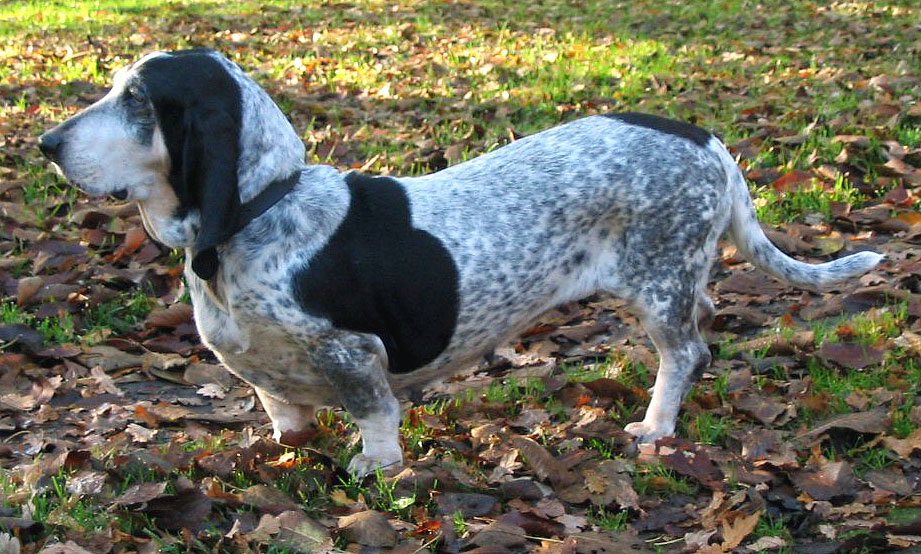
The Blue Basset from Gascony(French Of a fat content, by weight, in the dry matter) is a French hound with short legs and a long back, easily recognizable by that white coat so mottled in black that, seen from far away, it seems to be dyed blue. It is a trail hunting dog, with a prodigious nose and powerful voice, today rare outside its native Gascony. If you are looking for a companion who is quiet at home but tireless when there is a smell to follow, you will find in the Basset Bleu de Gascogne a breed with a lot of character in a small body.
Is the Blue Basset of Gascony for you?
Before you fall in love with those long ears, you should understand what kind of dog it is. The Gascony Blue Basset is a pack dog, bred for centuries to track and warn with its voice, not a saloon dog. It marks his day-to-day: He’ll want to use his nose, bark or howl eagerly, and when he catches an interesting scent, his instinct will outweigh your call. In return, he is gentle, sociable and non-aggressive. Here’s the honest summary.
In favour .
- Kind, balanced temperament and very sociable with people and other dogs.
- Handled size: a real hound in small-to-medium size.
- Short, straight hair that barely needs maintenance.
- Resilient and enjoys the countryside; loves to track and explore.
- Good with kids if the coexistence is respectful.
To be taken into account
- Strong voice: barking and howling; not ideal for a flat with sensitive neighbours.
- Nose that commands: with a trace it disconnects and can escape.
- Stubborn and stubborn in education; he needs patience.
- Long ears and a predisposition to overweight that require vigilance.
- It’s a rare breed. It’s hard to find serious breeders outside France.
Character and temperament

The Blue Basset de Gascogne is, first and foremost, a pack dog, and that explains almost everything it does. It is a kind, quiet at home and deeply sociable dog: bred to work side by side with other dogs and with the hunter, does not understand life alone and rarely shows aggressiveness.
That sweetness coexists with a independent and stubborn background. When the nose gets to work, the dog enters its world and stops hearing you; it’s not capricious disobedience, it’s genetic: it’s been selected for centuries not to leave a trace. Hence its reputation for being stubborn, which is actually an enormously misunderstood concentration capacity.
The other unmistakable trait is the the voice. Like a good hound, it barks and, above all, howls with a deep, melodious tone that served to warn hunters at a distance. It is an expressive dog that communicates with sound, something charming in the field and problematic in a block of flats.
Coexistence: children, other pets, flat and loneliness
With children:‘s patient and playful nature makes it a good companion for the little ones, always with the usual rules of respect: do not disturb him while he eats or sleeps and supervise the game.
With other pets: shines here. Accustomed to living in packs, it usually gets along well with other dogs and appreciates canine companionship. With cats and small companions the thing changes: its instinct for tracking is very alive, so coexistence with rabbits, ferrets or cats requires early socialization and, still, caution.
On the floor:‘s size would fit, but its tendency to vocalize and its need for activity and smell make it happier in a house with a garden or with very active owners.
Soledad: is its weak point. A pack hound suffers from being alone for many hours; boredom results in howling, wrecking and an unhappy dog. It is not a breed for someone who spends the day outside without companionship for the dog.
Education and training
Training a Gascony Blue Basset is an exercise in patience and good humor. It is an intelligent dog, but its intelligence is oriented to tracking, not to pleasing the human: it will do what you ask if it is rewarded and interested. The positive reinforcement with appetizing prizes is, without a doubt, the way; harsh methods only get it to close in on the band.
The absolute priority is the called, and it is advisable to assume from the beginning that it will never be perfect. As soon as a powerful smell enters the scene, its head disconnects. That is why it is recommended to work the call constantly, reward it a lot and, outside fenced and safe areas, keep it with a long leash. To trust the one hundred percent in its obedience in the open air is to ask pears from the elm.
Taking advantage of his passion for food and smells, socializing him early with different people, dogs, and environments, and being very patient with his stubbornness are the keys to a well-behaved, balanced adult.
Exercise and activity
The fact that it has short legs does not fool anyone: this is a field dog with a remarkable physical background. It was bred to spend hours following a trail over difficult terrain, and that endurance is still there. It needs real daily exercise: long walks, exploratory moments with its nose glued to the ground and, if possible, space to run safely.
Even more important than physical fatigue is the olfactory stimulation. A walk in which you can smell at your own pace satisfies you more than a monotonous run. Tracking games, hiding food or olfactory-based sports disciplines are ideal for channeling your instinct and leaving you mentally satisfied.
Of course, you should respect his body. Because of his basset morphology, you have to avoid repeated jumps and abrupt descents of stairs or furniture, especially puppy, to take care of his long spine. Exercise yes, and a lot, but the right type for an elongated and strong bone dog.
Care: fur and hygiene

As for the coat, the Basset Azul de Gascogne is low maintenance. Its short, smooth and thick hair is content with a weekly brushing to remove the dead hair and distribute the natural fat that gives the mantle shine. It does not require hairdressing or cuts, and baths only when really needed, because it returns from the muddy field often.
The real attention is on the ears. Those long, thin, sloping ears, which reach at least to the tip of the snout, cover the ear canal, hold moisture and are a magnet for infections. They need to be checked and cleaned regularly, and dried well after baths or wet days. It is, next to weight, the most important care of the breed.
They complete the routine as usual: checking and cleaning the eyes(their somewhat loose facial skin can accumulate wounds), frequent tooth brushing, cutting nails when they hit the ground and daily antiparasitic prevention, especially if you go out in the mountains.
Foodstuffs
The keyword on the Gascony Blue Basset’s table is control. Like many hounds, it is an avid eater capable of eating far more than it needs, and its short-legged structure and long back suffer especially from overweight.
It is advisable to offer him a i think it’s a quality diet. adjusted to his age, weight and activity level, divided into measured rations and, better, in two servings a day.
The best thermometer is its silhouette: you should be able to feel the ribs without seeing them and appreciate its waistline. When in doubt, it is the veterinarian who should set the specific amount. Keeping it thin is probably the healthiest thing you can do for this dog.
Health and life expectancy
The Basset Azul de Gascogne is, in general, a rustic and robust dog, the result of a selection oriented to work rather than extreme aesthetics.
That said, it shares the weaknesses of basset hounds, with its elongated body and sloping ears.
- Back and spine:‘s chondrodystrophic morphology (long body, short legs) predisposes it to intervertebral disc problems; hence the importance of avoiding jumps and overweight.
- Oídos: long, closed ears promote otitis and infections if not hygienized.
- Ojos: somewhat loose facial skin may be associated with inverted or everted eyelids and irritations, as in other hounds.
- Sobrepeso: is not a disease, but it aggravates all of the above and is the factor that depends most on you.
As with any small breed, going to a responsible breeder selected for health and temperament, along with regular veterinary checkups, is the best guarantee of a long and healthy life.
Physical appearance
The Gascony Blue Basset is a small hound of typical basset construction: long body and short legs, but without being heavy or excessively short.
His trademark is the coat: Short and smooth hair on a white background, intensely mottled or dotted with black until giving that characteristic bluish appearance at a distance that gives the breed its name. On this basis, black spots and some very recognizable fire marks(Leonado) appear: Two above the eyes – the classic “four eyes” of Gascony hounds – on the cheeks, inside the ears and on the limbs.
The head is elongated and noble, with dark brown eyes looking sweet and somewhat sad, and thin, coiled and low-inserted ears, so long that they reach at least the end of the snout.
Origin and history

The origins of the Basset Azul de Gascogne sink into the Edad Media. It is directly descended from the former Large Blue Hound of Gascony(Grand Bleu de Gascogne), one of the most venerable French hound breeds, from which it took the bluish coat and passion for the trail but in a short-legged version, designed for slower hunting and on foot.
Gaston III of Foix-Béarn, known as Gaston Phoebe and author of the famous Free of chasse– one of the great medieval hunting treatises – is said to have kept packs of these blue hounds to hunt wild boars and wolves.
The big stumble came on the 19th century: With the decline of certain hunting modes, the Blue Basset was on the verge of extinction. Their recovery is attributed to the work of Alain Bourbon, the breeder who rescued and rebuilt the breed in the early 20th century. Today it is recognized by the Fédération Cynologique Internationale(group 6, hounds), by the British Kennel Club as an imported breed and by the American United Kennel Club since 1991, although it is still rare outside France.
Curiosities
- The “azul” in its name is an optical effect: there is no blue hair, but a dense mix of black and white that the eye interprets as a bluish hue at a distance.
- The two fire marks over the eyes give it the dog nickname “four eyes”, a trait shared by the entire Gascony blue hound family.
- It is one of the six types of basset recognized by the FCI, alongside neighbours such as the Basset Leonado of Brittany or the Vandean griffins.
- It should not be confused with its relatives: neither the Blue griffin of Gascony(hard-haired) nor the Little Blue Hound of Gascony are the same breed.
- Despite its international recognition, is not recognized by the American Kennel Club, which gives an idea of how minor it still is.
If you are attracted to this short-legged French Hound, you may want to compare its character with that of other related breeds before deciding. You may be interested in the unmistakable silhouetted close cousin Basset Hound; the tracker par excellence, the Bloodhound; the ever-cheerful Beagle; and the stylish Cocker Spaniel, another companion dog with long ears.
Frequently asked questions about the Gascony Blue Basset
Does the Gascon Blue Basset bark a lot?
Yes. It is a pack dog with a powerful, melodious voice, and both barking and howling are part of its nature. It warns, expresses and “sings” when following a trail. That is why it is not the most comfortable breed for a floor with noise-sensitive neighbors.
Is he a good family dog?
It is friendly, quiet at home, sociable and not aggressive, and usually gets along well with children and other dogs. Its only requirement is companionship and activity: it suffers from prolonged loneliness and needs daily exercise and smell.
Can you let go without a leash?
With caution, its tracking instinct is so strong that, at the sight of an interesting odor, it stops responding to the call and may move away.
How much exercise do you need?
More than its size suggests. Although it has short legs, it is a hardy country dog that needs long walks and, above all, opportunities to use its nose.
How long do you live and what health problems do you have?
Their life expectancy is estimated to be around 12-14 years. Like other bassets, it is advisable to monitor the back (intervertebral discs), long ears (otitis), eyes and, especially, overweight, which aggravates everything else.
Is it hard to educate?
It’s intelligent but stubborn and independent, with the nose as its priority. It’s not the easiest dog for a demanding beginner with obedience. With positive reinforcement, rewards, short sessions and a lot of patience it grows up well, assuming the call will never be perfect.
What kind of hair care do you need?
Their hair is kept short and smooth with weekly brushing and regular bathing. The key care is not the coat, but the long, fallen ears, which must be checked and cleaned regularly to prevent infection.
Why is it called “blue” if it’s not blue?
For a visual effect, their white coat is so mottled in black that, at a distance, the eye perceives a bluish tint.