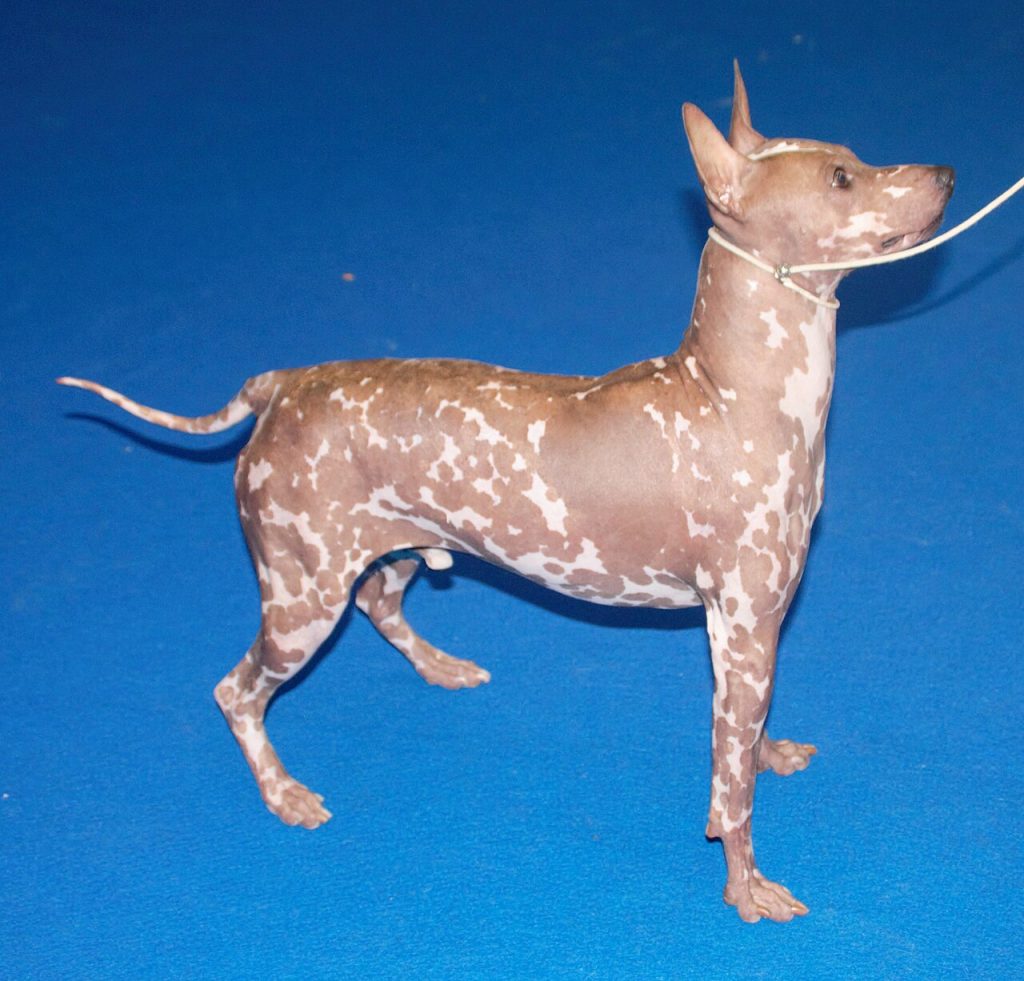
The Hairless American Terrier(American Hairless Terrier) is one of the very few hairless dogs born in the United States, and the only naked terrier in the world. Small, alert and very attached to his family, he retains all the cheerful and curious character of the mouse terrier from which he descends, but in a soft, warm-skinned version that asks for pampering, shade in summer and coat in winter. If you’re looking for a live-beetle roommate who barely lets loose his hair and goes out of his way to be with you, this breed deserves a thorough introduction.
Is the Hairless American Terrier for you?
Before you fall in love with its soft skin, be honest about what it’s like to live with a hairless dog. It’s not an aesthetic whim: its lack of fur changes how you care for it every day. Here’s the honest summary.
In favour .
- Barely loose hair: ideal for clean houses and for some allergy sufferers.
- Small and manageable, perfect for flooring.
- Very affectionate, sociable and attached to his people.
- Smart and alert: learns fast and enjoys the game.
- Long-haired and generally a rustic and healthy breed.
- It retains full teeth, unlike other bald breeds.
Against
- Their skin needs sunscreen in summer and a coat in winter.
- It’s sensitive to burns, scratches, dryness and small granite.
- He does not tolerate being alone for long hours: he gets bored and frustrated.
- Terrier energy: he needs daily walks and stimulation.
- Rare breed in Europe: hard to find serious breeders.
- Certain terrier stubbornness if he’s not educated with patience.
Character and temperament

The Hairless American Terrier is, above all, a companion terrier with the body of a working dog and the heart of a lap dog. He inherited from the mouse terrier that unmistakable spark: he is attentive to everything, he is interested in every noise of the gate and enthusiastically participates in the life of the house. He is curious, cheerful and quite talkative in his own way, always aware of what his family is doing.
Where it really shines is in the attachment. This breed was bred to live attached to people and it is noticeable: it seeks contact, lap and human warmth (literally, because without hair it thanks the body of its owner).
Although not a particularly barking or aggressive dog, it also maintains a certain minor hunting instinct, more playful than serious, which emerges chasing balls, insects or leaves dragged by the wind.
Coexistence: children, other pets, flat and loneliness
As a family companion it is a hit. With the children it is wonderfully understood for its playful and patient character, although it is advisable to teach the youngest to treat it carefully: its naked skin scratches and irritates easily and a rough game can hurt it.
other pets usually gets along well, especially if you grow up with them. It accepts other dogs and can live with cats; of course, remember that hunter point of its mouse heritage: with small rodents, hamsters or birds it is not the best company and it is better not to tempt luck.
In floor it feels like a fish in the water. It is small, clean and quiet at home when it has spent energy. What does not take anything well is the loneliness: it is a companion dog in the strictest sense and, if it spends many hours alone daily, separation anxiety, barking or destructive behavior may appear. It needs to be part of the day to day, not stay in ornament.
Education and training
We are dealing with a dog that is intelligent and eager to please, a combination that makes basic training easy. It quickly learns routines, manners and tricks, and enjoys sessions if they are presented to it as a game. The key is the positive reinforcement: rewards, a kind voice and consistency work infinitely better than screaming, which only get it to close in on the band.
It is not disobedient, but it likes to negotiate and is bored with mechanical repetition, so it prefers short, varied and fun sessions. The early socialization with people, dogs, noises and different environments is highly recommended so that this alert point does not lead to nervousness or excessive barking.
Because of his mental acuity, he enjoys olfactory games, interactive toys, and little challenges, keeping his head busy is as important as tiring his legs.
Exercise and activity

Just because it’s small doesn’t mean it’s a couch dog: inside it beats a terrier full of energy. It needs several daily walks, playtime and, if possible, space to run without a leash in a safe place. A couple of quiet outings aren’t enough for it; it appreciates moving, exploring and releasing adrenaline.
It’s a great candidate for canine sports of its size: agility, flyball, obedience or simple seek-and-bring games.
This is where their skin comes in again: on sunny days, it’s best to walk in the first and last hour to avoid burns and heatstrokes; in winter, with cold or rain, cover it and shorten the outlets if you patch it.
Skin care and hygiene
Here’s the big difference in this breed. Forget the brush and be prepared to care for the skin as you would care for your own. Without hair to protect it, it’s exposed to sun, cold, dryness and minor wounds, so skin hygiene completely replaces traditional brushing.
- Baños: periodic but untreated, with mild shampoos; the skin produces grease and may accumulate dirt and blackheads if neglected.
- Hidratación: creams or oils suitable for dogs if the skin is dry, avoiding products that clog pores.
- Sol: canine sunscreen in exposed areas and shade in summer; burns are a real risk.
- Frío: winter sweaters and coats, indoors and outdoors if necessary.
- Granite and pores: it is normal for small comedones to appear; a gentle cleaning routine keeps them at bay.
The rest of the care is that of any dog: checking and cleaning the ears, cutting the nails and maintaining good dental hygiene.
Foodstuffs
It has no exotic requirements for being bald, but it is advisable to take care of its diet. It needs a complete and of high quality food, adjusted to its small size, its age and its activity level. Being an active dog burns energy well, although rations must be measured to avoid overweight, which in small dogs takes a toll on joints and heart.
A diet rich in fatty acids (omega-3 and omega-6) helps keep the skin healthy and elastic, something especially valuable in this breed.
Health and life expectancy
As a whole it is a rustic and long-lasting breed, with a life expectancy usually placed between 14 and 16 years. An important genetic advantage: its absence of hair comes from a recessive gene different from that of other hairless breeds, so it does not carry the dental problems associated with baldness of the Xoloitzcuintle or the Chinese Crested and retains a complete denture.
The big weak point is, as expected, the skin. Without hair to protect it, the dog is vulnerable to sunburn in summer and hypothermia in winter, so protection from cold and sun is not a luxury, but part of its health. Dermatitis, dryness or granitis may also appear if hygiene fails.
Like all breeds, it can inherit some predispositions (problems of knee or eye dislocation, among others), so it is advisable to go to responsible breeders who perform health tests, keep veterinary reviews and the schedule of vaccinations and deparasitisation up to date.
Physical appearance

The Hairless American Terrier is a small, compact and athletic dog, with a silhouette that betrays its kinship to the mouse terrier.
Their ears are erect and very expressive, and their tail can be naturally short or long, but it is never amputated. The most striking feature is, of course, their skin: the puppies are born covered in a thin fluff that is lost from the snout backwards until they are completely naked by six weeks, sometimes retaining eyebrows and whiskers.
The skin can be of any color and is usually mottled, with freckles that enlarge with age, giving rise to specimens of unique appearance.
Origin and history
The history of this breed is one of the most curious in the canine world and starts by pure genetic chance. In 1972, in a litter of purebred rat terriers (Rat Terrier) a completely bald female was born. That dog, dubbed Josephine, was adopted by Willie and Edwin Scott in Louisiana (United States), who were fascinated: It was identical to a mouse terrier in every way, except for its lack of hair.
The Scotts decided to raise her. Their first litter produced another hairless female, Gypsy, but years passed without new bald cubs. 1981 had to wait until nine-year-old Josephine gave birth to two naked cubs, a male and a female. In 1983, that male, Snoopy, interbred with his bald sisters and from there was finally born a wide litter of hairless dogs: The founding nucleus of the new race.
They were initially registered as a hairless variety of the mouse terrier, but the Scots eventually gave them their own name and founded a club, the American Hairless Terrier Association. Official recognition came in time: The United Kennel Club (UKC) accepted them as an independent breed in 2004, and the American Kennel Club (AKC) did the same in 2016, placing them in the Terrier group. The FCI, on the other hand, does not recognize it yet, which explains its rarity outside the United States.
Curiosities
- It is the world-renowned only hairless terrier and one of the few bald breeds native to the United States.
- Its baldness is due to a recessive gene, different from the dominant gene of other hairless breeds; therefore, it does not suffer from the lack of teeth associated with those.
- The entire breed descends from a single dog, Josephine, born bald by a spontaneous mutation in 1972.
- There are two varieties: the hairless and the with hair, both recognized within the same standard.
- Having no fur, sweat through the skin, something very unusual in dogs.
- It is often mistaken for a hairless Chihuahua, but it is a terrier of very different body and character.
If you are attracted to this small, hairless terrier, you may be interested in other small, lively, family-oriented breeds. Take a look at the Yorkshire Terrier, another tough and characterful terrier; the Chihuahua, with whom it is sometimes confused; the unmistakable Dachshund or Teckel; or the Bulldog Francés, another great roommate.
Frequently Asked Questions About the Hairless American Terrier
Is the Hairless American Terrier hypoallergenic?
There is no dog that is 100% hypoallergenic, but because it has no hair and releases very little dandruff, it is usually better tolerated than other breeds by people with mild allergies.
Do you need sunscreen and a coat?
Yes, and it’s not optional. Their naked skin burns in the sun like ours, so in summer they need shade and sunscreen suitable for dogs in exposed areas. In winter it gets really cold: a coat or sweater on walks is almost mandatory.
Is he a good dog for the floor?
For its small size, its cleanliness and its attachment to the family it adapts very well to a flat, provided you give it several walks a day, play and company.
Do you get along with the kids?
In general, yes: affectionate, playful, and very sociable. It is advisable to supervise play with small children for two reasons: their small size and, above all, their hairless skin, which scratches and irritates easily.
How long does a hairless American Terrier live?
With proper nutrition, exercise, and skin care, many dogs reach full health into old age.
Loose hair and stain the house?
The hairless ones barely leave a trace, while the hairy ones let very little loose, sweating through the skin and leaving small greasy marks on blankets or sofas, which are easily cleaned.
Does he have dental problems like other hairless breeds?
Unlike the Xoloitzcuintle or the Chinese Crested, whose baldness is linked to a dominant gene associated with toothlessness, in this breed the absence of hair is due to a different recessive gene.
Is it easy to train?
He’s smart, he’s sharp, and he likes to please, which makes it easy to learn, and he’s got the terrier-type headdress, so he works a lot better with positive reinforcement, short sessions and consistency than with hard handedness.