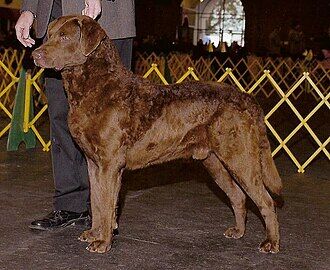
The Chesapeake Bay retriever is America’s water collector par excellence: A sturdy, brave, rain-proof-coat dog born on the icy shores of Maryland to retrieve ducks in near-frozen waters. He has a stronger and more independent personality than the Labrador or the Golden, and forges an intense, almost possessive bond with his family. It’s not the easy and complacent retriever of the topic: It’s a working dog with character that rewards those who can understand it. If you’re looking for a loyal, athletic, protective partner, this “Chessie” deserves your attention.
Is the Chesapeake Bay Retriever for you?

Before you fall in love with their athletic demeanor, be honest: the Chesapeake is not a “one-size-fits-all” retriever. It is a working dog with high energy, willpower, and a strong guarding instinct. It shines in the hands of experienced, active people, and can frustrate those who expect immediate docility from other collector breeds. Here’s the balance:
In favour .
- Loyal and deeply attached to his family; a natural guardian without the need for specific training.
- Tireless water athlete: swimming, diving and enduring the cold like few races.
- Intelligent and resolute; he learns quickly what motivates him.
- Low-maintenance waterproof fur, no cuts or hair.
- Resilient and rustic, designed to work hard for hours.
- Courageous and balanced: with good socialization he is sensible and not nervous.
Against
- Independent and stubborn; not a dog for beginners.
- He needs a lot of exercise and mental work every day or he gets bored.
- He can be reserved or territorial with strangers if he doesn’t socialize well.
- Their fur is loose and gives off a characteristic mild musky smell.
- It requires water, space and time; it suffers in small apartments and prolonged loneliness.
- Tendency to bond with a “leader” owner and to defy those who do not impose respect.
Character and temperament
Temperament is what sets the Chesapeake Bay Retriever apart from other collectors. It shares with them joy, intelligence, and a love of water, but it adds a layer of self-confidence, independence, and protection that brings it closer to a utility dog than a classic retriever. It is a bright, sensible dog, affectionate with its owners, and remarkably balanced when well reared.
With his people he develops an intense attachment. He is not the dog that extravagantly greets everyone who comes through the door; he reserves his delivery for the family and watches strangers with some caution. That protective nature makes him an excellent watcher, alert to anything out of the ordinary, though rarely aggressive without reason. Some specimens are assertive and willing; others, more passive and sociable. Early socialization largely determines which way each dog leans.
A delightful curiosity about the breed is its “smile”: many Chesapeake show their front teeth in a kind of grimace when they are happy. It is not a threat, but a gesture of joy or submission that surprises those unfamiliar with the breed. Combined with their fondness for “talking” with growls and sounds when they are happy, the Chessie is an expressive dog with a lot of personality.
Coexistence: children, other pets, flat and loneliness
- A well-socialized With children: is a tolerant and protective companion for the children in the family. Its size and energy advise to supervise play with the little ones, and it is advisable to teach children to respect their space. It is not a dog as automatically “child swallower” as the Labrador: it asks for careful introductions.
- With other dogs: can coexist without problems if grown accustomed, but its dominant nature makes some males territorial with other dogs of the same sex.
- With other pets: retains a strong hunting and prey instinct. It usually gets along well with cats it has been raised with; with small, unfamiliar animals, its instinct may fire.
- On the floor: is not its ideal environment. It is a large, active dog designed for the outdoors; it fits much better in a house with a garden and, above all, with frequent access to open spaces and water.
- In the face of loneliness:‘s close bond with family makes him unable to cope with isolation, a bored Chesapeake who only easily develops destructive behaviors or vocalizes excessively, needs companionship, encouragement, and a role to fulfill.
Education and training

The Chesapeake is very intelligent and learns very quickly, but that intelligence comes with its own judgment. Historically it was considered stubborn and difficult to train, and many ancient manuals recommended “hard hand”. Today we know that approach is counterproductive: The Chessie doesn’t respond well to coercion and can crash or disconnect if you press it. The key is consistency, not toughness.
A short, consistent daily obedience routine, interspersed with play before and after, works very well to keep your motivation alive. Positive reinforcement, clarity in rules, and an owner who earns their respect without resorting to physical punishment yield the best results. Because he learns quickly, he also memorizes bad habits quickly: consistency among all family members is essential.
It is a tremendously versatile breed. It competes and excels in field trials, hunting tests, obedience, agility, tracking and conformation, without ever losing its tough collector essence. Channeling your mind and body into one of these activities is the best way to have a happy and educated Chesapeake.
Exercise and activity

There are no shortcuts here: the Chesapeake Bay Retriever is a high-endurance dog that needs vigorous exercise every day. It was bred to swim for hours in cold water, break ice with its chest, and dive to retrieve pieces; a short walk around the block is no use to it. Without adequate physical outlet, its energy turns to frustration, shattering, and stubbornness.
The ideal combination of physical and intellectual activity: long walks or runs, collecting games (its natural passion), olfactory work and, above all, swimming. Water is its element: swimming with extraordinary power and resistance thanks to its palmed fingers and deep chest. If you have access to a safe lake, river, beach or pool, you will have a fully realized dog.
Disciplines such as hunting dummy, agility, canicross or charging tests are perfect to keep you in shape and with your head occupied.
Care: fur and hygiene
One of the great advantages of the Chesapeake is its low maintenance, provided you respect the nature of its coat. It has a double layer designed for cold water: a short, hard outer coat, slightly greasy to the touch, on a woolly, dense undercoat. That natural oil is what repels water and keeps the dog dry and warm, so the goal of care is to preserve it, not eliminate it.
A good weekly brushing with a short toothbrush is enough to remove dead hair and keep the coat healthy. As for the bathroom, less is more: It is recommended to bathe it only every three or four months with a mild shampoo and dry it well afterwards. Overwashing or using harsh products ruins the texture of the coat because it drags away the protective oil and can even remove the undercoat, leaving it unprotected from cold and water.
It is important to know that the Chesapeake loses hair, especially on the moles, and that its coat gives off a characteristic and slight musky smell, normal in the breed.
Foodstuffs
As a large, athletic, high-energy dog, the Chesapeake needs a high-quality diet tailored to its actual activity level. A hunting or highly athletic dog burns much more energy than a companion dog, and the diet should reflect this: neither more, which favors overweight and dysplasia, nor less, which reduces its performance and musculature.
The wise thing is a complete and balanced feed or diet, rich in high-quality protein, divided into two daily servings in the adult to reduce the risk of gastric torsion, common in large breeds with deep breasts. Avoid strenuous exercise just before and after eating for the same reason. In the puppy, a specific food for large breeds helps a controlled growth that protects its joints. Always keep fresh water available and monitor your weight regularly: You must notice the ribs without seeing them marked.
Health and life expectancy
The Chesapeake Bay Retriever is, in general, a rustic and hardy dog, the result of generations bred for hard work. Their life expectancy is around 10 to 13 years: British surveys put the median at around 10.5-11 years, while a study by the breed club in the United States lowered it to about 9.4 years. As in many breeds, there are very long-lived specimens (one in four was over 13 years old in those data) and others that stay short.
It is a breed prone to several hereditary diseases that should be known and, above all, prevented by buying breeders who perform health tests on the breeders.
- Dysplasia of the hip: joint malformation common in large breeds; testing in parents reduces risk.
- Progressive retinal atrophy: degenerative eye disease that can lead to blindness.
- Cataratas.
- Type III von Willebrand disease is characterized by: is a blood clotting disorder.
- Exercise-induced collapse.
- Regional alopecia in both sexes.
- Degenerative myelopathy: The Chesapeake is one of the breeds most affected by this neurological disease of the spinal cord.
Regular veterinary checkups, weight control and a good breeder are the best tools for your Chessie to live a healthy old age.
Physical appearance
The Chesapeake is a medium to large sized dog, strong looking, balanced and clearly functional: Everything in it speaks of power and resistance in the water. Males measure 58-66 cm at the withers and weigh 29-36 kg; the somewhat smaller females measure 53-61 cm and weigh 25-32 kg. A peculiarity of its structure is that the hindquarters are at the same height or slightly higher than the cross, which gives it momentum when swimming.
Its most distinctive feature is its eyes, which are very bright yellowish or amber in color, separated and intelligent in expression. Its head is rounded and broad, with a medium stop and snout, small ears and high insertion. It has a broad and powerful chest, which in its original work used to break the ice when diving, and palmate fingers that make it an exceptional swimmer.
The cloak is its hallmark: double raincoat, with short, wavy outer hair on the shoulders, neck, back and back (never curly), and a woolly undercoat. It comes in three shades designed to camouflage itself in its hunting environment: brown, in all its ranges; sedge, from reddish-yellow to brown; and brown or “deadgrass”, from muted tan to straw. Some white is admitted limited to chest, abdomen and fingers.
Origin and history
The story of the Chesapeake Bay Retriever begins with a shipwreck. In 1807, off the coast of Maryland, an English ship carrying cod from Newfoundland drifted after a storm and was rescued by the American ship Canton. Among the survivors were two puppies: a male named Sailor and a female named Canton, described then as Newfoundland dogs, although more accurately they were St. John’s water dogs (the Lesser Newfoundland). George Law, who rescued them, left the account in writing years later.
Both pups ended up in different areas of the bay and, although it is not recorded that they had litters together, they did leave offspring that are very reputable as water dogs. They were crossed with local dogs always prioritizing working ability over appearance, incorporating contributions from spaniels and hounds. From this mixture, shaped by the demanding conditions of ice-water duck hunting, a unique collector emerged.
In 1877 dogs from both banks of the bay were recognized as one of the three types of “Chesapeake Bay Ducking Dog”. In 1918, the American Kennel Club recognized a single unified type, the Chesapeake Bay Retriever, and its standard has hardly changed since then. Its roots in Maryland are such that in 1964 it was declared the state’s official dog, an unusual honor. Today it is recognized by the major federations; in the FCI it is classified in Group 8 (Retrievers, hunting hounds and water dogs), Section 1 Retrievers, with standard number 263.
Curiosities
- It has been the official state dog of Maryland since 1964 and the mascot of the University of Maryland, Baltimore County (UMBC).
- Its flared fingers and deep chest make it one of the most capable swimming dogs in existence, capable of breaking ice and working in near-frozen water.
- Its coat is so impermeable that it is very difficult to wet it completely; the water slips over the oil in its outer layer.
- The Chesapeake’s famous “smile”, showing its front teeth, is not aggression but a display of joy unique to a few.
- Its historic owners include General George Armstrong Custer and President Theodore Roosevelt, as well as more recent figures.
- Unlike the Labrador, its coat has a characteristic mild musky odor and should not be washed excessively to avoid spoiling it.
If you’re drawn to the world of hounds and water dogs, you might be interested in comparing the Chesapeake to its closest relatives. The Labrador Retriever is its best-known and easiest-character cousin; the Golden Retriever stands out for its docility and sweetness; the New Scotia Duck Tolling Retriever is another North American duck collector with its own hunting technique; and the imposing Terranova shares ancestral roots with the Chessie and the same passion for water.
Frequently Asked Questions About the Chesapeake Bay Retriever
Is the Chesapeake Bay Retriever a good family dog?
It develops a very close bond with its owners and is protective, though more independent and reserved with strangers than other retrievers. It is not the best choice for first-time owners.
How is it different from the Labrador Retriever?
Although similar, the Chesapeake has a wavy, dense and oily coat (the Labrador is smooth), a stronger, independent and protective character, and is specialized in cold water collection.
How much exercise do you need?
It is a very resistant dog that requires at least one to two hours of intense activity daily, combining physical exercise (especially swimming and collectibles) with mental stimulation.
Is it hard to train?
It is very intelligent and learns quickly, but it has its own criteria and can be stubborn. It responds poorly to physical punishment and well to constancy, clarity and positive reinforcement. It needs a master who earns its respect with consistency, not harshness.
How long does a Chesapeake Bay Retriever live?
Their life expectancy is around 10 to 13 years. British surveys put the median at around 10.5-11 years, and an American study lowered it to about 9.4. With good care and a responsible breeder, many live past the age of 13.
What care does your fur need?
Very few: a weekly brushing with a short toothbrush and baths only every three or four months with a mild shampoo. Excessive bathing removes the protective oil that waterproofs its coat, so it is advisable to space them. It loosens hair and gives off a mild musky odor normal in the breed.
Can he live in a flat?
It is not ideal. It is a large and very active dog that performs best in a house with a garden and frequent access to water and open spaces. It can adapt to a floor only if it is guaranteed intense daily exercise and company, since it does not tolerate solitude.
Why do you like water so much?
It was bred to retrieve ducks in the icy waters of the Chesapeake Bay. Its double waterproof coat, flared fingers, and powerful chest make it an exceptional swimmer capable of working for hours and even breaking ice.