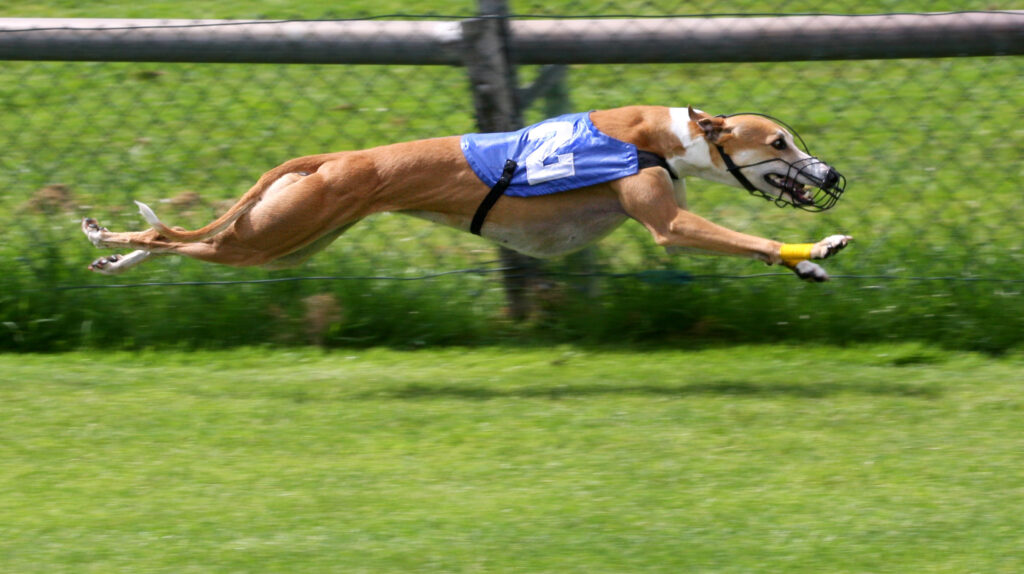
The Galgo Inglés(Greyhound) is the breed par excellence: The fastest land dog on the planet and also one of the quietest couchmates there is. Hiding behind its stylish, athletic figure is an affectionate, sensitive, silent animal that spends most of the day sleeping soundly. This comprehensive guide to the English Greyhound tells you, in no uncertain terms, what it’s really like to live with this millennial breed, what it needs and who it’s for (and who it’s not for).
Is the English Greyhound for you?
Many people imagine that a dog capable of running at almost 70 km/h needs hours and hours of daily exercise. With the English Greyhound, the opposite is true: he is a sprinter, not a runner. He needs only a couple of short, explosive runs to become satisfied and lie down again. Before deciding, honestly review his lights and shadows.
In favour .
- Quiet and clean indoors, he sleeps a lot of hours.
- Barely barks, ideal for apartments and neighborhoods.
- Affectionate, sociable and less aggressive with people and other dogs.
- Very short coat: minimal maintenance.
- He needs less exercise than people think.
- Adopting retired greyhounds gives great dogs a second life.
To be taken into account
- Strong hunting instinct: can shoot after cats or small animals.
- It releases with little obedience to the call; fenced space and muzzle are appropriate in risk areas.
- He’s cold and heat-sensitive. He has no undercoat and hardly any body fat.
- Fine skin, prone to cuts and abrasions.
- Medical details (anesthesia, bleeding) requiring a veterinarian with knowledge of the breed.
- He’s not a dog for endurance sports or for letting loose in the field unchecked.
Character and temperament

If we had to sum up the character of the English Greyhound in one word, it would be sweetness. It is a gentle, delicate and deeply affectionate dog, which enjoys human contact and usually follows its family from room to room.
It is also a remarkably balanced dog. Studies on canine behavior place it among the least aggressive breeds toward strangers, toward its owners, and toward other dogs. It is neither nervous nor reactive: it normally welcomes visitors with the same calm kindness with which it treats its family.
He has a sensitive nature. It works so much better with soft commands and positive reinforcement than with hardness, which only gets you blocked. It’s worth knowing one detail: Many greyhounds sleep with their eyes open and may be startled if suddenly awakened (the so-called “sleep startle”). That’s why it’s important to warn them with your voice before touching them while they’re resting, especially with children.
Coexistence: children, other pets, flat and loneliness
- With children: is excellent, as long as the child learns to treat it with respect and not to disturb it while it sleeps.
- With other dogs: is generally sociable and non-conflict-prone.
- With cats and small animals: the delicate point. Their hunting instinct for pursuit can be activated in front of a running cat, rabbit or bird. There are greyhounds that get along perfectly with cats at home, but it requires careful introductions, supervision and knowing the dog well.
- On the floor: is surprisingly good, being so quiet, sleeping so much and barking so little, it adapts wonderfully to apartment life, better than many small hyperactive breeds.
- Soledad: tolerates mice only reasonably well if it is well walked, but it is an attached dog that appreciates company.
Education and training
The English Greyhound is intelligent and learns, but you have to understand its hare mentality: it is designed to chase prey on its own, in plain sight and at full speed, not to wait for instructions.
The keys to raising him well:
- Positive reinforcement, rewards and patience: it responds fatal to abruptness and very well to kindness.
- Short, motivating sessions; bored with excessive repetition.
- Working the call from puppyhood or adoption, but never trusting 100%.
- For safety, the protectors recommend taking always on a leash out of the house and releasing it only in fenced enclosures; a greyhound thrown behind a dam hears nothing and can end up on a road or against a fence.
Exercise and activity

Here’s the great paradox of race. The English Greyhound is an elite athlete built for sheer speed: Its light, muscular body, large heart, flexible spine, and double-suspension gallop – in which all four legs separate from the ground twice per stride – allow it to reach top speeds close to 70 km/h. And yet, at home, he’s one of the laziest dogs there is.
The explanation is that he’s an anaerobic sprinter, not a long-distance runner. He loves a short, intense sprint, but he gets tired soon and he’s not cut out to be with you for marathons or hour-long mountain routes.
- A couple of daily walks of about 20 to 30 minutes.
- Some chance to run at full speed in a safe, fenced-in space.
- The rest of the day… sleeping.
That is why in English-speaking countries it is affectionately known as the “70-kilometer-an-hour couch dog”: explosive for five minutes, dormant the rest of the time.
Care: fur and hygiene
The maintenance of the coat of the English Greyhound is one of the simplest in the canine world. Its hair is very short, thin and attached to the body, with no undercoat, so a quick weekly brushing and an occasional rubber glove are enough to keep it shiny.
What does require attention are the consequences of having no undercoat and almost no body fat:
- Frío: is a cold-blooded dog who appreciates a coat for walks in winter and a warm, soft bed at home.
- Calor: is also sensitive to extreme temperatures; it avoids exercise in the hottest hours.
- Fine skin: makes cuts and abrasions easily; it is advisable to check it after running in the field.
- Almohadillas: some greyhounds develop hardness or “corns” on the pads that require veterinary care.
- Complete the routine with regular dental care, ear checkup, and nail trimming.
Foodstuffs
The English Greyhound needs a quality, complete and balanced diet, adapted to its weight, age and activity level.
- Distribute food in two shots a day instead of a single very plentiful one, a prudent practice in deep-chested dogs.
- Avoid strenuous exercise just before and after eating.
- Monitor body condition: In a healthy greyhound, it is normal for the last ribs and waist to be slightly marked; its natural thinness should not be confused with weightlessness.
- Water always fresh and available, especially after a run.
When in doubt about the quantity or type of food, it is best to follow the instructions of your veterinarian, who will adjust the ration to suit your particular dog.
Health and life expectancy
The English Greyhound is, in general, a robust dog with few serious hereditary problems, but it has such a peculiar physiology that it is advisable to know it well.
Medical details every homeowner should know:
- Anestesia: metabolizes barbiturate anesthetics differently because its liver has fewer oxidative enzymes; it needs tailored protocols.
- If you bleed late: there is the so-called greyhound fibrinolytic syndrome, which after surgery or trauma can cause delayed bleeding in 36-48 hours.
- Atypical analyte: has more red blood cells and fewer platelets than average, and thyroxine levels below the normal range of other dogs; an unfamiliar veterinarian might misinterpret its values.
- Sensitivity to insecticides: Pyrethrin-based products should be avoided and breed-safe antiparasitics used.
- Extreme weather conditions:‘s lack of undercoat and grease makes it vulnerable to intense cold and heat.
The golden rule is to have a veterinarian who knows the greyhound’s characteristics, especially for any procedure that requires anesthesia.
Physical appearance

The English Greyhound is the classic image of the greyhound: tall, slender, muscular and aerodynamic, with that unmistakable “S”-shaped silhouette that all sighted hunting dogs share.
As for the size, it is a large but light dog: males measure 71 to 76 cm at the withers and weigh between 27 and 40 kg, while females are somewhat smaller, 68 to 71 cm and between 25 and 34 kg.
The coat is short, slender and smooth. There are about thirty variations of color: white, fawn, black, red, bluish gray and brindle, among others, present alone or combined with white spots.
Origin and history
The English Greyhound is one of the oldest known dog breeds. There are depictions of greyhound-type dogs in sites and works of art from thousands of years ago in the Near East and North Africa, and greyhound/saluki-type skeletal remains excavated at Tell Brak, in present-day Syria, dated to about 4,000 years ago. Its most cited European ancestor is the delayed, the first documented hare in Europe, associated with Celtic peoples.
Interestingly, archaeozoology ruled out the existence of a true greyhound in Britain before the Roman occupation: It was the continental troops who brought or made known this type of dog and its use for hunting. The oldest find clearly identified as greyhound comes from a fort in what is now the Czech Republic, with bones from the 8th-9th centuries AD. C. genetically almost identical to the modern greyhound.
During the Middle Ages, the English Greyhound became a status symbol. In England there came to be laws that reserved hunting with greyhounds for royalty and nobility; commoners could not own them and, in some cases, the few specimens allowed to free men were mutilated so that they could not compete in hunting.
When large game forests became scarce, the greyhound was reoriented towards the pursuit of the hare in the open field (the courses) and, already in the 20th century, towards track racing after a mechanical lure. The first race of this type was held in London in 1876, but did not take off until the 1920s; in 1926 the oval track was popularized in Manchester, and from there it jumped to the United States, Ireland, Australia and other countries. Today, with the closure of racetracks and bans in many places, thousands of retired greyhounds are finding a second life as pets through adoption programs.
Curiosities
- It’s the the fastest land dog: it reaches top speeds of about 45 miles per hour, only behind the cheetah among the running animals.
- Its gallop is “double-suspension”: in each complete stride all four legs come off the ground twice.
- It is not directly related to color: the name “Greyhound” does not mean “gray dog”; it comes from Old English grighund and the breed has dozens of different colors.
- It is the only dog mentioned by name in several classic Bible translations, among “those who have a majestic walk”.
- It has appeared since the Middle Ages in heraldry and coats of arms as an emblem of nobility; it appears, for example, on the coat of arms of Henry VII of England.
- The first Best in Show in the history of the Crufts dog show, in 1928, was won by an English Greyhound.
- It has the highest percentage of fast muscle fibers of any breed, which explains its explosive nature.
If you are drawn to the world of greyhounds and athletic and stylish dogs, you will be interested in meeting their relatives and related breeds: the agile Whippet, a miniature version of the greyhound; the delicate Galgo Italiano; the exotic and fast Saluki; or the spectacular Galgo Afgano, all hunting greyhounds in plain sight with their own charm.
Frequently Asked Questions About the English Greyhound
Is the English Greyhound a good companion dog?
Yes, and much better than his athletic image suggests. He’s affectionate, quiet, clean indoors and very close to his family. He spends most of the day sleeping and barely barks, making him an excellent household companion.
How much exercise does an English Greyhound need?
Less than people think. He’s a sprinter, not a runner: he only needs a couple of 20-30-minute walks a day and a few quick runs in a fenced-in space. The rest of the time he prefers to rest.
Can the English Greyhound live in a flat?
It adapts very well to a floor because it is quiet, sleepy and hardly barks. It needs a daily walk and a comfortable, warm bed, but its indoor behavior is one of the easiest to carry.
Do you get along with children and other dogs?
In general, yes. It is patient and not abrupt with children (who must learn not to disturb it while it sleeps) and is usually sociable and not conflicted with other dogs, one of the least aggressive breeds according to studies.
Can an English Greyhound live with cats?
Many greyhounds coexist with cats at home after gradual and supervised introductions, but it depends on each dog.
How long does an English Greyhound live?
Their life expectancy is around 10 to 13 years; a British study in 2024 put the average at around 11.5 years.
Does the English Greyhound bark a lot?
It’s a particularly quiet dog that only barks occasionally, making it ideal for urban environments and neighborhood communities.
Does it need a lot of fur maintenance?
Very little. Her hair is very short and without undercoat: with a weekly brushing is enough. Of course, since she has no undercoat and no fat, she is cold, so in winter she thanks a coat to go out.