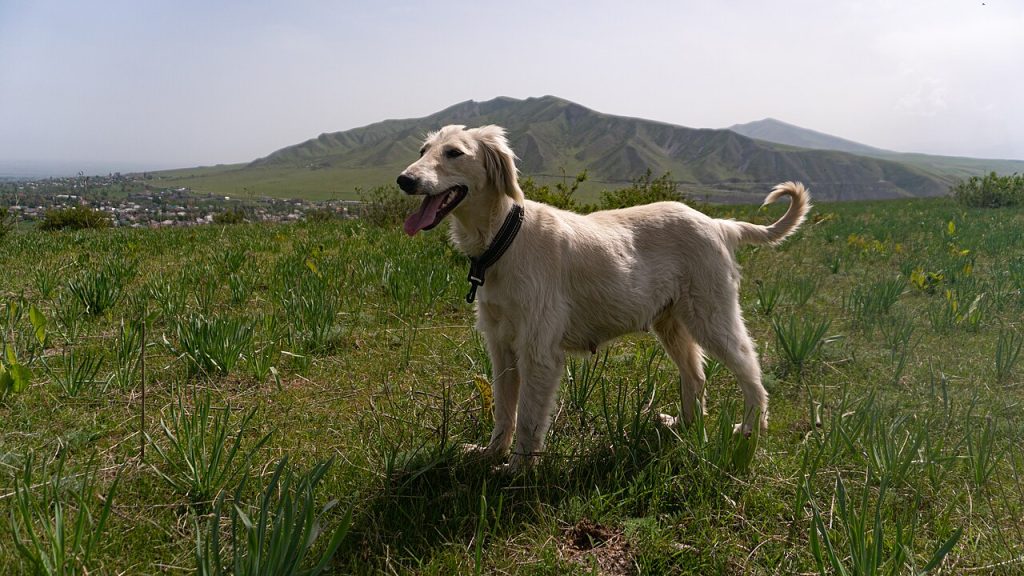
The Taigan is a mountain hare native to Kyrgyzstan, bred for centuries by nomadic peoples of the Tian Shan to hunt by sight at altitudes that would take most dogs’ breath away. Related to the Tazy and Saluki, the Taigan combines the elegance and speed of a greyhound with extraordinary endurance and a semi-long coat that protects it from the cold of the Asian highlands. It’s a rare breed, virtually unknown outside of Central Asia, and whoever’s looking for a taiga is actually looking for an ancestral, independent hunter deeply tied to a vanishing way of life.
Is the Taigan for you?
The Taigan is not a dog for everyone. It is a pure working hare, with a strong hunting instinct, a great need to run and an independent character inherited from generations that decided for themselves how to chase a hare down a rocky slope.

In favour .
- Exceptional physical endurance, especially in mountain terrain and at high altitude.
- Clean, with little body odor and easy fur maintenance.
- Quiet and reserved at home once he’s spent his energy.
- Loving and loyal to his family, not being a clingy dog.
- Rustic and healthy, the result of very harsh natural selection.
To be taken into account
- Very strong prey instinct: he can go after any small animal.
- Independent and selectively obedient; not a dog for submission contests.
- He needs a lot of exercise and space to run free.
- Very rare breed: finding specimens and breeders outside Central Asia is very difficult.
- It’s not a small-floor dog or for someone who spends little time outdoors.
Character and temperament
The Taigan’s temperament is that of a classic Asian working hare: Balanced, self-confident and independent. In its native environment it is asked to make decisions on its own during hunting, so it has developed a remarkable capacity for initiative. It is not a dog that waits for constant instructions; rather, it evaluates the situation and acts. This autonomy, so useful in the mountains, translates at home into a companion who knows how to be alone with himself without demanding constant attention.
To his family he is affectionate and loyal, but in a restrained and dignified manner, very different from the effusive nature of a retriever. He usually chooses one or two people of reference and becomes deeply attached to them. With strangers he tends to be reserved and cautious, without gratuitous aggression: Watch before you trust. This mixture of sensitivity and calmness makes it a dog that is very good at capturing the moods of those around it.
Like all sighthounds, their world is governed by sight and movement, and a running object awakens in them an ancestral drive to chase that is almost impossible to repress completely.
Coexistence: children, other pets, flat and loneliness

With the children the Taigan usually behaves in a patient and kind manner, as long as it respects its space and its need for tranquility when it rests. It is not a particularly playful or noisy dog, so it fits better with somewhat older children who understand the calm treatment that a hare appreciates.
The relationship with other dogs is usually good: Accustomed to hunting in pairs or in packs with other Taigans, it is a sociable dog with its congeners. The problem comes with the small animals. Their prey instinct, honed over centuries to chase hares, marmots, foxes, or feral cats, puts cats, rabbits, or other small pets at real risk, especially if they move abruptly. Cohabitation with a cat is only possible if the dog grows up with it as a puppy, and it is still wise to be cautious.
As for the floor, it’s not their ideal habitat. The Taigan is a large dog, built for large areas, that needs to go for a run every day. It can live indoors if it is guaranteed that exercise, because at home it is quiet, but it is not a breed for small spaces or for sedentary life. It tolerates the loneliness well for reasonable periods due to its independent nature, provided its physical needs are met; a bored and restless Taigan can become destructive or restless.
Education and training
Raising a Taigan requires patience and a clear understanding of what it is: an independent hare, not an obedience dog. He responds poorly to harsh or coercive methods, which only get him to close in on the gang. Positive reinforcement, consistency, and a relationship based on mutual trust work much better. Nevertheless, their obedience will always be something “negotiated”: He will do things when he understands the meaning and when his instinct doesn’t ask for anything else.
The early socialization is critical. Exposing him to people, environments, noises, and other animals as a puppy will help him develop the breed’s characteristic composure without becoming overly shy. The most delicate part of the training is the called: Because of its extremely strong chase instinct, a Taigan that sees a prey can disconnect completely. It is advisable to work the lap from very early on, but assuming that the real security is to release it only in fenced or highly controlled areas.
Exercise and activity

This is where the Taigan sets the bar very high. It’s a dog of extraordinary endurance, able to sustain effort for hours and at altitude, something few breeds can match. A quiet walk is not enough for it: it needs to gallop, stretching, starting that engine that natural selection polished in the Tian Shan mountains.
The ideal is to offer him long running sessions in open and safe spaces, hiking on varied terrain, or canine disciplines that take advantage of his speed such as the lure coursing(bait chase), where the hares shine. He also enjoys accompanying runners or cyclists once he is an adult and his bone development is complete. Without this physical outlet, the Taigan accumulates frustration and may develop problematic behaviors. It is, in short, a race for active people with access to the countryside or the mountains.
Care: fur and hygiene
The taigan’s coat is medium-length, smooth and slightly wavy or curly, with longer fringes on the ears, back of the legs and tail, forming the characteristic “calzones” and plumes of eastern hares. It is a functional cloak, designed to insulate from the cold of the highlands, and its maintenance is simple: A weekly brushing is sufficient for most of the year to keep it clean and knot-free, intensifying it during seasonal mowing.
It’s a naturally clean dog, with little smell, so baths should be sporadic, only when it gets really dirty. It is advisable to check and clean the ears regularly (the freckles can accumulate dirt), monitor the eyes, brush your teeth regularly and cut your nails if they do not wear out on their own with exercise. After field trips, it is a good idea to check the coat for spikes, ticks, or small wounds.
Foodstuffs
As a large, active, athletic dog, the Taigan needs a quality diet well suited to its enormous energy expenditure when it works or runs a lot. A high-protein diet from a good source helps it to maintain the dry muscle mass of a greyhound without straining its lightweight structure. The quantities should be adapted to age, level of exercise and time of year, as their needs vary widely between a hunting day and a rest day.
For its deep chest, like other breeds with a broad chest, it is advisable to take precautions against the gastric dilation-torsion: divide the food into two daily servings instead of one copious one and avoid intense exercise just before and after eating.
Health and life expectancy
The Taigan is a rugged and hardy breed, shaped by demanding natural selection in a very harsh environment. That history has generally given him good health and few hereditary problems associated with intensive breeding, precisely because he has never been through industrial breeding. As a sighthound, it shares a special sensitivity to anaesthesia with other hares because of its low body fat ratio, something every veterinarian should consider.
Routine preventive care – vaccination, deworming, tick control after field trips, and regular check-ups – are the best guarantees of longevity. Its low level of fat also makes it somewhat more vulnerable to extreme cold when inactive and to bumps on the thin limbs during running. As for life expectancy, it is in the typical range of a large hare, around 12 years old, although precise data are scarce due to the small spread of the breed.
Physical appearance
The Taigan is a large-sized hare with a more robust build than a Western Greyhound, adapted to the mountain. It has a body slightly longer than it is tall, with a deep and broad chest typical of a distance runner, a strong back and long, well-angled limbs. Males are noticeably larger than females. The head is elongated and elegant, with dangling ears covered in long fringes and an attentive, serene expression.
One of its most distinctive features is the tail, with the end coiled into a ring, covered in long hair. The mantle is semi-long, soft and somewhat curly, and features a wide variety of colours: From white and various shades of fawn to gray and black, often with white spots. Everything in its silhouette conveys the idea of a dog made to cover great distances over steep terrain with effort saving.
Origin and history
The Taigan comes from Kirguistán, specifically from the alpine region of Tian Shan, on the border with China. It is part of the large Asian hare family and is closely related to Tazy(the Central Asian steppe hare) and Saluki. For centuries, Kyrgyz nomadic peoples bred it as a sighthound, vital for survival in a hostile, high-altitude environment.
Its original function was to hunt a huge variety of pieces: marmots, hares, foxes, badgers, wild cats and even hoofed prey like the ibis and the roe deer, as well as the wolf. An iconic image of traditional hunting in Central Asia is the taiga working side by side with the hunter’s king eagle, a combination of hare and bird of prey that reflects how integrated the dog was in the local culture.
After the dissolution of the Soviet Union, the Taigan population suffered a notable decline and the breed came under serious threat. In recent years, conservation efforts have been stepped up: The Federación Cinológica Rusa has worked to recognize and preserve both the Taigan and Tazy, seeking quality specimens to ensure their continuity, and in Kyrgyzstan the breed has national recognition through the hunting commission of the Ministry of Environmental Protection. Even so, it is still a rare breed and not recognized by the FCI.
Curiosities
- Its name in Kyrgyz is spelled тайган, and it is also known as the Kyrgyz hare or “Kyrgyzskaya Borzaya” in Russian.
- It is capable of hunting at altitudes that would exhaust most breeds: its mountain endurance is legendary.
- In addition to hunting by sight, it is a versatile dog that can follow scent trails and retrieve the downed piece.
- She works in team with the royal eagle in traditional Kyrgyz silk weaving, a unique print from Central Asia.
- It is considered part of Kyrgyzstan’s cultural heritage and is a source of national pride.
- Its tail with a ringed tip is an identifying mark that distinguishes it from other hares.
If you are drawn to the world of hares and sighthounds, you may want to learn about other breeds of similar temperament and silhouette. Discover the Greyhound, the ultimate racing hare; the sleek and light Whippet; the majestic Galgo Afgano, another long-haired mountain hare; or the spectacular Gran Danés, if you are seduced by the presence of a large and noble dog.
Frequently Asked Questions About the Taiga
Where does the Taigan originate from?
The Taigan is native to Kyrgyzstan, specifically the mountainous Tian Shan region on the border with China.
Is the Taigan recognized by the FCI?
The Taigan is not recognized by the International Kennel Federation (IFF) but has national recognition in Kyrgyzstan through the hunting commission of the Ministry of Environmental Protection and with the support of the Russian Kennel Federation, which works on its conservation.
Is the Taigan a good family dog?
It is loyal, affectionate, restrained, and quiet at home, but it needs plenty of exercise and has a strong hunting instinct, so it does not fit into a sedentary lifestyle or homes with small pets.
Do you get along with cats and other small animals?
It is complicated. Its prey instinct is highly developed and it can chase cats, rabbits or other small animals. Coexistence with a cat is only viable if they grow together from puppies, and still it is advisable to supervise. With other dogs it is usually sociable.
How much exercise does a Taigan need?
It is a dog of extraordinary endurance that needs to gallop daily in open and safe spaces. Walks, hiking, running and disciplines such as lure coursing are ideal. Without enough physical release it can become frustrated and destructive.
Is it hard to train?
It is independent and selectively obedient, not a submissive dog. It responds well to positive reinforcement and patience, and poorly to harsh methods.
How long does a Taigan live?
Its life expectancy is in the typical range of a large hare, around 12 years. Being a rustic breed and not subjected to intensive breeding, it usually enjoys good health, although precise data are scarce because it is rare.
What colors can the Taigan be?
The Taigan has a wide variety of colours: white, fawn, grey and black, often with white spots.