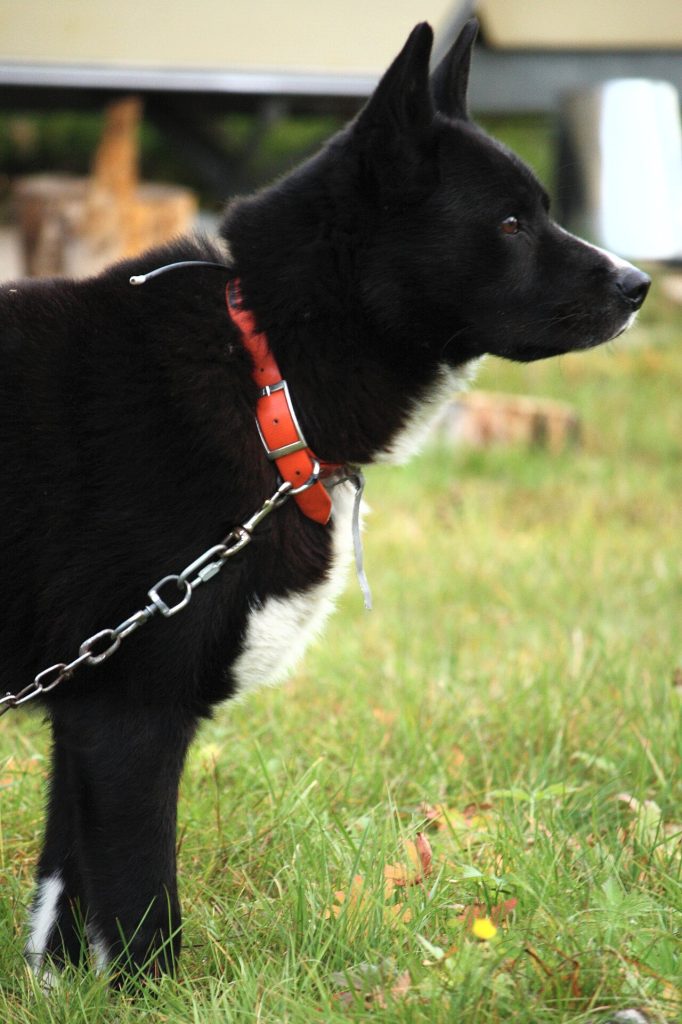
The Karelian Bear Dog(in Finnish this is Karjalankarhukoira) is a Nordic spitz type dog originating from Finland, bred for the most demanding that a hunter can face: Standing up to a brown bear. Courageous, industrious and independent, it is considered a national treasure in Finland and is one of the ten most common breeds in Finland. This profile tells you, unadorned, what the Karelian Bear Dog really looks like and if it fits into your life.
Is the Karelian Bear Dog for you?

The Karelian Bear Dog is not a dog for everyone, and it’s best to be clear about that first. He is a hardworking hunter with overwhelming energy, a marked prey instinct and an independent character forged to make decisions in the face of dangerous animals. In the right hands – active people with space and experience – it’s a loyal, healthy, spectacular companion. On the wrong ones, it becomes a problem of barking, leaking and wrecking.
In favour .
- Very loyal and affectionate to his family.
- Brave, confident and balanced; excellent alarm dog.
- Rustic, healthy and long-lived for his size.
- Intelligent and capable of learning complex tasks.
- Cold-resistant coat, ideal for harsh weather and outdoor life.
Against
- He needs a lot of exercise and mental stimulation.
- High prey instinct; unreliable with other animals.
- Territorial with dogs of the same sex.
- Independent and stubborn: not an easy dog to train.
- I’m prone to separation anxiety; I can’t stand being alone.
- Not recommended for flat or first-time homeowners.
Character and temperament
The temperament of the Karelian Bear Dog is that of an authentic Nordic hunting dog: bold, tenacious and with a self-confidence that borders on recklessness. It is the kind of dog capable of cornering a barking bear without backing down, and that determination defines its personality. With its family, however, it shows another face: it is very affectionate, attached and sensitive to the mood of its people.
With people it is almost never aggressive; it may be somewhat reserved with strangers if not well socialized, but biting a human is extremely rare in the breed. What is marked is the territorial and vigilante character: immediately warn of any suspicious movement or presence of other animals. He’s a born guardian, not out of aggression but out of constant attention to his surroundings.
The other side of that intensity is its strong prey instinct and its tendency to dominate other dogs. It’s not a dog that relaxes easily: it’s always alert, always looking for something to do. That’s why it fits so badly into a sedentary life and so well with an owner who gives it a purpose.
Coexistence: children, other pets, flat and loneliness

With children: is usually affectionate and protective of its own family members, especially if it grows up with them.
With other pets: is territorial with dogs of the same sex and its prey instinct towards cats, rodents, rabbits or poultry is high. With very early socialization it can accept the animals it lives with from puppyhood, but is rarely trusted loose near small pets or wildlife. Cohabitation requires management and common sense.
It needs space to run and release energy; locked in an apartment it accumulates frustration that discharges into barking and destruction.
In the face of loneliness: is a very social dog and prone to separation anxiety.
Education and training
The Karelian Bear Dog is intelligent and quick to learn, but it is not a submissive dog. It was bred to work autonomously, making decisions in front of prey without waiting for orders, and that independence is seen in training. It cooperates when it understands why and when it respects its guide; it closes in on imposition and harshness.
The key is positive reinforcement, consistency and getting started early. Early socialization with people, noises, environments and – very carefully – other animals is essential to modulate their territoriality and prey instinct. The two major challenges of the breed are reliable call (recall) and self-control before hunting stimuli; it is advisable to work on them from a puppy and never lower your guard, because a Karelian Bear Dog that catches a trail can disconnect from the owner in seconds.
It rewards the patient, active, and judgmental owner, and punishes improvisation and a lack of clear boundaries.
Exercise and activity
If there’s one thing about this breed that’s non-negotiable, it’s this. The Karelian Bear Dog is a working dog that’s used to having a job, and needs to unload both body and head daily. We’re talking about hours of activity: long walks through natural terrain, running, exploration, tracking and games that make him think. A couple of short laps around the apple don’t even serve him as an appetizer.
He especially enjoys the activities that connect with his instincts: hiking, mantrailing, olfactory sports, canicross or accompanying their owner on mountain outings. When he spends his energy properly, his home is calm and balanced. When he doesn’t spend it, the dark side of the breed appears: Barking, anxiety, leaking and wrecking. The rule is simple: A tired Karelian Bear Dog is a happy Karelian Bear Dog.
Care: fur and hygiene
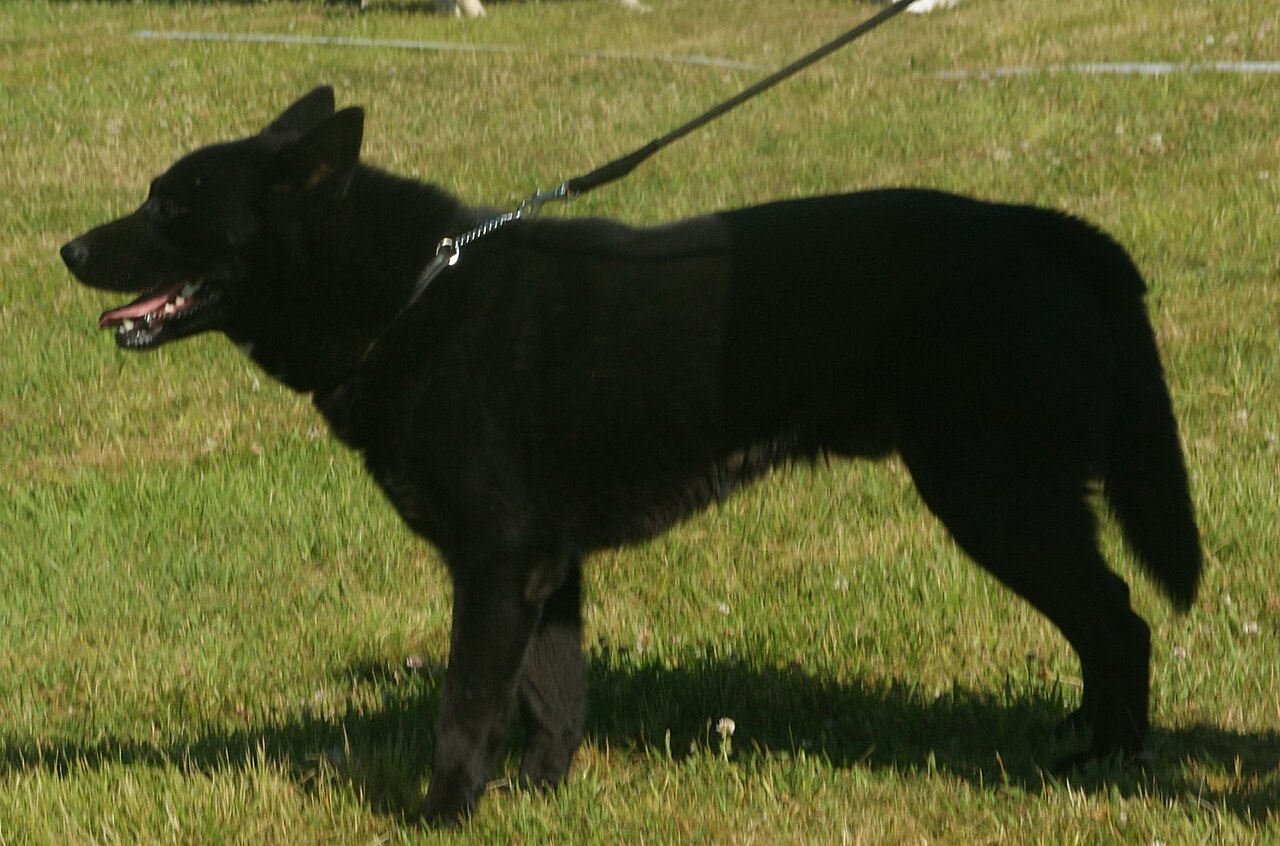
The coat of the Karelian Bear Dog is twofold: a straight and rough outer guard coat, and a thin, dense and soft undercoat that insulates it from the cold.
The exception is the seasonal mowing, in spring and autumn, when the undercoat loosens abundantly; in those weeks it is advisable to brush it daily to control the amount of hair. It does not need frequent bathing – its hair tends to self-clean and repel dirt – and excessive bathing diminishes the natural protection of the mantle. The rest of the care is the usual: checking and cleaning ears, cutting nails when necessary and maintaining dental hygiene.
Foodstuffs
As an active and muscular medium-sized dog, the Karelian Bear Dog needs a high-quality diet, with good protein intake that supports its activity and muscle mass.
It is advisable to divide the food into two servings a day and monitor the body condition to avoid both overweight and thinness. Since it is a relatively deep-chested dog, it is wise not to offer vigorous exercise just before or after eating. Any diet – high-quality feed, wet feed or formulated diet – is good as long as it is balanced; when in doubt about quantities or specific needs, it is best to consult your veterinarian.
Health and life expectancy
The Karelian Bear Dog is a rustic and generally healthy breed, with a life expectancy between 11 and 13 years. Its origin in demanding working conditions has left it a robust constitution.
- Condrodisplasia: is an inherited form of cartilage dysplasia, the same one described in the Norwegian Elkhound, caused by a recessive mutation in the ITGA10 gene.
- Pituitary dwarfism: a mutation in the LHX3 gene, inherited from the German Shepherd ancestry present in the breed, causes growth retardation, puppy hair retention and, later, alopecia.
Buying from a responsible breeder who performs genetic and health testing is the best guarantee to avoid these problems. With regular veterinary checkups, proper exercise and good nutrition, the Karelian Bear Dog usually enjoys a long and active life.
Physical appearance
The Karelian Bear Dog is a spitz-type dog, medium-sized, robust and well-proportioned, with an attentive and courageous expression. males measure between 54 and 60 cm to the cross and weighs between 25 and 28 kg; females are smaller, from 49 to 55 cm and between 17 and 20 kg.
The coat is double, with straight and stiff guard hair and dense undercoat. The color required by the current standard is the black and white, normally black with sharp white spots on the head, neck, chest, belly and legs; solid black-coated specimens are also allowed. Interestingly, in its origins the breed included wolf-gray individuals, red like the classic spitz and even black and fire, variants that later selection left behind. The tail, typical of the spitz, curls over the back, and the eyes, small and dark, give the face its characteristic wakefulness.
Origin and history
The Karelian Bear Dog is descended from the ancient Komi dog and from working dogs from Ladoga Karelia, Olonets Karelia and Eastern Karelia, regions on horseback between Finland and Russia where they were used for hunting. For centuries these dogs hunted small pieces of hair – squirrels, marsupials – as well as larger pieces such as moose, lynx, wolf, and especially the Eurasian brown bear.
Organized breeding of the breed began in 1936 with the aim of fixing a strong dog capable of harassing and barking at the larger game, and it was christened as a Karelian bear hunting dog.
In recent decades the breed has found an unexpected and admirable role: the non-lethal management of human-bear conflicts. Programs in the United States, Canada, and Japan – led by the Wind River Bear Institute – employ trained Karelian Bear Dogs to chase bears away from inhabited areas without harming them. In the Japanese resort town of Karuizawa, these dogs helped reduce black bear incidents from 255 in 2006 to just four in 2017.
Curiosities
- In Finland it is considered almost a national treasure and is among the ten most common dog breeds in the country.
- Hunting is a silent dog: it does not warn until it has its prey cornered, and then it barks sharply and very quickly.
- If a bear tries to escape, the Karelian Bear Dog bites it on the back to irritate it and prevent it from fleeing, keeping it at bay until the hunter arrives.
- It does not always need to hunt with its owner – it can be trained to work with different people.
- Its conversion as a bear-hunting dog has saved the lives of many plantigrades that would otherwise have been killed for approaching urban areas.
- Finland dedicated a postage stamp to it in 1965, reflecting its status as the country’s emblematic breed.
If you are attracted to the Karelian Bear Dog’s brave and independent character but want to compare with other breeds of similar profile, take a look at these close cousins, among Nordic spitz and working dogs: the Husky Siberiano, the Samoyedo, the Akita and the Pastor Alemán, with whom it shares some of its ancestry.
Frequently Asked Questions about the Karelian Bear Dog
Is the Karelian Bear Dog a good companion dog for a normal home?
It may be for an active family living in the countryside or in a house with land, but it is not a comfortable choice for a flat or for someone looking for a quiet dog. It’s a Norse hunter with a lot of energy, strong prey instinct and a constant need for physical and mental activity. It does wonderfully with experienced owners and space; frustrated and bored, it becomes destructive and barking.
Do you get along with other dogs and cats?
With people it is affable and not at all aggressive, but with other animals it is a different story. It tends to be territorial with dogs of the same sex and its prey instinct towards cats, rodents or poultry is high.
How long does a Karelian Bear Dog live?
It is a rustic and long-lived breed for its size; usually between 11 and 13 years old, and many well-kept specimens exceed that fringe.
Do you need a lot of exercise?
Yes, very much. It is a working breed used to having a task. It is not satisfied with a couple of short walks: it needs hours of daily activity, running, exploration and mental stimulation. Without that relaxation it develops anxiety, barking and destructive behavior. It is a dog for people who go out in the mountains, not for the sofa.
Is it hard to educate?
It is intelligent and learns quickly, but also independent and with its own criteria, something logical in a dog bred to decide on its own in front of a bear. It responds to positive reinforcement, consistency and respect, never to harshness.
Does he bark a lot?
Hunting is silent until it approaches the prey; then it warns with a sharp and very fast barking. At home it is an excellent alarm dog and barks at any movement or strange presence. Bored or alone it also barks from frustration, so exercise and company are the best prevention.
Can you stay alone for many hours?
It is a very social dog and prone to separation anxiety.Leaving it alone for long days usually results in barking, destruction and stress.It fits better in homes where there is almost always someone or where it can accompany its owner in his activities.
Where did the name ‘Bear Dog’ come from?
Working in pairs, these dogs corner the bear, barking incessantly and dodging its onslaughts to distract it.