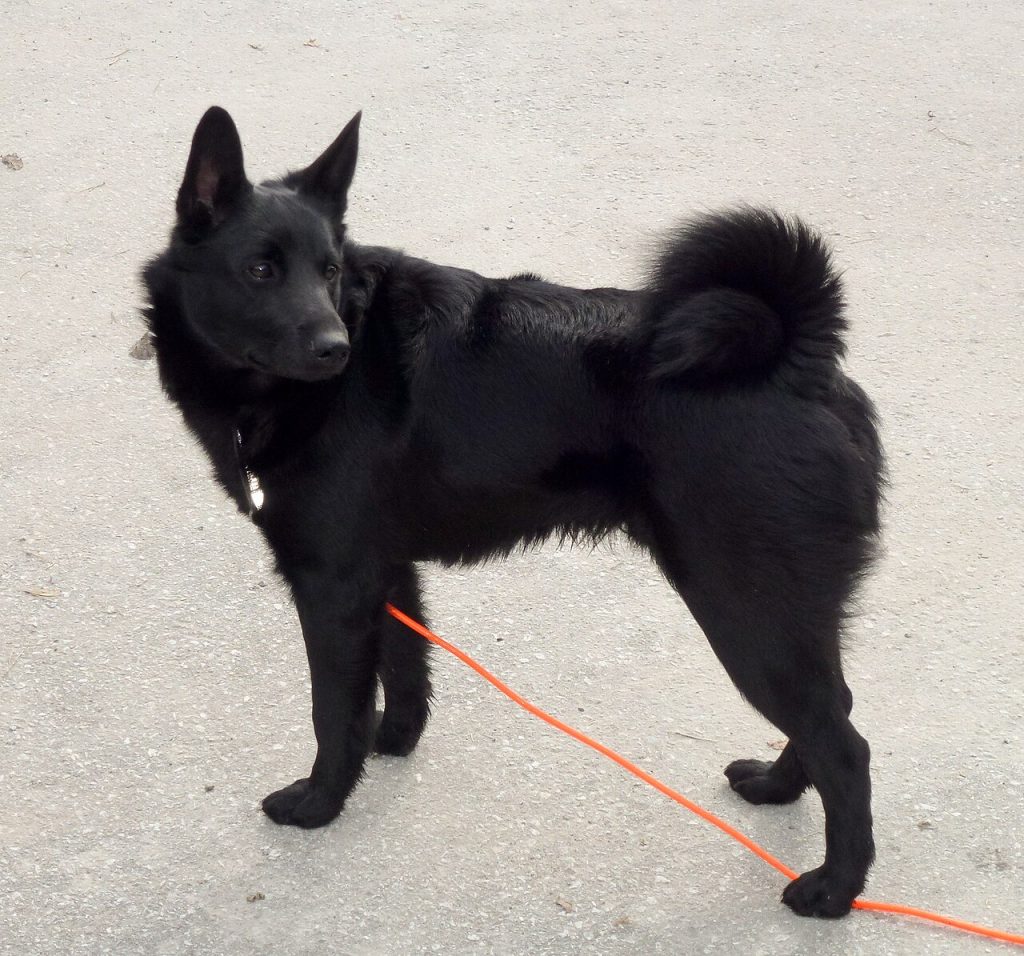
The Elkhound Noruego Negro(in Norwegian Norsk Elghund Sort) is a small, compact and quiet Nordic spitz, bred for over a century on the border between Norway and Sweden to hunt moose and bears with a leash. He’s the dark brother of the most famous Norwegian grey moose hunter: something smaller, more nimble and, above all, much quieter. Outside Scandinavia it is a rarity, but those who live with one discover a well-balanced family dog, clingy to his own and weatherproof in Nordic winters.
Is the Black Norwegian Elkhound for you?
This breed suits anyone looking for a medium-sized dog, robust and quiet indoors but tireless in the mountains. It ‘s not a dog of sedentary city or people who spend many hours outside: It needs real outdoor activity and, above all, to be part of family life. Its great advantage over other Norse is that it barks almost no, which makes it surprisingly easy to live with.
In favour .
- Very close to family, looking for contact and affection.
- It barks little: a breed bred to hunt silently.
- Tolerant of children and small pets.
- Handled size (16-20 kg) and compact body.
- Resistant to cold, rain and hard work.
- Intelligent and cooperative with his guide.
To be taken into account
- He needs plenty of daily olfactory exercise.
- Sharp hunting instinct. Requires solid recall.
- Independent Spitz: education with patience.
- Seasonal change and coat that requires regular brushing.
- Very rare breed outside the Nordic countries.
- You don’t really fit in with a totally sedentary lifestyle or a lot of hours alone.
Character and temperament

The Black Norwegian Elkhound is, above all, a family dog with a hunter’s soul. At home it is balanced, affectionate and deeply sociable: it is one of those who approach to ask for caresses, allow themselves to be hugged and prefer to always be close to their people. This need for physical contact with people defines much of its character and explains why it does not take well prolonged solitude.
It’s a very intelligent and very enterprising dog, a direct inheritance of its work hunting moose and bear in cooperation with the guide. That intelligence is accompanied by the typical Spitz independence: He thinks for himself and he’s not a blind follower of orders. Compared to its grey sibling, the black stands out for being more serene and silent, a breed specifically selected to remain calm and not bark in the presence of prey.
With strangers it is usually reserved but not aggressive, and its confidence is earned with calmness. Well socialized, it is a stable, attentive and not nervous companion, combining the liveliness of the wild dog with the sweetness of the domestic dog.
Coexistence: children, other pets, flat and loneliness
With children: has a reputation for being an excellent family dog and good-natured with the little ones.
With other pets: is remarkably tolerant of small animals and can get along well with other dogs, to the point of being used as a companion dog alongside other breeds.
On the floor:‘s contained size and little tendency to bark make it more viable on the floor than most Nordics, provided it is guaranteed plenty of daily exercise.
Soledad: is his weak point. Accustomed to living close to his family, he suffers if he spends many hours alone. It is advisable to accustom him gradually to solitude and not leave him isolated for full days in the usual way.
Education and training
This is a dog that is ready and willing to cooperate, but with the independence of the Nordic Spitz, responds well to positive reinforcement, to short and varied sessions, and to consistent guidance that gives him reasons to cooperate rather than force.
There are two clear priorities in their education. The first is the early socialization, so your natural reserve with strangers doesn’t lead to shyness. The second is a very solid recall: His sense of smell and his hunting instinct can lead him to follow a trail and ignore his surroundings, so calling work and attention to the guide must be taken care of from a puppy. Like a good aerial tracking dog, scent and search games are a great way to mentally stimulate him and strengthen the bond.
Exercise and activity
The Black Norwegian Elkhound is an all-terrain working dog and has it in its genes. It needs plenty of daily exercise: long walks, hikes on uneven terrain, mountains and, if possible, activity that combines body and smell. It is made to move for hours on the Scandinavian mountain, so a couple of laps around the block is not enough for it.
A well-trained specimen is calm and balanced at home; one who is bored and without stimulus can become restless. The good news is that its resistance to cold and rain makes it the ideal companion for outdoor life in any season.
Care: fur and hygiene

His cloak is twofold: an insulating inner layer of soft, black haze, and a longer, denser, stiffer, smoother, water-repellent covering hair. It is designed to withstand the heavy rains of Scandinavian autumn and the cold of winter, and it does it very well. The hair is shorter and stuck on the head and the front of the legs, and more abundant on the chest, neck, thighs and lower part of the tail.
Maintenance is moderate: It is enough to brush it two or three times a week to remove the dead hair and keep the coat healthy, intensifying brushing in seasonal moulting seasons. It doesn ‘t require haircuts or hairstyles . This dog looks better with its natural coat. Bathing, only when absolutely necessary, so as not to damage the natural protection of the mantle. The rest of the hygiene is routine: examination of ears, nails and teeth.
Interestingly, their hair is considered to be fairly hypoallergenic and works well for many people who are allergic to dogs.
Foodstuffs
As an active, medium to small-sized Nordic dog, it enjoys a complete and high-quality diet, adjusted to its age, weight and, above all, to its actual activity level.
The point to watch is the weight: It is a compact and muscular dog that must be kept in shape, without overweight, so as not to burden joints or hips. Splitting food into two daily servings, controlling treats (best used as a workout reward) and keeping fresh water always available are the basic guidelines. If you have any doubts about the quantity or type of diet, it is best to consult your veterinarian.
Health and life expectancy
It is a rustic and generally healthy breed, the result of more than a century of maintaining its working abilities.
- Hereditary glaucoma: Norwegian breeding programs require that at least one parent be tested free, and work is underway to generalize genetic testing to both parents.
- Hereditary ataxia: included among the genetic controls being implanted into responsible breeding.
- Hip dysplasia (HD) is characterized by: requires knowledge of the hip status of the breeders. Statistics over the last decade show that around 83% of specimens are free of dysplasia, a solid figure for the breed.
To limit inbreeding, the Norwegian Club enforces a rule that no male should exceed a maximum number of registered offspring.[1] The guideline life expectancy, in line with the Norwegian elghund family, is around 12 to 15 years.[2] Acquiring the puppy from a breeder who performs the relevant health tests is the best guarantee of longevity.
Physical appearance
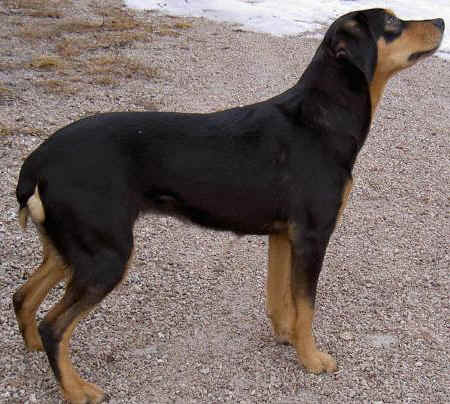
The Black Norwegian Elkhound is a typical spitz: short and compact body, dark eyes, erect, pointed ears, and a stubby, coiled tail over the back.
- The ideal is about 47 cm in males and 44 cm in females (with a margin of +3/-4 cm).
- Peso: approximately 16 to 20 kg.
- Solid black Color:, its identification mark and what distinguishes it from the Norwegian grey moose hunter.
- Manto: double, dense, short, rough and smooth, perfectly adapted to the outdoors.
Compared with its grey sibling, the black is somewhat smaller and lighter-looking and agile, a difference consistent with its leashed hunting work over rough terrain.
Origin and history
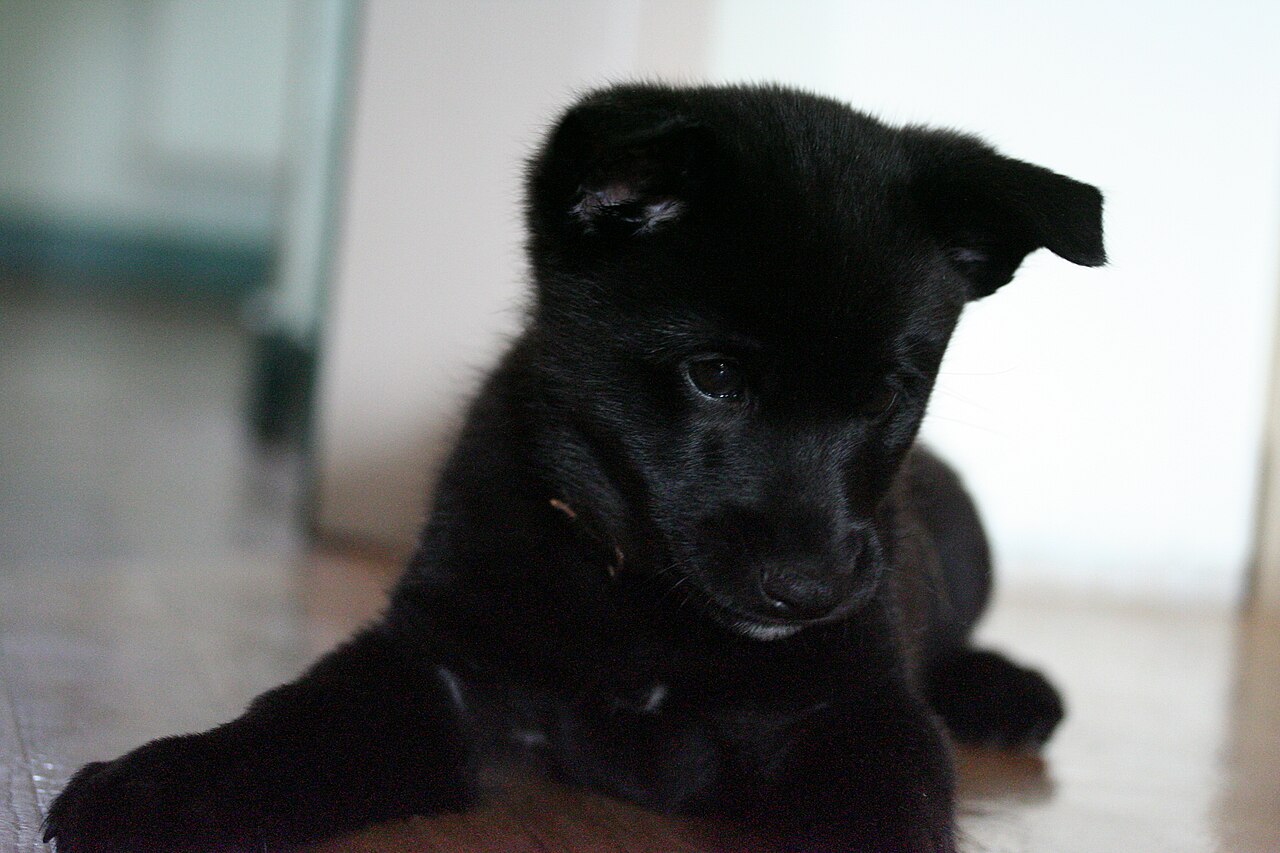
The breed descends from local populations of spitz-type dogs in the border areas between Norway and Sweden, and has existed as a breed of its own since the mid-19th century.
One of the first mentions in literature was by the Welshman Llewelyn Lloyd, who in 1828 was hunting bears near the Norwegian-Swedish border. He was especially pleased with two dogs that were lent to him: “Hector was black, with upraised ears and a curled tail, “and Stas, with whom thirteen bears had been slaughtered, “was black as a bat and with a thick tail”. Those dark-skinned wild dogs are the type from which today’s breed comes.
The Black Norwegian Elkhound came under threat of extinction, but has retained its good utility abilities and characteristic appearance for over a hundred years.
Curiosities
- The Nordic who hardly barks: unlike the grey, was selected to hunt silently and approach prey without betraying the hunter, making it unusually quiet.
- Hunting with a leash: is bred specifically for tied hunting, cooperating closely with the guide while tracking moose, deer and bears.
- Aerial scent: picks up the smell in the air and looks for elevated points to “read” the wind, a quality that also makes it an excellent search dog.
- “Elk” is not deer: in Norwegian elg is the European moose; the same animal that in the US they call moose. Hence the “Elkhound”.
- Almost hypoallergenic coat: is one of the few spitz-type breeds that many allergic people tolerate reasonably well.
If you are attracted to this working Nordic spitz, you may want to compare its character and needs with those of other related breeds. Check out the Husky Siberiano, Samoyedo, Akita and Chow Chow, all of them dense-mantled spiritual cousins, Nordic or Asian root and strong personality.
Frequently Asked Questions about the Black Norwegian Elkhound
Does the Black Norwegian Elkhound bark a lot?
No, it’s one of its major differences from the grey moose hunter: it was selected to hunt silently, so it barks less and behaves more calmly, making it more bearable in coexistence.
Is he a good family dog with kids?
Yes, he has a reputation as an excellent family dog, very attached to his people, affectionate and tolerant of children, enjoys physical contact and prefers to be always close to his family.
Can he live in a flat?
It can, thanks to its small size and barely barking, but only if it gets plenty of daily exercise outdoors.
How much exercise do you need?
It’s an all-terrain working dog that requires long walks, hunting and activity that combines body and smell.
How tall and how much does he weigh?
It measures between 40 and 51 cm (ideally, about 47 cm males and 44 cm females) and weighs between 16 and 20 kg. It is a compact spitz of medium-small size.
How long do you live and what health problems do you have?
Responsible breeding monitors hereditary glaucoma, ataxia, and hip dysplasia, as well as avoiding consanguinity because of a small population.
Is it hard to take care of your hair?
No, you just brush it two or three times a week, reinforcing it in the molars, you don’t need a hairdresser and you only bathe when you need to so you don’t damage your raincoat.
How is it different from the Norwegian grey moose hunter?
The black is somewhat smaller and more agile, solid black instead of gray, and much quieter.