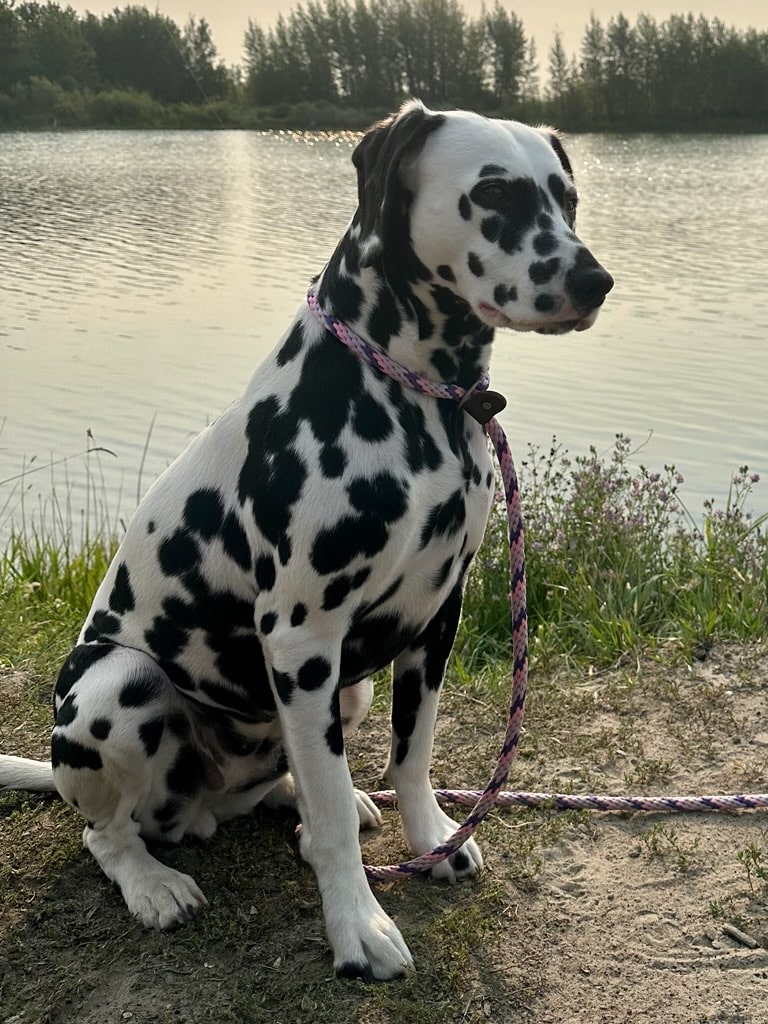
The Dálmata is one of the most recognizable dogs on the planet: White background dotted with black or brown spots, athletic body and an energy that won’t go out on its own. Behind that film frame is a working dog born to run alongside carriages, loyal to his own and demanding of his owner. Before you get carried away by their beauty, you should know what a Dalmatian really wants to be happy.
Is the Dalmatian for you?
The Dalmatian is a spectacular dog, but it is not for everyone. It is resistant, sociable with its family and a tireless companion for those who play sports; in return, it requires hours of daily exercise, companionship and a firm and constant hand in education. Before you decide, weigh these two columns honestly.
In favour .
- Athletic, with enormous physical endurance: ideal for active people, runners and hikers.
- Very close to his family and affectionate with those he meets.
- Short hair, almost no dog smell, easy to keep clean.
- Smart and flashy, he shines in obedience, agility and games.
- A good warning dog: watch and warn naturally.
To be taken into account
- It needs a lot of exercise; bored, it becomes destructive.
- It sheds hair all year round, and its short hairs stick to clothing and fabrics.
- Genetic predisposition to deafness and urinary stones.
- Reserved with strangers and strong-willed: not recommended for first-time owners.
- He can’t stand prolonged loneliness.
Character and temperament
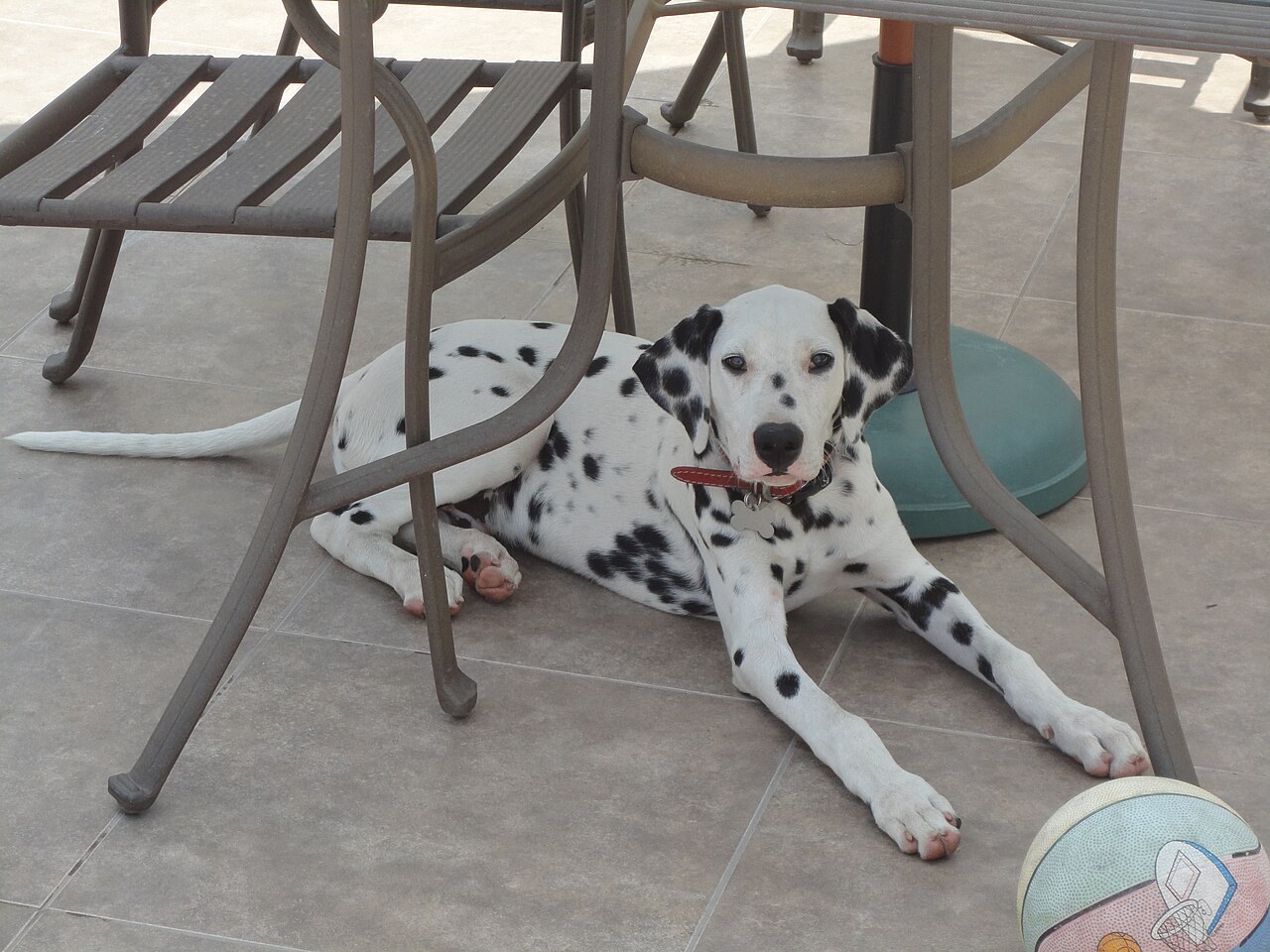
The Dalmatian is, first and foremost, a dog of overflowing energy. That spark comes from its past as a carriage escort: animals bred to run miles alongside horses without getting tired. Moved into a modern home, that same engine needs a daily exhaust valve. A well-exercised Dalmatian is calm and balanced at home; a bored one is another story.
It is playful, alert and very attached to its people, to the point of following you from room to room. With strangers, on the other hand, it is usually reserved and somewhat distant: it retains a guarding instinct inherited from when it guarded stables and borders. It is not an aggressive dog by nature, but territorial and observant, which makes it an excellent warning dog.
In terms of intelligence, he’s in the middle: In Stanley Coren’s famous classification, he is ranked 39th. That does not mean that he has a hard time learning, but he has his own standards and sometimes makes his own decisions. It’s an independent dog with a marked temperament that tests those who can’t read. Interestingly, one of their strongest natural affinities remains with horses.
Coexistence: children, other pets, flat and loneliness
- With children: is affectionate and playful, but due to its size and vigor it can be rough, especially with the youngest, whom it can throw to the ground unintentionally.
- With other dogs and pets: is suitable for early socialization. It has hunting instinct and has been used to control rats and vermin, so with cats and small animals you have to go head to head. With other dogs it usually gets along well if it grows used to them. With horses it has a special affinity.
- On the floor: can live in an apartment only if you cover its very high need for exercise. It is not a couch dog; without an outlet, a floor is too small for it and the furniture will pay for it.
- Soledad:‘s weakness is that spending long hours alone or unattended causes stress and destructive behaviors, from compulsive digging to biting his feet.
Education and training
The Dalmatian learns quickly when he understands what he gains from it, but his independent nature demands constancy. He is not the ideal candidate for an inexperienced owner: he needs clear rules from a puppy, positive reinforcement and, above all, a lot of patience. Harsh punishment is counterproductive; with a Dalmatian you move forward with rewards, play and consistency.
The early socialization is the key piece. Exposing him as a puppy to people, noises, other animals, and a variety of environments makes the difference between a confident adult and one who is reactive or fearful. There is an important nuance: Some Dalmatians are deaf in one or both ears, and the education of a deaf dog is based on visual cues and gestures rather than voice commands. It is not an insurmountable problem, but it is worth knowing and adapting to.
For its energy and sense of smell, it responds wonderfully to goal-oriented training: obedience, agility, nose work or sports disciplines that combine body and mind.
Exercise and activity
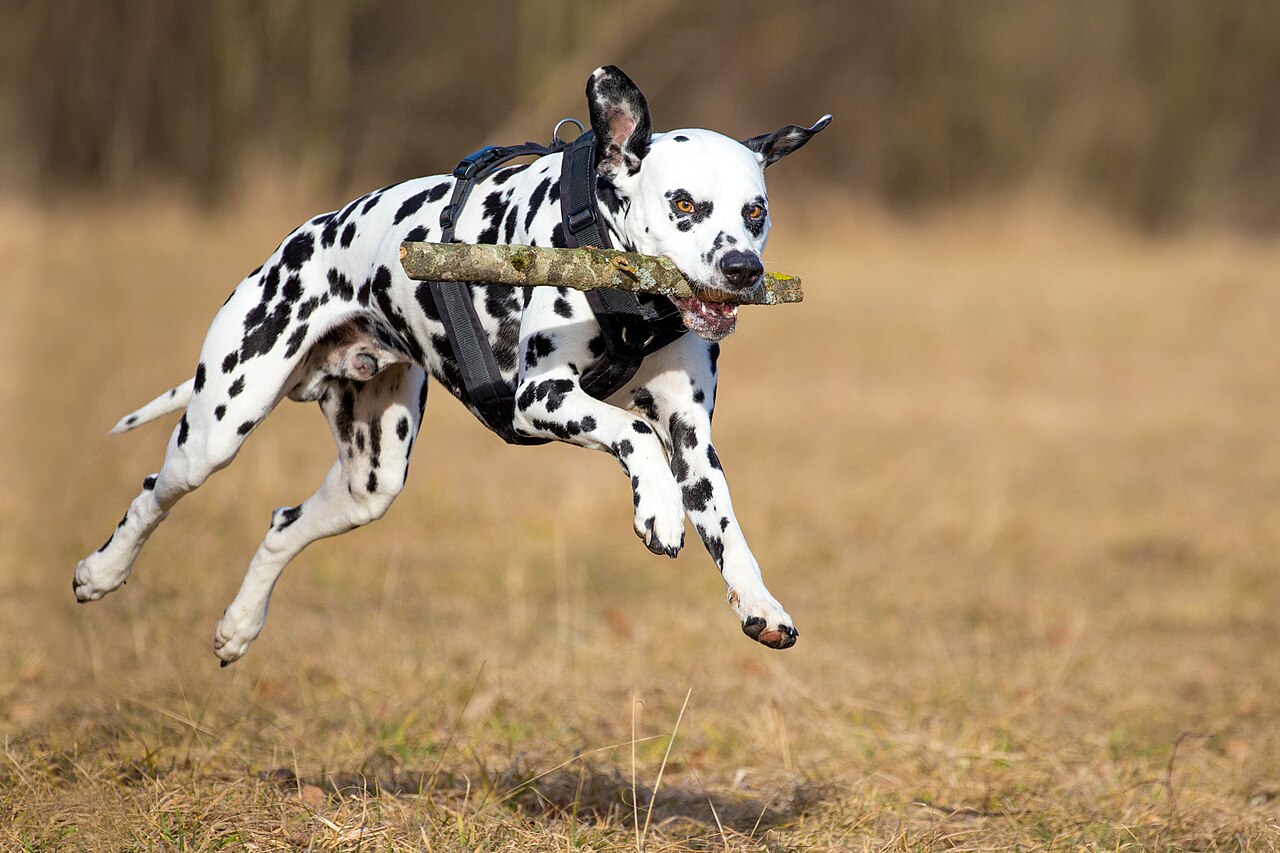
If there’s one thing that defines this breed, it’s this one: The Dalmatian was bred to run long distances and retains remarkable endurance and speed.
It is the perfect companion for running or cycling, for long walks or dog sports. In rural environments, if left to its own devices, it is able to go hiking on its own, so control and safety are important. In the city, it is reasonable to plan its activity and not leave it loose where it can run without brakes.
The rule is simple: exercise is not an optional extra for the Dalmatian, it’s a basic need. Much of the breed’s “behavioral problems” evaporate when the dog actually expends its energy. Cover that part and you have a balanced dog; neglect it and anxiety and destruction will appear.
Care: fur and hygiene
Its coat is short, thin, shiny and dense, and as it has little fat, it hardly gives off a dog smell, keeping itself clean easily.
These short, stiff hairs stick to carpets, upholstery, and clothing, and are difficult to remove. A weekly brushing with a brush or bristle brush reduces the amount of loose hair, but nothing eliminates it completely.
The rest of the care is the usual: bathing only when necessary to avoid drying the skin, checking and cleaning the ears, controlling the growth of the nails and regular dental hygiene.
Foodstuffs
The diet of the Dalmatian has a peculiarity that is not shared by any other breed, and it is important to understand it. Due to its unique metabolism of uric acid, this breed is prone to forming stones in the urinary tract.
This does not mean giving them little protein, but high-quality and well-chosen protein, accompanied by complex hydrates and keeping it low in salt and fat.The other great ally is water: you should always have fresh and abundant water at your disposal to dilute urine and drain excess uric acid.It is also advisable to monitor prizes and “table scraps”, which are usually rich in purines and salt.
As with any dog, adjust the diet to its age, weight, and activity level, and divide the food into several servings. Given the specificity of your case, the most sensible thing to do is to design the diet with your veterinarian, especially in adult males, who are most prone to urinary problems.
Health and life expectancy
The Dalmatian is, in general, a robust and long-lived dog: a British study from 2024 placed its average life expectancy around 13 years old, above the average of breed dogs.
The first is the deafness. It is a trait linked to their color genetics (extreme white pigmentation), and affects a significant percentage of the breed: Different studies place the number of dogs deaf in one or both ears between 16% and 26% depending on the country. That’s why a responsible practice is to run the BAER hearing test on puppies. A dog who is deaf in one ear leads a perfectly normal life, and so do many who are totally deaf, with proper training.
The second is hyperuricemia and urine stones. The Dalmatian’s liver malprocesses uric acid, which builds up and can precipitate into kidney, bladder, or urethral stones. It’s more common in middle-aged males and is prevented by the low-purine diet and plenty of water we talked about. Other points to watch for are autoimmune thyroiditis and some dermatological conditions. Interestingly, hip dysplasia is less common in this breed than in the average dog.
Physical appearance
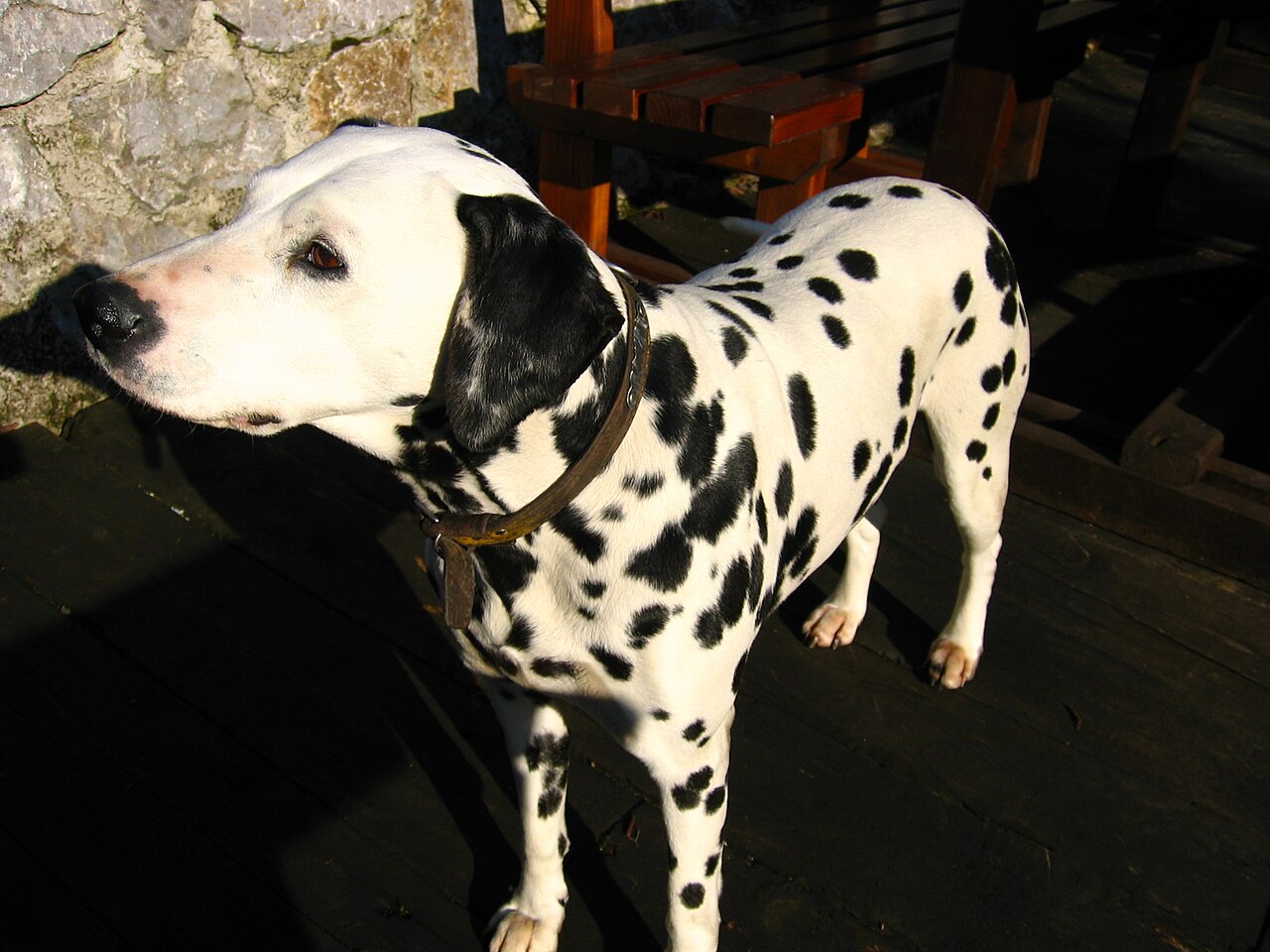
The Dalmatian is a medium-sized, muscular and well-proportioned dog, with an athletic body reminiscent of the Pointer and which betrays its ability to race. According to the standard, it measures about 48 to 58 cm to the cross. The head is proportionate and free of wrinkles, the ears hang attached to the cheeks, tapering toward the tip, and the tail, strong at the base, tapers to the corveon and is carried with a slight curve.
Its unmistakable feature is, of course, the mantle: pure white background covered with well-defined, rounded spots of about 2 to 3 cm spread all over the body. The most common variety is that of black spots, followed by that of brown spots (called “liver”); in the blacks the nose is black and in the “liver”, brown. There are other rarer colors, such as lemon, orange, blue or tricolor, which the standard considers to be faulty.
A precious detail of the breed: puppies are born completely white.. The first spots appear in a few days and continue to develop until about a year and a half of life. The more symmetrical, defined and uniform the spots are, the more valuable the specimen on display.
Origin and history
The Dalmatian owes its name to Dalmatia, the historical region on the eastern coast of the Adriatic, in the present-day Croacia, a country that the International Cynological Federation recognizes as its place of origin. The first traces of the breed there are very ancient: one of the earliest written references dates from 1375, when the Bishop of Đakovo described a white hunting dog with black spots which he named Canis Dalmaticus. There is also an altar painting in Veli Lošinj (1600-1630) and a fresco in Zaostrog.
Although its roots are in the Balkans, the breed developed and settled primarily in England. The first unofficial standard was drafted by Vero Shaw in 1882 and became official in 1890 with the founding of the first club of the breed. During the British Regency, the Dalmatian became a status symbol: It ran alongside the chariots of the aristocracy, and the finest specimens were highly prized.
This role of carriage dog is the key to his story. Compatible and understanding with horses, he escorted cars, cleared the road and watched. From there his eternal bond with the firefighters was born: he accompanied the horse-drawn fire trucks, guided the animals to the fire and stayed as a pet of the fire parks, an image that persists today.
Curiosities
- They’re born spotless. At birth they are completely white; the mottling appears during the first year and a half of life.
- The fireman’s dog. His past as an escort of fire engines made him the traditional mascot of parks, especially in the United States.
- It’s a unique metabolism. is famous for excreting uric acid in its urine, a metabolic trait not shared by other dog breeds.
- The novel The 101 Dalmatians(Dodie Smith, 1956) and the 1961 Disney film skyrocketed in popularity… with the bitter face of many subsequent abandonments for impulse purchases.
- Friend of the horses. His natural affinity for horses remains one of the strongest of any breed.
- The layers are usually numerous, from six to nine pups.
If you are attracted to the profile of the Dalmatian, an athletic and tough dog, you will be interested in comparing with other sporty and tireless breeds. Take a look at the Pointer, related to its origins; the elegant and energetic Weimaraner; the inseparable Vizsla; and the versatile German Shorthaired Pointer. All share with the Dalmatian this need to move and work side by side with their family.
Frequently asked questions about the Dalmatian
Is the Dalmatian a good dog for families with children?
It can be if it is well socialized and children learn to treat it with respect. It is affectionate and playful, but its size and energy make it a bit rough around the edges, especially with the smaller ones, which it may accidentally throw away. Adult supervision is always necessary.
How much exercise does a Dalmatian need?
He was raised to run long distances and needs intense exercise every day, ideally an hour or two between running, playing, and stimulation.
Why are there so many deaf Dalmatians?
Deafness is linked to the genetics of their extreme white pigmentation. Depending on the country, between 16% and 26% of Dalmatians are deaf in one or both ears.
Is it true that Dalmatian puppies are born spotless?
They are born completely white and the first spots appear within a few days, developing throughout the body until about a year and a half of life.
Does the Dalmatian need a special diet?
Because of its metabolism of uric acid, it is prone to urinary stones, so a diet low in purines (moderating viscera and certain meat by-products), with quality protein and, above all, plenty of water is advisable.
Does the Dalmatian shed a lot of hair?
Unlike other breeds, it sheds all year round, and its short, stiff hairs stick to clothing and fabrics.
How long does a Dalmatian live?
It is a long-lived breed: a British study from 2024 placed its average life expectancy at around 13 years, above the average of purebred dogs.
Is this a dog suitable for first-time owners?
It is not the most recommended for beginners. It has a strong and independent character, a lot of energy and specific health and exercise needs. With experience, perseverance and positive reinforcement it is a great companion.