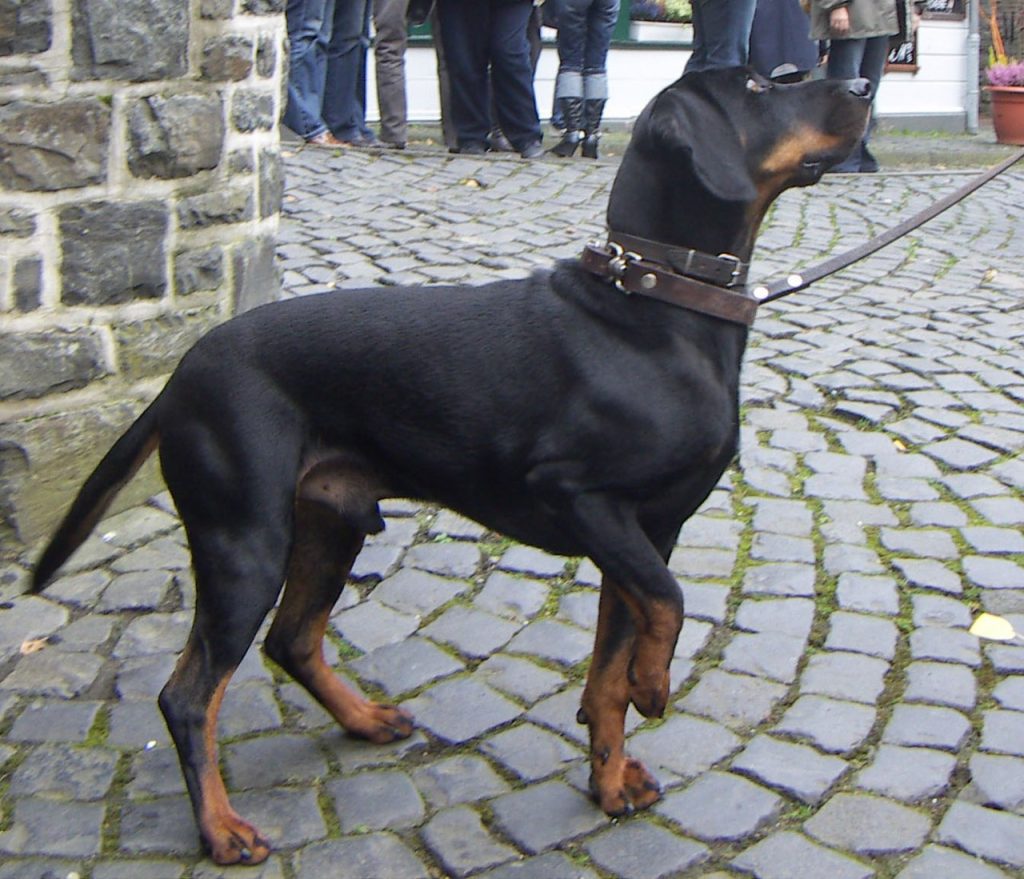
The Black and Fire Austrian Hound(German: Brandlbracke) is a medium-sized Austrian scenthound, bred for centuries to follow the scent of wounded hunting by the steep high mountain of the Alps. Elegant, tireless and with an unmistakable voice, he hides behind his athletic physique a surprisingly sweet and familiar dog. If you’re looking for a sporting companion, healthy and infrequent outside of your native Austria, this breed deserves to be thoroughly explored.
Is the Black and Fire Austrian Hound for you?
Before you fall in love with his image, you should be honest about the lifestyle he asks for. This is a working dog of body and soul: he shines with active owners, with space and a desire to move daily. On the couch of a small apartment, however, he shuts down. Here’s a quick summary.
In favour .
- Affectionate, well-adjusted and very familiar.
- Healthy, rustic breed, no known hereditary diseases.
- Short hair that barely needs maintenance.
- Extraordinary strength: ideal companion for hiking and sports.
- Exceptional sense of smell and voice; a pleasure to see you at work.
To be taken into account
- He needs a lot of exercise: not fit for a sedentary life.
- Strong tracking instinct: tends to follow smells and “disconnect”.
- Strong voice; may howl if bored or alone for too long.
- It doesn’t fit in a flat or a city with no land.
- Very rare breed outside Austria: hard to find.
Character and temperament

The Black and Fire Austrian Hound brings together two seemingly opposing souls who live in perfect balance. On one side is the hunter: A dog of determination, courage and almost inexhaustible enthusiasm when he catches a trail. On the other side is the housemate: affectionate, quiet at home and deeply attached to his family. Those who know him describe him as a naturally good-natured, good-natured, nonaggressive dog.
It’s a sensitive, intelligent animal that enjoys having a task at hand. He’s not nervous or hysterical, but he’s not an “ornament” dog either: He needs to feel useful. That combination of docility at home and passion in the countryside is just what made him the favorite hound of Austrian hunters and guards. To his people he is loyal and affectionate; to strangers he is polite and reserved, not distrustful.
Its famous voice deserves a separate paragraph. Like a good tracking dog, it “sings” when it follows a lead, and it does so with a sonorous and melodious timbre that in its land is considered a virtue. In a domestic environment you have to know: it is not a silent dog, and it is advisable to channel that expressiveness with activity instead of letting it become a howling out of boredom.
Coexistence: children, other pets, flat and loneliness
In the family, the Black and Fire Austrian Hound is a grateful dog. With the children it is usually patient and playful, and fits well in active homes where there is movement and outdoor plans. As with any large and energetic dog, coexistence with the youngest should be supervised and children taught to respect their rest times.
With other dogs he tends to get along well, partly because of his past working in a pack, where social tolerance is indispensable. Early socialization reinforces that good character. Caution comes with the small animals: Cats, rabbits or birds can awaken your chase instinct. It’s not impossible for a cat to live with you if they grow up together, but you have to manage it with gradual introductions and common sense.
About the floor, let ‘s be clear: It’s not his place. We’re talking about a mountain hound built to cover miles, and an apartment without a garden only works if the owner is very athletic and compensates with long outings and daily olfactory work. Ideally, a house with fenced-in land in a rural or semi-rural area. As for the loneliness, it doesn ‘t tolerate long hours alone: Boredom is their worst enemy and results in howling and destructive behavior.
Education and training
Training a Black-and-Fire Austrian Hound is a balancing exercise between harnessing its intelligence and respecting its independence. It loves to work and learns quickly when it understands what is expected of it, but it is a hound: as soon as it catches an interesting smell, its head goes behind the trail and the world ceases to exist. That is the key to understanding its strengths and its limits.
It works wonderfully with positive reinforcement, rewards and short, motivational sessions. Harsh methods or monotonous repetition demotivate and make it stubborn. It’s good to start early with socialization and basic learning, and always give it a why: a working dog learns best when obedience makes sense to it.
The most difficult subject is undoubtedly the call (recall) in the presence of olfactory stimuli. No matter how hard you work, a hound with a good trail ahead is difficult to stop, so in unsafe areas it is prudent to keep it on a long leash. Olfactory work, search games and sports tracking are its best school: they tire it, satisfy it and strengthen your bond.
Exercise and activity

If there’s one thing about this breed that’s non-negotiable, it’s this: the Austrian Black-and-Fire Hound was bred for whole days following trails through rugged terrain, and that endurance is still intact. It needs at least one to two hours a day of quality exercise, and it appreciates much more. A simple hygienic walk is not enough.
What really fills it is running power and, above all, use the nose power. Hiking, walking accompanied, mountain biking with the dog by his side and, very especially, tracking activities come like rings on his finger. Combining physical exercise with olfactory stimulation is the formula for having a happy and balanced dog.
You have to keep your instincts in mind: In open spaces without fences, the temptation to leave after a smell is enormous, so total freedom is only safe in controlled areas. A Black-and-Fire Austrian Hound without enough outlet builds up frustration, and that frustration eventually comes out in the form of howling, anxiety and destruction. Meeting your need for exercise isn’t an extra: It’s the basis of their well-being.
Care: fur and hygiene
In the maintenance chapter, this breed is one of the grateful ones. Its hair is short, dense and smooth., with hardly any hairdressing requirements. With a weekly brushing to remove dead hair and distribute the natural fat is enough to keep the coat healthy and shiny; in moulting season you can increase the frequency. The baths, only when really needed.
The point that demands the most attention are the ears: If the dog falls and hits its head, it ventilates worse and can accumulate moisture and wax, especially if the dog works in the field or often gets wet. They should be checked and cleaned regularly to prevent otitis. Complete the routine with trimming your nails when necessary, good dental hygiene, and checking your pads and skin after mountaineering, where you can pick up ticks or ears.
Foodstuffs
The Austrian Black-and-Fire Hound is an athletic dog and a high energy expenditure when active, so its diet must match its actual working level. A complete, high-quality diet, with a good proportion of protein to support the muscles, is best. During the hunting season or when there is a lot of activity, the need increases; during rest periods, it is advisable to moderate it so that it does not get fat.
As a general guideline, it is wise to divide the daily ration into two portions and adjust the amounts according to the age, weight and wear and tear of each animal, following the manufacturer’s and veterinarian’s guidelines. Because of its deep chest and physical intensity, it is wise to avoid strenuous exercise just before and after eating and to make sure that fresh water is always available, especially after long outings.
Health and life expectancy
Here comes one of its great exploits. The Austrian Black-and-Fire Hound is a rustic and remarkably healthy breed: no specific genetic diseases are known, something unusual among purebred dogs and the result of a breed always oriented to function rather than to aesthetics.
That doesn’t mean you should neglect it. As with any active dog, vaccinations, internal and external deworming and regular veterinary checks should be kept up to date. The points to be routinely monitored are dangling ears (risk of otitis), body weight so as not to overload the joints and, in dogs that hunt, injuries, ticks and foreign bodies typical of working in the mountains. With basic care and plenty of exercise, it’s a dog that ages well and stays fit for years.
Physical appearance
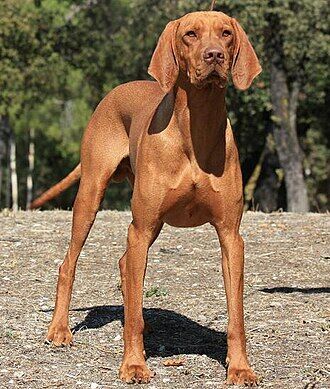
The Black and Fire Austrian Hound is a medium-sized dog, strongly built but stylized, designed for endurance and agility rather than brute strength. Males measure between 50 and 56 cm to the cross and females between 48 and 54 cm, with a weight ranging roughly between 15 and 22 kg. The body is slightly longer than it is tall, with a broad skull, brown eyes of friendly expression, and ears of medium length, flat and rounded tips. The tail is long and slightly curved.
Its hallmark is the colour, which in this breed is a serious matter: intense, dense and short black coat, with well-defined fire-coloured markings (from lilac to light brown) on the legs, chest and face. And, most of all, the two obligatory lions’ spots above the eyes, which gives it that “four-eyed” look. It’s not an aesthetic whim: The dark mantle protects it from the harsh mountain weather, while the fire marks make it visible to the hunter among the thick vegetation.
Origin and history
The history of the Austrian Black-and-Fire Hound is deeply rooted in the hunting tradition of Austria. It is considered a descendant of the older celtic hounds, possibly crossed at some point with Jura hounds from Switzerland. For centuries, the inhabitants of the Austrian mountainous regions selected these dogs for only one quality: their ability to track and retrieve wounded game in difficult terrain and at high altitude.
The decisive step came in the 19th century when the purebred standards and registration movement began in Austria. In 1884 the Austrian canine breeding club (Österreichischen Hundezuchtvereins) was founded, and the first dog registered was, precisely, an Austrian Black and Fire Hound named “Bergmann”. The breed was officially recognized by the International Kennel Federation (FCI) in the year 1954, and much later, in 2006, by the United Kennel Club of America. Today it is still a dog very attached to its land and little spread outside Austria, where it is appreciated as an elite hunter.
Curiosities
- The four-eyed dog. Its Austro-Bavarian nickname, Vieräugl, literally means “four eyes”, for the flaming spots over the eyes that look like a second pair of pupils.
- Many names, one dog. It is also known as Brandlbracke, Kärntner Bracke or Österreichische Glatthaarige Bracke.
- The meaning of “Brandl”.“Brand” alludes to fire, in reference to the lion-like markings, and “Bracke” designates a type of hound that hunts primarily guided by smell.
- He specializes in heights. Its classic job is to follow the trail of wounded game – very often the hare – into the high mountain, where other breeds falter.
- Even to protect forests. Its fine sense of smell has even been used to detect the emerald ash borer, a pest insect, proving that its nose goes far beyond hunting.
If you are attracted to the profile of this Austrian hound, you may also be interested in other breeds with a similar sense of smell and temperament. Check out the Beagle, another sociable and snooty hound; the imposing Bloodhound, the undisputed king of the trail; the unmistakable Basset Hound; or the versatile Dachshund (Teckel), also bred to hunt by smell.
Frequently Asked Questions About the Black and Fire Austrian Hound
Is the Austrian Black-and-Fire Hound a good family dog?
Yes. Despite its purely canine past, it is a dog of a kind, balanced and very attached nature to its people. It gets along well with children and enjoys company. The condition is to give it the daily exercise it needs: a tired and well-stimulated Black and Fire Austrian Hound is a calm and grateful companion inside the house.
Can he live in a flat?
It is not its ideal environment. It is a mountain dog designed to run and trail for hours, so it is much better suited to a house with land in a rural or outlying area. A flat is only viable if the owner compensates with several long outings a day and olfactory work; otherwise boredom, howling and debris appear.
How much exercise do you need a day?
Enough: at least one or two hours of long activity, ideally with free run stretches on safe terrain and sniffing games.
Does he bark or howl a lot?
It has a powerful, melodious voice, characteristic of greyhounds, which it uses when it follows a scent or is excited. It is not a hysterical barker, but if it is bored or spends too much time it can only become vocal. Exercise and mental stimulation are the best prevention.
Is it easy to train?
He is intelligent and loves to work, which helps, but he is also independent and is distracted by any trace. He responds very well to positive reinforcement and short, motivational sessions; rigid obedience and monotonous repetition bore him. Calling in the presence of strong smells is his most difficult subject.
Do you get along with children and other pets?
With children it is usually patient and affectionate. With other dogs it coexists well, especially if it socializes from a puppy.
How long do you live and what health problems do you have?
It is a rustic and healthy breed, with a life expectancy of 12 to 14 years. No specific genetic diseases are known, something uncommon among breed dogs.
Why do they call him “Vieräugl” or “four-eyed dog”?
It is one of the distinctive features of the breed and forms part of its standard.