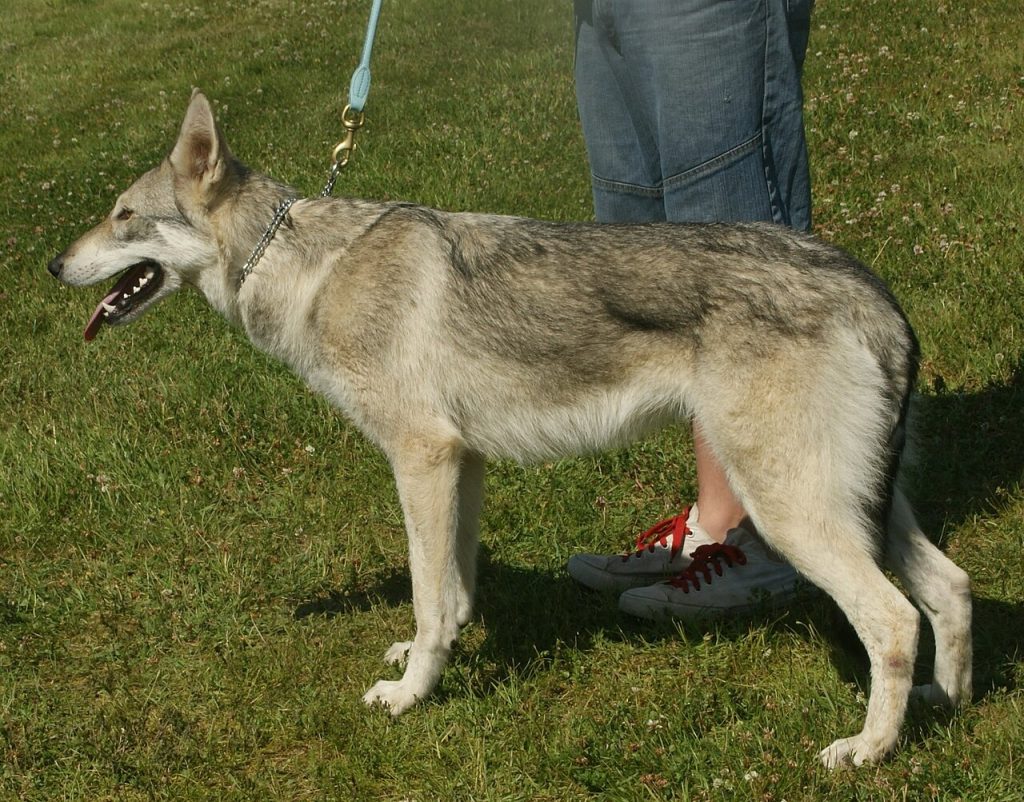
The Saarloos wolfhound is one of the most fascinating and least understood breeds in the canine world: A dog born literally from a cross between a German shepherd and a wolf, with the look, demeanor and instinct of a wolf, but bred for decades as a companion. It’s not a dog for just anyone. Its reserved nature, its enormous need for space, and its emotional sensitivity make it a magnificent animal for those who truly understand what they are dealing with, and a source of frustration for those looking for an easygoing, sociable dog. In this guide, we tell you, without ornaments or legends, what it’s really like to live with a Saarloos Wolfhound.
Is the Saarloos Wolfhound for you?
Before you fall in love with her wolf look, you better be honest: The Saarloos Wolfhound is a demanding dog that does not fit into most homes. It is neither aggressive nor dangerous, but it is profoundly independent, suspicious of the unknown and highly dependent on its human pack. He needs space, time, prior experience with dogs and an outdoor life. Here’s a summary for you to decide with your head and not just your heart.
In favour .
- Spectacular appearance, with the beauty and bearing of a wolf.
- Extremely loyal and attached to his family; forms very strong bonds.
- Quiet and quiet at home: rarely barks.
- Clean and with very little body odor.
- Cold-resistant and enjoys the outdoors.
- Intelligent and observant, very connected to his environment.
Against
- Reserved and shy with strangers; needs intense puppy socialization.
- Not recommended for first-time owners.
- Strong running instinct: can react by running away from fear.
- It’s not suitable for apartments or confined living; it needs a garden and exercise.
- Loneliness and boredom are fatal.
- Limited obedience: not designed to work under orders.
Character and temperament

The temperament of the Saarloos Wolfhound is its most defining trait and also the most misunderstood. Its creator, Leendert Saarloos, sought to recover in the German Shepherd the “natural” qualities of the wolf to obtain a better working dog. The result was just the opposite of an obedient dog: an animal of stubborn, cautious and independent character who never served as a service dog, but who turned out to be an exceptional companion for those who live close to nature.
The Saarloos is first and foremost a reserved dog . With his family he is affectionate, calm, and surprisingly sensitive; he senses people’s moods and becomes intensely attached to his group. With strangers, however, he is shy and suspicious: He doesn’t attack, he retreats. That flight reaction thing he’s afraid of is an inherited wolf instinct and one of the keys to understanding the race. He’s not looking for conflict; he’s looking for distance.
It is a dog that decides. It does not obey because it obeys: it cooperates if it trusts you and if it understands why. Therefore, whoever seeks a dog submissive and eager to please will be disappointed, and whoever seeks a companion with his own criteria will find in the Saarloos a deep and loyal animal.
Coexistence: children, other pets, flat and loneliness
With children: A well-socialized Saarloos Wolfhound is usually affectionate and patient with children in its own family, which it considers part of its pack. However, due to its size, its sensitivity and its tendency to be frightened by sudden movements or loud noises, it is not the ideal breed for homes with very young children, and all interaction should be supervised.
With other pets: is a very “herd” dog, usually gets along well with other dogs and enjoys canine company, which also helps him feel safe.
On the floor: no. The Saarloos is not an apartment dog. It needs space, a secure, well-fenced garden, and frequent contact with the outside. Locked in a floor, without exits or stimuli, it becomes an unhappy and stressed dog.
In the face of loneliness: has a hard time being alone. His strong bond with his family causes him to be anxious about long separation. He is a dog for whom he spends many hours with him, not for whom he is left alone all day.
Education and training

Raising a Saarloos Wolfhound requires patience, consistency, and a realistic understanding of what the breed can and cannot do. Don’t expect mechanical obedience from a German Shepherd or a Border Collie: the Saarloos learns, but decides when to apply what it learns, and responds to the relationship of trust far more than to commands.
The most important piece of your education is the early socialization. Breeders and breed clubs insist that a Saarloos puppy needs thorough and complete before the 12th week of life socialization to ensure balanced social behavior. A puppy that has not been positively exposed to new people, noises, surfaces, and situations in that critical window can become an overly fearful adult. That is why it is strongly recommended that you have prior experience with dogs before adopting one.
Positive reinforcement, calmness and constancy are the only way. Hard or coercive methods are counterproductive: a scared or pressured Saarloos shuts down or flees, does not submit. With respect and confidence, instead, he becomes an attentive and collaborative companion.
Exercise and activity
The Saarloos Wolfhound needs abundant and varied exercise: long walks, runs on safe ground, exploration and, above all, the ability to move in a wide space.
She especially enjoys outdoor activities in nature: hiking, hiking in the countryside or the mountains and long walks where you can use your sense of smell and observe the environment. Many specimens also stand out in sports such as canicross, mushing or canine trekking, where their physical resistance shines. A Saarloos that gets enough exercise and exploration is a balanced dog; one that doesn’t accumulates frustration.
Care: fur and hygiene

The good news for carers is that the Saarloos Wolfhound is a dog of simple maintenance. Its coat is short and dense, with a coat that protects it very well from inclement weather and cold. In everyday life, a weekly brushing is enough to keep it in good condition and remove dead hair.
The exception is the seasonal seedlings: as a good double-coated dog, it sheds plenty of hair a couple of times a year (spring and autumn), and in those weeks it is advisable to brush it much more frequently to control the amount of hair.
Bathing is only necessary when it is really dirty; in fact, the Saarloos is a naturally clean dog with very little body odor. As with any breed, it completes hygiene by checking and cleaning the ears, taking care of dental hygiene and trimming the nails when needed.
Foodstuffs
The Saarloos Wolfhound needs a high-quality food, rich in animal protein, adapted to its large size, musculature and activity level. A dog that exercises a lot in the field has remarkable energy requirements, which must be covered without becoming overweight.
Many owners of wolf breeds opt for meat-based diets (i.e. high-end diets with a high meat content, or natural BARF-type diets well formulated and supervised by a veterinarian). As it is a relatively fast-growing large dog, in the puppy stage it is advisable to take care of the calcium supply and growth rate to protect its joints. Divide food into two daily servings, ensure fresh water is always available, and adjust quantities to your age, weight, and actual expenditure. When in doubt, it is best to design the ration with the veterinarian.
Health and life expectancy
In general, the Saarloos Wolfhound is a rustic and hardy dog, with a life expectancy usually situated around 10 to 12 years. However, the breed carries an important genetic challenge derived from its origin: part of a very small founder base, which has led it to a high degree of inbreeding.
Acknowledging this, the Dutch Kennel Club (Raad van Beheer) launched, after several years of studies with Wageningen University, an ambitious controlled crossing programme(approved in 2012) to increase the genetic diversity, vitality and fertility of the breed through planned crosses with other breeds and with ‘similar’ specimens without pedigree, reintegrating the offspring into the pure Saarloos over several generations. Among the breeds used are the Swiss white shepherd, the Siberian husky, the Iberian pudding or the Norwegian moose hunter.
As with other large breeds, problems such as hypoplasia of the hip and elbow should be monitored, and the puppy should always be purchased from a serious breeder who has undergone appropriate health checks and participates in breed programs.
Physical appearance
The Saarloos Wolfhound is a dog of strong constitution whose appearance, coat and movement unmistakably remind of the wolf, to the point that it often confuses those who do not know it.
- Altura: males 65 to 75 cm at the withers; females 60 to 70 cm.
- Peso: up to about 45 kg in the largest specimens.
- Pelaje: short and dense, with good weather protection.
- Colores: has three recognized varieties: wolf gray (wolfgrey, the most common because its gene is dominant), red or forest brown (forestbrown) and white (rarely, as its gene is recessive, but accepted in the standard).
- Expresión: head and wolf-like look; clear eyes that reinforce that wild air.
Origin and history
The history of the Saarloos Wolf Dog begins in the Netherlands with Leendert Saarloos(1884 – 1969), a zoologist and breeder of dogs. Saarloos believed that the German Shepherd had over-domesticated himself and lost his natural qualities, and wanted to “restore” the wolf’s vigor to obtain a better and healthier working dog.
In 1935 he crossed a male German shepherd with a female Eurasian gray wolf from Siberia, bred at the Rotterdam Zoo. He then re-crossed the offspring with German shepherds until he obtained dogs with about a quarter wolf blood. The resulting animal did not serve as a service dog – it was too independent for that – but as a companion closely connected to nature.
The Dutch canine society officially recognized the breed in 1975, naming it “Saarlooswolfhond” in honor of its creator, who had died a few years earlier. In 1981 came the recognition of the International Cinological Federation (FCI), which classifies it in Group 1 (shepherd dogs and boyeros). Decades later, in 2026, the breed also entered the Foundation Stock Service of the American Kennel Club. Genetic studies have confirmed its uniqueness: DNA analyses show that the Saarloos is one of the breeds with the greatest genetic association with the grey wolf, with estimates placing its lupine ancestry at around 18 – 33%.
Curiosities
- The name in Dutch is Saarlooswolfhond and in German Saarlooswolfhund; in Spanish it is known as Perro Lobo de Saarloos.
- Despite its wolf-like appearance, it is not a modern hybrid: lupine blood comes from a single crossing from the 1930s, greatly diluted over generations.
- Its best-known cousin is the czechoslovak wolfhound, another wolf-looking breed but of distinct origin and character; genetic studies place them with comparable proportions of wolf ancestry.
- It rarely barks: it communicates more with body language and, sometimes, with howling.
- The Dutch Club’s breeding programme is one of the most cited examples of active genetic management of a breed to save it from inbreeding.
If you are attracted to the wolflike appearance, independent intelligence, or impressive size of the Saarloos Wolfhound, you may also be interested in other breeds with which it shares traits. Discover the Pastor Alemán, its founding breed; the sleek and tough Husky Siberiano, employed in its own breeding program; the Norse hunter Samoyedo; and the tireless and brilliant shepherd Border Collie, at the opposite end of obedience to the Saarloos.
Frequently asked questions about the Saarloos Wolfhound
Is the Saarloos wolfhound dangerous?
It is not an aggressive dog. Its instinct in the face of fear is flight, not attack: it tends to run away from the unknown rather than face it. That said, it is a large, reserved and sensitive dog that needs expert socialization and responsible handling, so it is not suitable for everyone.
Is he a good dog for beginners?
The Saarloos requires prior experience with dogs, a lot of patience and an understanding of their independent nature. Their early socialization is critical and their fear reactions can be puzzling to a novice owner.
Can he live in a flat?
It is not advisable. It needs space, a secure, fenced-in garden, plenty of exercise and contact with the outside world. In a flat, without enough exits or stimuli, it becomes a stressed and unhappy dog.
How long does a Saarloos wolfhound live?
Their life expectancy is usually between 10 and 12 years, and proper nutrition, regular exercise, weight control, and regular veterinary check-ups help to reach the upper end of that range.
Does he bark a lot?
No, he’s a remarkably quiet dog who rarely barks, communicating mostly through body language and occasionally howling, another inheritance from his lupine side.
Do you get along with children and other dogs?
With his family and with the children of the house he is usually affectionate, although due to his sensitivity he is not ideal with very small children and always under supervision.
Is it a wolf or a dog?
It is a domestic dog recognized by the FCI, not a wolf or a recent hybrid. Its lupine blood comes from a single wolf cross made in the 1930s and greatly diluted thereafter; genetic studies estimate its wolf ancestry at around 18 – 33%.
What colours is the Saarloos Wolfhound?
The standard recognizes three colors: wolf gray (the most common), red or forest brown, and white (rarer for being recessive, but accepted).