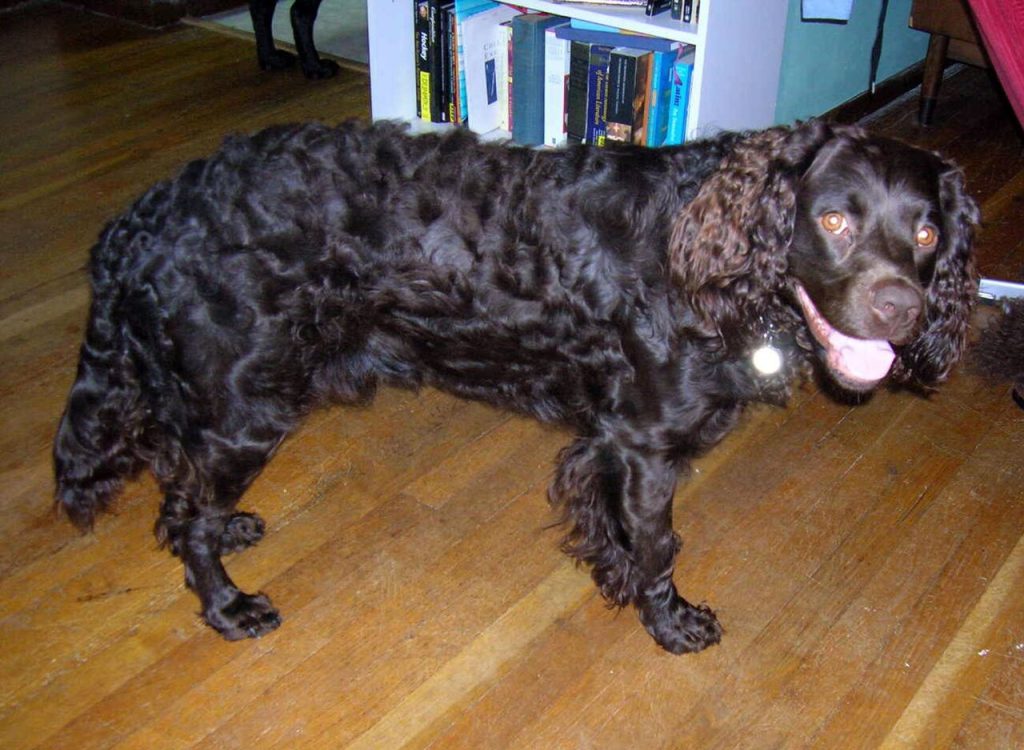
The American water dog is one of the great well-kept secrets of canine science: a medium-sized, curly-haired collector, born in the marshes of Wisconsin to hunt in and out of the water, who could fit in a canoe and endure the cold without crashing. Today it is still a rare breed even in the United States, but those who live with an American Water Dog discover a companion who is cheerful, intelligent, and deeply attached to his family. In this guide, we take a closer look at your personality, cohabitation, care, and health so that you can make an informed decision.

Is the American Water Dog for you?
The American Water Dog is a versatile hunting dog turned into a family companion. It works wonderfully with active people who enjoy the outdoors, the water, and having the dog involved in daily life. It is not a garden dog that is left alone: it needs to be part of the group, do things, and feel useful. Before you fall in love with its curly coat, weigh these pros and cons.
In favour .
- Intelligent and eager to please: he learns fast.
- Medium size and adaptable: lives well on the floor if he exercises.
- Loving and very attached to his family, especially one person.
- Born cobbler in and out of the water, with great strength.
- Good warning dog, attentive and protective.
- Relatively sound health for a pure breed.
To be taken into account
- He gets bored easily and then he can be destructive.
- He has his own personality and can be stubborn.
- It matures mentally slowly: long puppy.
- He can be vocal and, in some lines, possessive about food.
- Rare breed: hard to find serious breeders.
- The coat has a characteristic dog-like, slightly oily smell.
Character and temperament
As a good spaniel, the American Water Dog is friendly, active, and intelligent. It is an alert dog, eager to please and eager to participate in whatever its family is doing. It enjoys being the center of attention and does not mind being noticed: it can be quite talkative and vocalizes when something excites it or requires company.
It is, first and foremost, a one-family dog that tends to bond very closely with a particular person. That loyalty makes him an excellent companion and a good warning dog, since he is naturally protective of his own. The flip side of the coin is that boredom doesn’t do you any good. If left alone and without stimulation for too long, it will seek entertainment on its own and can become destructive.
It also has a mind of its own. It is not a robotic dog that obeys because it obeys; it reflects, evaluates and sometimes decides that its idea is better than yours. That spark, far from being a defect, is part of its charm: with the right, dedicated and patient owner, it reaches a level of complicity and remarkable performance. With age it can become a little more temperamental, without becoming aggressive.

Coexistence: children, other pets, flat and loneliness
Except for a few lines that still retain a dominant temperament, the American Water Dog gets along well with children and enjoys playing with them.
With other pets the coexistence is usually correct, although it is advisable to remember their hunting origin: in front of small animals their instinct can be activated.
One of its strengths is that although it was born to hunt, its medium size makes it well suited to life on the ground, provided it gets enough daily exercise. It’s not a dog that needs acres: He needs activity, water if possible and, above all, company. Prolonged loneliness is his great Achilles heel. Being such a clingy dog, he can’t take long absences and translate boredom into wrecking or barking. If you spend too many hours outside, it’s not your ideal breed.
Education and training
The American Water Dog learns easily and responds very well to training, especially when offered variety rather than repeating the same exercise over and over again.
It is good to start early, with positive reinforcement, patience and consistency. It has character and can get stubborn, so gentle firmness works much better than toughness, which only makes it close. Keep in mind that it matures mentally slowly: it is still a mental puppy for a long time, so you should not be frustrated if it takes too long to “set the head”.
It’s a good idea to work from a puppy on tolerance around the feeder and teach him that the proximity of people to his bowl is something positive, not a threat.
Exercise and activity
We are dealing with a real hunting dog, with the endurance to spend hours working. It needs plenty of daily exercise: long walks, runs, games of chance and, if it has the opportunity, swimming. In the water it is not the fastest swimmer, but it compensates with a very high resistance; it swam for what it was bred and enjoys as few.
Beyond physical exercise, it appreciates mental stimulation and canine sports. It shines in collecting and hunting tests, but also excels in disciplines such as agility and flyball: in fact, the first specimen of the breed won a flyball championship title in 1993. Channeling its energy and intelligence with varied activities is the best way to have a balanced and happy dog at home.

Care: fur and hygiene
The American Water Dog’s coat is its hallmark and a wonder of nature adapted to cold water. It’s a double cloak: a rough outer layer that repels water and protects from weeds and brush, and a dense inner layer that insulates and maintains heat. The hair can be presented in two patterns, tightly curled or in marked waves (the so-called “marcel” pattern), and has a somewhat oily touch that gives it its characteristic “doggy” smell.
That coat requires regular brushing to avoid knots, especially on the ears, chest, and legs, where the hair is longer. It is not advisable to bathe it excessively: Too frequent or aggressive washing removes the natural grease that makes the hair waterproof and protects the skin. As with any dog with droopy ears and a fondness for water, attention should be paid to the ears and they should be thoroughly dried after baths and dips to prevent infection. Complete the routine with your usual nail and tooth care.
Foodstuffs
The American Water Dog needs a complete and quality diet, adjusted to its average size, age and, very importantly, its actual activity level. A dog that hunts or sports burns much more energy than one that walks quietly, and the diet should reflect this. Fans of the breed point out that they usually have a good appetite, so it is good to watch the amounts and not fall into overweight, which punishes their joints.
Keep the food in two servings a day, measure portions and moderate rewards, especially if you use them as a booster in training. Always have fresh water available and, since some lines can be possessive with food, maintain a calm environment when eating.
Health and life expectancy
Overall, the American Water Dog is considered a fairly healthy breed. A peculiarity of its history helped: for a long time it was bred in packs, which maintained a notable genetic variation and prevented the hereditary diseases of the most popular and inbred breeds from being fixed.
Still, he’s not out of trouble. The most documented are the eyepieces: cataracts (which may appear very early, even before one year of age) and progressive retinal atrophy, both of which are suspected to be hereditary. Hypothyroidism, allergies, epilepsy and diabetes are also described, in addition to glandular disorders that cause hair loss around six months, affecting the neck, thighs and tail; the work of breed clubs has reduced their frequency. Hip dysplasia occurs in about 8.3% of specimens according to studies by the Orthopedic Foundation for Animals, one of the lowest rates among sports breeds, and no elbow dysplasia has been found. The Spanish source adds, furthermore, possible heart problems and cancer cases. Buying from breeders who run health tests is the best guarantee.
Physical appearance
The American Water Dog is a medium-sized, compact and well-balanced dog, with a robust and functional pattern without striding.
The color ranges from liver to brown and chocolate, and the standard allows for small white spots on the chest and fingers. The head is broad, with medium-sized ears covered in long hair, and the eyes should harmonize with the hue of the mantle (hazel, brown or chocolate); eyes of a bright yellow are considered eliminative faults. The tail, well proportioned and not amputated, provides balance when running and steering when swimming. Interestingly, his low popularity has had an advantage: the breed has hardly changed since its origins in the 19th century, and the lines of work and exposure have not been separated, so that both types look virtually the same.
Origin and history
The American Water Dog was born in the United States, specifically in Wisconsin, during the 19th century. It developed in the valleys of the Fox River and its tributary, the Wolf River, where hunters needed a very specific dog: a collector capable of working both on land and in the marsh, able to withstand the icy waters of Wisconsin and compact enough to travel in a small skiff or canoe without hindrance.
There is no precise documentation on the exact breeds involved in their creation, but experts point to a mixture that may have included the English Water Spaniel (now extinct), the Irish Water Dog, the Curly Coated Retriever, the Spanish Water Dog, some field Spaniel or the Sussex Spaniel, the Poodle and even native dogs, with a possible contribution from the Chesapeake Bay Retriever. From that combination came a brown dog, then known as the American Brown Spaniel, with curly and dense hair, used to hunt waterfowl, lagopods, prairie chickens, and various furry animals.
In time, the breed was on the verge of extinction: commercial hunting sank due to economic changes and drought, duck populations dwindled and, after World War II, came Wisconsin setters, pointers and other more specialized spaniels. She was saved by a man: This is Dr. Fred J. Pfeifer of New London, Wisconsin, who founded the Wolf River Kennels to preserve it, set its standard and promoted it nationwide. Thanks to its tenacity, the United Kennel Club recognized it as the American Water Spaniel in 1920, the Field Dog Stud Book in 1938 and the American Kennel Club in 1940. In 1985 it was named the state dog of Wisconsin. Even so, it remains a rare breed, with about 3,000 specimens concentrated mostly in the American Midwest.
Curiosities
- Dog of a state. has been the official state dog of Wisconsin since 1985, an honor reserved for very few breeds.
- After its heyday in the 1920s and 1930s, The forgotten American. fell into obscurity, earning the nickname forget about American ..
- Father of another race. It is considered to have been one of the main breeds involved in the development of the Boykin Spaniel; according to some historians, the original “Dumpy” that gave rise to the Boykin may have actually been a stray American Water Dog.
- Pioneer of flyball. The first specimen of the breed to achieve a flyball championship title did so in 1993.
- Made for the canoe. Its compact size was a design requirement: it had to fit on a skiff without occupying the hunter’s seat.
If you are attracted to this curly collector but want to compare profiles before deciding, take a look at other related breeds: the classic Cocker Spaniel, the inexhaustible Labrador Retriever, the sweet Golden Retriever and the versatile Caniche (Poodle), present in their own lineage.
Frequently Asked Questions About the American Water Dog
Is the American Water Dog a good family pet?
Yes, except for a few lines with a dominant temperament, he’s affectionate, gets along well with children and has an intense bond with his family, needs to be a part of daily life and doesn’t tolerate prolonged loneliness well.
How tall and how much does he weigh?
It is a medium-sized dog: it measures between 38 and 46 cm at the withers and weighs between 11 and 20 kg. Some specimens reach 50 cm and 23 kg.
Can he live in a flat?
Yes, its medium size makes it suitable for living on the floor as long as it gets enough daily exercise.
Does it lose a lot of hair and smell?
It has a double curly coat that requires regular brushing. Its hair is oily to make it waterproof, which gives it a characteristic “doggy” smell.
Is it easy to educate?
It learns quickly and responds very well to positive reinforcement, especially if the sessions are varied. It has its own personality and can get stubborn, and it matures mentally slowly, so it requires patience and consistency.
How much exercise do you need?
It is a highly resistant hunting dog, requiring long walks, charging games and, if possible, swimming. It also enjoys agility, flyball and other dog sports.
What health problems might you have?
It is a relatively healthy breed, but can suffer from eye problems (cataracts and progressive retinal atrophy), hypothyroidism, allergies, epilepsy, diabetes, glandular disorders with hair loss and, to a lesser extent, hip dysplasia.
Is this a rare breed?
Although it is the state dog of Wisconsin, it is still uncommon, with an estimated 3,000 living, mostly in the Midwestern United States.