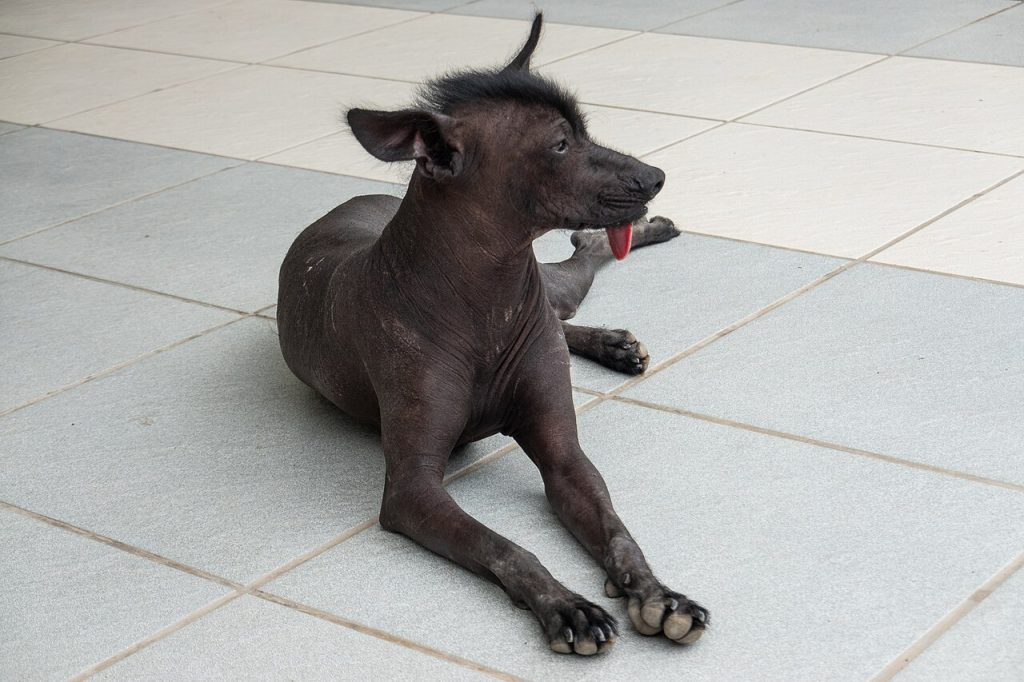
The Hairless dog from Peru– also known as the viringo, calato dog or chimú dog – is the only canine breed native to Peru and one of the oldest dogs in the Americas.
Is the hairless dog from Peru for you?
The viringo is a quiet, clean, and surprisingly easy-to-keep-at-home companion dog, but its bare skin imposes some very specific needs. Before you fall in love with its unique appearance, you should know what to expect from day to day with this breed.
In favour .
- It doesn’t shed hair and it doesn’t smell like a dog. It’s great for home.
- Very well tolerated by allergy sufferers.
- Clean, discreet and quiet inside.
- Healthy and long-lived, with few hereditary problems.
- Loyal, affectionate and very close to his family.
- It adapts well to different floors and sizes.
To be taken into account
- The skin needs sun protection and a coat in the cold.
- Reserved with strangers: requires socialization.
- Sensitive to stress and prolonged loneliness.
- He usually has incomplete dentures.
- He needs daily exercise despite his calmness at home.
- Rare breed: serious breeders can be hard to find.
Character and temperament

The Hairless Dog of Peru has a noble, balanced character and is very attached to his own. It’s a companion dog in the most literal sense: He seeks closeness to his family, enjoys contact, and develops an intense attachment to the people he considers his pack. Inside the house it is serene, observant, and quiet; it is not a barking or nervous dog, but rather restrained and elegant in its movements.
With strangers he is reserved and somewhat suspicious, a trait inherited from his primitive nature that makes him a good warning dog, attentive to what is happening around him. He’s not aggressive, but he’s cautious, and he needs time to accept strangers. That same sensitivity makes him an emotional dog: perceives the home environment, is sensitive to stress and responds much better to affection and patience than to overly firmness.
It is intelligent and alert, with a remarkable memory and a great ability to read its owner. Well treated, it turns out to be a faithful, grateful and balanced companion; poorly managed or poorly socialized, it can become shy or overly fearful. The key to its temperament lies in the trust we can give it.
Coexistence: children, other pets, flat and loneliness
The Viringo is an excellent family dog when it grows up in a stable environment. With the respectful children it is affectionate and patient, although its sensitive skin and reserved character ask for interactions to be calm and supervised: it is not a dog that tolerates rough treatment.
With other pets it usually gets along well, especially if it is bred with them from puppyhood. It coexists without problems with other dogs and can share a home with cats, although it retains a certain hunting instinct that should be taken into account with very small animals such as rodents or birds.
He ‘s a perfect dog for living in a flat: its small size, its cleanliness and its calm interior make it ideal for urban environments, provided you go out every day. The worst thing he wears is the extended loneliness. It is an emotionally dependent dog that suffers if left alone for long hours, so it fits better in homes where someone spends time at home or can be organized to not be left isolated for whole days.
Education and training
The Peruvian Hairless Dog is intelligent and sensitive, a combination that facilitates learning as long as the right approach is used. It responds wonderfully to positive reinforcement– rewards, caresses, kind voice – and very poorly to harsh or authoritarian methods, which only block it or make it lose confidence. It is a dog that works to please whoever it wants, not by submission.
The absolute priority in their education is the early socialization. Due to their reserved nature, it is advisable to expose them from puppyhood to people, noises, other animals and different environments so that they grow up safe and do not become fearful.
In basic obedience it learns quickly if the sessions are short, positive and consistent. It is not a working dog or especially stubborn, but it does need consistency and patience. Its fine reading of human moods makes it very receptive to a calm and constant owner.
Exercise and activity

Although calm at home, the Peruvian Hairless Dog is an agile and athletic dog that needs its daily exercise ration. It comes from a primitive, fast and resistant type, and appreciates walks, games and the possibility of running in a safe space.
It is not a hyperactive dog or a high demanding sport, but it is also not a sedentary dog: if it is not given physical and mental outlet, it can accumulate stress and boredom.
It is necessary to adapt the exercise to the climate. In summer it is advisable to walk in the cool hours and protect it from the sun; in winter, keep it warm and avoid the wet cold.
Skin care and hygiene
The absence of a coat makes the skin the center of all the viringo’s care, but far from complicating life, in many respects it simplifies it: there is no hair to brush, no shaving, no hairdressing.
You need soft baths with some regularity to remove the fat that’s secreting the skin and keep it clean, not abuse to not dry it out. Then keep her hydrated is suitable with creams or oils suitable for dogs, as it tends to dry. In summer the sun protection is a must: their skin burns easily, so canine sunscreen is recommended on exposed areas and avoid sunlight hours. In winter, however, he needs a coat– a sweater and a warm bed – because he feels the cold much more than a hairy dog.
In addition, hygiene is the usual: checking and cleaning of ears, cutting nails and, with special attention, care of the mouth, since many specimens have incomplete teeth.
Foodstuffs
The Peruvian Hairless Dog does not have exotic dietary requirements, but it is advisable to adjust the diet to its size, age and activity level. A balanced and quality diet, rich in protein of good origin, favors both its physical condition and the health of its skin, which is its most delicate point.
Since there are three sizes – small, medium, and large – rations vary greatly from one animal to another, it is wise to follow weight-based feed guidelines and control the scale to avoid both overweight and thinness.
Fresh water always available and orderly eating routines complete a simple dietary plan.
Health and life expectancy

The Viringo is a rugged and healthy breed, with a life expectancy between 11 and 13 years and few serious hereditary problems. Its ruggedness comes from centuries of natural selection: its characteristics have barely changed in thousands of years, giving it remarkable robustness.
The specifics of their health revolve around the hairless gene. This same gene causes many specimens to have incomplete dentition, with no premolars and molars, something that must be monitored with mouth checks. The naked skin is the other big spotlight: without proper care you may suffer from sunburn, dryness, irritation or skin problems. Protection from the sun, cold and dehydration is the best preventive medicine.
In breeding it is a breed without notable complications, beyond the embryonic mortality associated with the lethal gene in homozygosis, which explains that in each litter is born also a proportion of puppies with hair.
Physical appearance
The hairless dog of Peru is a slender, elegant and harmonious animal, which transmits strength and agility without being rough. Its most defining trait is the absence of hair: the skin is smooth and naked, although it can retain some hair on the head (sometimes a characteristic crest), on the legs and on the tip of the tail.
The skin comes in a wide variety of colors: black slate, elephant grey, chocolate brown, copper or mottled tones, either full colour or with pink or white spots, especially on the face and chest. eyes are always brown, lighter in fair-skinned specimens and darker in dark-skinned ones; albinism is not admitted. The ears, shaped like a candle flame, is held upright and can be folded.
The ratio between height to cross and body length is 1:1, giving it a square and balanced silhouette. The breed is divided into three sizes: small (25-40 cm and 4-8 kg), medium (40-50 cm and 8-12 kg) and large (50-65 cm and 12-25 kg), allowing you to choose the size that best fits each household.
Origin and history
The Peruvian hairless dog is one of the oldest dogs on the American continent and the only native of Peru. Their presence is documented in pottery from pre-Inca cultures such as the Vicús, Moche, Chancay, Sicán and Chimú, with representations appearing from around 300 BC. C. And they go all the way back to the 15th century. In addition, pre-Columbian bone remains have been found: In the famous tomb of the Lord of Sipán, discovered in 1987 by archaeologist Walter Alva, the moche figure rested surrounded by companions and a dog.
The Incas called it allqu and it was also known as cabbage; the name vyring seems to come from the moches, whose descendants on the northern coast of Peru still call it so.
Official recognition came to the 12 June 1995, when the Federation Cynologique Internationale (FCI) registered it with the number 310, classifying it in Group V (Spitz type and primitives), section 6 of primitive type dogs. In 2001, the Congress of the Republic of Peru declared it Heritage of the Peruvian nation and ordered the presence of specimens in museums and archaeological areas of the coast. Today it is a symbol of the country, celebrated in its art and literature.
Curiosities
- It’s a medicinal dog. Due to the heat emitted by its naked skin, it was traditionally attributed properties to relieve rheumatism and respiratory ailments, acting as a living “hot water bag”.
- A lot of names. Viringo, Clawed Dog, Chimu Dog, Chinese Dog, Sechura Dog, Orchid Dog or Vitilingo: few breeds accumulate so many popular appellations.
- Relative to other naked dogs. shares the same nudity gene (Foxi3) with the Mexican xoloitzcuintle and the Chinese crested.
- Keeper of museums. An official resolution set out to place specimens in site museums and archaeological areas of the Peruvian coast, reinforcing their role as living heritage.
- An American cousin. In the early 20th century, some hobbyists in the United States developed from thirteen specimens brought from Peru a related variety, the Peruvian Inca Orchid Dog, recognized by the AKC.
If you are drawn to the world of primitive, exotic or companion dogs, you may be interested in other breeds with their own personality. You can discover the elegant and fast Greyhound, the spectacular and leafy Chow Chow, the independent and noble Akita or the sociable and familiar Whippet, all with stories as unique as the viringo.
Frequently Asked Questions About the Hairless Dog of Peru
Is the Peruvian Hairless Dog hypoallergenic?
Since it has no coat, it does not shed hair and hardly accumulates dandruff, fleas or ticks, so many allergic people tolerate it better than other breeds. There is no 100% hypoallergenic dog, but the viringo is one of those that generates the least environmental allergens.
Do you get cold because you don’t have hair?
Yes. Its bare skin makes it sensitive to cold, currents and humidity, and in winter it needs a coat or a sweater and a warm bed. In summer, however, it must be protected from the sun with sunscreen suitable for dogs because it burns easily. It is a dog designed for temperate climates and to live indoors with its family.
Why are puppies sometimes born with hair?
The absence of hair is caused by a dominant gene with lethality in homozygosis: embryos with double copies do not develop. Therefore, when crossing two specimens without hair, a proportion of puppies with hair (carriers of the recessive allele) are always born.
How long does a hairless Peruvian dog live?
It is a rustic breed with few serious hereditary problems; its longevity depends mainly on a balanced diet, regular exercise, and protection from the sun and cold.
Does it have fewer teeth than other dogs?
Yes, the same gene that causes hairlessness is associated with incomplete teeth: many virgins lack some premolars and molars. It does not usually cause problems with eating, but it is advisable to take care of oral hygiene and check the mouth with the veterinarian, especially in completely naked specimens.
Is he a good companion dog for a flat?
Yes, it is one of the primitive dogs best adapted to the home. It is clean, does not smell like a dog, does not shed hair and is quiet inside as long as it has its daily exercise ration. Its small to medium size and its attachment to the family make it very suitable for living on the floor.
Do you get along with children and other pets?
Well socialized it is affectionate and loyal to its family, including respectful children. It is sensitive and somewhat reserved with strangers, so early socialization is appropriate. With other dogs and pets it usually coexists without problems if it grows up with them, although it retains a certain hunting instinct with very small animals.
Do you need a lot of skin care?
Their care is simple but specific: gentle baths from time to time, moisturizing of the skin to prevent dryness, sun protection in summer and a coat in winter.