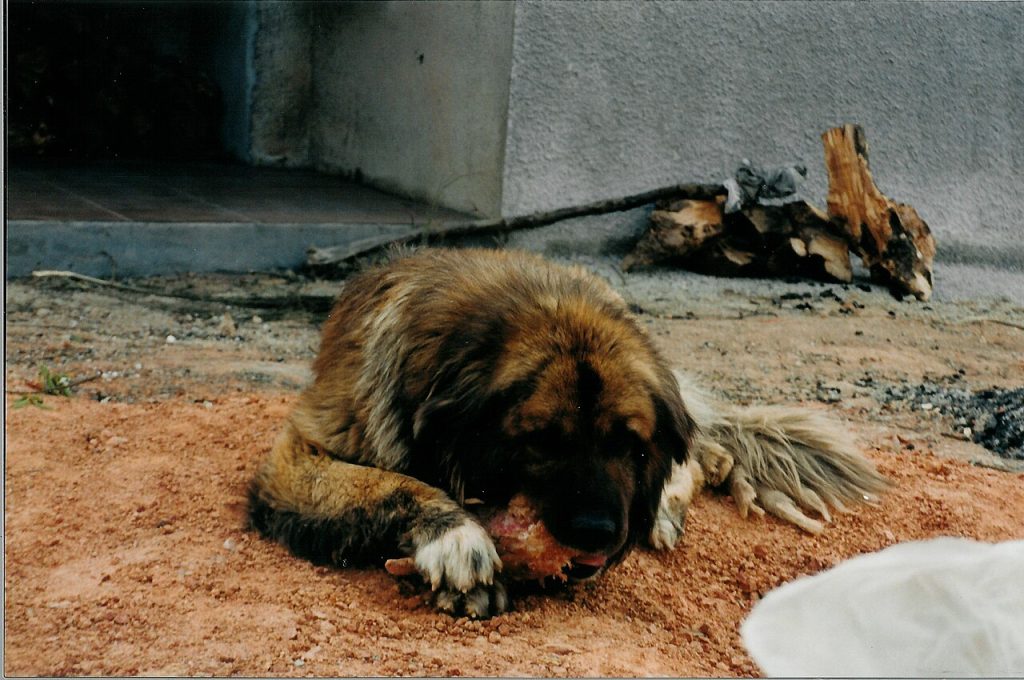
The Dog from the Sierra de la Estrella(in Portuguese Cão da Serra da Estrela, and in English Estrela Mountain Dog) is an imposing herding dog native to the Portuguese mountain range that gives it its name. Large, rustic and with a centuries-old protective instinct, it combines quiet nobility inside with unwavering vigilance outside. If you’re looking for a loyal keeper and a serene companion for a family with space, the Star Mountain Dog deserves to be thoroughly explored.
Is the Star Mountain Dog for you?

Before you fall in love with his behavior as a mountain guardian, you should be honest about what it entails. The Sierra de la Estrella Dog is a large, territorial and independent dog, bred to make decisions on its own in front of the wolf. It is not a complicated dog, but it is demanding in space, commitment and serene leadership. These are its most sincere pros and cons.
In favour .
- Exceptional guardian: vigilant, courageous and very deterrent.
- Loyal and deeply attached to his family.
- Quiet and balanced indoors as an adult.
- Very tolerant and protective of the children in his household.
- Rustic and hardy, adapted to the cold and outdoor life.
- Intelligent and independent: he knows how to be alone without being overwhelmed.
Against
- Territorial and suspicious of strangers: demands serious socialization.
- Big and strong; not suitable for first-time owners without advice.
- It needs space and, if possible, fenced land.
- Strong and frequent barking if it detects anything out of the ordinary.
- It moults abundantly in the spring.
- Independent character: obeys out of obligation, not out of blind submission.
Character and temperament
The temperament of the Sierra de la Estrella Dog is a direct result of his trade. For centuries he stayed with the herd while the shepherd was absent towards the village, and from there a dog independent, calm and able to make decisions for himself was born. He does not expect constant orders: he evaluates the situation and acts.
With his family he is loyal, affectionate and surprisingly calm. Inside the house he tends to be a quiet dog, saving his energy for when it’s needed. In the face of the unknown, however, he displays his guardian side: distrusts the stranger, watches his territory and warns with a loud bark. It’s not unwarranted aggression, it’s inherited prudence. A well-bred, well-socialized specimen makes the perfect distinction between a welcome visit and a real threat.
This protective instinct, coupled with its size, demands a owner who exercises calm and consistent leadership. It responds poorly to abruptness and very well to respect and bonding.
Coexistence: children, other pets, flat and loneliness

With the children is usually patient and protective; its guardian instinct leads it to consider the smallest of the house as part of the herd to care for.
With other pets, the key is early socialization. Raised from puppyhood alongside other dogs or cats, it coexists without problems; its original function was to protect animals, not hunt them. With unknown dogs of the same sex it can be territorial, something common in herd guards.
As for the floor., is not its ideal environment: it is a large, powerful barking dog with a need to guard a territory. It performs much better in a house with a fenced garden. In the face of loneliness, on the other hand, behaves quite well: its independent character allows it to wait patiently for the owner to return, provided it receives enough company, exercise and attention the rest of the time.
Education and training
Training a Star Mountain Dog is an exercise in patience and consistency rather than mechanical repetition. It is intelligent and learns quickly, but its independence makes it ask “why should I do this?” before obeying. It is not a dog of precision sports obedience; it is a dog that collaborates with those it respects and with whom it has a solid bond.
The early socialization is non-negotiable. A puppy that knows people, noises, environments and other animals during its first weeks becomes a confident adult who knows how to modulate its natural distrust. Neglecting this stage produces excessively reserved or reactive specimens, difficult to handle because of their size.
It works with positive reinforcement, clear boundaries and short sessions. Abruptness and punishment are counterproductive: they erode the trust on which all their cooperation is based. It is advisable to work from a puppy on the acceptance of handling, the call and control of the bark, and to channel its guardian instinct instead of repressing it.
Exercise and activity
Its energy level is medium: it is a functional mountain dog, not a tireless athlete or a nervous dog. With one or two daily walks of good duration, access to a space where to move at its own pace and some mental stimulation is satisfied. It especially enjoys walks in the countryside and outdoor time, for which its coat prepares it abundantly.
An important nuance affects the puppies and young dogs: being a large, fast-growing breed, exercise must be dosed during development. Over-exertion, jumping and slippery floors favor joint problems.
Care: fur and hygiene

The coat of the Sierra de la Estrella is double and dense, designed by nature to withstand the harsh winters of the high mountain. There are two varieties: long hair, slightly wavy and somewhat more abundant, and short hair, more attached to the body. In both cases the maintenance is simple and practical, without the need for specialized hairdressing.
Outside of the mud, a weekly brushing is enough to keep the hair clean and knot-free and, by the way, strengthen the bond with the dog. In seasonal seedlings, especially in spring, sub-hair shedding is noticeable and brushing several times a week is advisable to remove dead hair. Bathing should be sporadic, only when the dog is really dirty, so as not to damage the natural protection of the coat. Complete the routine by checking your nails, ears and teeth.
Foodstuffs
As a large dog, it needs a balanced and high-quality diet, adapted to its life stage, weight and activity level.The most delicate phase is the puppy phase: as it grows rapidly, an excessive energy intake accelerates bone development and increases the risk of dysplasia.It is advisable to use a feed formulated for growing large breeds and follow the veterinarian’s guidelines.
In the adult, the main target is avoid obesity at all costs: overweight punishes the joints of a dog already large. It is advisable to divide the daily ration into two servings, respect the rest around meals (due to the risk of gastric torsion typical of deep-breasted breeds) and monitor the weight regularly, going to the veterinarian if necessary.
Health and life expectancy
The Sierra de la Estrella Dog is, as a whole, a rustic and resistant breed, forged by generations of hard mountain life.
The main aspect to watch out for is the hip and elbow dysplasia, common in large breeds. It is a disease of partly hereditary and partly environmental origin: the dog is not born dysplastic, but factors such as slippery soils, an unbalanced diet, excessive or lack of growth exercise, and an unfavorable genetic load can trigger abnormal joint development. That’s why it’s critical to acquire parents with evaluated hips puppies and take care of weight and exercise during the first few months.
As with other deep-breasted breeds, it is advisable to be aware of the risk of gastric torsion and to adopt preventive eating habits.
Physical appearance
It is a of a thickness of not more than 10 mm dog, of robust and harmonious construction that transmits strength without heaviness. The males usually measure between 65 and 72 cm at the cross and the females between 62 and 68 cm, with an approximate weight of 40 to 50 kg in males and slightly less in females.
The head is strong and well-proportioned, with a serene and attentive expression and dark amber eyes. The ears, small in relation to the head, hang backwards. The neck is powerful and, in many specimens, has a paw and mane that reinforce its majestic air. The tail, long and well-populated, usually ends in a light hook.
The coat, in its long and short hair varieties, features lionskin (in different shades), wolf and gray colors, often with the characteristic dark mask on the face.
Origin and history
The Sierra de la Estrella Dog takes its name from the The Serra da Estrela, the highest mountain range in mainland Portugal, in the centre of the country.
There is a theory that in the time of the Visigoths, large dogs from the Asian plateaus were progressively introduced into different parts of Europe. These guard dogs accompanied shepherds and flocks on their annual migrations, including transhumance, to defend them from wolves and raiders. In the Serra da Estrela, this breed was shaped for centuries according to the meteorological and orographic conditions of the area, the management of livestock and the patient selection of shepherds, attentive both to the ability to protect and to certain aesthetic features.
The modern organization of the race came late: Associação Portuguesa do Cão da Serra da Estrela (Portuguese association of horse riding and horse riding) was founded in Lisbon in December 1986 and its statutes were published the following year in Diario of the Republic, the Portuguese Official Gazette. It is recognized by the FCI within group 2 (pinscher and schnauzer type, molosoid and mountain dogs), as the portuguese standard number 173. Already in the XXI century, some specimens have returned to their ancestral trade protecting herds of the Iberian wolf, today a protected species.
Curiosities
- Its Portuguese name, Cão da Serra da Estrela, literally means “dog of the star range”, in reference to the highest mountain range in peninsular Portugal.
- It is considered one of the oldest dog breeds on the Iberian Peninsula, with centuries of work behind it.
- It exists in two varieties of mantle – long hair and short hair – that share identical character and function.
- Their majestic air owes much to the mane and paw that many adults wear around their necks.
- In the 21st century, it has recovered part of its original role: protecting herds from the Iberian wolf, now a protected species.
- Outside Portugal it has breed clubs in countries such as the United Kingdom, the Netherlands, Sweden, Finland and the United States.
If you are attracted to the Serene Great Watchdog profile of the Sierra de la Estrella, you may also be interested in other breeds of similar size and function: Mastín, another protective colossus; the versatile and familiar Gran Danés; the rugged Italian Watchdog Cane Corso; or the gentle mountain giant San Bernardo.
Frequently Asked Questions about the Star Mountain Dog
Is the Star Mountain Dog a good family dog?
Yes. Despite its origin as a herd guardian, it is a loyal dog, quiet in the house and remarkably tolerant of the children in its family. It needs, of course, early socialization, a present owner and space; it is not a dog designed to live isolated in a kennel or for first-time hands without advice.
How long does a Star Mountain Dog live?
The normal life expectancy of this large mountain breed is around 10 to 12 years. Controlled weight, adequate exercise during growth and good hip monitoring help to reach the high end of that range.
Do you need a lot of exercise?
It is a medium-energy dog: it is not hyperactive, but it is large and functional. With one or two long walks a day, access to a space to move and some mental stimulation is enough. During growth it is advisable to avoid excessive effort and slippery soils to take care of its joints.
Is he aggressive or dangerous?
It is not a dog of gratuitous aggression, but it is territorial and distrustful of strangers: it was bred precisely for that. Well socialized it distinguishes perfectly between a visit and a threat. Its size and its guardian instinct demand responsible handling, positive reinforcement and clear boundaries from puppyhood.
Does it fit on a floor?
It’s not their ideal environment. It’s a big dog, with a powerful barking and guarding instinct, which performs best in a house with fenced terrain. It can live on the floor if it gets long walks, frequent outings and company, but you have to assume its size and its need for space.
How much hair does it shed and what care does the mantle need?
It has a dense double coat and performs abundant seasonal moulting, especially in the spring.
What health problems does the breed have?
The point to watch, as in almost all large breeds, is hip and elbow dysplasia, of partially hereditary and environmental component.
Where did the Star Mountain Dog come from?
It is considered one of the oldest canine breeds on the Iberian Peninsula, developed for centuries by shepherds to protect herds from wolves and thieves.