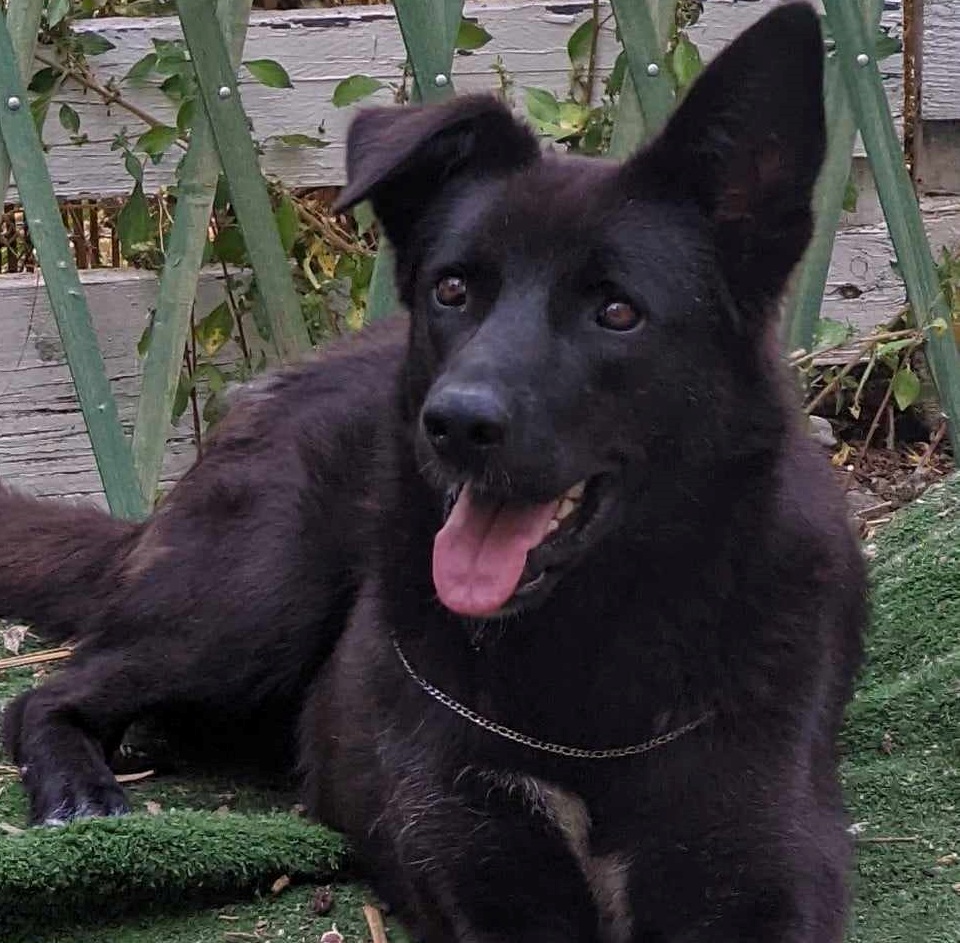
The Alopekis is one of the oldest and most unknown dogs in Europe: a small, rustic, fox-faced, indigenous Greek breed that for thousands of years hunted rats, guarded the herd and helped the shepherd on the Balkan farms. Today it is critically endangered, but those who live with an Alopekis describe a lively, loyal and surprisingly well-balanced dog, just as happy in a yard as in a flat. In this comprehensive guide, we review their character, care, health, and fascinating thousand-year history to help you decide if the Alopekis is the right dog for you.
Is Alopekis for you?
The Alopekis is a multifunctional farm dog converted into a companion. It is small but not delicate: energetic, smart and very attached to his family. Before looking for one should know that it is a very rare breed, without recognition by the FCI and with very few specimens outside Greece, so getting a genuine puppy is difficult. These boxes summarize for who fits and for who does not.
In favour .
- Small and manageable size (4-7 kg), adaptable to floor or cottage.
- Very loyal, obedient and affectionate to his people.
- Excellent alarm dog: alert and brave despite its size.
- Rustic and easy-to-maintain fur, very clean by nature.
- Good with kids and other farm animals.
- A native hunter of rodents (rats, mice), very useful in the rural environment.
Against
- Critically endangered species: finding specimens is very complicated.
- High energy: needs daily exercise and stimulation, not a couch dog.
- Hunting instinct marked for rodents and small prey.
- He may bark to warn; it is best to train him as a puppy.
- No FCI standard or established breeding clubs.
- He needs company: prolonged solitude is not good for him.
Character and temperament

The Alopekis combines two qualities that do not always go together: it is at the same time calm inside and very active outside. As a companion it is obedient, calm and deeply loyal to its owners. It is an expressive and friendly dog with people, enjoys family life and easily wins the affection of everyone.
That sweetness doesn’t take away his character. The Alopekis is awake and alert: He has a strong protective instinct for his family and for the animals he lives with, and he will not hesitate to sound the alarm at any new development. For centuries he was the keeper of the stables, and that role of brave sentry is still etched into his temperament. Despite its small size, it shows remarkable self-confidence.
It is also a high-energy dog, able to travel very long distances without getting tired. This versatility makes it suitable for both an urban and rural home, and adapts as a companion to people of all ages.
Coexistence: children, other pets, flat and loneliness
With children: the Alopekis has a reputation for being good with the little ones. Its sociable character, its small size and its endurance make it a good playmate, always with the supervision and mutual respect that any dog requires.
With other pets: has traditionally coexisted with chickens, ducks and other farm dogs, including the large cattle guard Greek Mastiff. It is, therefore, a dog accustomed to sharing space.
Although On the floor: was born as a field dog, its small size and clean nature make it perfectly compatible with apartment life, provided its need for daily exercise is met.
In the face of loneliness: is a dog that is attached to his family and enjoys company. It is not the ideal breed to spend many hours alone every day; if he is going to stay at home, it is advisable to accustom him gradually and leave him stimuli to avoid boredom.
Education and training
The Alopekis is a quick and cooperative dog, which greatly facilitates its education. Its obedient nature and its attachment to its owner make it respond well to training based on positive reinforcement, rewards and play. Like any primitive breed, it values consistency: it needs clear rules and a kind but firm leader, not imposition.
Early socialization is key. Exposing your puppy to people, noises, other dogs, and a variety of situations as a puppy will help him channel his watchful instinct and distinguish between what deserves warning and what does not. It is also good to work on calling and self-control early on, because your hunting instinct may lead you to run after an interesting rodent or trail. Short, dynamic and motivating sessions yield better results than long, monotonous routines.
Exercise and activity
Don’t be fooled by its size: the Alopekis is a high-energy dog, historically capable of accompanying livestock and covering kilometres daily.
Long walks, olfactory games, interactive toys, object searching and canine sports like agility come as a marvel: They take advantage of their agility, their sense of smell and their intelligence. An Alopekis who is bored may become restless or develop undesirable behaviors, so the key is to give him a job or a game that occupies his mind. In rural environments, their fondness for patrolling and controlling vermin serves as a natural activity.
Care: fur and hygiene

One of the great advantages of the Alopekis is its low maintenance requirements. It has a double coat (with insulating inner layer) that comes in three varieties: short, hard and smooth; semi-long, rough and twisted; or semi-long, hard and wire-like in texture. In all cases it is a durable coat, designed for the dog to live comfortably outdoors, and should never be thin, sparse, soft or silky.
Weekly brushing is sufficient to keep it in good condition; during mowing it is advisable to increase the frequency. The texture and quality of the hair help it to keep clean on its own, and the Alopekis is also a very neat dog by nature, which is groomed frequently and carefully. Bathing should be occasional, only when it’s really dirty. As with any dog, complete hygiene with regular checkups of ears, teeth and nails.
Foodstuffs
The Alopekis has no special dietary needs beyond those of a small, active and rustic dog. The ideal is a complete and quality food, adjusted to its age, weight and activity level, divided into one or two daily intakes.
Given their small size, it is advisable to monitor the quantities and not abuse the prizes to avoid overweight, which would overload their joints and reduce agility to a dog designed for movement.
Health and life expectancy
The Alopekis is, first and foremost, a healthy, rustic dog. Since it is an indigenous breed formed by natural selection over millennia, and not by intensive artificial breeding, it lacks the exaggerated traits that cause problems in many modern breeds. It is of mesomorphic and symmetrical constitution, with regular dentition and without dwarfism: their legs are not shortened and the acquired clubfoot is considered a defect. This absence of hypertypes plays into their health and longevity.
There are no official health studies or consolidated life expectancy figures for the breed, in part because of its small population. What those who know her do point out is that rusticity is her best insurance: If it is well fed, exercised and given basic veterinary care (vaccination, deworming and checkups), it is usually a long-lived dog with few problems. The greatest threat to the Alopekis is not a specific disease, but its delicate situation as a breed on the brink of extinction.
Physical appearance
The Alopekis is a small, volcanic-looking dog – hence its name, which in ancient Greek alluded to a cross between dog and fox. Its most characteristic features are its wedge-shaped head, erect, pointed ears, and sickle-shaped curved tail.
It’s classified as a primitive dog: robust body, symmetrical and harmonious complexion, without the deformations of the hypertiped breeds. It averages between 25 and 30 cm to the cross and weighs between 4 and 7 kg. As far as colour is concerned, all shades and combinations are acceptable except for the complete absence of pigment (albinism). The most common are white, black, brown and bicolor (black and white, white with spots, black with white marks, brown with fire marks), and less frequently whitish and yellowish tones.
Origin and history

The story of the Alopekis goes back to prehistoric Greece. Their domestication is prior to the Mycenaean period (around 1750 BC). C.), and the earliest known depiction comes from the Neolithic: an engraved pithos(large vessel), found in Thessaly and dated to about 3000 B.C. C., shows the unmistakable silhouette of an Alopekis. It is preserved in the Archaeological Museum of Athens and is the oldest dog image in Greece. A similar find, from Rafina, dates to the Early Bronze Age (2500-2100 BC). C.).
First-rate classical authors mentioned the breed: Aristotle, Xenophon, and Aristophanes. In his hunting treatise Cinegético, Xenophon describes the Alopekis as one of the two great Greek examples of a hunting dog.
For centuries, the Alopekis was the farm dog par excellence throughout Greece: He exterminated rats and mice, protected poultry from foxes, jackals and weasels, and worked side by side with the big shepherd and guard dogs. Because of its size, it could even nest with the hens in the henhouse. Today the breed has suffered a dramatic population decline – in part because of mass sterilization campaigns to reduce stray dogs – and is considered critically endangered. There are still small settlements in northern Greece (Serres, Drama, Xanthi…), and groups of Greek amateurs work to preserve this living treasure of cynology.
Curiosities
- His name means “dog-fox”. The ancient Greek ἀλωπεκίς(alōpekís) designated a cross between fox and dog; it was also called Κυναλώπηξ(Kynalópex), with the same meaning.
- It’s got a lot of local names. Depending on the region it is known as Alepuditsa, Alepudoskylo, Venetaki, Zacharoskylo, Moropa, Bombis, Bouboudi, Tsoupi or Fneli, among others.
- It’s one of the oldest dogs in Europe. Its silhouette appears engraved on pottery from over 5,000 years ago.
- It’s not recognized by the FCI. Despite its age, Alopekis does not have an official International Canine Federation standard.
- Despite weighing only a few pounds, Pocket watchman. was valued for centuries as a brave keeper of the corral and home.
If you are attracted to the Alopekis because of its compact size, its watchful instinct, and its past as a game hunter, you may be interested in other small, alert, versatile breeds. You can continue to explore with the Dachshund, another elongated-bodied, prey-hunting dog; the Yorkshire Terrier, a humble-born mouse; the Pembroke Welsh Corgi, a small farm and shepherd dog; or the Chihuahua, tiny but as alert as brave.
Frequently Asked Questions about Alopekis
Where did Alopekis originate from?
The Alopekis is a breed native to Greece and adjacent areas of the Balkan Peninsula. It is a primitive dog, formed by natural selection over thousands of years, present mainly in the agricultural regions of northern Greece.
How tall and how much does an Alopekis weigh?
It is a small-sized dog: it measures on average between 25 and 30 cm at the withers and weighs between 4 and 7 kg.
Is Alopekis good with children?
Yes, it has a reputation for being friendly, sociable and good with children, and its manageable size and well-balanced character make it a good family companion, always with proper supervision.
Is it good enough to live in a flat?
Although traditionally a farm dog, its small size and clean nature make it suitable for the floor, provided it is provided with sufficient daily exercise and mental stimulation.
Do you need a lot of exercise?
It has high energy. It is not a sedentary dog: it needs daily walks, play and mental stimulation. It is able to travel long distances and enjoys activities such as olfactory games or agility.
Is Alopekis recognized by the FCI?
Despite being one of the oldest breeds in Europe, the Alopekis is not recognized by the Fédération Cynologique Internationale (FCI) or has an official standard.
Is it endangered?
Yes. The breed is listed as critically endangered. Its population has been greatly reduced, in part due to mass sterilization campaigns of stray dogs. Only small populations remain in northern Greece, where amateur groups work to conserve it.
What kind of skin care do you need?
Its double and resistant coat (short and smooth, rough or wire, depending on the specimen) is maintained with a weekly brushing and occasional baths.