The Sabueso Lituano(in Lithuanian lithuanian skalikas) is the only dog breed native to Lithuania and one of the rarest in Europe. It is a medium-sized, strong-boned, fire-black hound, bred for centuries to track hare, fox and wild boar in the great forests of the former Grand Duchy of Lithuania. Today it survives thanks to the efforts of a handful of breeders, with a population of only a few hundred. If you are looking for an exotic, hardy, and prodigious-smelling companion, the Lithuanian Hound is a fascinating rarity.
Is that the Lithuanian Hound for you?
The Lithuanian Hound is, first and foremost, a functional hunting dog. It has not been selected to live lying on a couch, but to spend whole days following a trail through the mountains. That determines everything: its exercise needs, its independence and the type of family that fits it. Before you fall in love with its strangeness, look honestly at these two columns.
In favour .
- Sturdy, healthy and strongly built dog with very few known hereditary problems.
- Short coat that barely needs maintenance.
- Huge endurance and energy: ideal for very active people and for hunting or tracking sports.
- Exceptional sense of smell and great ability to concentrate on work.
- He responds well to training when he’s motivated.
- A rarity: to have one is to be part of the preservation of an almost extinct race.
Against
- He needs a lot of exercise; in a small, sedentary apartment, he becomes frustrated.
- Very strong hunting and tracking instinct. It can ignore you when it catches a scent.
- It barks and “sings” when following a lead, something not compatible with sensitive neighbors.
- It’s very rare outside Lithuania: getting a puppy is difficult and expensive.
- He’s not your typical city dog or a purely companion dog; he’s a workaholic.
- The small population means that there is little specific veterinary information.
Character and temperament
The Lithuanian Hound’s temperament is that of a born hunter: energetic, determined and with remarkable tenacity. The specimens described in the standard are dogs with a lively gaze and an alert expression, attentive to everything that happens around them. At work they turn into tireless trackers, able to follow a lead for hours without giving up. That determination is its great virtue as a hunting dog and, at the same time, what makes it a companion that an experienced owner demands.
Outside the mountain, the Lithuanian Hound is usually well-balanced and friendly with its family. It is not a nervous or hysterical dog, but rather self-assured and confident. It shares with other hounds that characteristic mixture of friendliness at home and independence in the field: With you, he’s affectionate, but when he catches an interesting trace, he can disconnect from the world and focus only on the smell. Understanding that dual nature is the key to living well with it.
It is a sociable dog with people and, due to its herd origin, tends to get along well with other dogs. It does not stand out as an aggressive guard, although its powerful barking and attentive presence can warn of a stranger.
Coexistence: children, other pets, flat and loneliness
With children: The Lithuanian Hound is a medium-sized dog, tolerant and stable in character, which generally makes it suitable for families with children who know how to respect the dog. Its energy is high, so it fits better with slightly older children able to follow its rhythm in play and walks than with babies.
With other pets:, having been bred to work in packs, usually gets along well with other dogs. The delicate point is small animals: their strong hunting instinct makes cats, rabbits or rodents may awaken their chase impulse.
Floor and space: is not the most suitable breed for a small flat in the center of a city. It is a dog designed for large open spaces, and in fact its decline is partly attributed to the reduction of hunting grounds.
Soledad: as a good working and pack dog, it is a social animal that does not like to spend long hours alone. Boredom and lack of exercise are its worst enemy: a Lithuanian Hound without stimulation can become restless, vocal or destructive. If you work all day outside and no one can attend to it, this is not your breed.
Education and training
The good news is that the Lithuanian Hound responds well to training – it is an intelligent and cooperative dog when properly motivated. It quickly learns tasks related to its natural function – tracking, hunting, basic obedience in the field – and enjoys working alongside its guide.
The challenge is not their intelligence, but their independence. Like all hounds, it has a nose “connected to the brain”: When he catches an interesting scent, his instinct may outweigh your call. That is why the work of calling and remote control must begin early and be always reinforced with patience and rewards. Positive reinforcement, consistency, and short, varied sessions work much better than harshness, which can only turn off such a proud dog.
Early socialization is critical: Exposing a puppy to people, other dogs, noises, and different environments will make him a balanced adult, and since his motor is smell, incorporating tracking and searching games into training not only entertains him, but channels his instinct in a healthy way.
Exercise and activity
This is a non-negotiable point. The Lithuanian Hound is a dog of great endurance, bred to travel long distances following a trail, and needs rigorous and abundant exercise every day. We are talking about much more than a couple of short walks: it needs runs, long walks, exploration and mental stimulation to be balanced.
An ideal owner is someone who is a sportsman, a hunter, or a fan of dog tracking and endurance sports. Activities that take advantage of their sense of smell – mantrailing, tracking tests, hiking – are perfect for them, because they combine the physical wear and tear with the mental work that their dog brain demands. Without that exhaust valve, all that energy turns into behavioral problems.
It is wise to remember its hunting instinct when releasing it: in unfenced areas and with wildlife around it, it may run after a trail and lose contact with you.
Care: fur and hygiene
Its hair is short, dense, and shiny – about 3 to 5 centimeters in the back, and shorter in the legs and ears – with a firm, elastic skin without folds. A weekly brushing is enough to remove the dead hair and distribute the natural fat that keeps the coat shiny; in times of moult it is advisable to brush it a little more often.
He doesn ‘t need frequent baths . with washing it only when it’s really dirty is enough not to dry out your skin. As a dog with long, sloping ears, attached to the cheeks, regular cleaning and checking of the ears does merit special attention, since this type of ear retains moisture and promotes infections. Complete your routine with nail trimming, dental hygiene, and pad checking, especially if you work in the field.
Foodstuffs
As a high-energy, athletic dog, the Lithuanian Hound needs a high-quality, protein-rich diet tailored to its actual activity level. A dog that hunts or exercises for several hours a day burns a lot more than a dog that just walks, and its diet must reflect this to maintain muscle mass without accumulating fat.
It is customary to divide food into two portions a day and to avoid strenuous exercise just before or after eating. In deep-breasted breeds such as this one, it is wise to be cautious about copious meals followed by activity. Always adjust the amounts to the dog’s body condition – you should be able to notice the ribs without seeing them – and consult your veterinarian about the most appropriate diet for your dog’s age, weight and job. Constant access to clean water is essential, especially on hunting days.
Health and life expectancy
The Lithuanian Hound is renowned for being a rustic, robust and healthy dog, with strong bones and good musculature, without a long list of associated hereditary diseases as occurs in many widespread breeds.
The main health challenge of the breed is not a specific ailment, but its very small population. With so few specimens, inbreeding is a major concern for breeders: A 2008 study calculated a blood coefficient of 2.09 percent and a degree of kinship of 6.74 percent in the population. Maintaining genetic diversity is therefore a priority for the conservation of the breed and its long-term health.
Otherwise, usual preventive care is recommended: daily vaccination and deworming, frequent checks of dropped ears, dental hygiene and regular veterinary checks. Since it is a working dog, it is advisable to check it after field days for ticks, wounds or foreign bodies. There is no officially established life expectancy figure for its rarity, but as a healthy medium-sized hound it is reasonable to expect a longevity in the usual range of medium-sized dogs.
Physical appearance
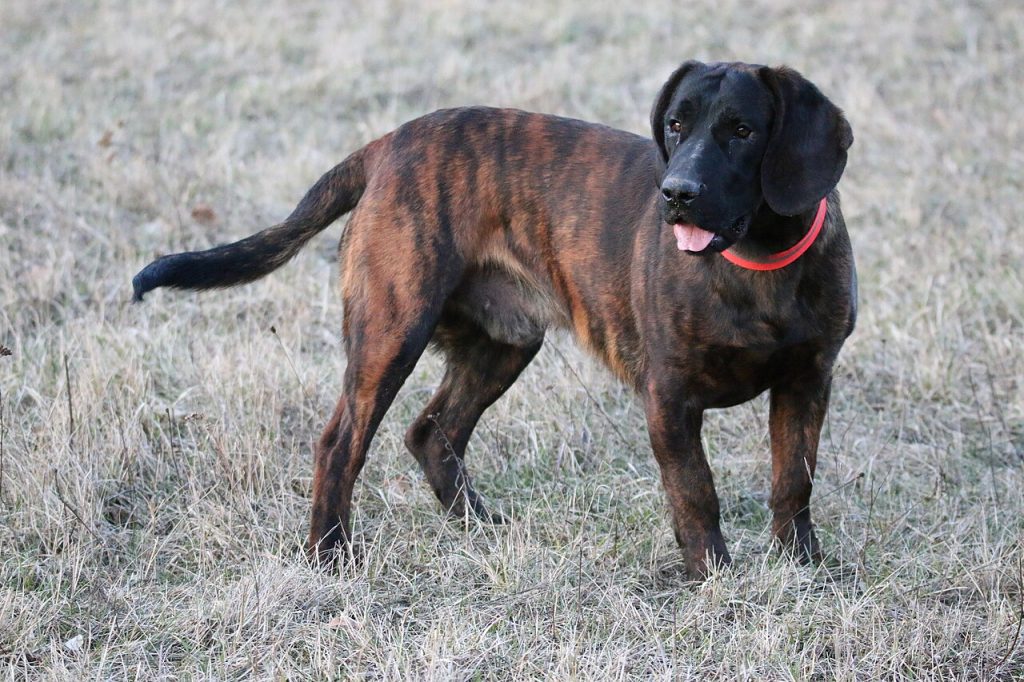
The Lithuanian Hound is a medium-sized, solid dog with strong bones, but at the same time slender and muscular. The males measure between 52 and 60 cm at the withers and the females between 48 and 55 cm. It conveys the image of an agile and powerful hunter, with a firm body, a straight and wide back and a broad, deep and low chest, reaching up to the elbow or below.
His cloak is unmistakable: black with fire marks (red colour) on the snout, chest, lower abdomen, inner face of legs and eyebrow arches, with a sharp boundary between black and fire. The standard allows for a small white spot on the chest, but not on the fingers. The hair is dense and shiny, longer on the back, neck and tail, and shorter on the legs and ears.
The head is large and wedge-shaped, with a broad forehead and a broad black nose. The ears are of medium length, triangular and rounded tips, and hang attached to the cheeks. The neck is long and strong, no paw. The long, sabre-shaped tail is naturally low. The eyes, dark brown to brown in color and oval in shape, give the face that vivid and energetic expression so typical of the breed. Its legs are straight and strong, with round feet and compact toes that make it a fast and very agile pursuer.
Origin and history
The Lithuanian Hound is the only breed of dog native to Lithuania and its history dates back to the Middle Ages, to the times of the Grand Duchy of Lithuania. It was traditionally used to hunt hare, fox and wild boar. It is believed to have arisen from crossing bloodhounds with other trail breeds; the Russian zoologist Leonid Sabaneyev claimed that it was closely related to the St. Hubert’s Hound, brought from France in the 15th century. The nobility’s fondness for hunting with pack hounds was imported precisely from France, with which Lithuania maintained close ties.
The breed appears mentioned in written sources as early as 1541, when a forest guard from Grodno sued for the theft of a hound, and is also listed in the Lithuanian Statutes of 1588. In the 19th century, authors described as many as five types or local varieties of hounds, varying in size depending on the prey – the smaller for the hare, the larger oars for the deer – but all shared the black coat with fire.
The 20th century almost wiped out the race. After the Second World War the population plummeted to just 78 specimens, many without documentation of origin. A group of enthusiastic cinologists – Z. I’m going to go, V. Morkūnas, A. The name of the village is Morkūnas. Penkauskas, among others – boosted his recovery. Since there were not enough specimens left to revive the old subtypes, breeders chose to fix a more universal type. The provisional standard was established in 1966 and revised in 1983, and in 1981 the first monographic exhibition was held, with 62 dogs. By 1987 the number of registered specimens was about 350. After the dissolution of the Soviet Union, the population fell again, to around 150 in 1998, largely due to changes in hunting habits: The Lithuanian Hound does its best chasing large animals in large open spaces that are becoming increasingly scarce. It should be noted that the breed is not recognized by the International Cinological Federation (FCI).
Curiosities
- A national treasure. is the only native dog of Lithuania, considered part of the country’s heritage.
- Honored in bronze. In June 2011 a sculpture of the Lithuanian Hound was inaugurated in Telšiai, the city where Zigmas Goštautas lived, key in its recovery.
- On a coin. In 2017 the Bank of Lithuania issued a commemorative coin (in denominations of 10 and 1,50 euros) with two Lithuanian hounds and a žemaitukas, the Lithuanian native horse breed.
- Five to one. The current type is a synthesis: it brings together in a single universal race what were once up to five distinct local varieties.
- It’s extremely rare. is one of the rarest canine breeds in Europe, almost unknown outside Lithuanian borders.
If you are attracted to the Lithuanian Hound’s profile – prodigious scent, inexhaustible energy, and tracker vocation – you may be interested in other working and tracking breeds with a similar character. You may meet the veteran Bloodhound, the legendary scent hound from which he is likely descended; the popular, snooty Beagle; the imposing Basset Hound; or the sleek, versatile Vizsla, another great hunting dog for active owners.
Frequently Asked Questions About the Lithuanian Hound
Is the Lithuanian Hound a good family dog?
It is balanced, tolerant, and stable at home, but its high need for exercise and strong hunting instinct make it a better match for sporting or hunting owners than for someone looking for a quiet urban companion dog.
How tall is he and how big is he?
It is a medium-sized dog: the males measure between 52 and 60 cm at the cross and the females between 48 and 55 cm. It is of strong, slender and muscular constitution, with robust bones.
Is it recognized by the FCI?
Despite being the only dog breed originating in Lithuania and having its own standard, the Lithuanian Hound is not recognised by the International Kennel Federation (IFC).
Can he live in a flat?
It is not ideal. It is designed for large open spaces and needs a lot of daily exercise. It can adapt to living at home if it is guaranteed intense daily activity, but a house with a garden or easy access to the countryside is much more suitable.
Is it hard to train?
It is intelligent and responds well to training with positive reinforcement. The challenge is its independence as a hound: when it catches a trail it can ignore the call.
Do you get along with other dogs and cats?
With other dogs it usually coexists well because of its pack origin. With cats and small animals you have to be careful: its hunting instinct is strong and can chase them. Coexistence works better if they grow together from puppies.
How much hair do you shed and what skin care do you need?
It has short hair and is easy to maintain. It only needs a weekly brushing (more on the muzzle) and baths only when it is dirty.
Why is it such a strange breed?
It was on the brink of extinction after World War II, when there were only about 78 individuals remaining. It recovered thanks to several enthusiastic breeders, but the change in hunting habits and the reduction of large open areas keep it in very low numbers, with consanguinity as a major concern.