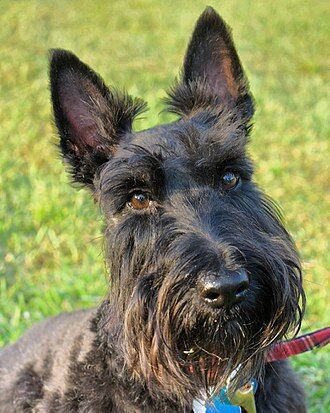
The Terrier Escocés(Scottish Terrier or, affectionately, Scottie) is a small, compact and huge terrier: independent, stubborn and deeply loyal to his family. Born in the Scottish Highlands to hunt alligators and badgers, he retains that brave temperament that earned him the nickname “Diehard”. If you are looking for a dog of manageable size but with a personality that is not easily tamed, the Scottish Terrier deserves your attention.
Is the Scottish Terrier for you?
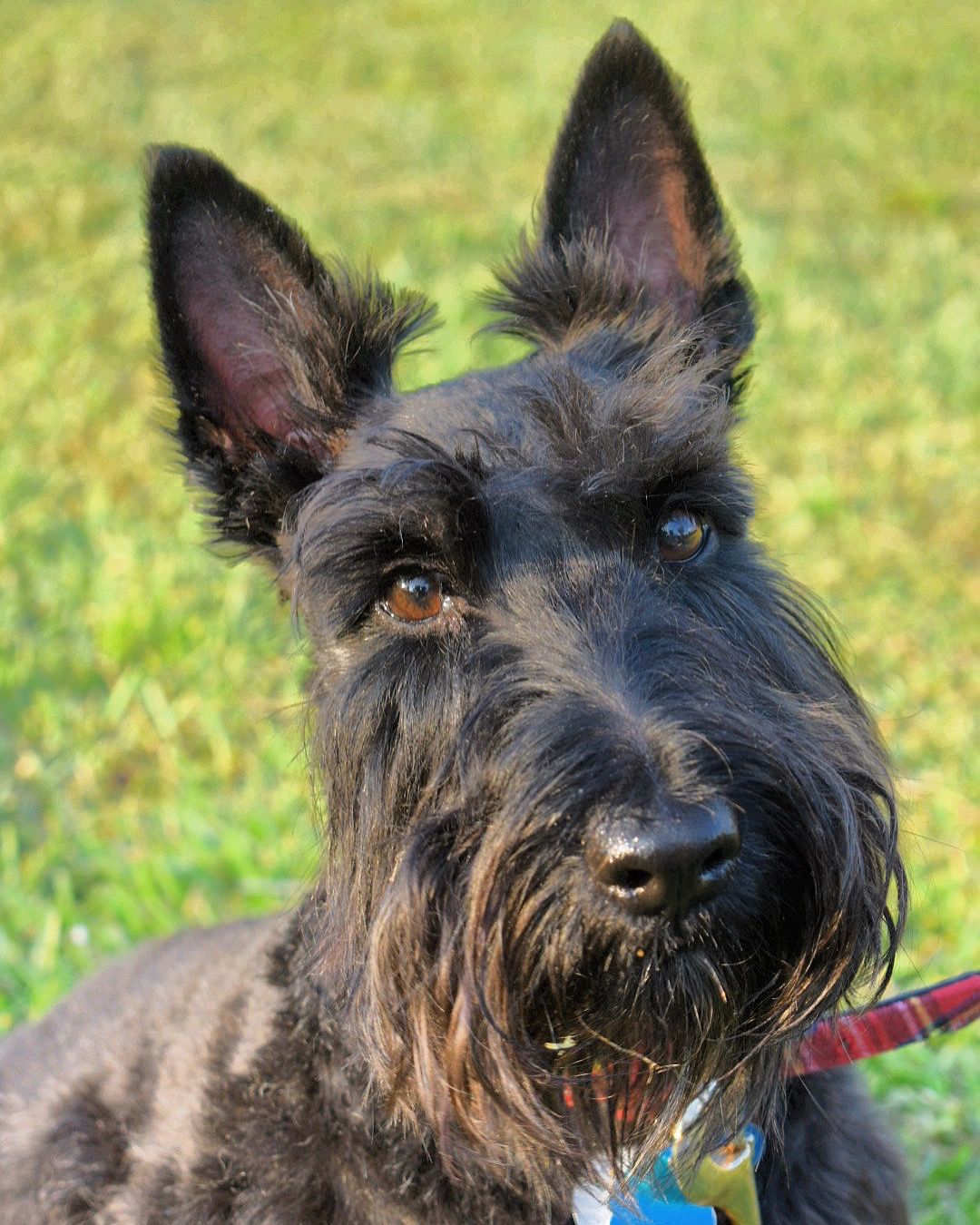
The Scottish Terrier is a dog of strong character in a small body. It is not a complacent stuffed animal: it is a hunter with its own criteria, which decides when to obey and when not. That makes it fascinating for those who value independence and frustrating for those who expect a submissive dog. Before you fall in love with its unmistakable silhouette, it is advisable to know what you will encounter.
In favour .
- Comfortable size for flat and city without giving up a sturdy dog.
- Very loyal: creates an intense bond with one or two people.
- It barks only when it has to, which makes it a good alarm dog.
- Brave and self-assured, no nerves.
- Hair that barely loosens if it’s kept well.
- Smart and with a great sense of humor.
To be taken into account
- Very stubborn – training requires patience and perseverance.
- Strong hunting instinct with rodents, cats and small animals.
- Tendency to dig and chase what moves.
- Reserved with strangers and, without socialization, abrupt with other dogs.
- The hard coat needs periodic stripping.
- Predisposition to certain cancers and hereditary disorders.
In summary, the Scottish Terrier is suitable for people who enjoy a dog with personality, who do not seek blind obedience and who can devote time to education and coat care.
Character and temperament
Few dogs this small have such a marked temperament. The Scottie is territorial, alert, quick and decisive, perhaps more so than any other terrier. It is independent and self-assured, playful and intelligent, but also famously stubborn. It is not a dog that lives to please: it has its own ideas and defends them.
This firmness is not at odds with affection. On the contrary, the Scottish Terrier is very affectionate with his own and tends to bond very closely with one or two people throughout his life. With them he is loyal to the marrow. With strangers, on the other hand, he is distant and reserved: he is not the typical dog who jumps to greet everyone who passes by.
That combination – a strong bond with family, a healthy distrust of strangers, and a habit of barking only when there is a reason – makes him a good warning dog. It is not an imposing guard, but it clearly warns of what is happening in its territory. The historical nickname “Diehard” sums up his essence well: A dog that doesn’t give up and faces situations with remarkable composure for its size.
Coexistence: children, other pets, flat and loneliness
The Scottish Terrier adapts well to different households, as long as their particularities are respected.
- A well-socialized With children: can be a good family pet and act as a protector, but it is not the most suitable dog for very young children or those who have no experience with dogs.
- With other dogs: can be abrupt or dominant if it has not been socialized since puppyhood.
- With cats and small animals: was bred to hunt and kill vermin, so living with cats, rabbits, ferrets or rodents is not advisable: its prey instinct is genuine and difficult to eliminate.
- On the floor:‘s compact size and tendency to bark moderately make it suitable for apartment living, provided it receives daily walks and stimulation.
- Soledad: is independent, but it is very attached to its family. It tolerates time alone better than other breeds, although it is not advisable to leave it alone for whole days and on a regular basis.
- Jardín: if you have one, get ready for the holes.
Education and training
Training a Scottish Terrier is an exercise in patience. It is intelligent and learns quickly what interests it, but its independence often makes it decide that it is not worth obeying. It is not stubbornness for lack of understanding, but for excess of character.
The key is positive reinforcement, short sessions and perseverance. Punishment and rigid imposition have the opposite effect: Scottie’s closing in on the band. It works much better to turn training into a game and reward success generously. Since it was selected to work alone underground, chasing its prey without waiting for orders, its brain is wired to make decisions on its own; asking it for millimeter obedience as a herding dog is not realistic.
Early socialization is non-negotiable. Getting him used to people, noises, environments and, above all, other dogs from puppyhood reduces his tendency to abruptness and reactivity.
Exercise and activity

The Scottish Terrier is a moderately energetic dog – neither a tireless athlete nor a sedentary dog – but it is agile, fast, muscular – surprisingly heavy and compact for its size – and enjoys activity, but it does not need to run miles daily.
With a couple of walks a day and some playing time, he usually has enough to keep his balance. He loves to smell, explore, and chase, so leisurely walks to investigate his surroundings provide both mental and physical stimulation. Activities that appeal to your instinct – search games, digging in permitted areas, or toys that dispose of food – keep you entertained and prevent boredom.
An important warning: because of its strong hunting impulse, it is advisable to keep it on a leash or in safe and fenced areas. As soon as it detects a squirrel, a rat or any small animal, it can shoot out without answering the call. It is not disobedience: it is its hunting programming coming into action.
Care: fur and hygiene
The coat of the Scottish Terrier is twofold: a short, dense and soft inner layer that insulates, and a hard, rough and weather-resistant outer layer.
The long hair on the beard, legs, and lower body – known as the Scottie’s ” skirts ” – tends to tangle, so brushing often, ideally daily, is recommended to avoid knots. To preserve the texture and color of the hard coat, the traditional technique is stripping(manual pulling of dead hair), which keeps the coat rough as it should be. If machine-cutting is chosen instead of striptease, the hair tends to soften and lose color intensity over time; it is a valid choice for a companion pet, but changes the original texture.
It is not a breed with specific skin problems, but, like any dog, can suffer from parasites or scabies if not checked. One advantage: when the coat is kept well, it sheds very little hair at home.
Foodstuffs
The Scottish Terrier does not have exotic dietary demands, but its compact, muscular build calls for some care with quantities. Being a small and robust dog, it is easy to gain weight if overfed or rewards are abused, and overweight especially punishes a short-legged body.
It is reasonable to provide them with a complete, high-quality feed, appropriate to their age, weight and activity level, divided into rations recommended by the manufacturer or veterinarian. Maintain a regular schedule, control the scale, and use head boxes, especially during training, when calories can easily accumulate unnoticed. Fresh water always available and veterinary checks complete a simple but effective routine. If you have any specific questions about diet or supplements, it is best to consult your veterinarian, who will tailor the guidelines to each dog.
Health and life expectancy
The life expectancy of the Scottish Terrier is usually between 11 and 13 years; a British study from 2024 estimated an average of around 12.7 years, in line with that of purebred dogs.
Among hereditary disorders, two stand out: the disease of von Willebrand(vWD), a blood clotting disorder that can lead to prolonged bleeding – type I is relatively common in the breed, although DNA testing among responsible breeders has greatly reduced its incidence – and cranio-mandibular osteopathy(CMO), known as “Scottie’s jaw”, an overgrowth of bone in the jaw that appears between three and seven months and can make chewing difficult; it usually stabilizes and even subsides with growth.
Another peculiarity of the breed is scottie’s cramp(Scottie cramp), a non-painful or fatal hereditary disorder that alters gait when the dog is under intense stress or strain: The legs stiffen, the back arch, and the dog may fall, fully recovering when the stimulus stops. Patellar dislocation, cerebellar abiotrophy, and, with age, eye conditions such as cataracts and glaucoma may also occur.
The point that deserves the most attention is the and cancer: Scottish Terriers are at a higher risk than other breeds of developing certain tumours, in particular bladder cancer (transitional cell carcinoma), of which it is estimated that they may suffer up to 20 times more than the average; also melanoma and other tumours. That is why it is good to be alert to signs such as blood in the urine or difficulty urinating and to go to the veterinarian soon. Acquiring the puppy from a serious breeder who performs health checks and maintains regular veterinary check-ups are the best prevention tools.
Physical appearance

The Scottish Terrier is a small, compact and strong-boned dog with short legs and a massive body that hangs between them. Its height at the cross is around 25,4 to 28 cm and its typical weight is between 8,6 and 10,4 kg(males usually weigh slightly more than females).
His figure is unmistakable. The length of its head and snout stands out in proportion to its body size, giving it a powerful jaw. The eyes are small, lively and almond-like; the ears, small, pointed and erect, crown a piercing and “varminty” expression, that awakened look of a hunter. The tail, strong and of medium length, carries it upright. In fact, its most characteristic pattern emerges when it’s alert or focused: chest forward, tail stretched up and whole body in tension.
The coat, double and hard outer layer, supports three recognized colors: black(the most associated with the breed today, although it was not the favorite until the 20th century), wheat(wheaten, in different shades up to almost white) and triggered(brindle, a mixture of black and brown).
Origin and history
The Scottish Terrier comes, as its name suggests, from Scotland, and is an ancient breed whose exact origin is lost in the lack of documentation. It was one of the Highland terrier breeds that for centuries were grouped under the generic label of “Skye Terriers”. From that group eventually emerged five Scottish terrier breeds: The Skye, the Cairn, the Dandie Dinmont, the West Highland White and the Scottish Terrier himself. The Scottie and Westie, in particular, share ancestors from the Blackmount region of Perthshire and the Rannoch moor.
These dogs were bred to hunt and eliminate vermin on farms and to chase badgers and foxes in the mountains. The earliest written references to a dog of similar description date from 1436, in Don Leslie’s work The history of Scotland 1436-1561. The breed also gained royal prestige: In the 17th century, when King James VI of Scotland became James I of England, he sent as a gift six terriers – considered the forerunners of the Scottie – to a French monarch, helping to spread its fame.
During the 19th century it was known by various names – Highland, Cairn, Diehard and, above all, Aberdeen Terrier, due to the abundance of specimens in that area. The modern history of the breed begins with the dog shows: The need to judge dogs forced him to write down their appearance and character. It is said that all modern Scotties ultimately descended from four pioneer dogs, including the female Splinter II, considered the “founding godmother” of the modern breed.
The first club dedicated to the breed, the Scottish Terrier Club of England, was founded in 1881; the Scottish arrived in 1888. After years of disagreement over the standard, a 1930 revision – based on four very influential dogs – fixed the appearance we know today, modifying the length of the head, the proximity to the ground, and the squaring of the body. That standard was recognized by the British Kennel Club around 1930. The breed arrived in the United States in the early 1890s, founded its club there (STCA) in 1900 and achieved such popularity that by 1936 it was the third most sought-after breed in the country.
Curiosities
- The dog from the White House. Along with the German Shepherd, the Scottish Terrier is the only breed to have lived in the White House more than three times. The most famous was Fala, the inseparable companion of President Franklin D. Roosevelt, who was rarely parted from him.
- When the game was popularized in the 1930s, Scotties were one of the fashionable pets in the United States, and the token became one of the most beloved symbols on the board.
- The breed’s nickname is attributed to the first Earl of Dumbarton, who had a herd of Scotties so brave that he called them “Diehards”.
- Star of the shows. is one of the most successful breeds at the prestigious Westminster Kennel Club show, where it has achieved the “Best in Show” on nine occasions, the first in 1911 and the most recent in 2010.
- Famous surrendered to their charm. Among its historical owners are Queen Victoria, Dwight D. Eisenhower, Jacqueline Kennedy Onassis and writer Rudyard Kipling.
- Cinema and culture. A Scottish Terrier named Jock is one of the characters from Disney’s The Lady and the Tramp.
If you are attracted to the terrier character and Scottish heritage of this breed, you may also be interested in its relatives and other terriers of similar temperament: The West Highland White Terrier, with whom it shares direct ancestors; the Cairn Terrier, another of the original Scottish terrier breeds; the versatile Border Terrier; and the imposing Airedale Terrier, the largest of the terriers. Comparing their characters will help you choose the dog that best fits you.
Frequently Asked Questions About the Scottish Terrier
Is the Scottish Terrier a good dog for beginners?
It is not the easiest choice. Its independence and stubbornness require patience, perseverance and positive reinforcement. A beginner who is very involved and willing to learn can succeed, but whoever expects a docile and obedient dog without effort will be surprised.
Does the Scottish Terrier bark a lot?
It is not a compulsive barker by nature, although, like any dog, it may develop excessive barking if bored or uneducated.
How long does a Scottish Terrier live?
Their life expectancy is around 11 to 13 years. A British study from 2024 placed the average at around 12.7 years, similar to that of other purebred dogs.
Does it shed a lot of hair?
No breed is completely hypoallergenic, but its coat type causes it to lose less hair than many other breeds.
Do you get along with children and other dogs?
Well socialized can be a good family pet and even protective, but it is not the most recommended for very young children or inexperienced with dogs.
Can you get along with cats or other small animals?
It is not advisable. It was bred to hunt vermin and retains a strong prey instinct, so coexistence with cats, rabbits, ferrets or rodents is risky.
How much exercise do you need?
It has a moderate energy. With a couple of daily walks and playtime is usually enough. Because of its hunting instinct, it is advisable to keep it on a leash or in fenced areas, as it can run after small animals.
What health problems does the Scottish Terrier have?
It may have von Willebrand’s disease, craniomandibular osteopathy, Scottie’s cramp, knee dislocation and eye conditions such as cataracts or glaucoma. In addition, it has a higher risk of certain cancers, especially bladder cancer, so it is advisable to go to breeders with health tests and keep veterinary checks.