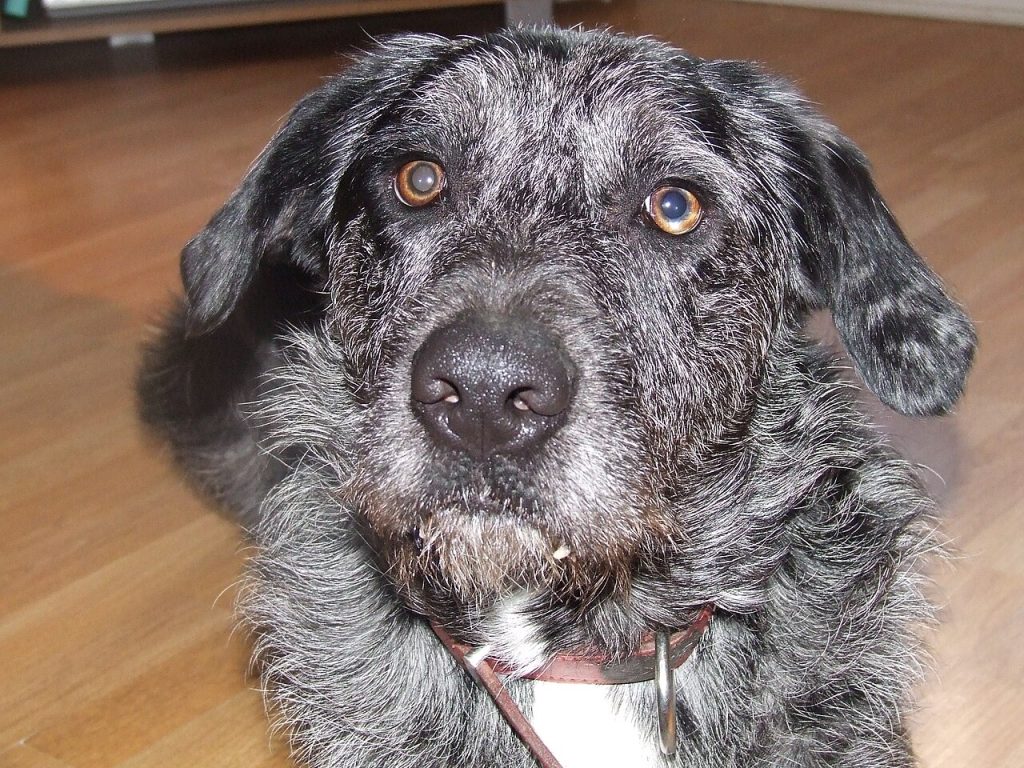
The Otterhound is a large, hairy and unmistakable British hound: rough, waterproof coat, soaked beard, dangling ears and a low voice that can be heard for miles. Brought up to hunt otters in the rivers of England, today it is one of the rarest breeds in the world and one of the most noble and champion companions there is. If you’re looking for a sociable, resilient dog with character, read on: The Otterhound has many virtues, but also requirements that you should know before falling in love with that bearded face.
Is the Otterhound for you?

The Otterhound is an endearing dog breed, but it does not fit into any home. It is large, noisy, active and brings water, mud and dog smell wherever it goes. In return, it offers an exceptionally friendly temperament, a lot of stamina and a personality that is hard to get bored with.
In favour .
- Sweet, sociable and balanced character; good family dog.
- Very tough and enjoys exercise, the countryside and the water.
- It usually tolerates children and other dogs well.
- Wonderful sense of smell, perfect for tracking games.
- Not aggressive and not spiteful.
- Unique aspect that draws attention wherever it passes.
Against
- Very powerful and low voice; barks and howls with pleasure.
- He needs plenty of daily exercise: he is not sedentary.
- Dirt: wet beard, mud, some drool and smell.
- Independent and olfactory, it’s harder to train.
- Very rare: very hard to come by and with a waiting list.
- Predisposed to gastric torsion; requires care.
Character and temperament
Those who live with an Otterhound often describe it in the same words: Good-natured, cheerful and a little clownish. He’s a pack dog, so it’s in his blood to be sociable and tolerant of other dogs and people. He is not a dominant or suspicious dog; his default reaction to a stranger is kindness, not guarding. That’s why, despite its impressive size and voice, it’s a poor candidate for a defense dog.
Within that nobility lives a distinctly independent vein. The Otterhound was bred to work for hours tracking on its own, following a scent without waiting for instructions at every step. This autonomy results in a loving but self-disciplined dog that sometimes turns a deaf ear when its nose finds something interesting. It’s not malicious stubbornness: It’s just that your brain is designed to follow trails.
It is also an expressive and communicative dog. It uses a wide range of sounds, from conversational growls to the famous melodious, deep howling that served to warn the pack.
Coexistence: children, other pets, flat and loneliness
With children: The Otterhound is usually an excellent family dog, patient and of good background. The only nuance is its size and its awkwardness when excited: it can throw a small child unintentionally, so it is advisable to supervise games and teach him to moderate enthusiasm.

With other dogs: due to its pack origin, coexistence with other dogs is usually easy and natural. It is one of the few giants that rarely seeks conflict. With cats and small mammals, on the other hand, you have to be careful: its hunting instinct is very alive and can see a small pet as a prey. Coexistence is possible with early socialization, but it should never be taken for granted.
On the floor: is not his ideal environment. He’s big, active and noisy; his howl will reverberate all over the stairs. He can live on the floor if he gets a lot of exercise, but he’s much better off in a house with a garden where he can move and smell.
Soledad: is a social dog that does not do well with prolonged loneliness. Isolated and bored, it tends to howl, dig and seek entertainment in its own, usually destructive way. It needs companionship and encouragement; it is not a dog for someone who spends the day outside the house.
Education and training
Training an Otterhound is an exercise in patience and good humor. It’s intelligent, it picks things up, but its independence as a hound and its domineering nose make it not obey for pleasure like a Border Collie or a Golden would. It needs to be motivated, not forced.
The keys that work: positive reinforcement (food rewards, which you love), short, fun sessions, and a lot of perseverance. Early socialization is essential for their natural sociability to take hold and for them to become accustomed to cats and small animals if they are to live together. The call (the “here”) is the hardest part: When it follows a trail, it can disconnect from the world, so safety in open areas requires specific work or keeping it on a long leash. Harsh or punishment-based training is not only unnecessary, but counterproductive with such a noble and sensitive dog.
Exercise and activity
There are no shortcuts here: the Otterhound needs real exercise. It was selected for generations to work whole days in cold rivers and rough terrain, with remarkable physical endurance. A short walk to the block is not enough for it.
The ideal is to combine daily long walks, sniffing and playing, and whenever possible, swimming: She loves the water, and no wonder her legs are splayed. Tracking activities (mantrailing, nose games) are perfect for him because they channel his instinct and tire him out mentally. A well-trained Otterhound is a calm and happy dog at home; one that does not expend energy becomes noisy, restless, and destructive.
Care: fur and hygiene

Their double coat is the breed’s hallmark: a rough, dense and impermeable outer layer between 4 and 8 cm, and a more woolly and insulating undercoat.
It’s not a sophisticated barbershop dog, but it’s a country dog: drags water, mud and dog smell into the house, especially after a bath in the river. Full baths, only when necessary, and thorough drying of the undercoat. As with all breeds, hanging ears (prone to moisture) should be checked and cleaned, teeth brushed and nails trimmed regularly. Anyone who can’t stand a little dirt and clutter won’t enjoy this dog.
Foodstuffs
The Otterhound is a large and active dog, so it needs a complete and balanced diet according to its size, age and activity level, with quality protein. The ration must be adjusted to keep it at a healthy weight: overweight punishes its joints and heart.
The critical point is gastric torsion(dilation-volvulus), to which this breed is especially prone. To reduce the risk, it is recommended to divide food into two daily servings instead of just one, to avoid strenuous exercise just before and after eating, and to avoid letting your baby swallow water and air suddenly after exertion. Any signs of swollen abdomen, unproductive arches or sudden restlessness should promptly be brought to the attention of the veterinarian: Torsion is a life-threatening emergency.
Health and life expectancy
The Otterhound’s life expectancy is around 10 years, according to a survey of members of the breed club in the UK, which yielded an average of 10.21 years.
The most cited health problem in that same survey is gastric torsion: It was responsible for 9.0% of the cases and 7.4% of the deaths, a very significant figure which requires extreme precautions in feeding. As with most large breeds, it is also advisable to monitor joint health (hip and elbows) and, given the very small size of the breed population, rely on serious breeders who work on genetic diversity and do health tests. Regular veterinary checks, weight control and good ear hygiene complete prevention.
Physical appearance
The Otterhound is a large, straight-lined, unkempt and sympathetic dog. The males measure about 69 cm high to the cross and the females about 61 cm high, with a weight that is usually between 36 and 52 kg. The head is deep, not wide, and the coat forms a kind of beard and mustache very characteristic.
The eyes are sunken and the ears are long, dangling and curl slightly inward, creating that “draped” fold so typical of the breed. The neck is long, with a slight paw allowed. The limbs are straight and well-muscled, and the feet are large, round, thickly padded and fresh or chilled, making him an exceptional swimmer. The tail is thick at the base and does not curl over the back. The mantle, 4 to 8 cm, is dense, rough and impermeable, with a broken appearance. Recognized colors include full coat, grizzly grey, sand, red, wheat and blue, with white markings allowed, plus lemon, blue or badger spots.
Origin and history
The Otterhound is a deeply English dog, linked to a now-defunct activity: The otter hunt. Otter hunting dates back to the Middle Ages (there are references as early as the 14th century, in the time of Edward III), but the breed as such can only be clearly traced back to the 18th century, and its first documented appearance at a dog show was in Leeds in 1861. The first Otterhounds similar to today’s Otterhounds appeared in northwestern England in the first half of the 19th century, with herds as famous as the Hawkstone Otter Hunt.
To match such an elusive prey, the Otterhound was said to need “the courage of a Bulldog, the strength in the water of a Newfoundland, the smell of a Pointer, the sagacity of a Retriever, the endurance of a Foxhound, the patience of a Beagle, and the intelligence of a Collie”. To forge that total dog, in the second half of the 19th century French griffins were crossed, including contributions from Grand Basset Griffon Vendéen, and in the early 20th century the Griffon Nivernais was added; a specific dog, “Boatman”, a cross of Grand Griffon Vendéen and Bloodhound, became the ancestor of several lines.
In 1978, after the decline of the populations of the otter, it was declared a protected species in Great Britain and hunting ceased. Many herds were dissolved or converted to the hunt of the mink; only a few lines were suitable for life as a companion dog.
Curiosities
- The most endangered native race in the UK. With about 600 specimens in the world and just 41 registrations in 2016, the Kennel Club includes it on its list of vulnerable native breeds.
- Born swimmer. Its padded feet and waterproof coat make it one of the most aquatic hounds in existence.
- A scent of legend. could track an otter in the water hours after it had passed.
- The baritone voice. Its deep, melodious howl served to guide hunters; it is one of the most “talking” dogs.
- “The dog that needs seven dogs”. The old description that brought together the virtues of seven different races sums up why it is so special.
If you are attracted to the Otterhound’s noble and hardworking nature, you may be interested in other similar hounds and water dogs. You can take a look at the Bloodhound, a direct relative and trail master; the Basset Hound, another legendary hound of smell and ears; the Beagle, a cheerful and sociable hound in a compact version; or the Terranova, the water giant whose water strength was cited as a model for the Otterhound itself.
Frequently Asked Questions About the Otterhound
Is the Otterhound a weird dog?
It is considered the most endangered native breed in the UK: it is estimated that there are around 600 worldwide and in 2016 only 41 new puppies were registered.
How long does an Otterhound live?
A survey of members of the breed club in the United Kingdom placed the average life expectancy at about 10 years (10.21 according to that study), a normal figure for a dog of its size.
Does the Otterhound smell and drool a lot?
Its rough and waterproof coat, designed for water, retains moisture and odors more than that of other breeds, especially the beard after drinking.
Do you get along with the kids?
Generally, yes. It is a cheerful, tolerant and good-natured dog, which usually fits well into families. However, it is large and clumsy when excited, so it is advisable to supervise the treatment of small children to avoid unintentional pushes or falls.
Do you need a lot of exercise?
It is a hardy dog bred to work for hours in water and on land, with medium to high energy. It needs long walks, sniffing and, if possible, swimming. A bored and physically exhausted Otterhound can become noisy and destructive.
Can he live in a flat?
It’s not their ideal habitat. It’s a large, active dog with a powerful, low-pitched voice that they use eagerly. It can adapt to a floor if given plenty of daily exercise, but it’s much more comfortable in a house with a garden and space, preferably away from tight-knit neighbors.
Is it easy to train?
It is intelligent but independent and has a dominant sense of smell, typical of hounds. It learns, albeit at its own pace and with constant olfactory distractions. It works with positive reinforcement, patience and short sessions; hardness-based training does not work with it.
How much maintenance does your coat take?
A thorough brushing once or twice a week to avoid knots in the rough coat and untangle the beard. It does not require constant professional peeling, but it does require care after bathing in the river or mud. It is a hair that dirties the environment, rather than one that requires sophisticated hairdressing.