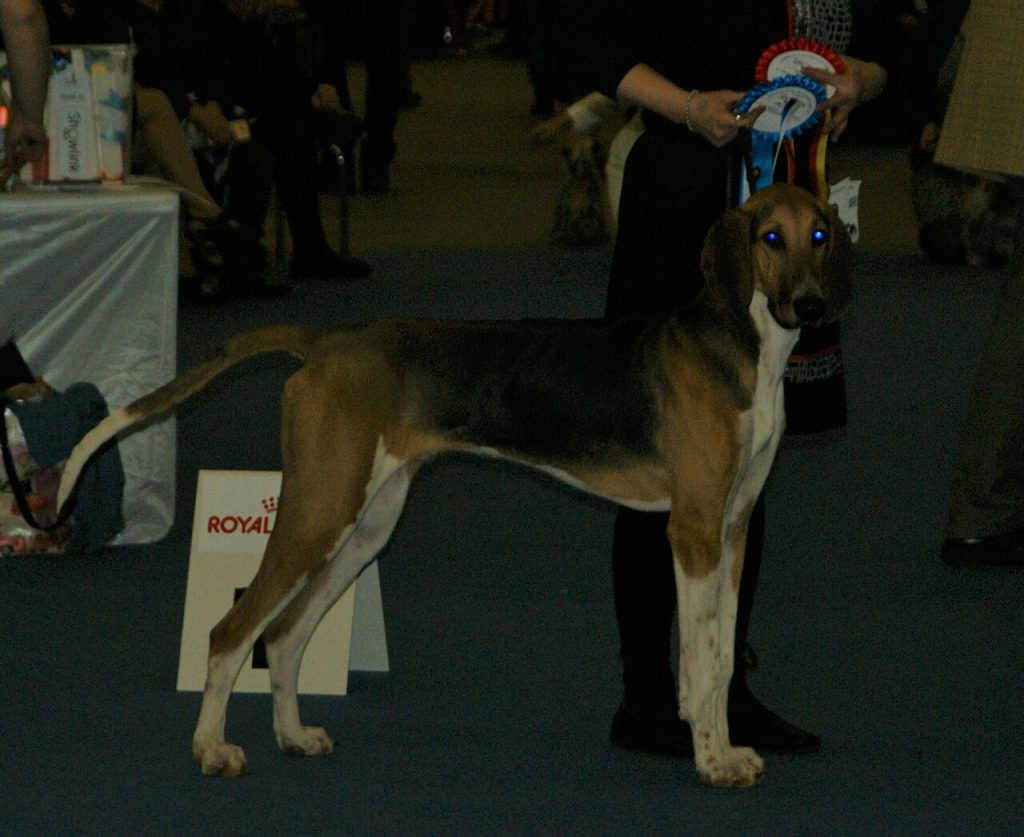
The Poitevino(French Poitevin, also called Chien of the Haut-Poitou) is one of the great French hounds: an athletic, fast, and incredibly hardy pack dog, born in the 17th century to hunt wolves in the Poitou region. Elegant as a greyhound and functional as a foxhound, the Poitevino is more of an older hunting athlete than a couch dog, and knowing him well is the best way to know if he fits in with you.
Is the Poitevino for you?

The Poitevino is a magnificent breed, but highly specialized. It is neither an urban family dog nor an apartment companion: it is a working hound bred to run for hours in packs. Before raising one, look honestly at these two columns.
In favour .
- Exceptional endurance and speed – a natural athlete.
- Extraordinary sense of smell and melodious voice when tracking.
- Very sociable with other dogs; ideal for life in a pack.
- Short coat with minimal maintenance.
- Rustic and healthy breed, no morphological exaggerations.
- Balanced and not aggressive with people.
Against
- Huge exercise needs: hours of daily activity.
- He doesn’t adapt well to living in isolation or on the floor.
- High hunting instinct: the call is never reliable in the field.
- More aloof and independent than other hounds.
- Very rare breed: hard to find outside France.
- Not suitable for first-time owners or sedentary users.
Character and temperament
The Poitevino has a balanced temperament, courageous and hardworking, but with a trait that distinguishes it from other French hounds: He’s noticeably more reserved. Without being shy or frightened, it is more aloof and less effusive than a beagle or a bloodhound, and it does not constantly seek human approval. He’s a dog who knows how to sit, who trusts his own judgment and gives his best when he works.
That independence has a historical explanation: For centuries it lived and hunted in large packs, where cohesion with packmates weighed as much or more than the bond with man. That’s why the Poitevino doesn’t adapt well when kept alone, outside of a pack environment. He’s kind to people and not conflicted, but his heart is in the field, the race and the trail.
Coexistence: children, other pets, flat and loneliness

With children: is a tolerant dog and not aggressive towards people, so the coexistence with children is usually good. However, its size, its overflowing energy and its somewhat distant character make it not the typical patient stuffed animal; it works better with older children who understand that it is an athlete, not a toy.
With other dogs: is his strong point. bred for the pack, the Poitevino is deeply sociable with his congeners and in fact thrives when living in the company of other dogs.
With other pets: is a hunter with a strong prey instinct, designed to chase wolves, wild boars and deer. Cats, rabbits and small animals can awaken their hunting side, so coexistence requires early socialization and supervision.
On the floor and in the solitude: is not a floor breed. It needs space, intense exercise and companionship. A bored Poitevino and just a frustrated dog that barks, howls and gets stressed. Its place is the rural environment, with activity and herd.
Education and training
The Poitevino is intelligent and very capable, but its upbringing demands a realistic approach. In what it is passionate about – tracking, following a trail, hunting – it learns with astonishing ease and works with enormous dedication. In domestic obedience, on the other hand, its independence emerges: it can decide that there are more interesting things to do than sit when asked.
The key is to start early, with positive reinforcement, short sessions and a lot of consistency. Punishment and harshness don’t work with a reserved dog: They close it even closer. It is advisable to channel his energy towards activities that make sense for him (crawling, nose work, dog sport) and accept a reality of all hounds: When they pick up a trace, the nose rules and the call is no longer reliable. That’s why, in the open and unfenced field, safety depends on physical control, not just obedience.
Exercise and activity
If there’s one thing that defines this breed, it’s this one: the Poitevino is a machine of endurance.
We’re talking about two hours or more of intense exercise daily: Long runs, field marches, accompanying cycling or horseback riding, tracking and olfactory work. A quiet walk around the block doesn’t make him tickle. A Poitevino without sufficient exercise accumulates frustration and develops problematic behaviors. That’s why it’s a dog for active people, athletes or hunters, with access to large spaces.
Care: fur and hygiene

The Poitevino’s hair is short, dense, and attached to the body, so a weekly brushing is enough to remove the dead hair and distribute the natural grease that gives it shine.
As a field dog, it is advisable to check it after each day in the mountain: ticks, spikes between the fingers, scratches and foreign bodies. Special attention is deserved by its fallen ears, which retain moisture and can become infected; they must be cleaned and dried regularly.
Foodstuffs
As a medium-sized dog with a very high energy expenditure, the Poitevino needs a diet of quality and well adjusted to its activity level. A specimen that hunts or trains for several hours a day burns many more calories than a sedentary dog, and its diet should reflect this, with a sufficient protein and fat contribution to sustain the effort and recover the muscle.
As a general rule, the food is divided into two servings a day and intense exercise is avoided just before or after eating, which is especially important in deep-breasted dogs because of the risk of gastric torsion.
Health and life expectancy
The Poitevino is a rustic breed, functional and little manipulated by aesthetic selection, which in practice translates into a healthy and robust dog.
As it is a very active and field dog, its main risks are those of that life: Musculoskeletal injuries due to exercise, otitis due to drooping ears, external and internal parasites and hunting accidents. As with all breeds of large size and deep chest, it is advisable to monitor the gastric torsion. With regular veterinary checkups, vaccination, deworming and exercise control, it’s a dog that stays in top shape for many years.
Physical appearance
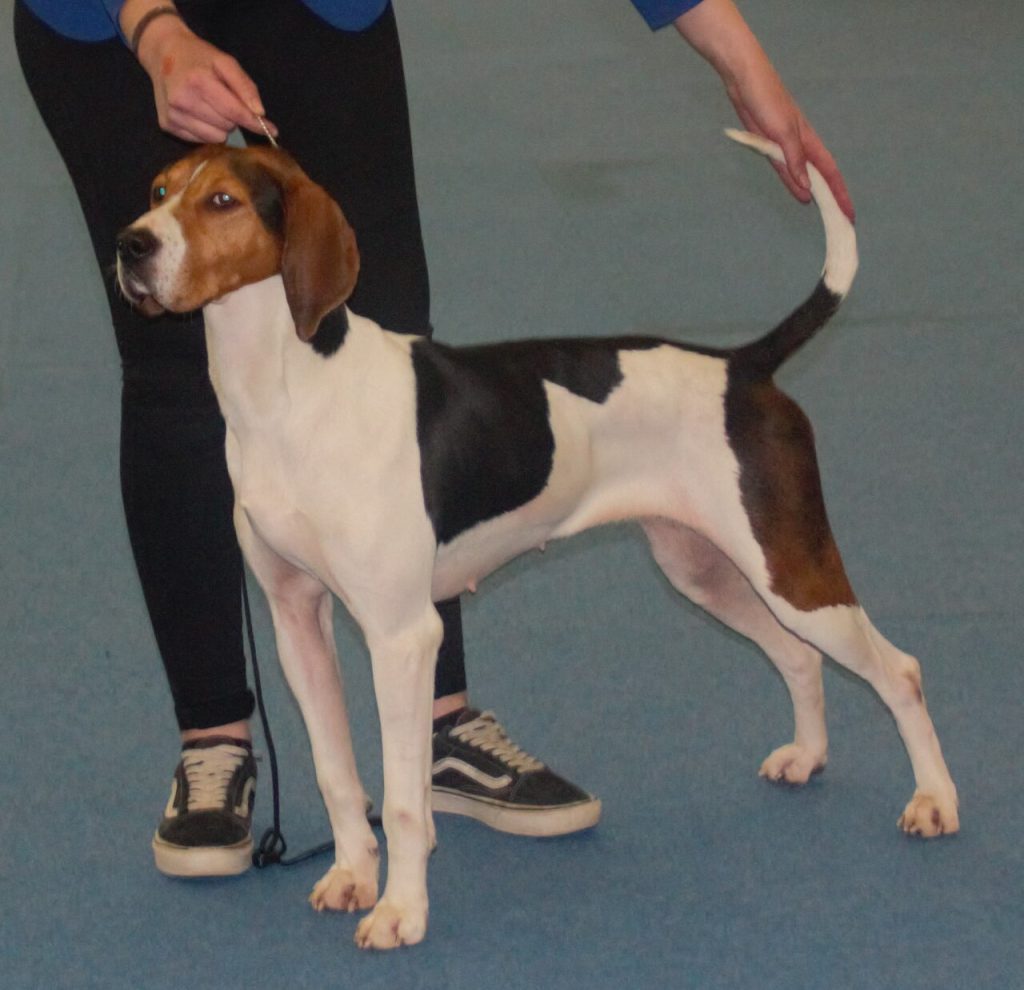
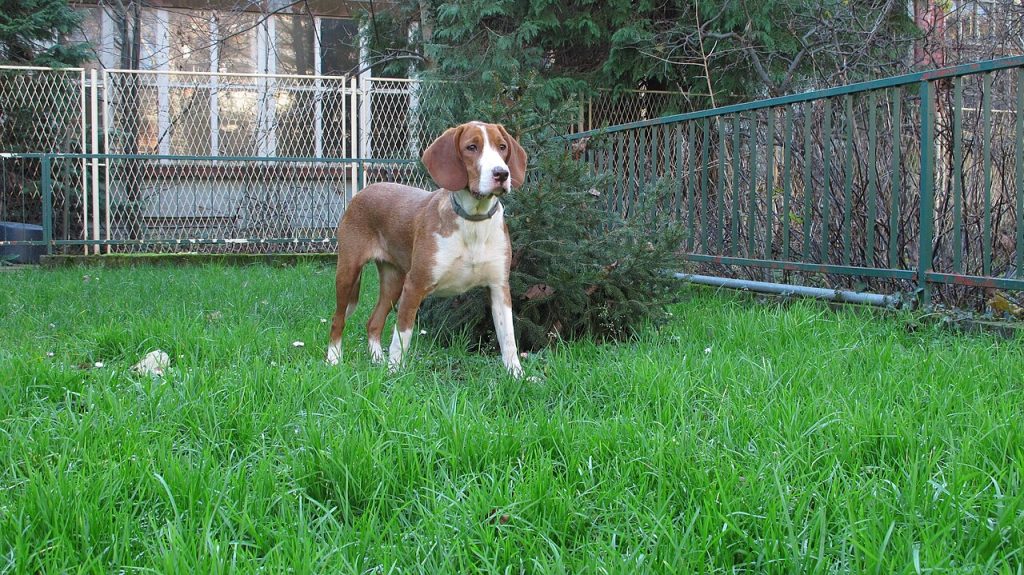
The Poitevino is a refined and athletic hound that resembles a mixture of foxhound and greyhound. It is of medium to large size: it measures about 58 to 72 cm at the cross and weighs about 20 to 30 kg, depending on sex and line.
It has a flat, slightly sloping skull, a long, narrow, sharp snout, and a slender, well-muscled neck. The legs are long, straight and strong-boned, and the tail is long. The hair is short and usually tricolor – sometimes with a single large black spot as a mantle – although specimens with large black or white and orange spots are also allowed. That set of greyhound features on a hound’s body is what gives it its unmistakable imprint and its reputation as a sprinter.
Origin and history
The Poitevino was born in the French region of Poitou in the 17th century, specifically for a demanding task: the hunt for the wolf. Its history dates back to 1692, when twelve English staghounds were given as a gift to the French dolphin. Part of their offspring came into the hands of François de Larrye, marquis of Haut-Poitou, who crossed them with local hounds. From these crosses came strong and athletic tricolor dogs: The first Poitevinos, the notorious Larrye herd.
The breed was several times on the brink of extinction. During the French Revolution, the Marquis de Larrye was guillotined in 1793, in the midst of the Terror, and his pack dispersed. Two brothers from Montmorillon, Émile and Arthur de la Besage, gathered the few remaining specimens and rebuilt a flock. In 1842, an outbreak of rabies in the kennels almost wiped it out, and the breed recovered by resorting to crossing with English foxhounds, until in three generations the foxhound’s influence was barely noticeable. The two world wars again decimated the breed, which again needed foxhound inputs to rebuild. She survives today thanks to the French herds that keep her alive.
Curiosities
- His nickname says it all: “the greyhound among the French hounds”, for his speed and his greyhound traits.
- The Duke of Brissac wrote of it in his book La Vénerie that it was capable of chasing prey for more than seven hours.
- The Poitevino was key in the creation of two of France’s most popular herding dogs: the Grand Anglo-Français Tricolore and the Chien Français Tricolore, in addition to the Anglo-Français de Petite Vénerie.
- Many tricolor hound breeds cite Poitevina blood in their ancestry; their tricolor coat is almost a mark of origin.
- Today, although it was created for the wolf, the surviving packs hunt mainly wild boar and deer within the tradition of the “Grande Vénerie”.
If you are attracted to the Poitevino for its athletic and pack hound profile, you may be interested in other breeds with a tracking, hunting or high-energy vocation. Beagle Bloodhound Basset Hound Greyhound
Frequently asked questions about Poitevino
Is the Poitevino a good companion dog for a flat?
It’s not their natural environment. The Poitevino was bred for centuries to live and hunt in packs, and is a dog of great endurance accustomed to several-hour racing days. On a flat floor, without much daily exercise and without the company of other dogs, it tends to become bored, barking, and distant. It fits much better in the field, with space, intense activity and, if possible, other dogs.
How much exercise does a Poitevino need a day?
We’re talking about a breed capable of chasing prey for up to seven hours and of reaching speeds in packs of up to 35 miles an hour. It needs at least a couple of long hours of intense physical exercise a day: running, walking, bike-joring or crawling. A simple walk around the neighborhood is not enough for it.
Does the Poitevino get along with other dogs?
Yes, and in fact it does. It is a pack dog par excellence and does not adapt well when living isolated from other dogs. With its felines it is sociable and balanced. With cats and small animals, on the other hand, you have to be careful because of its very strong hunting instinct.
Is the Poitevino easy to train?
It is intelligent and hardworking, but independent and more reserved than other hounds. It responds well to tracking and hunting work, for which it has a natural talent, but domestic obedience requires constancy, positive reinforcement and patience. When it catches a trail, its nose commands: the call is never completely reliable in the open field.
How long does a Poitevino live?
As a rustic and functional medium-sized hound, its life expectancy is around 10 to 13 years. It is a healthy breed, without the selective pathologies of more manipulated breeds, provided it is given the exercise, food and veterinary review it needs.
What is Poitevino used for today?
Originally created in the 17th century to hunt wolves, several packs are maintained in France today and are used mainly for hunting wild boar and deer within the tradition of the ‘Grande Vénerie’.
What colour is the Poitevino’s coat?
Their hair is short and usually tricolor, sometimes with a single large black patch like mantle, and specimens with large black or white and orange patches are also admitted.
Are the Poitevino and the Poitevin the same breed?
Yes. ‘Poitevin’ is the original French name and ‘Poitevino’ its Castilianised form. It is also known as Chien de Haut-Poitou. It is a unique French hound breed originating from the Poitou region.