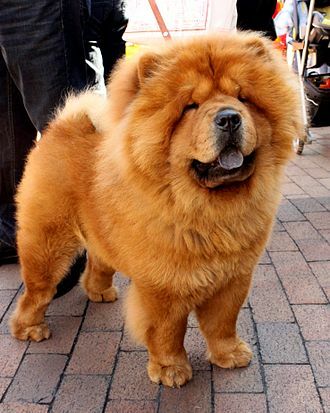
The Chow Chow is one of the most recognizable dogs in the world: a broad head framed by a lion’s mane, a stiff gait and, above all, that blue-violet tongue that no other race has. Hiding behind its stuffed air is an ancient dog native to northern China, dignified, independent and deeply loyal to its people. In this comprehensive guide we review their character, coexistence, care and everything you need to know before sharing your life with a Chow Chow.
Is Chow Chow for you?
The Chow Chow is not a dog for everyone, and it’s good to know that before you fall in love with its appearance. He’s a quiet, clean, unbarking companion, but also stubborn, reserved with strangers and not complacent: He doesn’t live to please you, he lives with you on his own terms. If you’re looking for a dog that’s easy, sociable with anyone and always willing to play, this probably isn’t your breed. If, on the other hand, you value a dog that is serene, loyal to one family, and has a personality of its own, the Chow Chow may be right for you.

In favour .
- Quiet and inactive at home: fits well on floors.
- Very clean, almost feline, and rarely barks for no reason.
- Loyal and protective of his family; excellent natural guardian.
- Independent: tolerates his time alone well.
- Unmistakable appearance and elegant and dignified demeanor.
To be taken into account
- Stubborn and unruly: education costs.
- Reserved or suspicious of strangers; needs early socialization.
- Dense coat that requires frequent brushing and loosens a lot in seedlings.
- Sensitive to heat from its abundant double layer.
- Predisposition to various joint and eye problems.
Character and temperament
The Chow Chow has a reputation as a “cat dog”, and the comparison is apt. He’s dignified, independent and selective with his affection: usually chooses one or two people from the household, with whom he establishes an intense bond, while keeping a polite distance from the rest. It is not the dog that welcomes visitors by wagging its tail; rather, it calmly watches them in the background, assessing whether they deserve its trust.
This reserve should not be confused with aggressiveness. A well-bred and socialized Chow Chow from puppyhood is stable, balanced and not nervous. Shyness and aggression are not traits peculiar to the breed when the dog has been well educated; it is, instead, a marked territorial instinct.
In day-to-day life, it is a calm, quiet dog that demands little attention. It enjoys the company of its owners without needing to be attached to them, and always retains a point of pride and independence that should be respected.
Coexistence: children, other pets, flat and loneliness
- With children: tolerates well the children in the family with whom it has grown up, but it is not a particularly playful dog or patient with pulling and abrupt games.
- A good puppy selection and careful socialization are key; introduced as an adult with other dogs, its territorial nature can generate friction.
- On the floor: is one of its great advantages. It is not a very active breed and adapts without problems to apartment life, as long as its daily walks are covered.
- In the face of loneliness:‘s independence plays to its advantage. It tolerates being alone better than many breeds, without falling easily into separation anxiety, although like all dogs it needs routines and enough company.

Education and training
Raising a Chow Chow is an exercise in patience and perseverance. He’s smart, but his independence and stubbornness mean he rarely obeys just to please. He needs a reason: understands what an order is for and decides if it pays to obey it. That is why positive reinforcement – rewards, calmness, and clear routines – works better than any imposition-based method, which with this breed is counterproductive.
Early socialization is undoubtedly the most important aspect of their upbringing. Exposing them as puppies to people, noises, other dogs, and various situations makes the difference between a balanced adult and one who is suspicious or reactive.
Do not expect the enthusiastic obedience of a Labrador or a Border Collie. Learn as much as you need, but at your own pace and with some independence of judgment. Short, positive, and respectful sessions will yield better results than long, repetitive ones.
Exercise and activity
The Chow Chow is a moderately low-energy dog: it spends much of the day quietly and does not need large doses of exercise. This does not mean that it can remain inactive. To maintain a stable temperament and a healthy weight, it is well suited to two daily walks, each of about 30 minutes, which allow it to explore its environment and be mentally stimulated.
It is advisable to adapt the exercise to its anatomy and coat. Its stiff gait and tendency to joint problems discourage intense efforts and repeated jumps, especially in growing puppies. And because of its dense double layer it is very sensitive to heat: in summer you have to walk it in the cool hours and avoid activity under the sun, since it does not tolerate high temperatures.
Care: fur and hygiene
The mantle is the hallmark of the Chow Chow and also their most demanding care. It has a very dense double layer that exists in two varieties: the long or rough hair (rough), the most well-known, with that spectacular mane around the neck, and the short or soft hair (smooth), less common but equally thick.
Ideally, brush thoroughly several times a week – and daily during the seasonal mowing season, when it sheds a lot of hair – to avoid knots and tangles, especially in the neck, behind the ears, and at the back. Regular brushing keeps the coat healthy and reduces hair around the house. It is not advisable to shave the Chow Chow, as its double layer protects it from both cold and heat.
The rest of the hygiene is the usual one: checking and cleaning your eyes (your eyelids are a delicate area), keeping your ears dry and clean, taking care of dental hygiene and cutting your nails regularly.
Foodstuffs
The Chow Chow needs quality food and, above all, well-measured. Being a moderately active dog, it tends to gain weight if overfed, and excess weight is especially harmful for a breed predisposed to joint problems. Rations should be adjusted to your age, weight, and exercise level, and food should be divided into two servings instead of one.
A complete and balanced feed, or a diet formulated by a veterinarian, should meet your needs without excess. It is advisable to monitor the adequate intake of quality protein and fatty acids to help keep their dense mantle in good condition. As with any relatively deep-chested dog, distributing meals and avoiding strenuous exercise just before and after eating are prudent measures. Always have fresh water available, especially in hot weather.
Health and life expectancy
The average life expectancy of the Chow Chow is around 12 years – a large British study put it at 12.1 years – and many well-kept specimens move in a range of 9 to 15 years.
The most characteristic point is the joints. The Chow Chow is the breed with the highest prevalence of elbow dysplasia: A number of studies have found that about half of babies over two years of age have some degree of it. It is also more prone than average to hip dysplasia, cruciate ligament rupture, and kneecap dislocation. That’s why it’s so important to control your weight and exercise during your growth.
In the ocular plane, there is entropy and ectropion (changes in the position of the eyelids, favored by their sunken eyes and facial folds) and a high predisposition to glaucoma. Skin is another front to watch: the breed is prone to atopic dermatitis, foliar pemphigus and alopecia X. It is also associated with thyroid disorders, risk of autoimmune diseases, exocrine pancreatic insufficiency and, in females, an increased incidence of pyometra. A responsible breeder must provide the health history of the parents and the relevant health tests.

Physical appearance
The Chow Chow is a medium-sized dog, with a robust and compact body, almost square in profile. According to the FCI standard, males measure between 48 and 56 cm at the cross and females between 46 and 51 cm, with a weight that is usually around 20-32 kg. Its construction is solid and massive, with a wide skull, wide snout and strong jaw.
The head is one of its most striking features: small, triangular, erect and slightly rounded ears at the tip, slanted forward, giving it that tight and dignified expression.
The coat, dense and double, can be red (the most popular), black, blue, cinnamon or lionskin and cream; there are no spotted or multicolored Chow Chows. And then there’s his most famous stamp: the blue-black or purple tongue, a colour that also extends to the lips and inside the mouth. He’s the only dog with that blue pigmentation on his lips and oral cavity. Finally, his gait is unmistakable: The back legs, very straight and with little angulation, give it a rigid gait, “stumped”, which joins the supports in parallel.
Origin and history
The Chow Chow is a very ancient breed, originating in northern China and considered one of the basal breeds, that is, prior to most modern breeds that emerged in the 19th century. Genetic studies place it among the oldest dogs in existence, with roots going back several thousand years in central China; some sources speak of 2,000 to 3,000 years of documented history.
In his native land he was a versatile dog: He was the guardian of homes and temples, the hound, the sledge shooter through swampy terrain – something already mentioned by Marco Polo – and, in times of need, the source of meat and hides. It is also believed to have served as a model for the Lions of Fu, the stone guards guarding the entrances to Buddhist temples and palaces, which explains its aleonoid appearance.
His name, interestingly, is not Chinese. “Chow chow” comes from 18th century business English: the British sailors used this expression to refer generically to the varied merchandise they brought from the East (porcelain, ivory, curiosities…), and it ended up being applied to the dogs that were imported among those cargoes. In Chinese the breed is known as 松狮犬 (sōng shī quǎn), literally “lion dog”. At the end of the 19th century, it came to the West, where its exoticism soon made it a much-loved dog.
Curiosities
- Unique blue language: is the only dog with a blue-violet tongue, lips, and oral cavity. The gene that produces it is dominant, which is why many Chow half-breeds retain that trait.
- Sigmund Freud had a Chow Chow named Jofi who attended his therapy sessions. The psychoanalyst was convinced that the dog helped him assess the mood of his patients.
- Walking on stilts:‘s almost angular hind legs give it a stiff and peculiar gait, as if walking on stilts, unlike that of any other breed.
- Ancestor of the Eurasier: The Eurasier, a 20th-century German breed, was born from a cross between the Chow Chow, the Wolfspitz and the Samoyed.
- Inspired by the guardian lions:‘s appearance is linked to the Fu lions of Chinese Buddhist tradition.
- Spitz of the millennium: belongs to the Asian spitz group and is among the oldest canine breeds on the planet.
If you are attracted to the Chow Chow, you may be interested in other breeds of Asian origin, such as the spitz or with an equally independent and dignified character. You can compare its profile with that of the Shar Pei, the other Chinese dog with its distinctive blue tongue and folds; with the Shiba Inu and Akita, two Japanese spits with a reserved temperament and great loyalty; or with the white, smiling Samoyedo, a Nordic relative who helped create related breeds. They all share with the Chow Chow that blend of beauty, independence and a deep bond with their family.
Frequently Asked Questions About Chow Chow
Is the Chow Chow an aggressive or dangerous dog?
Not by nature. A well-bred and socialized Chow Chow from puppyhood is stable and balanced; shyness and aggression are not traits peculiar to the breed. It is reserved with strangers and very territorial, so early socialization and consistent education are essential for that protective instinct to be well channeled.
Why does the Chow Chow have a blue or purple tongue?
It is a distinctive genetic trait of the breed: its tongue, lips and inside of the mouth have a bluish-black or violet pigmentation. The gene responsible is dominant, so many mixed-breed dogs descended from Chow Chow retain that color. It is the only dog with that hue in the lips and oral cavity, although the Shar Pei can also exhibit it.
How much hair does the Chow Chow shed and how much brushing does it need?
The ideal is to brush it thoroughly several times a week and daily during the mowing, paying attention to the neck, behind the ears and the back area to avoid knots.
Does the Chow Chow adapt well to living in a flat?
Yes, it is one of its advantages. It is not a very active breed, it is quiet indoors and barks little, so it fits well in an apartment as long as its two daily walks are covered.
Is it a good breed for families with children?
It can be if it grows up with them and socializes early, but it is not a particularly playful dog or patient with jerks and abrupt games.
How much exercise does a Chow Chow need?
Moderate: Two daily walks of about 30 minutes are enough to keep him healthy and balanced. He should avoid strenuous exercise and repetitive jumping because of his tendency to have joint problems, and walk in cooler hours in the summer, as he tolerates the heat very poorly.
How long does a Chow Chow live and what health problems do they have?
Their average life expectancy is around 12 years, with specimens living between 9 and 15. Their most well-known predispositions are elbow dysplasia (it is the most prevalent breed) and hip dysplasia, eye problems such as entropy and glaucoma, and skin conditions such as atopic dermatitis.
Is it hard to educate the Chow Chow?
It requires patience. It is intelligent but independent and stubborn, and does not obey just to please. It works much better with positive reinforcement, short sessions and consistent rules from puppyhood than with any imposition method, which with this breed is counterproductive.