The Welsh Pembroke Corgi is a small dog with short legs and fox head that hides the character of a real working dog. Born in Wales to drive cattle by biting their heels, he is today one of the most popular and recognizable companions in the world, thanks in large part to his fame as Queen Elizabeth II’s favourite dog. Smart, cheerful and surprisingly athletic, the Pembroke Welsh Corgi combines manageable size with a huge personality.
Is the Pembroke Welsh Corgi for you?
Before you get carried away by those ears and that fox face, you should know that behind the adorable look is a shepherd dog with energy, instinct and opinion of his own, these are the lights and shadows of sharing your life with a Pembroke Welsh Corgi.
In favour .
- Very intelligent and with a great desire to please: he learns fast.
- Handled size that fits well on floors if you exercise.
- Affectionate, sociable and very involved in family life.
- He’s an excellent alarm dog. He alerts you to anything that happens.
- Athletic and tough despite his short legs.
To be taken into account
- It sheds a LOT of hair all year round, with two strong shoots.
- Barker: You need to learn to control the warning.
- Shepherding instinct: he can bite heels and chase.
- Tendency to gain weight; his long back suffers from overweight.
- Stubborn if bored; requires mental and physical stimulation.
Character and temperament
The Pembroke Welsh Corgi is, first and foremost, an alert dog. He is considered one of the most intelligent dogs in existence: It ranks 11th in the famous Stanley Coren rankings, which translates into a remarkable ability to understand commands and solve situations. That intelligence is accompanied by a strong desire to please his family, so he usually enjoys collaborating and learning new things.
He’s a dog deeply attached to his own. He tends to follow his landlord from room to room and wants to be in the middle of everything that goes on in the house. That same constant alertness makes him a fantastic warning dog: It barks when it senses something out of the ordinary. The flip side is that if not given enough stimulation, the barking may become excessive and a working dog’s stubbornness may be exposed.
It retains the instinct to drive, to chase what moves and, in some puppies, to bite the heels just as their ancestors did with cattle.
Coexistence: children, other pets, flat and loneliness
- With children: is usually a great companion, playful and patient, as long as the child knows how to treat it with respect.
- Well-socialized With other pets: coexists smoothly with other dogs and animals. The key is to introduce it to other species from puppyhood to avoid pursuit behaviors due to its prey instinct.
- On the floor:‘s compact size makes it suitable for apartment living, but only if it meets its daily exercise needs.
- In the face of loneliness: is a very sociable dog who does not like to spend many hours alone. If you work outside all day, he will need company, interactive toys and routines that prevent boredom.
Education and training
Few breeds learn as quickly as the Pembroke Welsh Corgi. Its intelligence and willingness to please make it very receptive to positive training, with rewards, play and short and fun reinforcements. It responds wonderfully to basic obedience and, once confidence is established, to more complex tricks and exercises.
Now, that same intelligence has its counterpart: It’s a dog with its own criteria that can be stubborn if the sessions are boring or if it senses inconsistency. It is good to work on consistency, avoid punishment (which only creates distrust) and keep sessions short so that you do not lose interest. Early socialization with people, noises, other dogs, and diverse environments is essential to channel their alert nature.
Two aspects deserve special attention: the control of barking, which is educated by rewarding calmness and teaching a command of silence, and the biting of heels, a behavior inherited from shepherding that is redirected by offering tasks and games to channel that impulse.
Exercise and activity
Having short legs doesn’t mean it’s a quiet couch dog. On the contrary: the Pembroke Welsh Corgi is an amazing athlete. Despite its dwarfism and that illusion of slow little legs, a healthy and fit Corgi can run at remarkable speeds, because it uses more force from the front of the body than most dogs.
He needs real daily exercise: long walks, pick-and-drop games, and to be able to be some activity that stimulates your mind. He excels in dog sports such as agility, obedience, flyball, tracking, and herding tests, disciplines in which his agility and ability to learn give him an advantage. Activity time is not optional: A Corgi without physical or mental expense gets bored, gets fat and develops behavioral problems.
A health recommendation: watch out for sudden jumps and descents, especially of puppies and adults, because their elongated spine is delicate.
Care: fur and hygiene
The Pembroke Welsh Corgi has a double coat: a dense, insulating inner coat and a medium-length, smooth, naturally water- and dirt-repellent outer coat.
Maintenance, however, is simple. Regular brushing – several times a week, and daily during moult – is enough to remove dead hair, keep the coat healthy, and reduce the hair that ends up scattered throughout the house. She does not need a haircut; in fact, shaving her double coat is counterproductive. Bathing should be occasional, only when it’s really dirty, so as not to take away the hair’s natural protection.
Complement your hygiene routine by checking and cleaning your ears, cutting your nails when you walk, and brushing your teeth frequently to prevent mouth problems.
Foodstuffs
Feeding is one of the critical points of this breed, and the reason is simple: the Corgi is a naturally voracious eater. Like a good herding dog, it has a voracious appetite and gives the feeling of never being satisfied, which makes it tremendously prone to obesity if left to eat at will.
Ideally, a balanced, high-quality feed, appropriate to the child’s age, weight, and activity level, should be given twice a day in measured amounts. You have to keep a very close eye on the rewards and leftovers at the table, which add calories without you even realizing it. Maintaining a proper weight is not aesthetic: For the length of your spine, excess weight hurts your back and joints and can lead to osteoarthritis, shortening and worsening your life. Having fresh, clean water at all times completes the picture.
Health and life expectancy
The Pembroke Welsh Corgi is a robust and generally healthy dog, with a life expectancy around 12-15 years; a British study in 2024 placed its average at 13.2 years, above the average of purebred dogs.
It is an achondroplastic breed, that is, of true dwarfism: its short legs are the result of a genetic condition that, together with its long trunk, affects its health.
- Dysplasia of the hip, of polygenic origin.
- Degenerative myelopathy, a progressive neurological disease for which there is genetic testing.
- Von Willebrand’s disease is also known as:, a blood clotting disorder.
- Hereditary eye problems such as progressive retinal atrophy, cataracts or retinal dysplasia.
- Back and joint problems aggravated by being overweight, at risk of osteoarthritis.
The good news is that many of these conditions have genetic testing, so going to responsible breeders to test your breeders, keeping your weight in check, taking care of your back, and getting regular veterinary checkups are the best guarantees for a long, healthy life.
Physical appearance
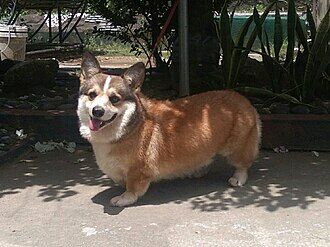
The Pembroke Welsh Corgi is a small but stubborn dog, with a robust build and a strong and vigorous appearance within a short body. It measures around 25 to 30 cm at the cross and weighs, depending on the specimen and sex, around 10 to 14 kg, with males being somewhat larger than females. His silhouette is unmistakable: long and low body on short legs, giving an impression of length versus height.
Its head closely resembles that of a fox, both in form and expression, it is alert and intelligent. Its ears are erect, firm, medium-sized and proportionate to the head triangle.
The coat is medium-length, smooth and double coated. Colors permitted range from red to sable and lionside, through black and fire, usually with white spots on the chest, neck, legs and sometimes the face. A characteristic historical feature is the tail: many individuals are born with a natural short tail, although traditionally it was amputated; today this practice is banned in many countries as it is considered a mutilation, and the main federations allow the entire tail on display.
Origin and history
The Pembroke Welsh Corgi is descended from Pembrokeshire, in Wales, and is considered one of the oldest dogs in Britain.
There are several theories about his arrival in Wales. The most widespread one links the Pembroke with the Flemish weavers who settled in Pembrokeshire after the Norman invasion, around the 12th century, and who would have brought with them continental dogs related to breeds such as the pomerania or the schipperke. His lineage has been traced back to 1107. Other sources place the origin of the corgis in dogs introduced by the Vikings or by the Celts much earlier.
Whatever its exact origin, the Pembroke was developed as a boyer dog: He led the cattle by biting their heels and barking, and his short stature allowed him to bend over to avoid being kicked. At that time, the peasants grazed in the open lands of the Crown, without fences, and they needed a fast and intelligent dog able to handle the cattle by himself. The Pembroke was a perfect fit.
For centuries, the Pembroke and Cardigan crossed freely, but from the 1930s onwards breeders sought to accentuate their differences. In 1934 they were officially recognized as two separate breeds.
Curiosities
- The Queen’s dog. The Pembroke Welsh Corgi is known worldwide as the favourite breed of Elizabeth II, who had over thirty corgis throughout her reign.
- The fox face. Its head and expression are so reminiscent of a fox that it is one of its most recognizable traits.
- Top 11 in intelligence. ranks 11th in Stanley Coren’s famous canine intelligence ranking, among the most capable working dogs.
- Speedster with short legs. Despite its dwarfism, a fit Corgi is surprisingly fast and agile thanks to the strength of its front train.
- Star of the pop culture. Its popularity has grown with appearances in series and films, and in cities such as New York or San Francisco, crowded corgis encounters are held.
- Vulnerable race on their land. Paradoxically, while it triumphs in the US, in the UK it came to be on the list of native breeds vulnerable to breeding decline.
If you are interested in the Pembroke Welsh Corgi, you will surely enjoy getting to know other related breeds. Its blood sibling, the Cardigan Welsh Corgi, is the other variety of Welsh Corgi, somewhat larger and long-tailed. Among the intelligent and active herding dogs stand out the tireless Border Collie and the elegant Shetland Shepherd. Pomerania
Frequently asked questions about the Pembroke Welsh Corgi
Is the Pembroke Welsh Corgi a good dog for families with children?
Yes, it is usually a great companion for families, playful and affectionate, and children should be taught to treat it with respect and to supervise play, for its shepherding instinct can lead it to “lead” little ones by gently nibbling on their ankles.
How much exercise does a Pembroke Welsh Corgi need?
It is an athletic herding dog that needs daily exercise: long walks, play and, if possible, some mental or sports activity such as agility.
Does the Pembroke Welsh Corgi shed a lot of hair?
Yes, quite a bit. It has a double coat that changes throughout the year, with two intense moults in spring and autumn. Regular brushing – daily during moult – keeps the hair in check and the coat healthy.
Can a Pembroke Welsh Corgi live on one floor?
A Corgi that doesn’t spend energy on a floor tends to bark excessively and behave destructively.
Why do so many Corgis have such short tails?
Some specimens are born with short tails naturally, but traditionally they were amputated.
How long does a Pembroke Welsh Corgi live?
Their life expectancy is around 12 to 15 years. A British study in 2024 placed their average at around 13 years, above the average for purebred dogs. Maintaining a healthy weight is key to reaching that age in good health.
Is it hard to train the Pembroke Welsh Corgi?
No, it is one of the easiest dogs to train because of its intelligence and its desire to please, but it has its own character and can be stubborn if bored.
What’s the difference between the Corgi Pembroke and the Cardigan?
They are two distinct breeds from Welsh Corgi. The Pembroke is shorter in body, with slightly smaller ears and straighter legs, and traditionally a short tail. The Cardigan is slightly larger and always has a long tail.