The Antiguo Pastor Inglés (Bobtail) is one of those dogs you recognize instantly: a huge ball of gray and white hair, with his face covered in a freckle and that wobbly bear walk. Behind his giant stuffed appearance is a working dog born to drive cattle, smart, sociable and deeply familiar. He is affectionate, playful and loyal, but his spectacular cloak demands a commitment of care that you should know before falling in love with him.
Is Old English Shepherd Bobtail for you?
Before letting yourself be carried away by its face hidden behind the bang, be honest: the Bobtail is a large, furry dog and very dependent on its family. It fits wonderfully with those who are looking for a kind companion and willing to participate in everything, but it is not the dog for whom spends many hours outside the house or does not want to hear about brushes.
In favour .
- A sweet character, tolerant and very close to his family.
- Great with kids and, well socialized, with other pets.
- Intelligent and hardworking: he learns quickly and enjoys having homework.
- It sheds relatively little hair for what it looks like.
- Adaptable: you can live on the floor if you have exercise and company.
To be taken into account
- Its coat requires almost daily brushing; neglecting it brings knots and scratches.
- He has a hard time dealing with loneliness. He needs to be a part of everyday life.
- He doesn’t tolerate heat well because of his thick coat.
- Large and energetic dog: requires space and daily walks.
- He may be stubborn; he needs constant training.
Character and temperament
If we had to sum up the Old English Shepherd in one word, it would be that’s good.. It is a dog of balanced temperament and tolerance, getting along well with almost everyone and rarely looking for a fight. Its shepherding instinct gives it a special sensitivity towards the family: it tends to be attentive to its own, to “gather” the group and to watch that no one is left behind on the walk.
He’s cheerful, playful and sometimes clownish, with a point of charming awkwardness that he keeps throughout his life. That eternal youthfulness makes it fun, but it also means it retains a lot of energy and a lot of willingness to interact. It is faithful and intelligent, and although it is not an aggressive keeper, it warns with a deep, deep bark very characteristic of the breed. What you really need is to feel integrated: An isolated or ignored bobtail becomes unhappy.
Coexistence: children, other pets, flat and loneliness
- With children: is one of its great virtues. Patient and affectionate, it is usually a great playmate. Due to its size, it is advisable to monitor interactions with the smaller ones to avoid involuntary pushes.
- With other pets: is well socialized, coexisting with other dogs and even cats without problems.
- On the floor: is possible if it’s compensated for by daily exercise and plenty of companionship.
- In the face of loneliness: is its weak point. It is not good to spend long hours alone; boredom can lead to barking or nibbling on furniture. Best for homes with frequent presence.
- Clima:‘s dense coat makes it unsuitable for very hot areas; it appreciates cool and shade.
Education and training
The Bobtail is smart and quick to learn, a direct inheritance from his past as a working dog. That’s an advantage, but it comes with a certain independence: sometimes he decides on his own, and he can be a little stubborn if you don’t see the logic of what you’re asking him to do. The key is to start early and stay consistent.
It works very well with positive reinforcement: awards, play and a gentle voice yield much more than toughness, which only makes it close. Early socialization – exposing him as a puppy to people, noises, other dogs, and varied environments – is essential for the adult to be that confident, tolerant dog that promises the breed. It is also good to teach him from day one to tolerate the handling of his coat, ears and feet; this will save him stress during brushing sessions and at the veterinarian.
Exercise and activity
It’s not an extreme endurance athlete, but it’s a dog that needs to expend energy daily. Two good walks, some running or play and, above all, mental stimulation, keep it balanced. Remember that it was bred to lead herds for hours: it has a bottom and head, and it’s grateful that you give it something to do.
It is an excellent candidate for dog sports such as agility, obedience, rally, flyball or herding tests, where it can demonstrate both its physique and intelligence. These activities, in addition to burning energy, strengthen the bond with its family, which is what it cares most about.
Care: fur and hygiene
Here is the great commitment of the breed. The Old English Shepherd wears a double coat, long, plentiful and roughly textured, with a waterproof undercoat that protected it from the elements. It is beautiful, but demanding: without maintenance, it easily flattens and forms knots that are difficult to untie.
The classic recommendation is a daily brushing of five to ten minutes, paying attention to the rubbing areas (armpits, behind the ears, inside the legs), where the hair gets tangled first. If done conscientiously and regularly, it may be enough to keep the mantle healthy without the need for large cuts. Many homeowners, however, opt for regular hygiene cuts to make their day more comfortable. The puppy is born with a shorter, softer coat; when he changes it for the adult coat, the real work begins. Complement hygiene with baths when needed, checking and cleaning of ears (very covered with hair), checking of eyes covered by fringe and care of nails and teeth.
Foodstuffs
As a large and active dog, the Bobtail needs a complete and balanced diet, adjusted to its size, age and activity level. The sensible thing is to divide the daily ration into two meals instead of one: in large and deep-breasted breeds it is a prudent measure to reduce the risk of gastric torsion, a problem to which this breed is prone.
Weight should be monitored: Under so much hair it is not always easy to see that the dog is gaining weight, so it is a good idea to feel his ribs regularly and let him be guided by the vet. During growth, a large breed puppy must be fed a specific feed that controls the rate of development and protects its joints. And, as always, fresh water at your disposal, especially on the hot days you’ve been having.
Health and life expectancy
The Old English Shepherd is, in general, a rustic and resistant dog, with a life expectancy of around 10 to 12 years; a British study published in 2024 placed the average age of the breed at around 12 years, a figure commensurate with its size.
The most relevant are hypoplasia of the hip, common in the breed, so it is important to choose breeders who evaluate the breeders; and gastric torsion or dilation(a serious and urgent condition to which it is prone, like many large dogs with deep breasts), which makes it advisable to distribute food and avoid exercise right after eating. It is also associated with a predisposition to dilated myocardial disease, allergic-type dermatological problems and demodicosis. A very important and specific point: The Bobtail is one of the most common breeds of mDR1 mutation, which causes sensitivity to certain medicines (such as ivermectin or doramectin) at doses that would be safe in other dogs.
Physical appearance
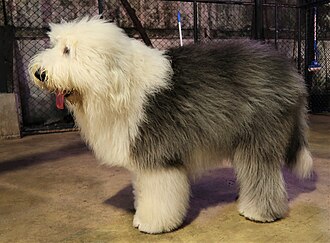
The Old English Shepherd is a large, compact, robust-looking dog with an unmistakable silhouette. The males reach a height at the withers from about 61 cm, and the females are slightly lower; the weight moves, in an indicative way, between 30 and 40 kg. A curious feature of its construction is that the cross is lower than the back, which gives it that upward profile backwards and contributes to its characteristic swing when walking.
The head is bulky and square-shaped, with small, dropped ears attached to the head, almost hidden by hair, and a large black truffle. The body is short and strong, with a deep chest. The mantle, its star feature, can be any shade of gray, greyish, blue or blue merle, sometimes with black specimens, always combined with white areas on the head, neck, lower body and extremities. Puppies are born with black and white fur, and the classic silver-gray appears only after the baby’s hair is removed. As for the tail, the tradition of amputating it gave the breed its name (“Bobtail”), although today more and more specimens with long and crowded tails are seen.
Origin and history
The breed was developed in western England in the mid-19th century as a herder’s dog to drive and guard sheep and cattle in rural areas. From that driving job comes its robustness, its resistance and that instinct to keep the group together.
About its ancestors there is no absolute certainty, but experts agree that the Bearded Collie is almost certainly in its family tree, and is speculated with contributions from the old Russian Owtchar (Ovtcharka) and local boyer dogs such as the Smithfield. The Old English Shepherd was first presented at an exhibition in Birmingham in 1873 and, around 1880, became recognised and its first breed club was born. He soon crossed the Atlantic: In the 1880s it came to the United States, where in the early 20th century it became a popular dog among the wealthiest families. Since then he’s been a star of the show rings.
Curiosities
- The “Dulux dog”. is the mascot of the Dulux paint brand since 1961, to the point that in some countries the breed is directly called “Dulux’s dog”.
- Inspired by the Beatles. Martha, the bitch of Paul McCartney, gave birth to the song Martha My Dear.
- She’s a movie star. has appeared in numerous films, from Disney’s The Shaggy Dog saga to family cartoons and comedies; he is Max, Prince Eric’s dog in La Sirenita.
- His name tells a story.“Bobtail” refers to the cut tail; according to a popular version, breeders amputated it to distinguish working dogs, exempt from certain taxes.
- He walks like a bear. Its displacement, with that swing of the posterior third, is picked up even in the breed standard.
If you’re drawn to the world of herding dogs and their blend of intelligence and familiarity, you’ll be interested to compare the Bobtail to some of its relatives and fellow professionals: the Bearded Collie, considered one of its ancestors; the tireless Border Collie; the versatile Pastor Australiano; and the elegant Shepherd of Shetland.
Frequently Asked Questions about the Old English Shepherd (Bobtail)
Does the Old English Shepherd lose a lot of hair?
It has a very abundant double coat that tends to retain dead hair inside its own coat instead of letting it loose around the house, but that hair has to be taken out with frequent brushing.
How much exercise does a Bobtail need?
It needs daily activity: one or two good walks a day plus some playtime or mental work. It’s a herding dog, so it enjoys having a task. It’s not hyperactive, but if it gets bored and spends too much time, it can only become destructive.
Is he a good dog for families with children?
Yes. It is one of the breeds with the best reputation as a family dog: tolerant, patient and very attached to its owners, including children and other pets.
Can he live in a flat?
It can adapt to a floor as long as it receives daily exercise and companionship. What it really does not tolerate is loneliness or being isolated from the daily family life. It also does not feel good in the heat: its coat is designed for cool climates.
How often do you have to brush an Old English Shepherd?
The ideal is a daily brushing of five to ten minutes, especially in the rubbing areas. Getting used to it from puppyhood prevents the coat from becoming damp.
How long does the Bobtail live?
Their life expectancy is around 10 to 12 years. A British study from 2024 placed the average of the breed at around 12 years, a normal figure for a dog of its size.
Why is it called Bobtail?
Bobtail means “cut tail” in English. Traditionally this breed had its tail amputated, and in addition some specimens are already born with a very short tail.
Is it hard to train?
It is intelligent and quick to learn, but it also has a temperament and can be somewhat stubborn. It responds very well to positive reinforcement, consistency and early socialization. It is not the best choice for someone who has never had a dog if he does not surround himself with good advice.