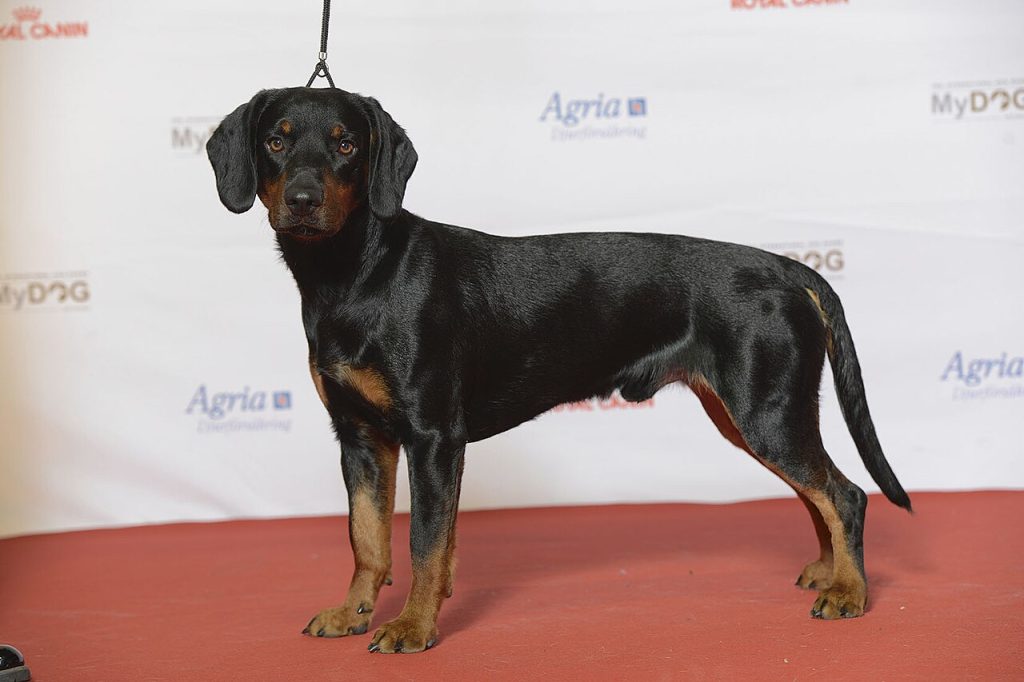
The Slovak hound(Slovenský kopov) is one of those dogs that almost no one knows outside their homeland and that, however, has a personality so marked that it hooks the person who treats it. Born in the mountains of Slovakia to follow the boar’s trail for hours, it’s a black and fiery hound, tough, smart and surprisingly quiet at home. It’s not a fashion dog or a couch dog: He’s a race hunter with a noble character that you should understand well before deciding if he fits into your life.
Is the Slovak Hound for you?
Before you fall in love with his black pattern and fire you should be honest: The Slovak Hound is primarily a large hunting dog. His tracking instinct and need for work don’t go away because he lives in a cottage on the outskirts. With the right home, it’s a balanced, loyal companion; with the wrong one, a frustrated dog that follows trails on its own. These boxes help you decide at a glance.
In favour .
- Very durable, healthy and easy to maintain.
- Short coat that barely needs grooming.
- Smart and with an excellent sense of direction.
- Quiet and not much barking in the house.
- Strong bond with his family; good with the children he respects.
- A natural watcher without being an aggressive dog.
Against
- High hunting and tracking instinct: it goes after a scent.
- Independent and stubborn; not a submissive dog.
- He needs a lot of physical and mental exercise.
- Rare outside Slovakia: difficult to find and poorly documented.
- Not suitable for small apartments or sedentary living.
- He can be reserved with strangers if he doesn’t socialize well.
Bottom line: If you hunt, canoe, hike, or live in the countryside with time to devote to it, the Slovak Hound can be the dog of your life.

Character and temperament
The temperament of the Slovak Hound is that of a true hunter, forged over centuries to work alone or in small packs, away from the hunter and making their own decisions about the trail. That inheritance explains his most defining trait: the independence. It’s not a dog that waits for orders every two minutes; it’s a dog that thinks, evaluates and acts. When it comes to living together, this translates into a self-confident, courageous and remarkably self-directed partner.
Despite that autonomy, he’s a smart and easy to train. dog when he’s well motivated. You don’t teach by force: He’ll be convinced. At home, he’s surprisingly calm and balanced. Unlike many other hounds, it is not particularly vocal: He doesn’t bark for a bark. Reserve your voice for important things, such as alerting you to a stranger entering the property or to signal a find during hunting. It is a noble dog, attached to its family, which develops a strong protective instinct towards its territory and its people without falling into gratuitous aggression.
Coexistence: children, other pets, flat and loneliness
With children: The Slovak Hound has a reputation for being good and patient with the children in the family. Its stable character and its bond with its owners make it a good companion for homes with children, always under the usual rules of coexistence between dogs and minors: supervision and mutual respect.
With other pets: should be realistic here. We are talking about a larger hunting dog with a highly developed prey instinct. Coexistence with other dogs is usually fine, especially if raised alongside them, but small animals (cats, rodents, birds) can awaken their tracking and chasing instinct. Early and careful socialization is essential.
On the floor: is not their medium. A Slovak Hound needs space, smells to follow and work. It can adapt to living indoors – in fact, it is clean and quiet inside – but it requires a house with land or, at least, an intense exercise routine to compensate for the lack of space.
Soledad:, like any dog attached to its family, does not like to spend long hours alone. A bored and un-stimulated specimen will seek its own amusement, usually following tracks or trying to escape to explore.

Education and training
Training a Slovak Hound is an exercise in patience and consistency. He is intelligent and quick to learn, but his independence means that he obeys, not to please, but when he understands that he will be rewarded. positive reinforcement training, with high-value prizes and short, varied sessions, works much better than imposition. A dog of this character is locked in bands to harsh methods.
The priorities of your education should be three. First, the early socialization: expose him from puppyhood to people, environments, noises and other animals to mold him into a safe, non-suspicious adult. Second, the called: It’s the race’s greatest challenge, because when it catches a trail, it tends to disconnect from the world. Working the call very early, with powerful reinforcements and in controlled environments, is non-negotiable if you’re ever going to release it. Third, the impulse control against hunting stimuli. Still, no training completely nullifies the instinct: In areas with wildlife, the muzzle or the long strap is the sensible choice.
Exercise and activity
If there’s one thing you can’t spare with the Slovak Hound, it’s exercise. It’s a dog bred to cover miles of rough terrain following a trail, with a remarkable physical background and endurance. A couple of short walks a day won’t go far enough. It needs intense and prolonged daily activity: long walks, running, mountain, exploration in wide and safe spaces.
Just as important as exercise is the mental stimulation. His brain is designed to work with his nose, so smelling games, mantrailing, tracking tests and any sport that takes advantage of his smell make him immensely happy. Without that physical and mental relief, a Slovak Hound develops frustration, anxiety, and destructive behaviors. It is, in essence, a dog for active people who enjoy the outdoors.
Care: fur and hygiene
The good news for anyone looking for a low-maintenance aesthetic dog is that the Slovak Hound is the simplest. His hair is short, dense and attached to the body., designed to protect him from the bush and the cold of the mountain without requiring much attention. A weekly brushing to remove dead hair and distribute the natural grease that lends its coat shine is more than enough. In times of moult, a slightly more frequent brushing helps to keep the house clean.
Bathing should be occasional, only when it’s really dirty, so as not to alter your skin’s natural protection. The rest of the hygiene is the basic routine of any active dog, with special attention to a point peculiar to hounds: the drooping ears. Because they are not properly ventilated, they retain moisture and are prone to infection, so they should be checked and cleaned regularly. Complete the care the cut of nails when they do not wear themselves and good dental hygiene.
Foodstuffs
As a medium-sized, muscular and very active working dog, the Slovak Hound needs a quality and balanced nutrition, with a good intake of animal protein to support its muscle mass and energy level.
Being a relatively deep-chested and very dynamic dog, it is prudent split the food in two. and avoid intense exercise just before and after eating, a sensible precaution against the risk of gastric torsion in active dogs. Watch your weight: Although the breed tends to stay in shape easily thanks to its activity, a sedentary and overfed dog will gain weight and have its joints compromised. Fresh water always available, especially after exercise.
Health and life expectancy
The Slovak Hound is, collectively, a rustic and healthy dog. As it is a strictly working breed, with selection focused on functionality and discarding non-performing specimens, it does not drag along the long list of hereditary problems of many popular breeds. Its genetics have remained relatively healthy precisely because it has not become a trendy or mass-exposure dog.
That said, he shares the logical precautions of a medium-sized working hound. drooping ears s require surveillance because of their tendency to otitis. As with any athletic dog, joint health should be taken care of throughout life. And as a field dog, checking after each day in the mountain (parasites, ticks, wounds, spikes) is part of his routine. With good nutrition, exercise and preventive veterinary care, your life expectancy is around 12-14 years, a longevity in keeping with its rugged nature.
Physical appearance
The Slovak Hound is the prototype of the hunting hound: a medium size dog, with a well-proportioned, muscular body, long legs, long tail and the characteristic drooping ears of tracking dogs. According to the standard, the ideal height is around 18 inches to the cross and the weight 16 kg or less, with females somewhat smaller than males. The standard sets an ideal size precisely to discourage breeding of specimens that are too large or too small and to preserve the breed type.
Its trademark is the black coat with fire marks.(the classic “black and fire”): the hair is short and always black, with brownish markings scattered by the usual pattern of this coat. The eyes are always dark, sunk and with a lively and brave expression that betrays their character. In construction, it is more robust than the black and fire American Coonhound, of similar brands, but lighter than the Polish Ogar, a related hound of heavier build.

Origin and history
The Slovak Hound is a breed deeply linked to the forests and mountains of Eslovaquia, in the heart of Central Europe. Although hunting dogs of this type have been known in the region since antiquity, the breed as we know it today began to be defined in the 1870s. In its development, it is believed that breeds such as the Brandlbracke (Austrian black and fire sabot) intervened, in addition to contributions from greyhounds in the area, which helped to fix its type and tracking qualities. Its own name, “kopov”, seems to refer to the color of its coat.
He was raised with one goal: hunting larger game, especially wild boar, and track wounded cattle through rough terrain. It was never conceived as a companion or exhibition dog, and that functional vocation marks its entire identity. The breed club was established at Bratislava in the year 1988, consolidating its official recognition. The Fédération Cynologique Internationale (FCI) recognizes it with the number 244, within Group 6 (hounds and similar breeds), Section 1.2 (medium sized hounds). Extremely common in its home country, it remains a rarity outside of it.
Curiosities
- The “Black Jungle Sabre” that’s not from the Black Jungle. In North America it was even promoted as “Black Forest Hound”, a name invented for marketing purposes: the breed has no relation to the German Black Forest.
- Unlike most tracking dogs, A little barking hound. is not vocal in day-to-day life; it only gives voice to a stranger or when finding a piece.
- The misnomer of the German name. Its German designation, Schwarzwildbracke, means “boar hound” and not “Black Forest hound” (Schwarzwaldbracke), origin of the previous confusion.
- It’s an international rarity. is so rare outside Slovakia that in some countries there are very few breeders, making it an almost unknown dog to the general public.
- Work dog rather than beauty dog. Its breeding has always been based on testing the specimens in the field, prioritizing hunting ability over aesthetics, which has helped preserve its health.
If you are attracted to the Slovak Hound because of its hardworking and hardy nature, you may be interested in other breeds with a similar vocation. You can compare its character with that of the Bloodhound, the trail king; with the popular Beagle, another dog with an infallible nose but a smaller size; with the Basset Hound, a tenacious dog with short legs; or with the versatile Vizsla, another energetic Central European hunting dog.
Frequently asked questions about the Slovak Hound
Is the Slovak Hound a good companion dog?
It can be for the right home. It is quiet, clean and affectionate indoors, and good with the children in the family. But it is above all a hunting dog with huge exercise needs: it will only be a good companion if you give it plenty of physical and mental activity.
How tall and how much does a Slovak Hound weigh?
The ideal height according to the standard is around 46 cm at the withers and the weight 16 kg, with the females somewhat smaller.
What color is the Slovak Hound?
It is always black with fire marks (black and fire), without exception. The hair is short and dense, and the eyes are always dark.
Is it hard to train?
It is intelligent and quick to learn, but its independence makes it stubborn. It responds very well to positive reinforcement and very poorly to harsh methods. The biggest challenge is the call, because when it engages a trail it tends to disconnect; it is best to work on it from a puppy.
How much exercise do you need?
Many. It’s bred to travel miles in the mountains, so it needs intense daily activity: long walks, running, mountaineering and olfactory games. Without enough physical and mental relaxation, it develops frustration and destructive behaviors.
Do you get along with other animals?
It usually coexists well with other dogs, especially if it grows up with them. On the other hand, its strong hunting instinct may cause it to chase small animals such as cats or rodents.
How long does a Slovak Hound live?
It is a rustic and healthy dog, with a life expectancy of around 12-14 years.[citation needed] Its functional breeding has helped to keep the breed free of many hereditary problems, although it is advisable to watch for drooping ears to prevent otitis.
Why is he so little known outside Slovakia?
Because it has always been bred as a specialized hunting dog, not as a companion or exhibition dog. It is very common in its country of origin, but very rare in the rest of the world, with very few breeders outside Central Europe.