The Spaniel Japonés, also called Japanese Chin or Japanese Chin, is a small, elegant and surprisingly feline companion dog. bred for centuries for the Japanese nobility, today it is an affectionate, clean and quiet lap companion, ideal for floor living. If you are looking for a discreet, affectionate and personalized dog, the Japanese Spaniel deserves your attention.
Is the Japanese Spaniel for you?
Before you fall in love with its smashed face and huge eyes, it’s good to know what kind of dog you’re getting into. The Japanese Spaniel is a companion dog in the most literal sense: it lives to be with you, not to run marathons or watch the farm. It fits wonderfully with certain homes and not so much with others.
In favour .
- Mini size, perfect for flat or small house.
- Quiet and quiet: barks little compared to other toy dogs.
- Very clean and almost odorless; grooms like a cat.
- Loving and very close to his family.
- He needs little exercise: short walks and play at home are enough.
- Intelligent and observant, he learns routines quickly.
To be taken into account
- He’s brachycephalic: he suffers from heat and intense exercise.
- You can develop separation anxiety if you spend a lot of time alone.
- He has a stubborn streak; training requires patience.
- The silky coat requires regular brushing so as not to get tangled.
- It is delicate: it is not the ideal dog with very young and abrupt children.
- It is advisable not to release it without a leash in open areas.
Character and temperament
If we had to sum up the character of the Japanese Spaniel in one word, it would be cat. It’s not a free metaphor: This breed has much in common with cats, both in its way of moving and in its attitude. She loves to lean on the backs of couches, armchairs, or any elevated point from which she can dominate the room. It is said that he is able to walk on a center table sorting the objects without pulling one, with a delicacy almost of a balancer.
It ‘s a alert, intelligent and independent dog . He doesn’t live to obey every command like a Border Collie, but he observes, calculates and decides. With his family he is tender, funny, and endearing; with strangers he is usually reserved but polite, without the hysteria of some toy dogs. He was raised to entertain and accompany royalty, and that legacy stands out: He has a little aristocratic touch that enjoys being the center of attention, though not being a burden.
Of course, beneath that docile appearance lies a remarkable stubbornness. In Stanley Coren’s classification of canine intelligence he occupies an intermediate place (62nd place), which reflects more his independence than lack of alertness: He understands perfectly what you’re asking, he just decides if it’s worth it to do it. It is also a sensitive dog, responding much better to affection and positive reinforcement than to scolding.
Coexistence: children, other pets, flat and loneliness
- With children: is affectionate and playful, but its small size and delicate structure make it fragile. It fits better in homes with older children who understand that it is not a toy; with babies or very brusque children you have to supervise always.
- With other pets: is sociable and non-confrontational. He gets along well with other small dogs and, thanks to his feline nature, usually gets along surprisingly well with house cats.
- On the floor: is one of the best dogs for apartments. It occupies little, barks little and settles in small spaces. It doesn’t need a garden.
- In the face of loneliness: here is its weak point. It’s very attached and can suffer from separation anxiety if you leave it alone for many hours. Getting it from puppy to stay in its zone or transporter, progressively, helps a lot to prevent the problem.
Education and training
Raising a Japanese Spaniel is an exercise in patience and diplomacy rather than hard work. He’s smart and he learns quickly what interests him, but his independence sometimes makes him elegantly ignore you if he doesn’t find motivation. The key is the positive reinforcement: tasty prizes, friendly voice and short, fun sessions. Luckily, it’s an easy dog to reward and enjoys pleasuring when the relationship is trusting.
Early socialization is essential so that their natural reserve does not lead to shyness. Exposing him as a puppy to people, noises, other animals, and various situations, always in a positive way, will produce a balanced and confident adult. Two lessons are worth prioritizing: to get him used to being alone without distress and to teach him to tolerate manipulation (brushing, eye cleaning, checkups), because it will accompany him all his life. Avoid leaving it loose in open spaces: Their instinct and size make them vulnerable, so call work and leash use are non-negotiable outside the home.
Exercise and activity
The Japanese Spaniel is a moderately active dog that will not require much effort from you. It enjoys quiet walks and playtime, but its need for exercise is low compared to almost any other breed. A couple of short walks a day, supplemented with intelligence games and some indoor activity, cover its physical and mental needs abundantly.
One must be very careful with intense effort and, above all, with heat. Since it is a flat-nosed (brachycephalic) dog, it regulates the temperature worse and gets tired earlier; in summer, it is advisable to walk it early in the morning or at dusk and avoid exercise in the hottest hours. More than the amount of exercise, what this breed values is quality of company: A thousand times better to be by your side than to run around.
Care: fur and hygiene
One of the pleasant surprises about this breed is how manageable its coat is despite its luxurious appearance. The Japanese Spaniel has a single silk and smooth coat, with no woolly undercoat, which makes it less clingy than other long-haired breeds. Still, that plentiful coat on the neck, ears, tail, and hindquarters requires regular brushing, ideally several times a week, to prevent knots and keep it shiny. Keep in mind that adult hair can take up to two years to develop fully.
It’s a very clean dog by nature, almost no body odor, so it doesn’t need frequent baths: One every few weeks or when it gets dirty is enough. Where you have to be consistent is in the facial hygiene: for their large, prominent eyes and facial folds, it is advisable to clean the eye area daily to prevent tear stains and irritation, and check the ears. Complete the routine with frequent tooth brushing – important in toy breeds – and periodic nail trimming.
Foodstuffs
Being such a small dog, the Japanese Spaniel eats little, but that very smallness makes quality very important. Ideally, a complete and balanced food, formulated for mini or small breeds, with croquettes adapted to their flat jaw so that they can pick them up and chew them comfortably. Splitting your daily allowance into two servings helps to keep your energy steady and your digestion steady.
The great enemy of this breed is the overweight: a few extra grams represent a huge percentage in such a light body, and excess weight aggravates joint and respiratory problems. It measures rations well, controls rewards (use them in training, not as a constant whim) and watches its silhouette. Fresh water always available, especially in summer, since it does not tolerate heat well.
Health and life expectancy
The Japanese Spaniel is, in general, a robust dog for its size, with a life expectancy around 12-14 years. An extensive British study from 2024 placed its average longevity at around 12.5 years, a figure very similar to the average of purebred dogs.
Like all races, it has a predisposition to certain problems that you should know about:
- Dislocation of the patella: the kneecap moves out of place, something common in small dogs.
- Cataratas: lens opacity affecting vision, especially with age.
- Early onset heart murmurs: should be examined in order to detect them in time.
- Brachycephalic care: due to its short snout, tolerates poorly heat and intense exertion; its large, bulging eyes are more prone to bumps and irritations.
Buying from responsible breeders who perform health tests (knuckles, eyes and heart) greatly reduces the risk of these hereditary problems.
Physical appearance
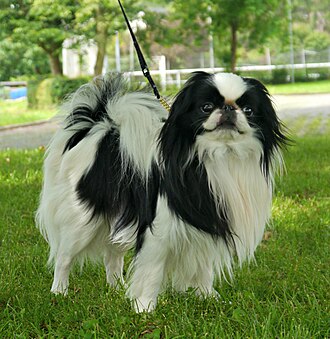
The Japanese Spaniel is a small, square, distinguished-looking dog. It measures between 20 and 27 cm to the cross(about 25 cm in average, with females often slightly taller) and its weight is usually around 2 to 5 kg, although specimens are seen in a wider range; neither the FCI nor the American Kennel Club set a standard weight for the breed.
Its most characteristic feature is the head: wide, round and large in proportion to the body, with a very short and flattened snout and dark eyes, large and far apart that give her that recognizable look of amazement. The ears, triangular and covered in fringe, hang from the sides. The upright neck and tail curled over the back, adorned with a plume of hair, complete an elegant and proud silhouette.
The coat is long, smooth and silky, forming a mane on the neck, fringes on the ears and legs and a plumage on the tail. Accepted colors are black and white, white and red(including all sword, lemon and orange ranges) and tricolor(white and black with fiery red markings). The spots, distributed symmetrically on the face, are part of its charm; many specimens have a small spot or line on their forehead that Japanese tradition has dubbed “the touch of Buddha”.
Origin and history
The origin of the Japanese Spaniel is as fascinating as it is controversial. Although its name links it to Japan – and it was registered as a breed there – almost all experts agree that its lineage originated in China, where it is related to the Pekingese and other Tibetan-type dogs. What’s being discussed is how he got to the Japanese archipelago. One version says that these dogs were given to Japanese royalty in 732 as a gift from the Korean court; others place them between the 6th and 7th centuries, and some delay their appearance until about the year 1000.
What is clear is that once in Japan, the Chin became a treasure trove for the aristocracy. It was a palace dog, bred to accompany ladies and nobles, given as a status symbol among noble families. His leap to the West began soon: In 1613 specimens were taken to England, and in 1853 the American naval officer Matthew Calbraith Perry – the same man who opened Japan to foreign trade – acquired one of these dogs. Beginning in the Meiji era (from 1868), the Japanese Spaniel became popular as a lap dog among ladies of high society, and from there made the ultimate leap to the rest of the world as the adorable companion dog we know today.
Curiosities
- More cat than dog: washes his face with his paw, climbs furniture and sits in high places.
- The touch of Buddha: the spot on the forehead of many specimens is interpreted in Japanese tradition as the fingerprint of Buddha.
- His name in kanji: in Japanese is written ⁇ (chin), a character that is used almost exclusively for this breed.
- Not further worked than hot-rolled: unlike most dogs, has only an outer coat, which lighten its coat despite its leafy appearance.
- Dog of the Emperors: for centuries was reserved for the Japanese nobility, a luxury that ordinary people could not afford.
- Spaniel not used for hunting: despite its name, was never a hunting dog; the term “spaniel” here alludes to its role as a refined lap dog.
If you are attracted to the charm of the Japanese Spaniel, you may be interested in other similarly cut breeds, either because of their Oriental kinship or their role as companion dogs. Check out the Pekinés, their closest relative, the stately Shih Tzu, the affectionate Cavalier King Charles Spaniel or the discreet Spaniel Tibetano. They all share that spirit of a lap dog designed to keep company.
Frequently Asked Questions About the Japanese Spaniel
Does the Japanese Spaniel bark a lot?
No, it’s one of the quietest and quietest companion dogs, barking punctually to warn, but not prone to excessive barking, making it ideal for living on the floor.
Is it a good breed to live in an apartment?
Excellent. His mini size, his low need for exercise and his discreet nature make him one of the best floor dogs. He doesn’t need a garden, just short walks and your company.
Can you be alone for long hours?
It’s not ideal. He’s very attached to his family and may develop separation anxiety. If you work out for long hours, get him used to puppyhood gradually and consider leaving him company or entertainment.
How long does a Japanese Spaniel live?
Their life expectancy is around 12-14 years. A British study from 2024 estimated their average longevity at around 12.5 years, in line with the average of purebred dogs.
Does it shed a lot of hair and need a lot of maintenance?
It has a silky coat with no undercoat that is brushed several times a week. It is very clean and hardly smells, so it does not require frequent bathing; the most important thing is daily eye hygiene.
Is he good with children and other animals?
Yes, it is sociable and affectionate, but its delicate size makes it a better companion for older, caring children. It gets along well with other small dogs and even cats, thanks to its feline nature.
Is it hard to educate?
He’s intelligent but independent and somewhat stubborn, and he learns quickly with positive reinforcement, rewards and short sessions, although you need to be patient and socialize him well from a puppy.
Why is his face so crushed?
It is a brachycephalic breed, selected for centuries for its short snout and characteristic expression. This requires special care: it does not tolerate heat and intense exercise, and its large eyes require attention.