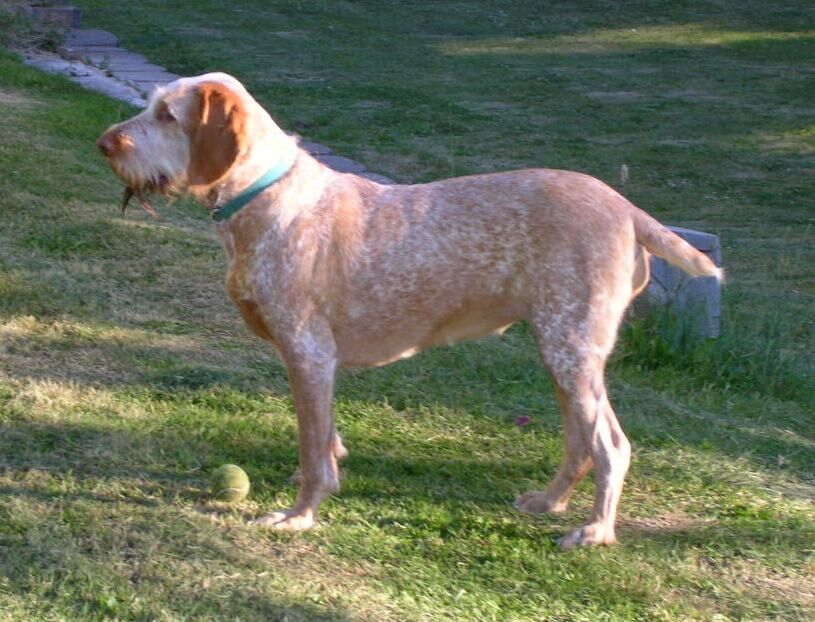
The Spinone Italiano is one of Italy’s oldest and noblest show dogs: a versatile hunter with hard hair, a full beard and a sweet look who hides, beneath his rustic appearance, one of the friendliest characters in the group. Originally from Piedmont, he combines tireless endurance in the countryside with a surprising calmness at home. If you’re looking for a large, well-balanced, family-friendly companion, the Italian Spinone deserves your full attention.
Is Italian Spinone for you?
Before you fall in love with that bearded face, be honest: the Spinone Italiano is a large hunting dog with real needs for exercise and companionship. It’s not an ornamental dog or a guard dog, and its happiness depends on you understanding what it was created for. Here are its lights and shadows at a glance.
In favour .
- Exceptionally docile and sociable character, rare in a hunting dog.
- Very patient and affectionate with the children.
- Quiet and not much barking in the house.
- Resilient, versatile and in love with water.
- Smart and eager to please, which makes the deal easier.
- Hard coat that requires less hairdressing than other bearded breeds.
To be taken into account
- It needs a lot of daily exercise: it doesn’t fit with a sedentary lifestyle.
- He’s very attached. Long-term loneliness is bad for him.
- Its beard retains water and food, and it tends to drip.
- He can be stubborn if he is not disciplined consistently.
- Large size: you need space and a budget.
- Rare breed: finding responsible breeders can be expensive.
Character and temperament
If the Spinone Italiano were to be summed up in one word, it would be the balance. Faced with the nervous intensity of many show dogs, the Spinone stands out for an almost feline serenity. It is docile, patient and deeply sociable, so much so that fans often describe it as a “good-hearted” dog, more interested in being with his family than imposing on anyone.
This sweetness does not detract from its intelligence. The Spinone is alert and observant, and enjoys collaborating with its guide. However, it has an independent vein and somewhat stubborn inherited from generations hunting in its air: it is not a dog that obeys for obedience’s sake, but one that cooperates when it trusts you. It is also sensitive; a sharp tone or an unfair correction easily extinguishes it.
In day-to-day life, it is an affectionate companion, quiet indoors and not very barking. It is not a guard dog – its instinct is to greet rather than distrust – although it will warn if something is strange to it.
Coexistence: children, other pets, flat and loneliness
The Spinone Italiano is one of the hunting dogs that best integrates into family life. Its tolerant character makes it especially suitable for homes with children, always with the supervision and respect that any large dog deserves.
- With children: is excellent. It is patient, robust and playful without abruptness. Nevertheless, due to its size, it is advisable to teach the youngest to treat it calmly.
- With other dogs: is sociable by nature, well socialized, lives comfortably and enjoys canine company.
- With other pets: retains hunting instinct and shows towards prey, so with cats or small animals the ideal is a coexistence from puppy and always with caution.
- On the floor: possible if you cover your daily exercise, because inside it is quiet; but it is more comfortable with garden or easy access to open spaces.
- In the face of loneliness: is his weak spot, so attached to his people, he suffers if he spends too many hours alone and can develop anxiety or destructive behaviors.
Education and training
Raising an Italian Spinone is, in general, a pleasant experience: it wants to please, connects quickly with its guide and learns eagerly. The key is to respect its sensitivity. It responds wonderfully to positive reinforcement – rewards, play, cheerful voice – and is blocked by harsh or repetitive methods.
Short, varied and motivating sessions work much better than long and monotonous routines.Socialization should begin early: exposing the puppy to people, dogs, noises and different environments consolidates its natural good character and prevents fears.
Two points to work on from the beginning: the call (its sense of smell and hunting instinct can take it far following a trail) and the management of the jump, because it is a large and effusive dog that as a puppy does not calculate its strength.
Exercise and activity
There are no shortcuts here: the Spinone Italiano is a hunting dog with endurance and needs to expend energy daily. We are talking about a minimum of one to two hours of activity combining long walks, free running, sniffing and play. A Spinone that only goes around the block will be a frustrated dog.
He is enthusiastic about everything that moves his body and his nose: tracking, exploring the countryside and, especially, the water. He swims with ease and dives without hesitation even in cold water, so a river, a lake or the beach are his paradise. Disciplines such as mantrailing, canicross or hunting trials come like a ring to his finger.
The good news is its “switch”: covered in exercise, at home it lowers revolutions and becomes a calm, sleepy dog.
Care: fur and hygiene
The coat of the Spinone Italiano is hard, dense and flat, about 4 to 6 cm long, shorter on the head, legs and front of the limbs. It barely has undercoat, which makes it relatively easy to maintain despite its unkempt appearance.
To preserve the characteristic rough texture, the ideal is a hand arrangement or stripping a couple of times a year, instead of cutting with a machine, which softens and clarifies the hair.
The rest of the care is the usual one, with an important nuance for his fallen ears: check them and clean them often, because lack of ventilation favors otitis.
Foodstuffs
As a large and active dog, the Spinone Italiano needs a complete and quality diet, adjusted to its age, weight and, above all, to its actual level of exercise.
Large, deep-chested dogs such as the Spinone have a certain risk of gastric dilation-torsion, and it helps to avoid copious meals and strenuous exercise just before or after eating.
In the case of puppies of large breeds, growth should be slowed down: a specific feed for large breeds prevents too rapid development that overloads the joints.
Health and life expectancy
The Spinone Italiano is, as a whole, a rustic and hardy breed, with a life expectancy of around 10 to 12 years.[citation needed] A large British study from 2024 placed its average around 11.9 years, somewhat below the general average of purebred dogs, a difference consistent with its larger size.
Among the problems documented in the breed are some neurological disorders, such as cerebellar abiotrophy (an inherited degeneration of the cerebellum) and idiopathic epilepsy.
The best prevention is to go to responsible breeders who check the health of the breeders, keep the dog in his weight, take care of the feeding during growth and do not skip periodic veterinary checks.
Physical appearance
The Spinone Italiano is a large dog, of solid build and well muscled, with a silhouette practically square: the body length is approximately equal to the height at the cross. The males measure 60 to 70 cm and weigh between 32 and 37 kg; the females, slightly lighter, measure 58 to 65 cm and weigh between 28 and 32 kg.
Its most recognizable feature is its head, with marked eyebrows, moustache and a full beard that give it a good-looking, almost human expression, reinforced by large, friendly eyes and long, sloping ears.
As for color, pure white; white with orange spots; white with brown spots; and brown or orange roan are allowed.
Origin and history
The exact origins of the Spinone Italiano are lost in time. What is known is that in the Italian peninsula there are hard-haired dogs and type shows at least since the Renaissance: in a fresco painted by Andrea Mantegna around 1470 in the Chamber of the Spouses of the Ducal Palace of Mantua a dog of this style is shown lying under the chair of Duke Ludovico III Gonzaga. As early as 1683, the French hunter Espée de Sélincourt claimed that the best griffon dogs “come from Italy and Piedmont”.
The modern Spinone is set in Piedmont, in northwestern Italy, during the 19th century, where it became the most important hunting breed in the region. During World War II it was used extensively by partisans, both for tracking and for transporting food. The conflict decimated the population, and in 1949 the Family of Spinone society was founded to save it; from 1950 the breed was reconstituted and in 1955 was definitively accepted by the International Canine Federation. In 1973 a second company was born, the Club Italiano Spinoni.
Today it is still a relatively minority breed. Between 2010 and 2018, annual registrations in Italy ranged between about 400 and 650, and in all those years the orange and white coat represented a little more than half of the total.
Curiosities
- Its name may have been derived from pine, a spiny Piedmont bush among which it hunted; its hard hair protected it from spikes.
- It is one of the oldest show dogs in Europe, with a history some going back centuries.
- It is depicted in Italian Renaissance art, which gives an idea of its long presence on the peninsula.
- It is a natural swimmer: it goes into cold or deep water without hesitation, something rare even among hunting dogs.
- Their characteristic sprint is extended and efficient, designed to cover a lot of ground without getting tired.
- The orange and white coat is by far the most common among the registered specimens.
If you are attracted to the profile of the Italian Spinone, you may be interested in other versatile, friendly hunting breeds, such as the similarly rough-haired close cousin, the Hard hair sample griffin; the energetic German Shorthaired Pointer; the sleek, athletic Vizsla; or another Italian water dog, the curly-haired Lagotto Romagnolo.
Frequently asked questions about Spinone Italiano
Is the Spinone Italiano a good family dog?
Yes, it is one of the most docile and sociable show dogs, tolerant and patient with children, balanced within the house and very attached to its people, it fits well in active homes that can give it daily exercise and company.
How long does an Italian Spinone live?
Their life expectancy is around 10 to 12 years. A British study from 2024 placed their average at around 11.9 years, somewhat below the average of purebred dogs, partly because of their larger size.
How tall and how much does an Italian Spinone weigh?
Males measure 60 to 70 cm at the withers and weigh between 32 and 37 kg; females measure 58 to 65 cm and weigh between 28 and 32 kg.
Does the Italian spinone shed a lot of hair?
It has a hard coat with little undercoat, so the muzzle is not as showy as in double-coated breeds, but it does loosen hair continuously.
Does Italian spinone need a lot of exercise?
It is a very resilient hunting dog, requiring at least one or two hours of activity a day between long walks, running and play. It loves the water and tracking.
Is it easy to train the Spinone Italiano?
It is intelligent and wants to please, which makes it easy to train, but it can also be somewhat stubborn and sensitive. It responds very well to positive reinforcement and badly to harsh methods.
Can the Spinone Italiano live on one floor?
It can adapt to a floor if it gets enough exercise outdoors, because it’s quiet inside. Still, because of its size and need for movement, it’s more comfortable in a house with a garden or near large areas to run.
Does the Italian Spinone drool?
His characteristic beard and moustache retain water and food, and he has a tendency to drip, especially after drinking.