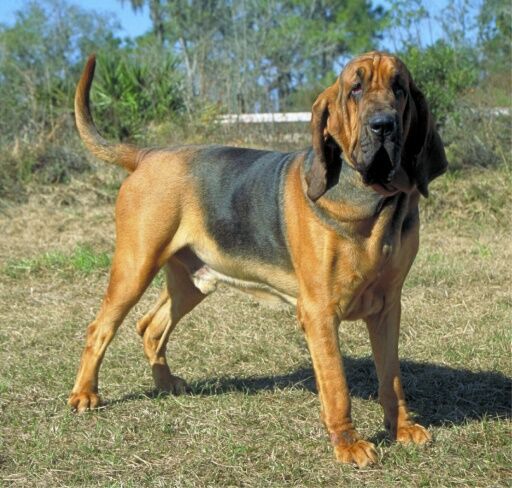
The Saint Hubert’s hound(internationally known as the bloodhound) is a large, noble and melancholy looking hound, famous for having one of the finest olfactory senses in the animal kingdom. Behind that wrinkled face and those endless ears is a calm, affectionate and surprisingly sensitive dog.
Is the Hound of St. Hubert for you?
Before you fall in love with that face, you should be honest: the St. Hubert Hound is a large dog, stubborn by design, that drools, smells strongly and needs a patient and time-consuming owner. In return, it offers a sweet temperament that is difficult to match. These boxes summarize the good and what you should assume.
Points in favour
- Sweet, affectionate and fair to his family.
- Very good with children and tolerant of other dogs.
- Extraordinary sense of smell – a marvel for tracking work and nose sports.
- Quiet and sleepy at home when you’ve exercised.
- Rarely aggressive; not a hostile guard dog.
To be taken into account
- Stubborn: When you get hooked on a smell, you ignore everything else.
- She drools a lot and has a strong body odor.
- He needs long, scented walks every day.
- Prone to gastric torsion and ear, skin and eye problems.
- It howls and “voices”; it can escape following a trail.
Character and temperament
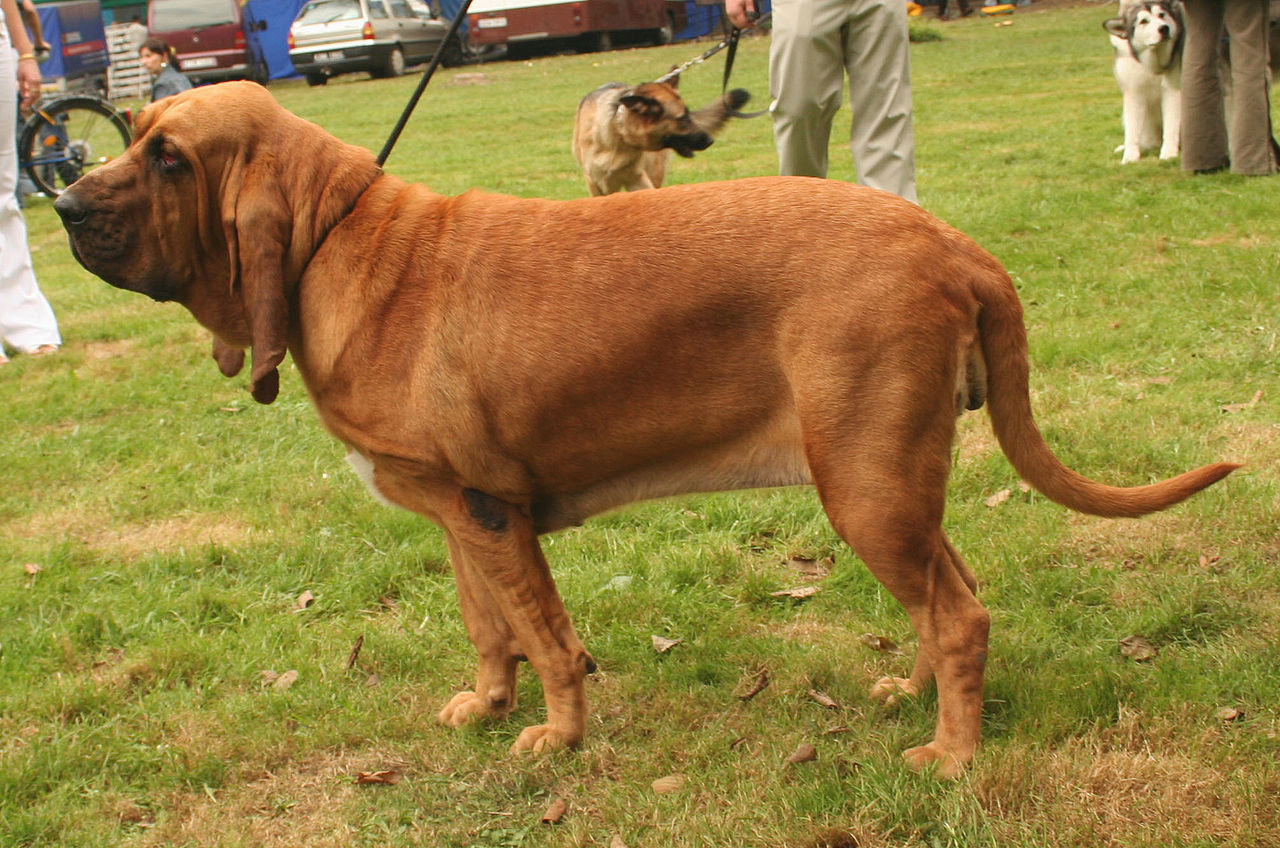
If we had to sum up the character of the St. Hubert Hound in one word, it would be that’s good.. It is a dog of enormous nobility, quiet inside the house, patient and deeply attached to people. He doesn’t have a hair of aggression: Their instinct is not to attack or protect, but to find. That same sensitivity that makes him so affectionate also makes him a dog that suffers from scolding and harsh methods.
Now, that sweetness coexists with one of the dog world’s most stubborn heads. Not for a fool, quite the contrary: It’s absolutely programmed to follow a trail to the end, and when its nose goes to work, the rest of the universe ceases to exist. Calling him, offering him prizes, or pulling the leash is of little use while he is “reading” a scent. Understanding this is the key to not getting frustrated: He ignores you not because he’s disobedient, but because his instinct is stronger than your voice.
It is also a sensitive and somewhat “dramatic” dog, capable of putting on a face of deep sorrow and seeking constant physical contact.
Coexistence: children, other pets, flat and loneliness
The San Huberto Hound fits very well in active and patient families.
- With children: is excellent. It is tolerant, patient and very unreactive. Its only risk with the smaller ones is the size: playing it can throw them unintentionally, so you should supervise.
- With other dogs: due to its herd past usually gets along well with other dogs and enjoys canine company.
- With cats and other pets: is best bred with them from puppyhood, although it’s not particularly hunter-like, its nose can encourage it to follow any little animal.
- On the floor: possible but not ideal. Inside it is quiet, but its size, its tendency to howl and “give voice”, the drooling and the need for long exits make a house with a well-fenced garden feel much better.
- In the face of loneliness: bad. It is a very attached dog; long periods only generate anxiety and can lead to howling or wrecking.
Education and training
Training a St. Hubert Hound is an exercise in humility and perseverance. It’s not a border collie that lives to please you; it’s an independent tracker that decides for itself. That doesn’t mean it can’t be educated, but it has to be done with its character, not against it.
The keys that work with this breed:
- He starts early and socializes a lot: puppy exposed to people, noises, surfaces and other animals becomes a balanced adult.
- Short and funny sessions: gets bored and disconnects right away; several short, motivational breaks are better than long sessions.
- Positive reinforcement and food: is a gluttonous dog; food is your best ally; punishment, on the other hand, blocks it and breaks trust.
- Work the call with realism: never 100% trust your ven in an open area with smells.
- Smell games and tracking are the best way to keep a tired and happy mind.
Exercise and activity

Here is an important nuance: the St. Hubert Hound is not a dog of explosive racing, but of endurance and, above all, of smell. Its ideal exercise is not frisbee or sprinting, but long and quiet walks through environments rich in smells where it can go tracking at its own pace. A dog that has been able to smell at ease returns home satisfied and asleep.
Plan at least one or two long walks a day, plus some mental stimulation. Nose sports (mantrailing, hunting) are his great passion and allow him to shine by doing what he was born to do. Keep an eye on two things: heat, because its thick coat causes it to overheat quickly and it is advisable to avoid exercise in the sunniest hours; and intense exercise right after eating, because of the risk of gastric torsion.
Care: fur and hygiene
The hair itself takes little work: it is short, hard and attached to the body, and with a weekly brushing with a rubber glove to remove dead hair is enough.
- Wrinkles and bumps: facial creases accumulate moisture and dirt; they must be cleaned and dried regularly to prevent dermatitis and infections.
- Orejas: long, dropped and poorly ventilated, they’re a weak point.
- Ojos: the fallen eyelid leaves them somewhat exposed; it is advisable to keep an eye on them and clean the burrows.
- Baba: has handkerchiefs, after drinking or eating it slips loose, and many owners place strategic towels in the house.
- Resto: Bath only when necessary (with mild shampoo), trimmed nails and routine dental hygiene.
Foodstuffs
The San Huberto Hound is a large and gluttonous dog, which requires two things to take care of: the quantity and the way of eating. It needs a quality food adapted to large breed dogs, with a good contribution for their bones and joints, adjusting the ration to their age and activity to avoid overweight, which punishes their joints.
Due to its predisposition to gastric torsion(dilatation-volvulus, the main cause of death of the breed), the feeding pattern is almost as important as the feed: divide your food into two or three servings a day instead of just one, prevent him from eating too quickly (anti-volatility feeders help) and don’t allow him to do strenuous exercise just before or after eating. Water is always available, but no big hangovers.
Health and life expectancy
The life expectancy of the St. Hubert Hound is around seven to twelve years, a modest figure typical of large dogs; recent studies in the UK place the average at around 9 years.
Health points to monitor:
- Gastric torsion (bloat): is the race’s greatest risk and its leading cause of death. Knowing its symptoms (swollen abdomen, unsuccessful attempts to vomit, restlessness) and acting urgently saves lives.
- Ears, skin and eyes:‘s long ears, folds and droopy eyelids make him prone to otitis, wrinkle dermatitis and eye problems.
- Articulaciones: as a large fast-growing dog, you have to take care of dysplasia and not overdo it with exercise in the puppy.
- Tumores: cancer is the second leading cause of death in the breed.
- Heat stroke: its dense coat makes it warm up quickly; beware of exercise in summer.
Physical appearance

The St. Hubert Hound is a large, strong and heavy-boned dog, longer than tall, with a solemn build and a characteristically loose skin.
His mark of identity is the head: long and narrow, with very wrinkled facial skin, a marked paw, and very long, slender, sloping ears that almost touch the ground. His eyes, with their eyelids somewhat drooping, give him that melancholy expression so much his own. The coat is short, hard and composed only of hair (without lanilla), in the classic colors black and fire, liver (liver) and fire, and red (lionate), with occasional white spots on the chest, legs or tail. The tail is long and it carries it high, like a sabre, untwisted.
Origin and history
The origins of the St. Hubert hound go back to the European Middle Ages. The tradition attributes its creation to the monks of the Abbey of St. Hubert, in the Ardennes (present-day Belgium), who from around 1200 sent several pairs of black hounds each year as a gift to the king of France.
Legend has it that William the Conqueror brought specimens to England, although there is no firm evidence for this. The truth is that the breed appears well documented in English texts from the 14th century, where it was used as limer or trail dog: A hound that, tied up, would locate the deer or wild boar before the hunt. Already then it stood out for its ability to follow the cold trail of a particular animal, and even people: Medieval Scottish chronicles speak of sleuth hounds following fugitives.
In the 16th century, English scholar John Caius described in detail their dangling ears and lips and their use in tracking thieves and poachers. In time, the British breed established the modern type, while the original St. Hubert strain was diluted on the mainland. In the 19th century, French enthusiasts rebuilt “their” chien de Saint-Hubert by importing British bloodhounds, and in the mid-20th century the Brussels-based FCI recognized Belgium as the breed’s country of origin. In parallel, the arrival of the dog in the United States (with figures such as breeder Edwin Brough, who in 1888 exhibited specimens in New York) consolidated its fame as a tracker of people.
Curiosities
- Misleading name:“bloodhound” doesn’t mean “bloodhound”. The strongest theory points to “bloodhound” in the sense of a dog following the trail of a wounded animal, not a ferocious nature.
- A record-breaking nose: reaches about 300 million olfactory receptors and has been documented tracking for up to about 330 hours, almost 12 days.
- Nick Carter, the legend: this American hound born in 1900 accumulated more than 650 catches and popularized the image of the bloodhound tracker.
- Evidence in the courts: in some U.S. states the identification of a suspect by a well-trained St. Hubert hound is admitted as evidence.
- Silent tracker: unlike other hounds, when working alone it usually tracks silently; the howl is reserved mainly for the pack.
- Movie star and mascot: has inspired characters like Trusty in The Lady and the Tramp, Bruno in Cenicienta or the crime prevention mascot McGruff in the US .
If you are drawn to the world of hounds and tracking dogs, you may want to compare the St. Hubert Hound to other breeds in the same family: the inseparable Beagle, the unmistakable Basset Hound, the agile Harrier or the tenacious Plott Hound.
Frequently Asked Questions About the St. Hubert Hound
Is the St. Hubert Hound a good family dog?
Yes. It is one of the most gentle and equitable dogs, very attached to its people and tolerant of children. Of course, because of its size and its energy when playing, it is advisable to supervise contact with very young children, and it needs a family with time to take it out and let it use the smell.
Is it hard to train?
It’s not that he’s not smart, it’s that he’s programmed to follow his nose, and when he’s hooked on a trail, he’s disconnected from the rest of the world, so obedience and leash ride costs more than other breeds, so with short sessions, patience, positive reinforcement and food as motivation, you get good results; punishment just blocks it.
How much exercise do you need?
He’s quite mental, but he’s more mental than he is fast. He prefers one or two long walks a day through places with varied smells, where he can track calmly, than intense running. At home he’s usually quiet and sleepy as long as he’s worn his body and, above all, his head.
How long does a St. Hubert hound live?
Its life expectancy is around seven to twelve years. It is one of the longest-lived breeds with the least longevity among large dogs: a British study from 2024 placed the average around 9 years, conditioned mainly by gastric torsion and tumors.
Why do you have all these wrinkles and those long ears?
Long ears and loose skin on the neck and face (the so-called papada or “slave”) help to remove and trap odor particles from the soil and direct them to the nose as it crawls.
Does he drool and smell a lot?
Yes to both. That dangling-lipped mouth drools easily, especially after drinking or eating, and the breed has a characteristic body odor more pronounced than other dogs.
Can you have it on one floor?
It can, but it’s not ideal. It tolerates indoor life because it’s quiet inside, but it’s a big dog, it howls and “gives a voice”, it babbles and it needs long, scented outings every day.
Is he really the dog with the best sense of smell in the world?
It is among the best tracking devices in existence, reaching some 300 million olfactory receptors, and has been documented tracking for several days; the most famous case, a tracking of about 330 hours (almost 12 days), is used by police and rescue teams worldwide, and its identification is admitted as evidence in some courts.