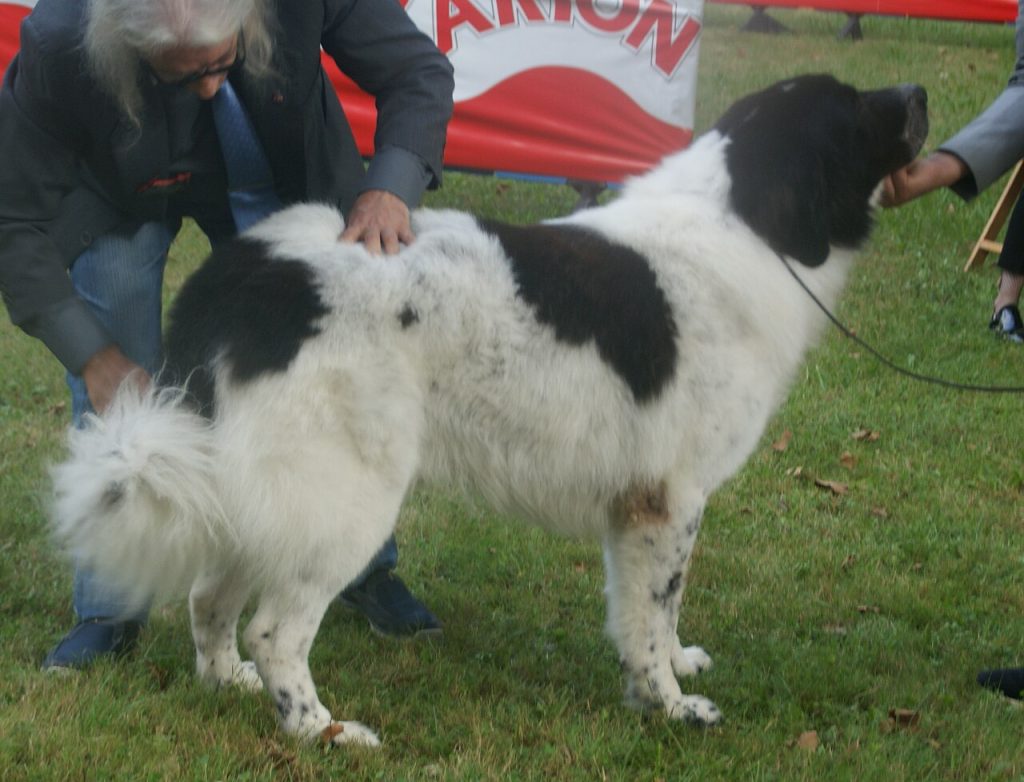
The Romanian Shepherd from Bucovina is one of the great molossus guardians of the Carpathians: a rustic, imposing and deeply protective dog, bred for centuries to defend flocks of sheep and cows from wolves, bears and cattle rustlers. Hiding behind his friendly bear appearance is a brave, territorial and surprisingly serene guardian with his family. It’s not a dog for everyone, but for anyone looking for a natural protector and familiar with large breeds, the Bucovina Shepherd is a little-known gem.
Is the Romanian Shepherd from Bucovina for you?

The Bucovina Shepherd is a giant cattle guard dog, made to live outdoors and protect a territory. Before you fall in love with his demeanor, be honest: this dog asks for space, experience and a job to do. If your idea is a quiet flatmate, it’s not your breed; if you’re looking for a loyal keeper for a farm or a house with land, few breeds will do it better.
In favour .
- Exceptional guardian: courageous, territorial and deterrent.
- Balanced and tolerant of his family and children.
- Very resistant to cold and outdoor life.
- Rustic and healthy, with few whimsical demands.
- A deep bark that scares away any intruders.
To be taken into account
- Giant carving: it needs a lot of space, not good for flooring.
- Very suspicious of strangers; demands intense socialization.
- Independent and stubborn: not easy to raise.
- Barking and territorial; can cause problems with neighbors.
- Uncommon outside Romania: difficult to find.
Character and temperament
The temperament of the Bucovina Romanian Shepherd is that of an authentic herding dog. It was selected to stay alone with the sheep for days, make decisions on its own and stand up to serious predators such as the wolf or bear.
With his family he is a serene, attached and protective dog. He is not effusive or jumpy; his way of wanting is to be present, watch and protect.
In the face of strangers, it changes completely: it becomes suspicious, alert and very territorial. It warns with a severe and thunderous bark, one of its hallmarks, and does not hesitate to intervene if it believes that its people or territory are in danger.
Coexistence: children, other pets, flat and loneliness

With children. is one of its strong points. Well socialized, the Bucovina Shepherd is usually patient, careful and protective with the children of the family.
With other pets. Raised alongside sheep and cows, it tends to be respectful of livestock and the animals it is reared with.
Floor and space. is not a floor dog. It needs a house with well fenced terrain where it can patrol and watch. The field, a farm or a cattle ranch are its natural habitat; the cold poses no problem thanks to its dense double coat.
Soledad. tolerates being outdoors and working autonomously, but should not be isolated from human contact. A dog of this strength that is bored or lives unattended may become excessively barking or difficult to handle. It needs a bond and routine.
Education and training
Educating a Romanian Shepherd from Bucovina is not a task for beginners. It’s an intelligent dog, but also independent and with a lot of its own criteria: For generations he made his decisions alone on the mountain, and it shows. He doesn’t wait for orders, he evaluates them. That’s why he responds much better to respect, consistency and positive reinforcement than to imposition or harshness, which only get him to close in on the band.
The absolute priority in this race is the socializing: expose him from puppyhood to people, noises, animals and various situations so that he learns to differentiate between the everyday and the real threat. A well-socialized Bucovina is a reliable keeper; one that is not can be a serious problem because of its size and instinct. It is also good to work on basic obedience and head control early on, when it is still manageable.
Exercise and activity
The Bucovina Shepherd has an average energy, not that of a sport dog. It does not need miles of running, but it does need daily movement, ample space and, above all, a function. These dogs are programmed to watch: giving them a territory to patrol and protect gives them more balance than any agility circuit.
It is important not to overdo it with strenuous exercise during its growth: being a giant size dog, its joints are delicate until it finishes developing, around 18-24 months.
Care: fur and hygiene

The coat of the Romanian Shepherd from Bucovina is double and abundant, designed to withstand the harsh winters of the Carpathians. The hair is short on the head and the front of the legs, while on the body it is long (6 to 9 cm), straight and rough, with a shorter and woolly inner layer that insulates from the cold. It forms a marked mane on the neck, freckles on the legs and a very populated tail.
Despite its volume, maintenance is reasonable: A weekly brush is enough for most of the year to remove dead hair and prevent knots. During the two seasonal mouldings (spring and autumn) it sheds a lot of hair and should be brushed daily. It does not need frequent bathing; its rustic coat is well maintained with punctual cleaning. As with any large dog, your ears, nails, and teeth should be checked regularly.
Foodstuffs
As a giant breed, the Bucovina Shepherd’s diet must take care of two things: quality and the rate of growth. A high-end feed or diet rich in quality protein and formulated for large or giant breeds promotes proper bone and joint development. In the puppy it is advisable not to overfeed or force growth, since excessive weight at an early age punishes the joints.
In adults, the ration is adjusted to their activity level and is preferably divided into two daily intakes. Being a large, deep-chested dog, it is wise to avoid strenuous exercise just before and after eating as a precaution against gastric dilation-torsion, a common risk in large-sized moles. Water always clean and available, especially if you live outdoors.
Health and life expectancy
The Romanian Shepherd of Bucovina is a natural, rustic and resistant breed, the result of a selection based on functionality rather than aesthetics.
As with any large-sized dog, the main precautions are those of its size: hip and elbow dysplasia and gastric dilation-torsion(swelling of the stomach), which advises dividing meals and avoiding exertion immediately after eating. A good breeder, regular veterinary checks and growth without overweight are the best prevention. Estimated life expectancy, in line with other great guardians, is around 10 to 12 years.
Physical appearance
The Bucovina Shepherd is a large to giant sized dog, imposing in appearance, haughty and powerful, but harmonious in its movements.
The head is massive, slightly raised relative to the backline, with a moderately wide skull and a strong truncated cone-shaped snout, never pointed. The eyes are small relative to the skull, almond shaped and brown, with a calm expression. The ears, high-inserted and V-shaped with a rounded tip, fall attached to the cheeks. The body is massive, with a broad, deep chest and a heavily populated tail that is lowered at rest and raised in the shape of a sickle when alert.
Its coat is one of its most striking features: white or beige-white background with well-defined spots of gray, black or black with reddish reflections.
Origin and history
The Romanian Shepherd of Bucovina (in Romanian, Ciobănesc Românesc from Bucovina) is a natural breed that originated in the Carpathian Mountains, with special roots in the historical region of Bucovina, in northeastern Romania.
It is part of the four Romanian shepherd dog breeds: the Mioritza Shepherd (formerly Barac), the Carpathian Shepherd (formerly Zăvod), the Corb Shepherd (the “raven”) and the Bucovina Shepherd itself.
The first breed standard was drafted in 1982 and was updated by the Romanian Kennel Association in 2001 and 2002, following the FCI model.
Curiosities
- Their bark is legendary: deep, deep and thunderous, able to be heard from great distances and deter predators before they even see them.
- It is one of the most recently recognized breeds by the FCI: it did not gain definitive recognition until 2019.
- The name alludes to Bukovina, a historical region today divided between Romania and Ukraine, famous for its painted monasteries and its pastoral tradition.
- Despite its size and ferocity toward intruders, it is highly valued in Romania for its gentleness toward house children.
- It is an outdoor dog par excellence: its dense double coat allows it to sleep outdoors even in the harsh mountain winters.
If you are attracted to the character of the big keepers and moldy, you may also be interested in other breeds of strength and protective temperament. Check out the Cane Corso, the imposing Mastín Inglés, the rescue giant San Bernardo or the elegant Gran Danés, other large breeds with which it shares presence and nobility.
Frequently Asked Questions about the Bucovina Romanian Shepherd
Is the Bucovina Romanian Shepherd a good family dog?
Yes, within its profile as a watchdog. With its family and, especially, with the children of the house it usually shows itself tolerant, calm and protective. It is not a living dog or a companion for every type of home: it needs a family with experience, space and time to socialize and educate it from puppyhood.
How tall and how much does a Bucovina Shepherd weigh?
It is a very large breed. The males measure between 68 and 78 cm at the cross and the females between 64 and 72 cm. The FCI standard does not fix an official weight, but by its size and moldy structure we speak of a heavy dog, which in adult males can easily exceed 50 kg.
Does he adapt to living in a flat?
It is not its ideal environment. It is designed to live outdoors guarding a large territory, withstands the cold well thanks to its double coat and needs space. It can live with a family in a house with well-fenced land; a small apartment in the city goes against its nature.
Is he an aggressive dog?
It is not aggressive in a gratuitous way, but it is very territorial and distrustful of strangers. It warns with a deep and powerful bark and defends its own with courage against predators or intruders.
How much exercise do you need?
It has average energy: it is not a tireless athlete, but it is a large dog that needs daily walks, space to move and, above all, a task that gives meaning to its day, such as watching.
Is it easy to educate?
It is not the simplest breed. It is intelligent but independent and with its own criteria, heritage of centuries working alone in the mountains. It responds to positive reinforcement, consistency and respect, never to imposition. It is advisable that it be educated by someone with experience in guard dogs.
How long does the Romanian Shepherd of Bucovina live?
There are no extensive longevity studies because it is a small breed outside of Romania. As a reference, large guard dogs usually live about 10 to 12 years with good care, proper feeding and veterinary control.
Does the FCI recognize this breed?
The International Kennel Federation recognises it as the Romanian Bucovina Shepherd, within Group 2 (mountain molossos).