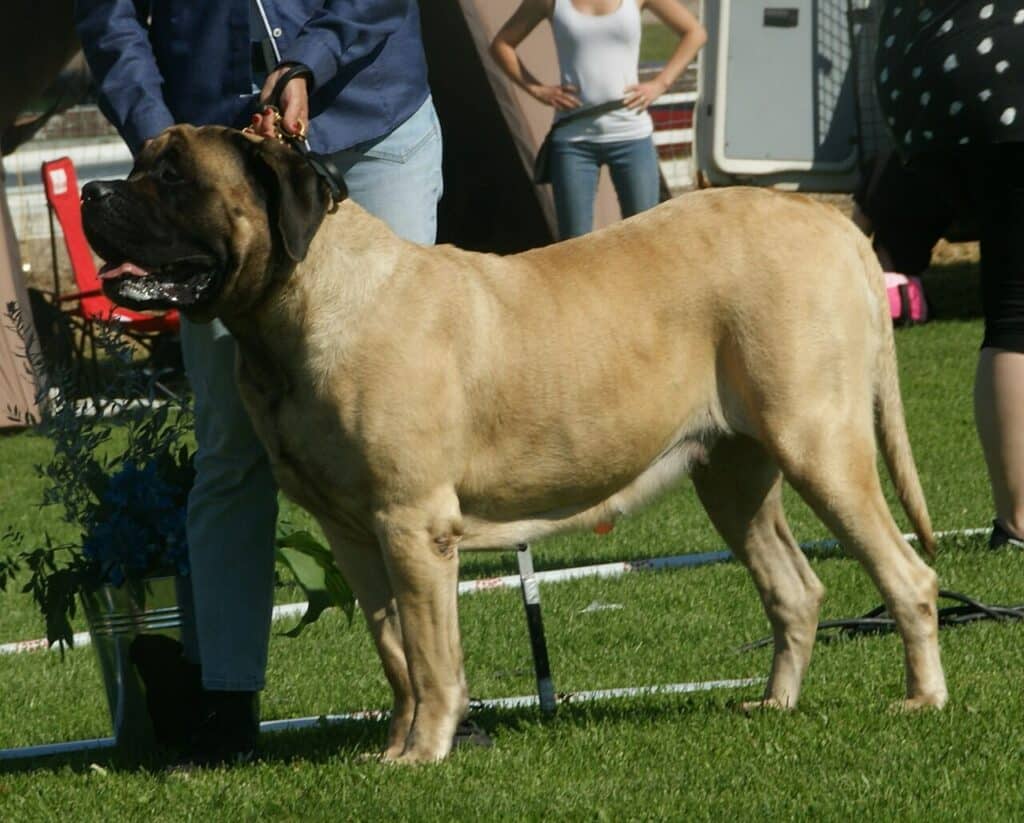
The Mastín Inglés(English Mastiff, or simply Mastiff) is one of the most imposing dogs that exists: the largest domestic breed of body mass on the planet. Originally from Great Britain, it combines a colossal size with a serene, noble and hugely attached to his family character.
Is the English Mastin for you?
The English Mastiff is not a dog for any household. Its character is wonderful, but its size, its sloppiness, and its special needs make it a breed for prepared people. Before you fall in love with a puppy, look carefully at this list.
In favour .
- Quiet, balanced character and very affectionate with his family.
- He’s a first-rate deterrent just by his presence.
- Patient and tolerant of the children in the house.
- It needs less intense exercise than its size suggests.
- Short hair, easy to maintain.
- Huge loyalty and attachment; he wants to be with his people.
To be taken into account
- Immense strength and size: unmanageable if not trained as a puppy.
- He babbles and snores; he’s not a “clean” dog.
- Short life span for what we’d like: around 7-10 years.
- Predisposed to hip dysplasia and gastric torsion.
- Delicate growth: exercise should be dosed in the first 2 years.
- High cost on food, vet and space at home.
Character and temperament
If one word defines the English Mastiff it is nobility. As early as 1800 the naturalist Sydenham Edwards wrote that “what the lion is to the cat, the mastiff is to the dog”: the noblest of the family.
That serenity goes hand in hand with a very strong protective instinct. It is not a barking dog or a nervous one, but it is always alert to what is happening in its territory. The typical response to a stranger is not to attack, but to calmly stand between your family and the visitor and wait to read the situation; if you sense that the person is welcome, you relax. His courage is proverbial, but it is always accompanied by cheerfulness, not gratuitous aggressiveness.
It is worth knowing that it is not one of the “cleverest” breeds in the sense of quick obedience: it can be somewhat stubborn and slow to react, and learns at its own pace.
Coexistence: children, other pets, flat and loneliness
- With children: is patient and affectionate with the little ones in the family. The risk is not its character, but its volume: an 80 kg specimen can accidentally knock down a child during play, so supervision is mandatory.
- With other pets:, well socialized from puppyhood, is usually tolerant and cohabits without problems.
- The adult On the floor: is quiet and sedentary at home, so it can adapt to a floor if it receives its walks.
- In the face of loneliness: is a very attached dog who needs his family. He does not like to spend many hours alone and is grateful to be part of the day-to-day of the house.
Education and training
The education of an English Mastiff is, above all, a matter of safety. A mischievous puppy is adorable; that same dog weighing 80 kg and without manners is ungovernable. That is why everything starts early: early socialization with people, noises, other dogs and situations, and basic manners (walking on a leash without pulling, sitting, going to the call) from the first months.
It works very well with positive reinforcement, quiet firmness and, above all, a lot of consistency. He ‘s a sensitive dog . harsh methods or yelling blocks him instead of teaching him. Since he is not the fastest learner, it is advisable to arm yourself with patience, short sessions, and gentle repetition. Calm, consistent leadership gives him security; clear rules from puppyhood prevent problems when he reaches his full size.
Exercise and activity
Here many are surprised: to be a colossus, the English Mastiff needs moderate exercise. One or two daily walks and some quiet activity are enough to keep it in shape and in good spirits. It is a low-energy dog that enjoys company more than marathons.
There are two golden rules. The first one: During your first two years you should not undergo long runs, jumps or strenuous exercise, so as not to damage the growth plates of joints that support a lot of weight. The second: Watch out for the heat. Its short snout and large body make it sensitive to high temperatures, so it is best to walk in cooler hours. Regular, gentle exercise, of course, must be maintained throughout life to prevent overweight and laziness.
Care: fur and hygiene
The hair of the English Mastiff is short and attached to the body, so its maintenance is one of the simplest: a weekly brushing is enough to remove the dead hair, with some more abundant seasonal moult.
- Babies and calves: You should clean your face and lips frequently, especially after eating or drinking.
- Folds and masks: check and dry the folds of the face to prevent skin irritation and infection.
- Ears, eyes and nails: regular cleaning and checking; nails, trimmed so they don’t bother you when you walk.
- Flat-rolled products of iron or non-alloy steel, of a width of less than 600 mm: a soft sleeping surface prevents calluses, hygromas (inflammation of elbows) and joint problems due to weight.
Foodstuffs
Feeding a giant has its own science. It needs a quality feed or diet formulated for large or giant breeds, with a careful balance of protein, calcium and energy. In the puppy this is critical: too fast growth burdens the joints, so it is advisable not to overdo it with calories or supplements without veterinary criteria.
A key health point: divide food into two or three servings a day instead of one big one. One large meal increases the risk of gastric torsion, a vital urgency in deep-chested breeds like this. You should also avoid exercise just before and after eating. And, above all, control your weight: obesity multiplies the wear and tear of joints that already take a lot.
Health and life expectancy
The life expectancy of the English Mastiff is short, as in almost all giant breeds: a British study placed it at around 9 years, and most sources manage an approximate range of 7 to 10 years.
The most important health problems include hypoplasia of the hip(and elbow) and gastric torsion. Obesity, osteosarcoma, and cystinuria are also common. Cardiomyopathy, allergies, vaginal hyperplasia, cruciate ligament rupture, hypothyroidism, osteochondritis (OCD), entropy, progressive retinal atrophy (PRA) and persistent pupillary membranes are described more occasionally.
Therefore, when buying a puppy from a responsible breeder, experts recommend asking for breeder tests: X-rays of hips and elbows, thyroid screening, and DNA testing for progressive retinal atrophy.
Physical appearance
The English Mastiff is impressive from any angle. It is a powerful, stocky, broad-skinned dog with a huge, almost square-shaped head. The body is massive, with great width and depth, especially between the front legs, which are very far apart; its length is greater than the height at the withers. It is the most massive canine breed that exists.
Standards do not set exact measurements, but the height at the withers is around 70-77 cm (males from about 76 cm and females from about 70 cm), with weights usually moving between 70 and 100 kg, and an average around 80-85 kg; males are clearly heavier.
The hair is short and attached to the body. As for the color, the standard supports fawn, apricot, and silver fawn, in addition to the brindle on those bases.
Origin and history
The English Mastiff is a British mallard breed with very ancient roots. It is considered a descendant of the Alano (Alaunt) and the Pugnax Britanniae, the fearsome war dog that the Romans encountered when invading Britain, with a significant contribution from the Alpine Mastiff already in the 19th century. Julius Caesar recorded these dogs around 55 B.C. Many were taken to Rome to fight in the arena against bulls, bears, lions, and other dogs.
For centuries, these molosos served as keepers of estates and flocks, bodyguards, and dogs for the bloody sports of the day. A famous story tells how, at the Battle of Agincourt (1415), Sir Peers Legh’s mastiff protected his wounded master for hours; that dog, back in England, gave rise to the famous Lyme Hall breed, which centuries later would be key in the modern breed.
The ban on animal fighting with the Cruelty to Animals Act of 1835 changed the course of the breed. Throughout the 19th century, breeders such as J. W. Thompson and T. V. Other H. Lukey initiated a systematic breeding that established the modern type by the 1880s. The two world wars, with meat rationing, nearly wiped out the breed in Britain; it was rebuilt thanks to imports from the United States and Canada. The AKC recognized it in 1885 and today it is present throughout the world, although in its country of origin it is still considered a vulnerable breed: In 2020, only 104 births were recorded in the UK. In the FCI it is classified within Group 2 (dog-type molluscs).
Curiosities
- It is the largest body mass in the world‘s pet dog: on average it weighs up to about 50 kg more than a wolf.
- The Zorba specimen (Aicama Zorba of La Susa) is listed as the heaviest and longest dog ever recorded: 155.6 kg and 2.51 m from nose to tail, according to Guinness 1989.
- There are indications that a mastiff arrived in America aboard the Mayflower in 1620.
- The “Crown Prince” of the 19th century, the progenitor of the modern race, belonged to psychiatrist L. Forbes Winslow, one of the names who shuffled around the case of Jack the Ripper.
- It has contributed to the origin of numerous “mastiff-type” breeds throughout the world.
- The dogs of Argentine President Javier Milei (Conan, Murray, Milton, Robert and Lucas) are English Mastiffs.
- There are long-haired specimens, called “Fluffies”, due to a recessive gene.
- It appears in literature: the Mastiff Carlo is one of the canine protagonists of Sherlock Holmes’ story “The Mystery of Copper Beeches”.
If you are attracted to the character of the large molossos, you may be interested in comparing the English Mastiff with other breeds of the same family and imposing appearance: the Bullmastiff, its more direct and somewhat more manageable relative; the Mastín Napolitano, another colossus with marked folds; the Doge of Bordeaux, the large-headed French guard; and the San Bernardo, the quintessentially good-natured giant.
Frequently asked questions about the English Mastiff
How much does an English Mastiff weigh?
It is the largest dog breed in the world in terms of body mass. Males usually weigh around 80-100 kg and females slightly less, although there are specimens that far exceed those figures.
How long does an English Mastiff live?
Like almost all giant breeds, their life expectancy is short.A British study placed the average at about 9 years, and most sources manage an approximate range of 7 to 10 years.A proper diet, weight control and well-managed growth help to lengthen and improve their life.
Is the English Mastiff an aggressive or dangerous dog?
It is not a dog of an aggressive character. The standard and tradition describe a noble, serene and affectionate temperament. It is a natural guardian that discourages by its size and presence rather than by biting: when a stranger enters it usually stands between its family and the visitor and waits.
Is it a good breed to have with children?
Yes, it is known for its patience and affection for the children in the family. The main concern is not the character, but the size: an 80 kg dog can accidentally throw a small child to the ground during play.
How much exercise do you need?
Less than its size suggests. One or two walks a day and some moderate activity are enough. It is very important NOT to subject it to running or strenuous exercise during its first two years so as not to damage the growth plates of its joints, and to avoid heat from its short snout.
Does the English Mastiff suck a lot?
It is not a breed for those who are looking for a particularly “clean” dog; it is advisable to have a rag on hand and clean his face regularly.
Can he live in a flat?
It can adapt to a flat if given the exercise and walks it needs, since as an adult it is quite quiet at home. However, due to its size it is more comfortable in a house with space, and suburban or rural environments feel better than a small flat.
Is it easy to educate?
It is loyal and wants to please, but does not stand out for its speed of learning and can be somewhat stubborn and slow. It responds well to positive reinforcement, patience and constancy, and badly to harsh methods. Socialization and basic manners should start from a puppy, because correcting an adult of 80 kg is already another story.