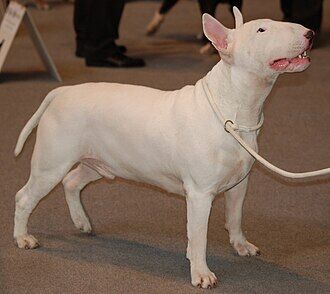
The Bull Terrier is one of the most recognizable dogs in the world: Their unmistakable egg-shaped head and small, triangular eyes are unlike those of any other race. Originally from England and a member of the terrier family, it is a strong, muscular dog deeply attached to its people. He has a reputation for being a brave and stubborn clown, a combination that makes him adorable to those who understand him and demanding to those who underestimate him. In this guide, we take an in-depth look at the character, coexistence, care, health, and history of the Bull Terrier.
Is the Bull Terrier for you?
The Bull Terrier is not a dog for everyone, and that should be clear before falling in love with its face. It is affectionate to the extreme, funny and loyal, but also strong, stubborn and very demanding of company and exercise. It is not recommended for people who are starting in dog ownership. Before deciding, weigh the good and what it will require of you.
In favour .
- Extremely affectionate and devoted to his family.
- Cheerful character, playful and with a great sense of humor.
- Brave, loyal and with a strong bond to its owner.
- Short coat, very easy to maintain.
- Robust and athletic, ideal for active people.
- Good watchdog for his fine ear and presence.
To be taken into account
- Very stubborn: he needs constant and patient education.
- Not for beginners or those who don’t spend much time at home.
- He has a hard time dealing with loneliness and can be destructive if he gets bored.
- Lots of energy: It requires much more exercise than average.
- Gluten; tends to overweight if diet is not controlled.
- Predisposition to deafness (especially white individuals) and skin problems.
- In several countries it is listed as a potentially dangerous breed (PPP).
Character and temperament

If we had to sum up the Bull Terrier in one sentence, it would be “a muscular clown with the heart of a child”. The breed standard describes him as a dog of balanced character, who must be docile to people despite his stubbornness, full of courage but at the same time sweet. Anyone who lives with one confirms it: They are tremendously affectionate, funny and eternal puppies, with an ability to play the fool that few breeds match.
That playful part coexists with a strong, very determined personality. The Bull Terrier is brave, stubborn, and quite independent; it knows what it wants, and if you let it, it will try to get away with it. It is not gratuitous aggression, but determination. That’s why early socialization is non-negotiable: A well-socialized puppy Bull Terrier gets along well with people and other animals, while one raised without guidelines can become difficult to handle given its strength.
He’s, first and foremost, a family dog. He is very attached to his people and needs to be a part of the day-to-day household; he is not a garden dog who is left alone. It is loyal, protective, and very sensitive to its owner’s mood. A curious fact confirms its balanced character: A study conducted in Germany in 2008 found no significant differences in temperament between the Bull Terrier and the Golden Retriever, a breed considered among the kindest.
Coexistence: children, other pets, flat and loneliness
The Bull Terrier may be an exceptional family companion, but its physique and character impose some rules of coexistence.
- With children: is affectionate and playful with the little ones in the house, but his enormous physical strength forces him to always supervise the game. Not out of malice, but because an enthusiastic push can knock a small child down. He should never be left unattended with minors.
- With other pets: with good socialization from puppyhood can coexist with other dogs and animals. Without that work, its terrier instinct and dominant character can generate tensions, especially between males.
- On the floor: can live on the floor perfectly as long as you cover his daily exercise needs.
- In the face of loneliness: is his big Achilles heel. The Bull Terrier is fatal to being alone for long hours. Boredom, stress, and separation anxiety can lead him to destructive behaviors – and with his powerful jaws the damage can be considerable. He is not the ideal breed if you spend the whole day outdoors.
Education and training
Training a Bull Terrier is an exercise in patience and perseverance. It’s an intelligent dog that learns things easily, but it’s also distracted just as quickly as it learns, so short, varied, motivating sessions work much better than long, repetitive ones. Its stubbornness makes it not one of those that obey “because it does”: you have to give it reasons.
Positive reinforcement is the way to go. It rewards and praises every good behavior and avoids harsh methods, which with this breed are counterproductive and deteriorate the bond.
The key stage is from the first few weeks of life to four to eight months, when it reaches sexual maturity and the traits of dominance are established. This is where the foundation of coexistence is built – or lost.
Exercise and activity

The Bull Terrier has an enormous amount of energy and needs to burn it. It requires much more activity than the average breed: long walks, intense play, racing, and find-and-bring games make it feel wonderful. A Bull Terrier that gets enough exercise is a balanced and happy dog; one that gets bored becomes nervous, destructive, and prone to overweight.
There is an important nuance: it is not advisable to over-demand it physically when it is young. Excessive exercise during growth can cause muscle and joint problems and even prevent it from reaching its optimal development. The key is dosage: regular and age-appropriate activity, without happening in puppies.
In addition to physical exercise, he appreciates mental stimulation. Smell games, interactive toys, and small obedience challenges help to keep that awake mind busy and channel its energy in a healthy way.
Care: fur and hygiene
In the fur section, the Bull Terrier is low maintenance. Her hair is short, flat, rough to the touch and shiny, with the skin tightly attached to the body. Frequent brushing – a couple of times a week – is enough to keep it in near-perfect condition and to distribute the natural grease that gives it its shine. Change your hair twice a year, at times when brushing should be more frequent.
Bathing should be occasional, only when it is really dirty and always with a specific shampoo for dogs so as not to irritate their skin. More important than the bathroom is the routine checkup: pay special attention to the ears, keeping them clean and dry to prevent infections and mites. Complete hygiene with regular nail trimming – without overdoing it – and dental care to prevent tartar.
If you notice redness, itching, or hives, it is best to see your veterinarian to identify the cause, which is often insect bites or food.
Foodstuffs
The Bull Terrier is notorious for being gluttonous, so ration control is critical. It tends to eat more than it needs, and combined with its musculature, that easily translates to overweight if you let it. Offer it a quality diet, tailored to its age, weight and activity level, and distribute the food in measured portions instead of leaving the bowl full all day.
Fresh and plentiful water cannot be lacking: it is an active dog that warms up easily and needs to be well hydrated.
Since this breed is prone to allergies, in some cases skin discomforts improve by changing the diet. Some people get good results with diets based on fish and free of chicken and cereals, but any dietary changes for health reasons should be consulted with the veterinarian first.
Health and life expectancy
As for longevity, the data varies according to the study. A British study from 2024 places the average life expectancy of the breed at around 12 years, while previous surveys in the UK gave a median of about 10 years and an average of 9, with quite a few specimens reaching 10-15 years.
The Bull Terrier is a robust breed, but it carries several genetic predispositions that are worth knowing:
- Sordera: is the most characteristic problem. It affects about 20% of all-white Bull Terriers and 1.3% of colored ones. That is why all puppies should pass the BAER test at about five weeks; a dog with unilateral deafness can lead a normal life.
- Lethal acrodermatitis: is an inherited genetic disease, exclusive to white individuals, linked to a defect in zinc metabolism.
- Skin problems: frequent allergies and dermatitis, with itching, hives and, in chronic cases, hair loss.
- Renal problems: including renal failure and polycystic kidney disease (PKD).
- Heart problems: mostly aortic stenosis and mitral valve dysplasia.
- Eye problems: highlights primary lens dislocation (PLL).
- Dislocation of the kneecap and compulsive behaviors such as tail chasing, which can lead to self-harm.
Acquiring the puppy from a responsible breeder who performs health tests (BAER, kidney, heart and eye checks) greatly reduces the risk.
Physical appearance

The defining trait of the Bull Terrier is, without question, its head. Viewed from the front it is egg-shaped, with the upper part of the skull almost flat from ear to ear. In profile, the outline descends smoothly in a continuous curve from the top of the skull to the tip of the nose, which is black and slopes downward. The eyes are unique in the canine world: Small, dark, sunken and triangular in shape. The ears are small, thin, close together and held upright.
The body is compact, round and highly muscled, with a broad and deep chest, strong shoulders and a well-arched rib cage. The tail is short, thick at the base, is sharpened towards the tip and carried horizontally.
The coat is short, flat and rough. As for colour, white (with spots allowed only on the head), tiger, red, lions, black and tricolor are allowed; in the English standard tiger is the preferred colour. Interestingly, the breed has no official height or weight limits in its standard: what is valued is the maximum possible substance and harmony for the size and sex of the specimen. In practice they are medium-sized dogs that are around 45-55 cm at the withers and can reach 35 kg. There is also the Miniature Bull Terrier variety, which is identical except for the height, which must not exceed 35.5 cm.
Origin and history
The history of the Bull Terrier began in 19th-century England. At the beginning of that century, dogs called “bull and terrier” were developed, crosses between the now extinct Old English Bulldog and different terriers, sought for controlling vermin and, unfortunately, for the bloody fighting shows of the time. That mixture combined the bulldog’s tenacity with the speed and agility of terriers. Over time, that common trunk split into the ancestors of the Bull Terrier and the Staffordshire Bull Terrier.
The true father of the breed was James Hinks, a breeder from Birmingham who, in the mid-19th century, crossed the bull and terrier with the English White Terrier (also extinct today) in search of a cleaner looking dog, better legs and a more elegant head. In 1862 he presented at an exhibition in Chelsea a dog named “Puss”, daughter of his white bulldog “Madman”. Those early specimens did not yet have the characteristic egg head. To refine the breed, contributions from Dalmatian, Pointer and Whippet (to gain elegance and agility) and Borzoi and Collie (to soften the stop) were used. The first recognized modern Bull Terrier was “Lord Gladiator”, from 1917, the first without any stop.
Hinks wanted his white dogs and bred them specifically for it. But the exclusively white breed brought health problems, so in the early 20th century breeders like Ted Lyon reintroduced the color by crossing it with the Staffordshire Bull Terrier. The color varieties were officially recognized (at least by the AKC) in 1936. Dog fighting was banned, and the Bull Terrier left behind its wrestling past to become what it is today: a companion dog. A common confusion should be clarified: Despite the name, the Bull Terrier is not the same as the pit bull, although they share ancestry.
Curiosities
- The Bull Terrier is one of the very few dogs in the world with triangular-shaped eyes, a trait that almost no other breed shares.
- U.S. General George S. Patton had a Bull Terrier named Willie, which had belonged to a deceased British pilot and which he bought in England in 1944.
- President Theodore Roosevelt had among his many pets a Bull Terrier named Pete, famous for biting an official and stalking the French ambassador.
- “Bullseye”, the pet dog of the American Target chain, is a Miniature Bull Terrier; and “Spuds MacKenzie”, an advertising icon of the 1980s, was also a Bull Terrier.
- Patsy Ann, a deaf Bull Terrier who lived in Juneau, Alaska, in the 1930’s, became famous for “predicting” the arrival of ships in the harbor.
- The egg-shaped shape of its head is not accidental – it was accentuated by selection over decades until it became the breed’s hallmark.
If you are interested in the Bull Terrier, you may want to compare its character and physique with other related breeds. Take a look at the Staffordshire Bull Terrier, its closest relative within the bull type terrier; the American Staffordshire Terrier, from the same family and often confused with it; the Boxer, another muscular and playful athlete of European origin; and the Bulldog, present in the ancestry of the entire bull family.
Frequently Asked Questions About the Bull Terrier
Is the Bull Terrier a dangerous dog?
It is not aggressive by nature; in fact a 2008 German study found no differences in temperament with the Golden Retriever. It is very strong and stubborn, so ill-mannered can cause problems, and in several countries is listed as a potentially dangerous breed (PPP).
Is the bull terrier the same as the pit bull?
Although the name confuses and they share common ancestry in the ancient crosses of bull and terrier, they are distinct breeds.
How long does a Bull Terrier live?
Its life expectancy is around 10-12 years. A British study from 2024 placed it at around 12 years, while previous surveys gave a median of about 10 years, with many specimens reaching 10-15.
Why are so many Bull Terriers deaf?
Deafness is linked to the white color of the coat. It affects about 20% of all white Bull Terriers and only 1.3% of colored ones.
Is the Bull Terrier good with kids?
He is affectionate and playful with the children in his family, but his great physical strength forces him to always supervise the game to avoid accidental pushes.
Can he live in a flat?
Yes, as long as you meet their high daily exercise needs. It is a dog that wants to be indoors with its people. The worst thing it takes is loneliness: leaving it alone for many hours can lead to anxiety and destructive behaviors.
Is it hard to train?
It is intelligent and learns quickly, but is also easily distracted and very stubborn. It works best with short sessions, positive reinforcement and a lot of consistency.
How much exercise does a Bull Terrier need?
Pretty: it has a lot of energy and needs more activity than the average breed, between long walks and intense play.