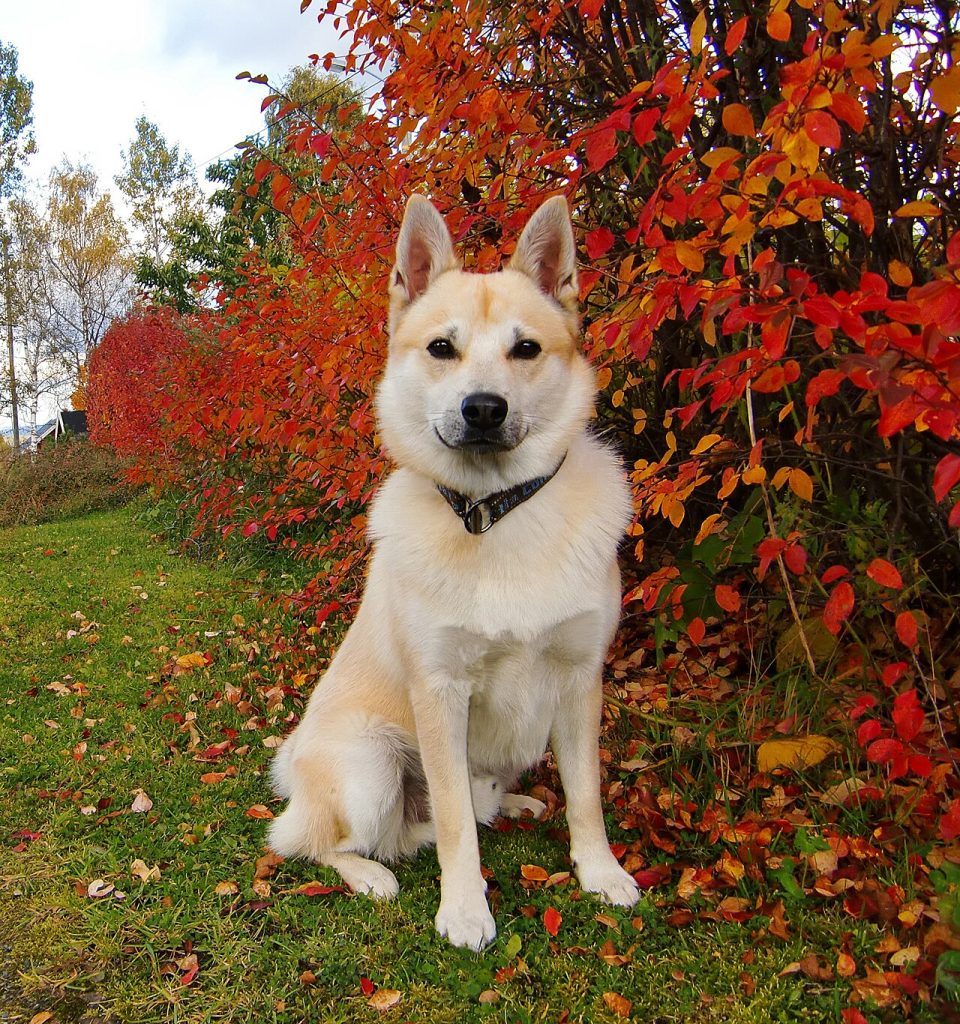
The Norwegian Buhund(in Norwegian Norsk buhund) is a spitz-type dog of slightly smaller than medium size, born on the rainy coasts of western Norway to work side by side with the farmer: Shepherd the cattle, watch the house and warn of any intruders. Cheerful, tireless and deeply attached to his family, he is a versatile and affectionate companion who needs movement and companionship in equal parts. If you’re looking for an active, smart, Nordic-like dog, the Norwegian Buhund has a lot to offer.
Is the Norwegian Buhund for you?

The Norwegian Buhund is a wonderful dog in the right hands, but it doesn’t fit into any lifestyle. Before you fall in love with its smiling spitz face, it’s best to look at both of its faces honestly: it’s as affectionate and hardworking as it is energetic and vocal. Here’s a quick summary to see if you’ll make a good match.
Points in favour
- Very affectionate and devoted to his family, he adores children.
- Intelligent and eager to learn: brilliant in obedience and agility.
- Excellent watchdog and guard by nature.
- Handled size and healthy rustic appearance.
- Easy coat to care for most of the year.
- Ideal companion for running, cycling or hiking.
Points to Consider
- It needs plenty of daily exercise; it becomes bored and destructive if ignored.
- Barker: warn of everything, something to work on in flats and communities.
- Stubborn and independent; requires patient and consistent education.
- Two intense transplants a year with abundant undercoat loss.
- Reserved with strangers if he doesn’t socialize well as a puppy.
- Not suitable for sedentary or unavailable owners.
Character and temperament
If the Norwegian Buhund had to be summed up in one word, it would be happiness. It is a tremendously lively and active dog, which does not get tired easily and needs daily discharge of energy to be balanced. Along with that nerve, they share a tremendous tenderness and an absolute devotion to their people: He forms very strong bonds with his family, enjoys caresses and is famous for his affection for children.
The Norwegian Buhund is communicative and courageous, always attentive to what is happening around him, and warns with barking of any noise or movement that seems suspicious to him.
On the mental level, it stands out for being very intelligent and remarkably stubborn, with an intense desire to learn new things. When it does not receive enough stimulation, it is immediately bored, becomes restless and can seek its own amusements, almost always at the expense of your furniture.
Coexistence: children, other pets, flat and loneliness
With children: is one of its great strengths. The Norwegian Buhund adores the little ones in the house and enjoys playing with them. Because of its energy and its need for training, it is always advisable to monitor interactions, especially with very young children or with older people, to avoid pushing and scaring during play.
With other pets: has been well socialized since puppyhood, living comfortably with other dogs and cats with whom he is raised.

On the floor: can adapt to apartment life as long as you cover its high level of exercise and work on barking control, a key aspect in the community.
In the face of loneliness: is a deeply social dog who needs to be with his people. Long periods of solitude, coupled with boredom, are the perfect recipe for barking, tearing and anxiety. It is not a breed for those who spend the whole day outside the house.
Education and training
The Norwegian Buhund is a brilliant pupil… and with character. Its high intelligence and willingness to learn make it very receptive, but its stubborn and independent side demands consistency and patience. It works wonderfully with positive reinforcement, rewards and play; instead, it shuts down or closes with harsh, repetitive or authoritarian methods.
The key is in short, varied, and fun sessions that keep their interest, because they get bored with the routine. Early socialization is essential: the sooner they get to know people, dogs, noises, and different situations, the more balanced and less suspicious they will be as adults.
Well-trained, this dog not only obeys – it enjoys learning. It is no accident that it excels in obedience, agility and other canine sports, where its combination of energy, brain and desire to please makes it an enthusiastic competitor.
Exercise and activity

There are no half-measures here: the Norwegian Buhund needs intense exercise every day. It is a dog bred to work from sun to sun on the farm, so it is not content with a short walk. It requires at least an hour long of daily activity, and appreciates much more: running, playing, long walks and outings in the countryside.
Its endurance and brain make it ideal for sports. It is an excellent agility dog and a perfect companion for those who lead an active life and want someone to go running, hiking or cycling with. Combining physical exercise with mental challenges (olfactory games, interactive toys, obedience) is the best way to have a happy and calm Norwegian Buhund at home.
The flip side of the coin is clear: if it is ignored or forced to stand still frequently, it expels that accumulated energy in the worst way, becoming destructive and difficult to handle.
Care: fur and hygiene
The coat of the Norwegian Buhund is short to medium in length and has the great advantage that it does not become tangled or flaky when moving.
The exception is the two annual mowing periods, when the wool “loosens” and the undercoat is intensely lost. During these weeks it is advisable to brush much more frequently, almost daily, to remove dead hair, relieve the dog and control the amount of hair that accumulates around the house. It’s a double coat designed for the cold, humid climate of Norway, so it insulates very well and doesn’t need a haircut.
The rest of the care is customary for any healthy dog: bathing only when really necessary to not remove the natural protection of the coat, checking and cleaning ears, cutting nails when they do not wear themselves and regular dental hygiene.
Foodstuffs
The Norwegian Buhund needs a complete and balanced diet, adapted to its medium to small size and, especially, to its high level of activity. A sporting dog that runs and works daily has different energy needs than a calmer dog, so it is advisable to choose a quality feed or diet and adapt the feed to its actual exercise, age and physical condition.
Being an athletic and rustic breed, maintaining an adequate weight is essential to care for their joints, especially considering the predisposition to hip dysplasia. Split your food into two servings a day, control sweets (it’s best to use part of your ration as a reward for training) and always have fresh water available. If you have any questions about quantities or type of diet, your veterinarian is the best reference.
Health and life expectancy
The Norwegian Buhund is a robust and rustic dog, the result of centuries of work in a demanding environment, and generally enjoys good health, with a life expectancy that is usually between 12 and 15 years.
The two issues to watch are the hereditary eye problems and the hypoplasia of the hip. That is why it is so important to go to responsible breeders who perform eye and hip X-rays on the breeders, thereby reducing the risk of transmitting these conditions. With regular veterinary checkups, weight control, adequate exercise, and good nutrition, the Norwegian Buhund is usually a healthy and active companion for many years.
Physical appearance
The Norwegian Buhund has the unmistakable silhouette of the Nordic spitz: square profile body, somewhat below average size, compact and well proportioned.
As for the size, the males measure between 43 and 46 cm at the cross and the females around 44 cm. The weight is around 14-18 kg in males and 12-16 kg in females.
The coat comes in two main colors. The wheat ranges from pale cream to deep orange, with or without dark tips and supporting black mask, always with as little white as possible. The black is preferable without too many tan reflections. Some white is allowed in specific areas – a narrow neck collar, a fine streak on the face, a small spot on the chest, feet, and tail tip. There are also gray specimens similar to the Norwegian Elkhound, and the British standard also includes the wolf color (wolf sable).
Origin and history
The Norwegian Buhund belongs to the large family of spitz-type dogs, a very old group with many variations in size, coat and color. Genetically it is closely related to the icelandic sheepdog and the Swedish Jämthund, all descended from the ancient Norse dogs that accompanied the peoples of northern Europe. For centuries, these dogs protected farms and guided cattle and sheep through Scandinavian landscapes.
His own name tells his story. “Buhund” comes from the Norwegian word bu, meaning farm, house or mountain shelter – the place where the shepherd lived while tending his flock during the summer – and which can also allude to cattle; joined to hundred, “dog”, it literally gives rise to the “farm dog”. The modern Norwegian Buhund was forged in the rainy coastal lands of western Norway, where it was an all-terrain helper: Shepherd, guardian and fellow worker.
Today the breed is recognized by the FCI within the Group 5 (spitz and primitive type dogs), Section 3 (Nordic guard and herding dogs), and has dedicated clubs in Norway, the United Kingdom and the United States, which have contributed to spreading and preserving this unique Scandinavian dog outside their borders.
Curiosities
- The surname “buhund” is not exclusive to Norway: it reflects a common tradition of farm dogs throughout Scandinavia, of which sister breeds such as the Icelandic Shepherd and the Jämthund are part.
- It is a true all-terrain farm dog: it could herd sheep, herd cows and guard the house in the same day.
- His cheerful nature and alert brain have made him a star of agility and obedience, sports he enjoys as much or more than his owner.
- There are gray specimens very similar to the Norwegian Elkhound, another iconic spitz of the country, proof of the common origin of the Nordic dogs.
- It was born on the west coast of Norway, one of the wettest areas in Europe; its double, waterproof coat is the perfect response to that climate.
If you’re attracted to the Norwegian Buhund, you’re likely to be interested in other energetic, brain-deep herding or Nordic breeds too – the sleek, smiling Samoyedo, the tough Husky Siberiano, the bright, tireless Border Collie, or the versatile Pastor Australiano– all ideal companions for active families.
Frequently asked questions about the Norwegian Buhund
Is the Norwegian Buhund a good dog for families with children?
Yes, it is one of its greatest virtues. The Norwegian Buhund loves children, is playful, resilient and tolerant, and enjoys being part of family life. Nevertheless, because of its high energy, it is advisable to supervise play with the little ones and teach it from puppyhood to control its enthusiasm, so that jumps and pushes do not end in a scare.
Does the Norwegian Buhund bark a lot?
It tends to be quite barking. It’s a farm dog used to warning of any movement or noise, so by nature it’s alert with its voice. It’s not a defect, but part of its guardian instinct; with training and a well-crafted “silence” command from puppyhood it’s controlled, but if you’re looking for a quiet dog this is not your breed.
How much exercise does a Norwegian Buhund need a day?
It needs at least an hour of daily activity, and appreciates much more: walks, runs, games, hiking or dog sports. It is tireless and, if it does not spend its energy, it gets bored and can become destructive. It is a dog designed for active people, not for a sedentary life.
Can the Norwegian Buhund be kept on one floor?
It can live on the floor as long as it is guaranteed the daily exercise it needs and the barking control is worked out, something important in a community of neighbors.
Does the Norwegian Buhund shed a lot of hair?
It has a typical spitz double coat that is maintained with a weekly brushing most of the year. The difference comes twice a year, when it sheds the undercoat intensely (“loosens the wool”): in those weeks you will need to brush it almost daily and you will see hair all over the house.
Is it easy to train the Norwegian Buhund?
He is very intelligent and learns quickly, but he is also stubborn and independent. He responds wonderfully to positive reinforcement, variety, and short, fun sessions; he shuts down with harsh and repetitive methods. With consistency and good socialization, he is a brilliant student, so much so that he excels in obedience and agility.
How long does a Norwegian Buhund live?
It is a rustic and long-lived breed that usually lives between 12 and 15 years. The main health issues to monitor are hereditary eye problems and hip dysplasia, so it is advisable to choose puppies from breeders who perform ophthalmological and hip tests on the parents.
Does the Norwegian Buhund get along with other dogs and pets?
Well socialized from puppyhood, it usually coexists without problems with other dogs and cats in the house. It retains some of its herding instinct, so it may try to “lead” other animals or people, and its alert character makes it somewhat reserved with unfamiliar dogs.