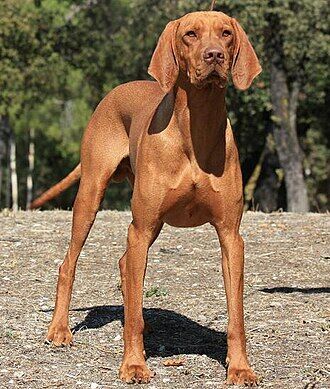
The Braco Húngaro, known in his homeland as vizsla, is a medium-sized, golden-coated and wakeful-looking show dog that falls in love at first sight. It combines the nose of a hound, the elegance of an athlete and an almost obsessive attachment to his family. If you are looking for an active, caring, and ever-close companion, read on: This breed has a lot to tell and some requirements that you should know before deciding.
Is the Hungarian Braco for you?
Before you get carried away by its golden stamp, be honest: the Hungarian Braco is not a dog for any lifestyle. It is a born hunter full of energy that needs movement and companionship in equal parts. Here’s a straightforward summary of what’s good and what you should value calmly.
In favour .
- Extremely loving and loyal to his family.
- Smart and easy to train with gentle methods.
- Short coat that barely requires maintenance.
- Good with children and, well socialized, with other dogs.
- Ideal companion for athletes and people outdoors.
- He barks a little and warns me when something doesn’t fit.
To be taken into account
- He needs plenty of daily exercise, not just a short walk.
- He suffers from separation anxiety if he spends hours alone.
- It has no undercoat: it is cold and should not live in the garden.
- Bored can become destructive.
- Their hunting instinct calls for control and call reinforcement.
- He’s very “clingy”: he’ll want to be with you all the time.
Character and temperament

If we had to define the Hungarian Braco in one word, it would be “devotion”. This breed lives for and for its people. It’s one of those dogs that follows you from room to room, that curls up beside you on the couch, and that, according to many owners, doesn’t rest quietly until it sneaks under the covers of the bed. Hence its affectionate nickname of “velcro dog”: it sticks to you and won’t let go.
Behind that affection is a sensitive and intelligent animal. It picks up on your tone of voice, reads your emotions and responds poorly to harshness. A scream or physical punishment does not correct it, it blocks it. It is a dog that thrives on patience, play and positive reinforcement, and that in the right hands becomes an exceptionally balanced companion.
It is not a barking dog or nervous without a reason, but retains a well-developed protective instinct. It warns when something is out of the ordinary and is reserved with strangers until it checks that there is no threat. Well socialized from puppyhood, it is kind and sociable; without that basis, it can become suspicious or too protective of its territory.
Coexistence: children, other pets, flat and loneliness
The Hungarian Braco fits into many homes as long as its needs are respected.
- With children: is patient, tolerant and playful, a great choice for families.
- With other dogs: is well socialized, enjoys canine company and loves to run in groups.
- With cats and small animals:‘s hunting instinct is very present, coexistence is possible if he grows up with them, but the running prey awakens his hunting side.
- On the floor: can live in an apartment as long as you cover his daily exercise quota.
- Soledad: is not designed to spend long hours alone; separation anxiety and boredom can lead to wrecking or barking.
Education and training
Few dogs are as eager to learn as a Hungarian Braco. It is docile, smart and eager to please, which makes it a diligent learner even for people with little experience. The key is in the how ?: it only responds to positive reinforcement, constancy and respect.
It starts with early socialization. The earlier he gets to know people, noises, surfaces, other animals and situations, the safer and more balanced he will be as an adult. Short, varied and fun sessions work much better than long, monotonous routines, because it’s a dog that gets bored with repetition.
Two fronts deserve special attention. The first is the call (come when you call): with its tracking instinct, a visla can shoot out after a scent, so it works the response to the call from a puppy and in controlled environments. The second is mental stimulation: smell games, intelligence toys and small daily challenges prevent it from channeling its energy into mischief.
Exercise and activity

There are no shortcuts here: the Hungarian Braco is a high-energy dog and needs to expend it. We’re talking about a minimum of one or two hours a day of intense activity, not a couple of laps around the block. Racing, long walks, pick-and-take, swimming or walking with you while you run or ride your bike are plans that make it happy.
It loves the water. Its origin as a collector dog leads it to jump into lakes, rivers and ponds without thinking twice, so a bath in the middle of nature is one of its greatest pleasures. It also shines in canine sports such as agility, canicross or trail trials, where it combines body and mind.
Remember that physical wear and tear must be accompanied by mental stimulation. A vissla tired in body but bored in head is still a restless dog. The combination of exercise and olfactory work is the recipe for having a calm and satisfied companion at home.
Care: fur and hygiene
If there’s one thing the owner of a Hungarian Braco appreciates, it’s how easy it is to keep its coat. It’s short, smooth and attached to the body, with no woolly undercoat, which translates into very little brushing work. A weekly check with a soft or rubber brush is enough to remove the dead hair and keep the coat shiny. Of course, you should know that it changes throughout the year, not just by season.
They are practically self-cleaning dogs and have very little characteristic dog smell, so baths should be occasional: only when they get really dirty. After a dip in the mud, it is often enough to let the dirt dry and brush it afterwards. Complete the routine with regular nail cutting to avoid injury, cleaning of fallen ears (which retain moisture) and dental hygiene.
An important detail derived from its hair: the lack of undercoat makes it feel the cold and rain more than other breeds. It is not a dog to live outdoors or in a garden cottage; it needs to be indoors, and in winter a coat on long walks is very good for it.
Foodstuffs
As a good athlete, the Hungarian Braco needs a quality diet that supports its musculature and its high level of activity. The ideal is a complete and balanced food, with good protein intake, adapted to its age, weight and the actual exercise it does every day. A dog that runs for two hours does not eat the same as one that walks average.
Divide the daily ration into two servings to promote digestion and help prevent gastric problems, and avoid strenuous exercise just before or after eating.
If you notice itching, digestive problems or skin reactions, consult your veterinarian to adjust your diet and, of course, fresh water is always available, especially after exercise.
Health and life expectancy
The Hungarian Braco is, in general, a robust and long-lived breed. Its life expectancy is around 12 to 14 years, and a large British study from 2024 placed the average at around 13.5 years, above the average of purebred dogs.
That said, there are predispositions that should be known and monitored.
- Hip dysplasia (rarely, but possible)
- It’s called canine epilepsy.
- Certain cancers such as mastocytoma, hemangiosarcoma and lymphoma.
- Hypothyroidism, which requires lifelong medication.
- Progressive retinal atrophy and sebaceous adenitis.
- Blood clotting disorders such as Von Willebrand disease and hemophilia A.
- Skin and food allergies.
The best prevention is to go to a responsible breeder who carries out the relevant health checks on the breeders.
Physical appearance

The Hungarian Braco is a medium-sized, slender but muscular breed of dog, with a noble demeanor that does not go unnoticed. The males measure between 58 and 64 cm at the cross and the females between 54 and 60 cm, with a weight of approximately 20 to 30 kg in males and 18 to 25 kg in females.
Its unmistakable hallmark is color. The mantle is a golden-yellow in various shades, often described as a “pancake color” or rusty, and most curiously, the nose, eyelids, nails, and even the eyes harmonize with that same warm hue. Small white marks on the chest or fingers are tolerated, but the set must convey that characteristic golden monochrome print.
The head is slender and proportionate, with a square snout and semi-long rounded “V”-shaped ears that fall glued to the cheeks. The expression is lively and intelligent. The tail, which has a rather low insertion, is carried horizontally and waves eagerly as it explores. In some countries it has traditionally been cut, although the trend and legislation are increasingly aimed at respecting it as natural.
Origin and history
The origins of the Hungarian Braco lie in rural Hungary, in the wide plains east of the Danube. Their ancestors accompanied the Magyar tribes as hunters and trackers, and the first known written reference appears in the Vienna Illuminated Chronicle, commissioned in the 14th century. The Vizsla was already hunting in the silk industry, lifting pieces for hawks before guns existed.
The race as we know it today took shape between the 18th and 19th centuries. The rural nobility was looking for a versatile, golden-colored, agile and tireless dog, and with the advent of firearms the goal changed: Now they wanted a show dog to mark the position of the parts and collect them, able to work in both dry and marshy terrain. In that process, blood from other sample breeds was used to determine the current type.
The 20th century almost wiped him out. The two world wars brought the breed to the brink of extinction, and reports say that after World War II, only about a dozen of the true type survived in Hungary. From that minimum, the amateurs rebuilt the population. In 1924 the Magyar Vizsla Klub was founded to preserve the standard, the FCI recognized the breed in 1936 and in 1960 the Vizsla gained official recognition from the American Kennel Club. Today it is the national pride of Hungary.
Curiosities
- The vizsla is one of the symbols of the country and a source of Magyar pride.
- The Velcro dog: their need for contact is such that many sleep curled up under the covers, glued to their owner.
- Self-cleaning and almost odorless: keeps its hair clean on its own and gives off very little “dog smell”.
- Distinguished kinship: contributed to the development of breeds such as the Weimaraner, the German Shorthaired Braco and the Hungarian Hardhaired Braco itself.
- Triumph at Crufts: a vizsla was proclaimed Best in Show at Crufts 2010, one of the most prestigious canine shows in the world.
- NBA player Kevin Love is one of the many proud owners of a Hungarian Braco.
If you’re attracted to the Hungarian Braco but want to compare before deciding, take a look at other related breeds or similar-skill breeds: its closest relative, the sleek Weimaraner; the versatile Short-haired German Bracho; the classic English Pointer; or the relentless Epagneul Bretón.
Frequently Asked Questions about the Hungarian Braco
Is the Hungarian Braco a good dog for families with children?
Yes. It is patient, tolerant and playful, which makes it an excellent family companion. It is good to supervise play with very young children because its energy and enthusiasm can provoke nudges without malice.
How much exercise does a Vizsla need a day?
He needs between one and two hours a day of vigorous activity – running, long walks, swimming or pick-and-drop – in addition to mental stimulation.
Can he live in a flat?
Yes, as long as you meet their daily high need for exercise and companionship. The problem is not the size of the house, but leaving it without air or alone for many hours.
Are you okay staying home alone?
He’s very attached to his family and may suffer from separation anxiety, which can lead to tearing or barking if he spends long hours alone on a regular basis.
How long does a Hungarian Braco live?
Their life expectancy is around 12 to 14 years. A British study from 2024 placed the average at around 13.5 years, above the average for purebred dogs.
You lose a lot of hair and it’s hard to take care of?
Its short hair is very easy to keep: a weekly brushing and occasional baths are enough.
Is it easy to train?
He is intelligent, docile, and wants to please, so he learns quickly. The condition is to use positive reinforcement and gentle methods: he is very sensitive, and harsh punishments block him instead of correcting him.
Can it live in the garden or outdoors?
No, he has no undercoat, so he feels the cold and the rain and needs to live indoors.