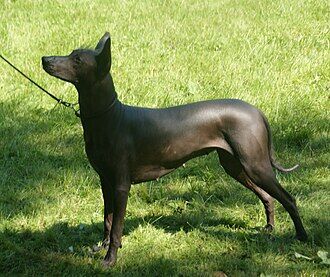
The Xoloitzcuintle(also spelled Xoloitzcuintli and known as xolo or Mexican pelon dog) is one of the oldest and most unique dog breeds in the world: the hairless dog born in Mexico thousands of years ago. It combines a slender and exotic physique with a calm, loyal and vigilant character.
Is the Xoloitzcuintle for you?

The Xoloitzcuintle is a calm and family-friendly companion dog, ideal for those who are looking for a clean, intelligent and low-maintenance animal in terms of hair, but is willing to take care of its skin and give it company.
In favour .
- It doesn’t loosen and is comfortable for many allergy sufferers.
- A calm, balanced and very loyal character.
- Smart and easy to educate.
- Healthy, rustic and remarkably long-lived (13-18 years).
- A good guard is discreet: he warns without being a barker.
- Without hair, there are no fleas or ticks nesting in the mantle.
To be taken into account
- Naked skin is cold: it needs a coat in winter and shade in summer.
- It requires skin care and well-dosed baths.
- He’s very attached to his people. He’s sick of prolonged loneliness.
- Reserved with strangers; needs early socialization.
- He needs daily exercise despite his calmness at home.
- Rare breed: finding serious breeders takes its time.
Character and temperament
If anything defines the Xoloitzcuintle it is its serenity. It is an attentive and observant dog, which follows its family around the house without straining and rarely loses its nerves. This calmness coexists with an alert intelligence: it learns quickly, reads people’s moods very well and develops a deep bond with those who care for it.
With his own, he is affectionate and faithful to a touching degree; with strangers, he is reserved and cautious, not unnecessarily aggressive. That combination of attachment and healthy distrust makes him an excellent alarm dog: He warns you of what seems odd, but he’s not a heavy barker. Miniature-sized specimens are usually somewhat more playful and “pussy”, while standard ones tend to have a more sober and guarded profile. In all cases, we are talking about a noble, sensitive, balanced companion who gives back more than the affection he receives.
Coexistence: children, other pets, flat and loneliness
- With children: is patient and affectionate if raised with them and socialized well.
- With other dogs: usually coexists smoothly, especially if he grows up with someone.
- With cats and small pets: adapts well when used as a puppy, although it retains hunter instinct and agility.
- On the floor: fits perfectly into an apartment thanks to its quiet character of doors inside, provided it covers your daily exercise.
- In the face of loneliness: is his weakness, he’s built to live close to his people and it’s bad for him to spend long hours alone, something to value before adopting.
Education and training

The Xoloitzcuintle is an intelligent and collaborative dog, which makes it much easier to train. It responds wonderfully to positive reinforcement – rewards, caresses and a gentle voice – and closes in on harsh methods, which only manage to make it suspicious. It is a sensitive dog, so the key is calm constancy rather than authoritarian firmness.
The absolute priority is early socialization: due to its natural tendency to be reserved, it is advisable to expose it as a puppy to people, dogs, noise and different environments so that it grows up safe and not suspicious. Basic obedience is easily assimilated, and many dogs excel in agility, obedience, and other dog sports. Short, varied, and motivating sessions yield better results than long, repetitive routines.
Exercise and activity
Although at home it is a serene dog, the Xoloitzcuintle is athletic, agile and resistant, with a body designed to move. It needs daily exercise to stay healthy and balanced: two good walks, play and the possibility of jogging or running in a safe space are usually enough.
It is advisable to adapt the activity to the climate: in summer, it is better to walk at the first and last minute to protect your skin from the sun, and in winter to keep it warm for outings.
Care: fur and hygiene
The great myth of the hairless dog is that it “needs no care”, and it’s just the opposite: I’m switching from brushing to skin care. In the bulb variety, the ideal routine is simple but consistent: spaced baths with mild soap, regular skin cleansing and light hydration when requested. The most common mistake is to bathe and lubricate it excessively, for this removes the natural protective fat, clogs the pores, and promotes acne and dandruff.
You should also take care of sun exposure: their bare skin burns, so they need shade and, in highly exposed areas, specific dog sun protection. In the hairy variety, the care is similar to that of any short coat dog: An occasional brush is enough. In both cases, don’t forget the routines common to the entire species: Checking nails, ears and, very importantly in this breed, dental hygiene, as hairless xolos usually have incomplete teeth.
Foodstuffs
The Xoloitzcuintle does not have exotic nutritional requirements: it needs a quality diet, balanced and adapted to its size, age and activity level.
It’s a dog that tends to stay in shape, but overweight punishes its joints and skin, so it’s best to avoid excess rewards. Splitting it into two servings a day helps with good digestion. As always, fresh water freely available and dietary changes made gradually so as not to alter its stomach.
Health and life expectancy
The Xoloitzcuintle is one of the healthiest and most rustic breeds in existence. Having been forged by natural selection over thousands of years, rather than through intensive aesthetic breeding, it has been relatively free from the structural and hereditary problems that affect other breeds. Their life expectancy is remarkable: The breed clubs and the American Kennel Club place her between the ages of 13 and 18.
Its health features are mainly related to its skin and its tropical origin. Its bare skin makes it sensitive to cold – it is clearly an indoor dog – and sunlight, and it can suffer from skin problems if neglected or bathed excessively. Hairlessness is genetically linked to incomplete dentition in many lampreys, so hygiene and dental checkups are important. Beyond this, it is a robust dog that, with good nutrition, exercise, and skin care, usually reaches old age in good shape.
Physical appearance

The Xoloitzcuintle’s silhouette is reminiscent of the Greyhound or the Pharaoh Hound: slender and elegant body, slightly rectangular in proportion (somewhat longer than high), long neck, almond-shaped eyes and large upright ears, fine and very expressive.
The breed comes in two varieties. The without hair has smooth, soft and tough skin, almost completely bare, with just a few short hairs on the head, fingers and tail tip. The with hair variety wears a short, flat, dense coat that covers the entire body. Colors range from black and slate gray or bluish to bronze, reddish, liver and yellowish-blonde, with the most common being dark; the skin may show spots or splashes. By size, the FCI recognizes three varieties: miniature(about 25-35 cm at the cross), intermediate(35-45 cm) and standard(45-60 cm), with a weight ranging from approximately 4 to 20 kg depending on the specimen.
Origin and history
Few races can boast such a deep history. The Xoloitzcuintle is originally from Mexico – believed to be from the Colima area – and is among the oldest dogs on the American continent, with a presence that dates back more than 3,000 years, according to some estimates, and even much further. Its name comes from Nahuatl: connects Xólotl, a Mexican god associated with fire, lightning and the underworld, with itzcuintli, “dog”. Hence their other names: Mexican pelon dog or Aztec dog.
For the Mesoamerican peoples, it was not just any dog. Mexican tradition held that Xólotl had created the xolo from a splinter of the Bone of Life, and that its sacred mission was to accompany and guide its owner’s soul on the perilous journey to Mictlán, the underworld. That’s why they were sacrificed and buried with the dead. Ceramic sculptures of these dogs can be seen in tombs in ancient western Mexico.
After European colonization, the breed was on the brink of extinction. His rescue came in the mid-20th century: In 1954 the famous Xolo Expedition, led by historian Norman Pelham Wright and endorsed by the FCI, toured remote areas of Mexico and found ten structurally solid specimens that served as the basis for recovering the breed. On May 1, 1956, the xolo was officially recognized in his country. In the United States, he had his ups and downs: The first example registered in the American Kennel Club, “Mee Too”, dates from 1887; the breed was removed from the registry in 1959 due to its scarcity and readmitted in 2009, competing since 2011 in the Non-Sporting group, where a xolo came to win the Best in Show.
Curiosities
- On August 12, 2016, the Government of Mexico City declared it “cultural heritage and symbol” of the capital.
- He is the canine protagonist of the film Coco(Disney/Pixar, 2017): the endearing dog Dante is a Xoloitzcuintle.
- Artists like Frida Kahlo and Diego Rivera raised and immortalized them in their work; one of Kahlo’s paintings with a xolo appears reproduced on a Mexican 500-peso bill.
- It gives name and mascot to football club Xoloitzcuintles from Caliente(Club Tijuana).
- Its naked body gives off a sensation of heat, and it was traditionally attributed properties to alleviate rheumatic ailments to those who slept next to it.
- The hairless variety usually has normal less teeth: the same gene that removes hair affects its teeth.
- It shares with the hairless dog from Peru and the Chinese crested the feature of naked skin, the result of independent mutations in different parts of the world.
If you are attracted to the Xoloitzcuintle, you may be interested in other breeds with which it shares traits: the Chihuahua, another great breed from Mexico; the Crestado Chino, another famous hairless dog; the Pharaoh Hound, with a slender figure and very similar upright ears; and the Basenji, another primitive and ancestral breed with an independent character.
Frequently asked questions about the Xoloitzcuintle
Is the Xoloitzcuintle hypoallergenic?
No dog is 100% hypoallergenic, but the hairless variety of the Xoloitzcuintle causes much less discomfort to people sensitive to hair and canine dandruff, and does not harbor fleas or ticks on the coat.
Does the Xoloitzcuintle get cold because it doesn’t have hair?
It is a breed of tropical origin and its bare skin loses heat easily, so it is an indoor dog that suffers in cold climates. In winter or in windy outings it is advisable to shelter it with a jersey, and in summer protect it from direct sunlight with shade and, if necessary, sunscreen suitable for dogs in the most exposed areas.
How long does a Xoloitzcuintle live?
It is a very long-lived and rustic breed: breed clubs and the American Kennel Club place its life expectancy between 13 and 18 years, above the canine average, thanks to it being forged by natural selection over millennia with few structural problems.
Why are puppies born with hair in a litter of Xolos?
Hairlessness depends on the FOXI3 gene in the heterozygous state: hairless individuals always carry the hair gene as well, and the combination of two “hairless” copies is lethal before birth.
Is the Xoloitzcuintle a good family dog?
Yes. It is quiet, very loyal and attached to its own, gets along well with children when it is socialized and enjoys constant company. It is reserved with strangers and good warner, which also makes it a discreet guardian. It is advisable not to leave it alone for too many hours because it is a dog very linked to its family.
Does the Xoloitzcuintle need a lot of exercise?
It needs moderate but daily exercise: a couple of good walks and some play or running are enough to keep it balanced. It is agile, athletic and resistant, so it is grateful to be able to stretch and jog, but at home it is calm and is not a hyperactive dog if it covers its basic activity.
What kind of skin care does a hairless Xolo need?
Their skin demands a simple routine: spaced baths with mild soap, regular cleaning, and light hydration. Excessive baths and creams are counterproductive because they remove natural protection and clog pores, which can lead to acne.
Does the Xoloitzcuintle bark a lot?
It is not a particularly barking dog. It warns when something seems strange to it, so it is a good watchdog, but in day-to-day life it is quiet and balanced.