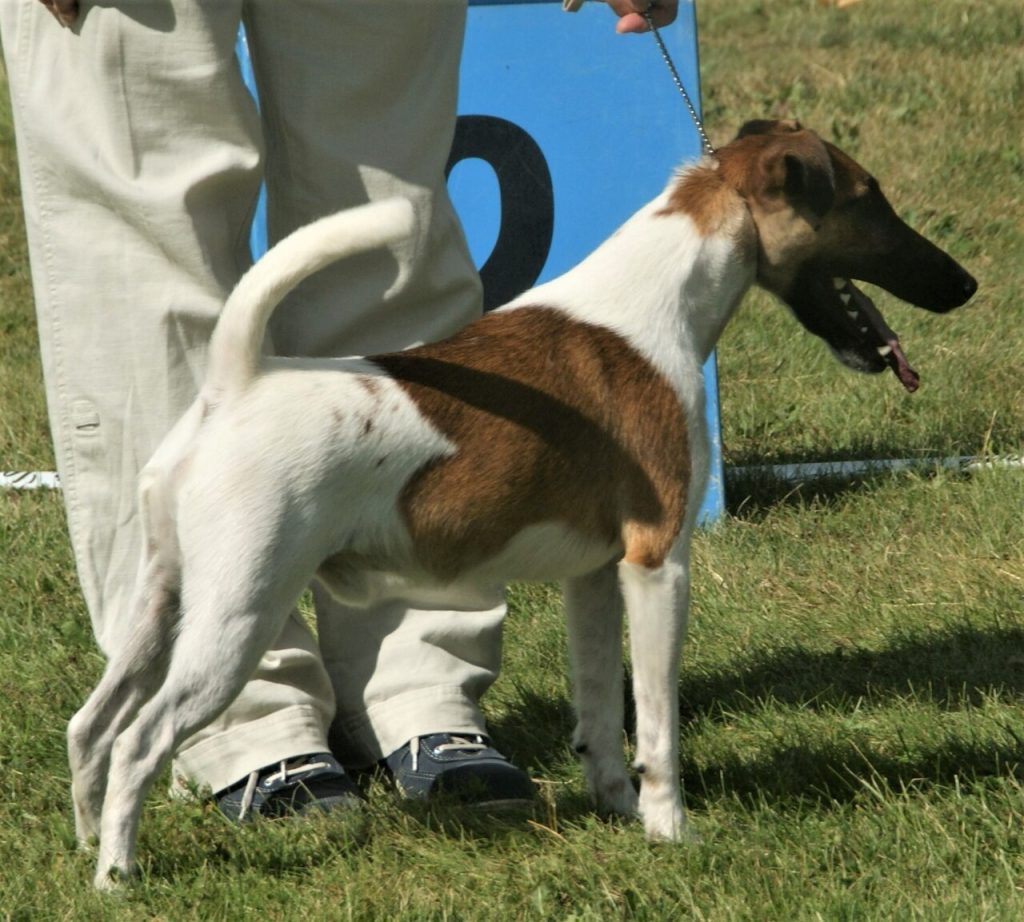
The Fox Terrier with smooth hair is an English pocket terrier with the soul of an athlete: small, white, muscular and with an energy capable of exhausting anyone. Born to get underground after the fox, today it is above all a lively, brave and devoted companion, ideal for those looking for a dog awake, sporty and with a lot of personality, but demanding in exercise and education.
Is the smooth-haired fox terrier for you?

Before you fall in love with its elegant appearance, you should be honest: this is a working terrier with all the letters. It is a dog that gives a lot, but also asks a lot in return. If your life is active and you want to devote time to it, you will hardly find a more devoted and fun companion. If you are looking for a quiet couch dog, look for another breed.
Points in favour
- Small and manageable, comfortable on the floor and on the road.
- Minimal hair maintenance: no stripping or hairdressing.
- Very healthy and long-lived, with a life expectancy of 12-15 years.
- Smart, brave and loyal; he learns fast if you motivate him.
- Ideal sports companion for running, agility or hiking.
- Cheerful, affectionate and always willing to play with his family.
Points to Consider
- He needs plenty of daily exercise; boredom takes its toll.
- Strong prey instinct: watch out for cats and small animals.
- He can be barking and some fighting with other dogs if he doesn’t socialize.
- Independent and stubborn; not the easiest for beginners.
- He loves digging and chasing everything that moves.
- It requires early and constant socialization to bring out its best version.
Character and temperament
The smooth-haired fox terrier is a pure terrier: vital, cheerful, courageous and with a contagious optimism. It is a vigilant dog that is interested in everything that happens around it and that wants to participate in the life of its family, not observe it from a corner. It likes an owner as curious and active as it is, someone with whom to go out, play and explore.
Behind that nice face is a born hunter. He was raised to stand alone against a fox cornered underground, and that heritage translates into courage, stubbornness and a tendency to chase anything that runs. It is not a fearful or cowardly dog; on the contrary, it sometimes sins too boldly. With his family he is affectionate and faithful, and with strangers he is kind if he has been well socialized, although he is always alert: If he hears a strange noise, he’ll let you know.
It is also a sensible dog within its intensity. It is not one of those that bark for hours in the garden for no reason, but it does enjoy a good chase (a cat, a ball, a leaf in the wind) and the occasional fuss. Bored and without spending energy, on the other hand, it can turn all that into a problem.
Coexistence: children, other pets, flat and loneliness

With children is usually a tireless playmate: robust, energetic and always ready for action. It fits wonderfully with children who know how to treat it with respect and who want to move as much as he does. As with any dog, supervision with the youngest is essential.
With other pets needs to be more careful. Its prey instinct is high, so cats, rabbits, ferrets or rodents can awaken its hunter side; coexistence is best achieved if they grow together from puppyhood. With other dogs it can be dominant or feisty, especially among males, so early socialization makes the difference.
On the floor lives perfectly thanks to its small size, as long as it is compensated with excess outings and exercise. He’s not a yard dog who entertains himself: It needs its people and activity. In the face of loneliness does not stand out for its patience; if left alone for many hours without stimuli, it may resort to barking, digging or wrecking. Gradually get him used to solitude and leave toys and challenges to keep him occupied.
Education and training
It’s a very intelligent dog and able to learn quickly, but its independence and terrier stubbornness mean it’s not always willing to obey just to please you. The key is positive reinforcement: rewards, play, and short, fun sessions work infinitely better than imposition, which only gets it to close in on you.
It prioritizes socialization (people, dogs, noises, environments) from puppyhood and works the call intensively; remember that, when its hunting instinct is triggered, a Fox Terrier can run out without looking back, so safety in open areas depends a lot on that training. He channels his energy and his head into olfactory games, playful obedience and canine sports: A terrier with a busy mind is a happy terrier and much easier to get along with.
Exercise and activity
There are no shortcuts here: the smooth-haired fox terrier is a high-energy dog that needs to burn it daily. It has at least an hour long activity, best divided into several moments, combining walks, runs, intense play and some mental work. A simple quiet walk around the block is far from enough for it.
He’s passionate about activities that test his body and his wits: agility, flyball, canicross, hiking or the chase and search games. Many birds also enjoy digging, so if you have a garden, you may need to set aside an area for them to dig without destroying your plants. A well-exercised Smooth Fox Terrier is a balanced dog; a bored one seeks his own amusement, and you will rarely like the result.
Care: fur and hygiene
One of the great advantages of this variety over the hard-haired variety is the unpretentiousness of its coat. The hair is short, dense, flat and very attached to the body, and is kept in good condition with a weekly brushing that removes the dead hair and distributes the natural fat of the skin.
Bathing should be sporadic, only when it is really dirty, so as not to alter the natural protection of your skin; always use specific dog shampoo. Complete the routine with the basics of any dog: Check and clean your ears, brush your teeth regularly, and, very important in this breed, keep your nails short, because long nails alter the posture of your foot and can make you limp.
Foodstuffs
Being a small but very active dog, the Fox Terrier needs a high-quality food, with a good protein ratio, that maintains its rhythm without exceeding calories.
Watch your weight carefully: Under your short hair, it’s easy for excess weight to go unnoticed until it’s a problem, and the extra pounds put a strain on your joints and your heart. Also beware of excess prizes during training (use small portions and discount them from the ration) and always have fresh water available. When in doubt about the ideal diet, your veterinarian is the best reference.
Health and life expectancy
The Fox Terrier is a rustic and generally healthy breed, with a remarkable life expectancy of between 12 and 15 years.
Among the conditions described are deafness, dislocation of the kneecap, and various eye disorders such as dislocation of the lens, dysthiasis, and cataracts. On the skeletal plane, legg-Calvé-Perthes disease, also known as Legg-Calvé-Perthes and shoulder dislocations may appear. Myasthenia gravis, idiopathic epilepsy and goiter have also been reported. There is also a hereditary ataxia linked to a mutation in the KCNJ10 gene, the same identified in the Jack Russell and Parson Russell Terrier. Choosing responsible breeders who perform health tests on breeders is the best prevention.
Physical appearance

The smooth-haired fox terrier is a small, compact and athletic looking dog, built to be fast and tough. The males weigh around 7.5-8 kg and the females slightly less (about 7-7.5 kg), with a height of approximately 39 cm at the withers. It gives an impression of balance and elegance, without anything coarse or excessive.
His head is characteristic: thin and fairly elongated, with a flat skull, long snout, dark, small eyes, and V-shaped ears that drop forward. The body shows a deep but not wide chest, a short, straight back, muscular hips and a high-bearing tail. The predominant colour is white (inherited from a mottling gene, not from albinism), usually with black, brown or both shades of spots. The mantle, short and smooth, completes that clean, functional silhouette that has made him so recognizable.
Origin and history
The Smooth Fox Terrier is one of the oldest and most significant English terriers. It has been known as a distinct breed in England since at least the 18th century: The first documented testimony dates from 1790, when Colonel Thornton painted a portrait of his dog Pitch. It was bred for a very specific task within fox hunting, the fox bolting: to accompany the pack of hounds and go underground to draw the fox out of its burrow towards the hunters. Its white colour was not casual: It helped to distinguish it from the fox in the heat of battle.
It was the first breed of the fox terrier family to receive official recognition from the British Kennel Club, around 1875, with the first standard in 1876. The American Kennel Club recognized the fox terrier in 1885. For a long time the smooth-haired and the hard-haired were considered varieties of the same breed and were crossed with each other, but in the 1980s the AKC officially separated them. Today, many experts argue that they probably descended from different ancestors: The smooth-haired would have as its main ancestor the ancient Smooth Black and Tan Terrier, with contributions from Beagle and Bull Terrier.
Curiosities
- The smooth-haired fox terrier is at the origin of many modern terrier breeds: much of the family descends, in one way or another, from these dogs.
- Igloo, the fox terrier of explorer Richard E. Byrd, accompanied his owner on expeditions to Antarctica.
- Titina traveled with Umberto Nobile in the Norge and Italia airships flying over the North Pole.
- Designer and filmmaker Tom Ford has had several Smooth Fox Terriers, which even appeared in his film A Single Man and in his parades.
- The famous Nipper dog, an image of the “His Master’s Voice” logo, was depicted in some advertisements as a Smooth-Haired Fox Terrier, although its actual breed is a matter of debate.
If you are attracted to this lively, athletic terrier, you may want to compare its character with that of other active, intelligent breeds. Check out the Beagle, another hunter with a fine nose and unrelenting energy; the versatile Border Collie, a champion of canine intelligence; the sleek Dálmata, a tireless athlete; or the small, tenacious Yorkshire Terrier, another terrier with a lot of character in a small size.
Frequently Asked Questions about the Smooth Fox Terrier
Is the Fox Terrier a good dog for beginners?
It is not the easiest choice. It is a very energetic terrier, with a marked hunting instinct and independent character, so it responds much better to someone who already has some experience or who is willing to be deeply involved in its socialization, education and daily exercise. With the foundations well laid, it is a wonderful companion; without them, it can become barking and difficult to handle.
How long does a Fox Terrier live?
It is a long-lived breed for its size, and with proper nutrition, exercise, and veterinary checks, it usually lives 12 to 15 years, and it is not uncommon for some to exceed that number and remain active into old age.
Do you get along with children and other pets?
With children who know how to treat it with respect, it is usually a tireless playmate and very funny. With other dogs it can be a bit of a fight if it is not well socialized, and with small animals (cats, rodents, rabbits) you have to be careful because of its strong prey instinct: coexistence is possible, but requires early introductions and supervision.
How much exercise do you need a day?
It has a minimum of one hour of long daily activity divided into walks, runs and games, more mental stimulation. It’s a dog designed to work underground after the fox, so the energy it doesn’t spend turns it into mischief, digging and barking.
Can he live in a flat?
Yes, as long as you give it the exercise and stimulation it needs, it’s small in size and well suited to urban life, but a floor without enough exits is the recipe for a frustrated terrier.
Does your hair need a lot of maintenance?
Very little, and therein lies one of its great advantages over the hard-haired Fox Terrier. Its short, smooth coat is maintained with weekly brushing and sporadic bathing; it does not need the stripping or hairdressing that the hard-haired variety demands.
Does the Smooth Fox Terrier bark a lot?
A well-behaved dog barks with discretion (to a noise or a stranger), not continuously.
How is it different from the hard-haired Fox Terrier?
They share terrier origin, size, and temperament, but the plain-haired terrier has a short, dense, sticky coat that hardly needs care, while the hard-haired terrier has rough, stiff hair that requires stripping.