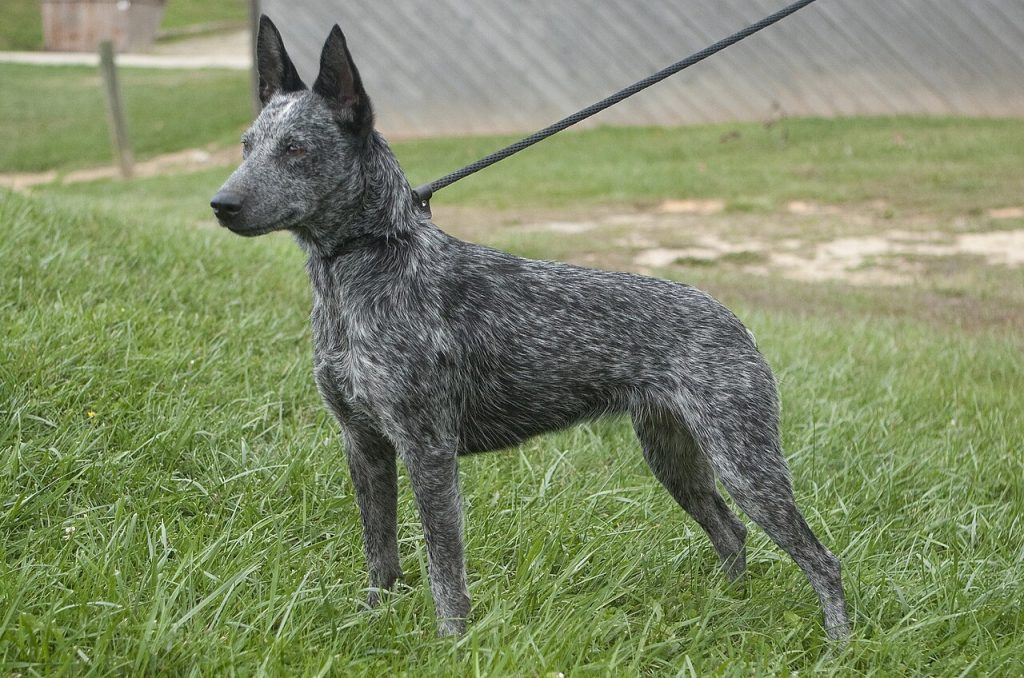
The Australian Short-Tailed Cattle Dog(in English, Australian Stumpy Tail Cattle Dog, and “Stumpy” for friends) is a medium-sized, rugged, naturally short-tailed Australian boyar dog, bred to move cattle under the relentless sun of the Australian outback. A close relative of the popular Australian Cattle Dog, it is a rare, energetic and independent breed, designed to work from sun to sun and reserved as few with strangers.
Is the Australian Short-Tailed Cattle Dog for you?
Before you fall in love with his raccoon silhouette, be honest: this is not a breed for everyone. It is a real working dog, with a motor that few urban pets need. These boxes summarize who fits and who does not.
It suits you if…
- You lead an active outdoor life and you want a dog to keep up with you for hours.
- You’re looking for a natural guardian, caring and loyal to your family.
- You like to train: agility, obedience, shepherding, flyball or smell work.
- You have a house with land or easy access to the country.
- You have some experience with strong-tempered dogs.
It’s better to avoid it if…
- You spend a lot of hours outside and the dog would be lonely and bored.
- You want a quiet couch dog or an “easy” first dog.
- You live in a small apartment with no time for intense daily exercise.
- You’re uncomfortable with a dog that’s reserved and very territorial with strangers.
- You don’t see yourself spending time on constant socializing and training.
Character and temperament
The standard describes the Australian Short-Tailed Cattle Dog with three words that depict it as full-length: alert, vigilant and reserved. It is an alert dog that seems to be always on duty, registering what is happening around it and responding quickly to its owner. With his people he forms an intense and loyal bond; with strangers, on the other hand, he keeps his distance and mistrust until he decides otherwise.
He is a high energy and high stimulation needs dog, two traits inherited from generations moving cattle in harsh conditions. That same intensity makes it a formidable companion for an active person and a problem for someone who leaves it idle: an idle Stumpy looks for his own job, and you’ll rarely like which one he chooses. It ‘s independent and resolute – I thought only when herding cattle away from the rancher – so don ‘t expect the complacent submission of a pet dog: He respects you if you earn his respect.
Coexistence: children, other pets, flat and loneliness

Niños. Well socialized can be a devoted family dog, but it carries a powerful herding instinct: when running and shouting, it tends to “pull” by nibbling on its heels.
Other pets. usually coexists well with dogs and cats with which it is bred, although its dominant character may clash with other dogs of the same sex.
Flat and lonely.‘s great limitation is this: it is not a dog made for apartment living or long days in solitude: it needs space, outings and, above all, a busy mind. If left alone and unstimulated, boredom turns into barking, wrecking and obsessive behavior. A house with land and a present owner is its ideal setting.
Education and training
The Stumpy is intelligent and quick to learn, but it is not a dog “who obeys for obedience’s sake”. Its independence demands consistent, positive and early training: clear reinforcements, short and varied sessions, and a leader he trusts.
Two priorities from puppyhood: socializing broad – people, dogs, noises, environments – to soften its natural suspicion towards the unknown, and control of heel biting instinct, redirecting it towards allowed play and work.
Exercise and activity
If you remember just one fact from this whole chart, let it be this: the Australian Short-Tailed Cattle Dog needs a lot of exercise, and not just physical. A couple of short walks aren’t enough for him. We’re talking about running, long walks, intense play and, very importantly, mental challenges that get his instincts working.

He is a versatile athlete who excels in agility, obedience, flyball, crawling, frisbee and, of course, herding tests, where his natural talent emerges. These activities are not a luxury, but an essential escape valve: a tired and mentally satisfied Stumpy is a balanced dog; one not spent, a source of problems.
Care: fur and hygiene
The good news for those who are afraid of the hairdresser: its maintenance is minimal. It has a short, dense, double coated hair, with a small throat in the neck. A weekly brushing keeps the mantle healthy and distributes the natural fat; during the two seasonal mows it is advisable to brush it daily to control the loose hair.
Bathing should be occasional, only when it gets really dirty, so as not to remove the greasy layer that waterproofs its skin. It completes the routine with the basics of any active dog: checking and cutting the nails, monitoring the ears of erect ears and taking care of dental hygiene.
Foodstuffs
Being an energetic working dog, its diet must conform to a actual heat expenditure. A complete and quality diet, divided into two daily intakes and proportionate to its age, weight and activity level, is the basis.
The main risk is not the lack of food but the overweight in poorly exercised specimens: every extra kilo punishes their joints. Water is always fresh and available, especially after exercise, and avoids intense effort right after eating.
Health and life expectancy
The Stumpy is a rural and generally healthy breed, forged by functional selection for work rather than aesthetics. Its life expectancy is around 12 – 15 years, a remarkable longevity for a medium dog.
Due to its close relationship with the Australian Cattle Dog, breeders keep an eye out for the typical boyer dog conditions: congenital hereditary deafness, progressive atrophy of the retina and hypoplasia of the hip. Choosing puppies of lines with ear, eye and hip tests is the best prevention. With regular veterinary checkups, daily vaccination and deworming, adequate exercise and controlled weight, it is a dog that usually gives little scare.
Physical appearance
The standard defines it as “a well-proportioned working dog, rather square in profile, of stiff and leathery appearance”. It is a medium, compact and muscular dog, transmitting endurance rather than elegance.
Its markings are the small, erect ears and, above all, the naturally short tail(under 10 cm). The coat is short and dense, with a small throat at the neck, and appears in mottled blue or red varieties. Unlike the Australian Cattle Dog, its standard does not support fire marks: the toasting is interpreted as an indication of miscegenation. In the FCI classification it belongs to the Group 1 (herding dogs and greyhounds), Section 2 (greyhounds), with standard no. 351.
Origin and history
The story of the Australian Short-Tailed Cattle Dog is intertwined with that of the Australian Cattle Dog itself. The first domestic dogs arrived in Australia with the First Fleet in 1788; a population of wild dogs soon thrived, and specimens with cattle fitness ended up in the hands of settlers such as the George Hall. Their son Thomas Hall developed them as working dogs, the famous Halls Heelers, common stock from which both the Cattle Dog and the Short Tail descend.
Robert Kaleski, author of the first standard of the breed in 1902, only described specimens with long tails; the short or absent tail was passed on as an inherited character. In Queensland, the two varieties – long-tail and short-tail – coexisted for decades until they split into separate classes in the 1950’s. The race was then on the brink of extinction: For a time, the breeder Iris Heale(Glen Iris hound) was the only one to keep registered specimens. In 1988, aware of the risk, Australian enthusiasts launched an Australian National Kennel Council “Developmental breeding program” that saved the breed.
First recognized as a breed of its own in 1963, it was officially renamed Australian Stumpy Tail Cattle Dog in 2001 and was accepted by the Fédération Cynologique Internationale (FCI) at the beginning of the 2000s.
Curiosities
- Rapunzel from birth. His short tail is 100% natural, no amputations, hence the nickname “Stumpy”.
- Saved in the end. was on the brink of extinction; for a time it depended on a single breeder with registered specimens.
- Cousin, that’s not twinning. shares roots with the Australian Cattle Dog (Blue Heeler), but they are separate breeds with their own standards.
- No signs of fire. The toast, normal in the Cattle Dog, disqualifies the Short Tail because it betrays crosses.
- Trial athlete. Competes in agility, obedience, flyball, tracking, frisbee and herding.
- A worldwide rarity. is very difficult to see outside Australia; breeders count on the fingers of one hand.
If you are attracted to this Australian boyer because of its energy and work instinct, you will be interested in other pastoral and boyer breeds with which it shares character or function: the tireless Border Collie, the versatile Pastor Australiano, the small but brave Welsh Corgi Pembroke– also a heel boyer – and the always reliable Pastor Alemán.
Frequently Asked Questions About the Australian Short-Tailed Cattle Dog
Is the Australian Short-Tailed Cattle Dog really born without a tail?
Yes. Its short or almost non-existent tail is natural: it carries a brachiuria gene and does not come from any amputation. The standard requires a tail less than 10 cm long, and many specimens barely have a stump. That is why it is affectionately nicknamed “Stumpy”.
Is it the same as the Australian Cattle Dog or the Blue Heeler?
They share a common origin – both descended from the Halls Heelers of the 19th century – but are two distinct and separately recognized breeds.
Is it good enough to live in a flat?
It’s not his ideal environment. It’s a high-energy working dog that needs intense exercise and mental stimulation daily. It can adapt to a floor if the owner gives it hours of actual activity, but it performs much better in a house with land and an active person in front.
Do you get along with the kids?
With early socialization, it can be a good family companion, but it retains a strong shepherding instinct: it tends to “catch” a runner by biting its heels.
How long does an Australian Short-Tailed Cattle Dog live?
It is a rustic breed, bred to work in harsh climates, and generally enjoys good health when kept active and at its weight.
Do you need a lot of hair care?
Its coat is short and dense, with a double layer; a weekly brushing is sufficient, which takes place daily in the two seasonal moods.
Is it an easy breed to find?
No. It is one of the rarest Australian breeds: it was on the brink of extinction in the middle of the 20th century and survived only thanks to a targeted breeding program. Outside Australia breeders are very few, so getting a puppy usually involves waiting lists.
Is he an aggressive dog?
Not by nature. It is reserved with strangers and a very good keeper, but does not seek conflict. It needs socialization, clear boundaries and an experienced owner to channel its energy; a boring and unguided Stumpy is what gives problems, not the character of the breed.