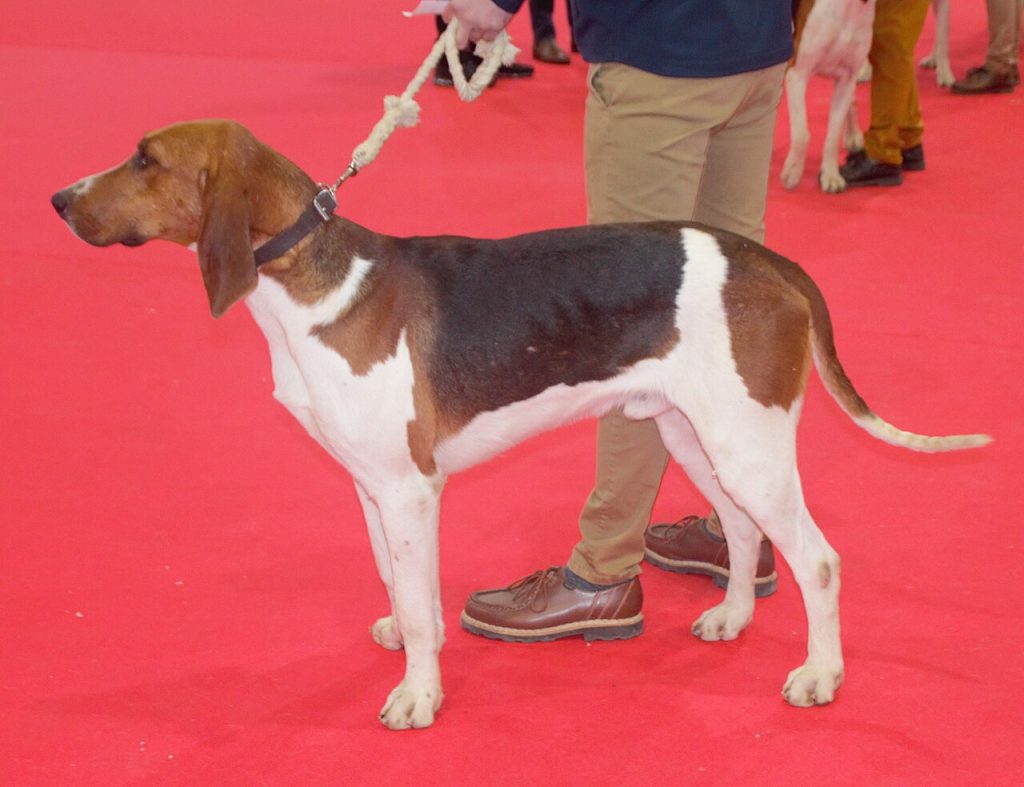
The Sabueso Francés Tricolor(French: Chien Français Tricolore) is one of the great hounds of France: A tall, stocky, athletic hunting dog, bred for generations to follow a group trail and work the big game under the direction of man. It is not a saloon dog, but a working hound with an extraordinary sense of smell and endurance, and you should understand it that way before falling in love with its elegant tricolor coat.
Is the Tricolor French Hound for you?
First of all, let’s be honest: The French Tricolor Hound is first and foremost a pack dog. He enjoys group work, large spaces and trail riding, and feels out of place on a floor or in a sedentary routine. If you’re looking for a hunting companion or a scent sport dog to live in the country, it’s a fascinating breed; if you’re looking for a quiet city pet, it’s almost certainly not your dog.
In favour .
- Exceptional sense of smell and stamina for pack hunting.
- Balanced temperament and very sociable with other dogs.
- Short hair, easy to maintain.
- Rustic, athletic and harmonious dog.
- It fits very well into an active rural environment.
To be taken into account
- Huge need for exercise; not floor fit.
- High hunting instinct: the call is difficult.
- He’s used to living in packs, he can’t stand loneliness.
- A rare breed outside of riding circles.
- Not recommended for first-time or urban owners.
Character and temperament
The French Tricolor Hound has a reputation for good character: it is a balanced dog, not aggressive – aggression is considered even a serious defect in the breed – and deeply gregarious.
Now, his mind is dominated by his nose. He’s a hound on all fours: As soon as he catches an interesting trail, he concentrates on it and ignores almost everything else. That passion for the trail, combined with remarkable independence, makes him a willing and hardworking dog in the field, but little “obedient” in the classic sense. It is not a watchdog or overly attached to one person; it is a team dog.
Coexistence: children, other pets, flat and loneliness

With other dogs is usually well understood: it has always lived in a group and canine coexistence is part of its nature. With the children tends to be kind and tolerant, although it is not a dog accustomed to moving from a home and it is advisable to monitor contact, especially for its size and energy.
With cats and small animals must be approached with caution: its hunting instinct is very high and it may interpret a fleeing animal as a piece. On the floor does not fit: it needs space and activity. And as a good pack dog, it’s bad to be alone. is prolonged; it is made to live accompanied, ideally with other dogs, and suffers if left isolated for many hours.
Education and training
Educating a Tricolor French Hound requires understanding that you are working with an olfactory specialist, not a competition obedience dog. It is intelligent and collaborative within the pack, but independent and highly trail-motivated, which makes calling (the recall) especially tricky when there is an interesting smell in the middle.
The keys are early socialization, perseverance, and positive work that harnesses their instincts instead of fighting them: Smell games, tracking and teamwork. The voice, the handling of the pack and the direction by the montero are part of their tradition. For a private owner, the realistic assumption is that he will rarely be a reliable loose dog in unfenced areas.
Exercise and activity

Here is the most demanding point of the breed. The French Tricolor Hound was designed to travel long distances following a trail for hours, and its body reflects this. Its exercise needs are enormous: kilometers a day, open field and, above all, stimulation of smell.
A couple of short walks won’t go far enough. Without adequate physical and mental expenditure, the dog becomes frustrated, gains weight, and can develop problematic behaviors. So it fits into the hands of hunters, riding packs, or canicross athletes, mantrailing, and tracking disciplines that can give it an outlet for that endurance machine it carries inside.
Care: fur and hygiene
The good news is that your short and shallow coat is very easy to maintain: with a weekly brushing to remove dead hair is enough, and baths only when really needed. The challenge of care is not in the hair, but in the consequences of your outdoor life.
Their long and sloping ears have poor ventilation and are prone to otitis: they must be checked and cleaned regularly. After each day in the field, it is advisable to inspect pads and fingers for wounds or spikes, check that they do not bring ticks and check the eyes and genital area.
Foodstuffs
As a large, athletic, and spending dog, the French Tricolor Hound needs a quality diet well adjusted to its activity level, which varies greatly between the hunting season and the months of rest. A good active large dog food, a balanced wet diet, or a veterinarian-supervised home ration are good choices, always adjusting the amounts to keep the dog at a lean weight.
As with all large, deep-breasted breeds, it is advisable to divide food into two portions and avoid strenuous exercise just before and after eating to reduce the risk of gastric torsion.
Health and life expectancy
The Tricolor French Hound is a rustic dog, selected for generations for its functionality rather than aesthetics, which has favored a healthy constitution.
Rather than breed-specific diseases, it is wise to watch for the inherent risks of a large, sporty dog with droopy ears: ear infections due to ear conformation, possible joint problems (hip and elbow) due to its size and activity, injuries and injuries derived from field work, and the ever-present gastric torsion of deep-chested breeds. Regular veterinary checks, deworming and weight control are the best prevention.
Physical appearance
The Tricolor French Hound is the prototype of the large French pack hound: a dog with a smooth and muscular body, long legs and harmonious silhouette, clearly built for the long distance race.
The head is elongated and distinguished, with a well-marked ulcerative colitis or ulcerative colitis, long and sloping ears, and slightly square bellies. His identification mark is tricolor coat: a broad black cloak on a white background, with brightly-toned fire marks. There is also a rough gray variant called louvard(“wolf look”). Fat feet, aggression and any sign of crossing with English hounds are considered defects.
Origin and history

The Tricolor French Hound belongs to the Chiens Français family, the French herding hounds reconstituted throughout the 20th century from the country’s great historical herds.
From this selection work came three varieties according to color: the tricolour (tricolor), the white and black (white and black) and the white and orange (white and orange). The tricolor is the most numerous of the three. The breed is internationally recognized by the Federación Cinológica Internacional within the Group 6 (hounds and similar breeds), in the large hound section. In its native France it is bred and kept mainly as a hunting dog for the great venerie– the deer, deer and wild boar riding – not as a show dog or companion dog.
Curiosities
- The adjective “Français” distinguishes these purebred hounds from the Anglo-Français, which are the deliberate and stabilized cross with the English Foxhound.
- Curiously, having used English blood to create the breed, today the standard penalizes any visible trace of that crossing in the modern specimen.
- The color louvard owes its name to its resemblance to the wolf coat (wolf in French).
- It is a herding dog (– What ?): it works in numerous groups led by the handler, not hunting for free.
- Its powerful hunting voice, which warns when it follows the trail, is an essential part of its usefulness and the sound show of a mount.
If you are attracted to this large pack hound, you may be interested in other hunting and tracking breeds with which it shares family air or vocation: the Bloodhound(the legendary St. Hubert’s Dog, the root of so many European hounds), the Basset Hound also of French origin, the popular Beagle as a smaller-scale pack hound, and the Pointer among the large hunting dogs. They’ll help you place the French Tricolor Hound within the wider world of working dogs.
Frequently Asked Questions About the French Tricolor Hound
Is the Tricolor French Hound a good companion dog or a floor dog?
It is not the usual choice as a house pet. It is a pack dog bred to hunt in groups in the countryside, with a very high hunting instinct and a huge need for exercise. It does not adapt well to a flat or urban family life; it fits into rural environments, with space and, above all, with hunting work or sport of very intense smell.
How tall and how much does a French Tricolor Hound weigh?
It is a large-sized hound: it measures between 62 and 72 cm at the withers, and the females are usually somewhat smaller.
How much exercise do you need?
It’s designed to travel great distances following a trail for hours. It’s not just a couple of walks: it needs miles a day, field and olfactory work. Without that physical and mental expenditure, it becomes frustrating and can become difficult to handle.
Does he get along with children and other dogs?
It has a reputation for good character and, having always been raised in a pack, is usually very sociable with other dogs. With children it can be kind, although it is not a dog accustomed to home life. With cats and small animals you have to be careful: its hunting instinct is very strong.
Is it hard to educate?
It is intelligent and collaborates well within the group, but is independent and guided by the nose. Recall is complicated when it catches a trail. It needs early socialization, patience and expert handling; it is not a recommended dog for someone inexperienced.
How long does the French Tricolor Hound live?
As a reference, large and active hounds usually live about 10-12 years when their diet, exercise and health are well taken care of.
What hair care and hygiene do you need?
The hair is short and shallow, so the maintenance of the mantle is simple: a weekly brushing is enough. The important thing are the long and fallen ears, which must be checked and cleaned to prevent otitis, and check pads, parasites and wounds after each day in the field.
How is it different from the Anglo-French Tricolor?
The French Tricolor Hound (Chien Français Tricolore) is considered a “pure” French hound: in the current specimen any trace of crossing with English hounds is penalized.