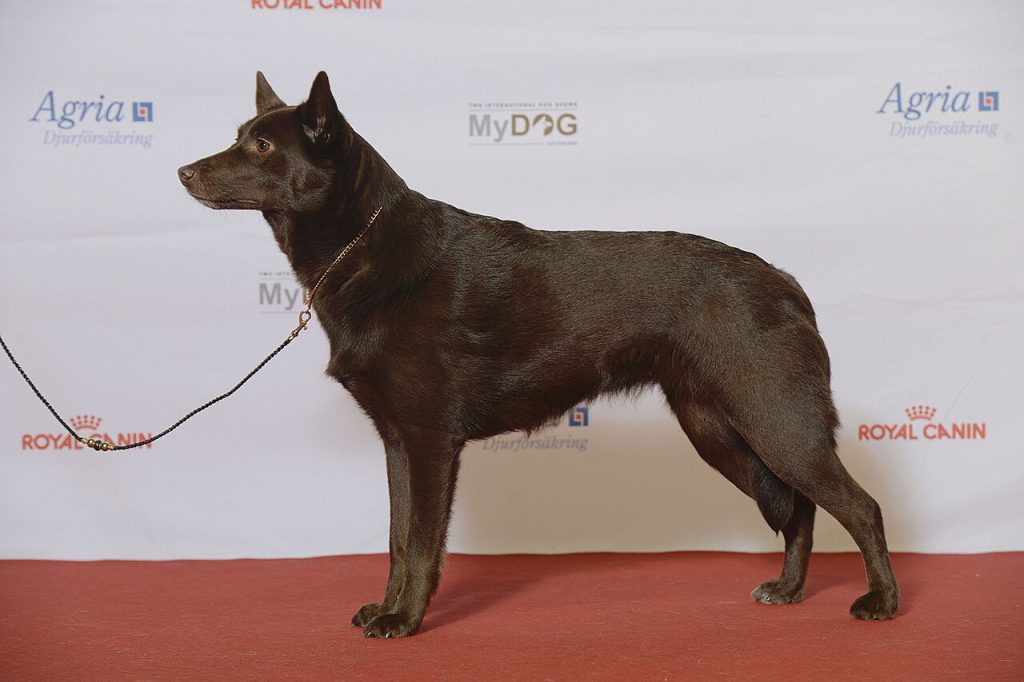
The Kelpie Australiano is the quintessential Australian country sheepdog: A medium-sized athlete capable of gathering and driving entire herds almost without instructions, under the relentless sun and for miles. Intelligent, tireless, and deeply attached to his person, the Australian Kelpie is one of the most efficient working dogs in the world, but that same intensity makes him a demanding companion who needs an owner willing to put his body and head to work.
Is the Australian Kelpie for you?
Before you fall in love with his wakeful gaze, be honest: The Australian Kelpie was bred for more than a century to work all day without rest, and that doesn’t go away when you walk through the door of an apartment. It’s a wonderful dog for the right person and a source of trouble for anyone looking for a quiet pet. These two boxes sum up the essentials.
In favour .
- High intelligence: He learns quickly and enjoys solving tasks.
- Almost unlimited physical endurance; ideal for canine sport and active life.
- Very loyal and attached to his family, especially his reference person.
- Very low-maintenance short coat.
- Rustic breed and generally healthy, with few hereditary problems.
- Medium size and manageable, without becoming a large dog.
Against
- It needs exercise and tremendous stimulation: it’s not a couch dog.
- If he is bored, he barks, digs, runs away, or nibbles in frustration.
- Strong herding instinct: tends to chase and “drive” children or cars.
- He can’t stand loneliness and long days without company.
- Independent and stubborn; not the easiest dog for beginners.
- Bad for small apartments and sedentary lifestyles.

Character and temperament
If we had to define the Australian Kelpie in one word, it would be “working dog”. In the English-speaking world, it is described without irony as workaholic: a dog with an internal drive to have something on its hands. That energy is not nervousness, but a calm, focused disposition that is activated as soon as a task arises, whether it is driving sheep, finding a ball or learning a new trick.
It’s an extraordinarily intelligent and ever-vigilant dog, capable of making decisions on its own. This autonomy, essential for a dog that works hundreds of metres from its shepherd, translates at home into a certain independence and stubbornness: The Kelpie does not obey out of submission, but because it understands and respects its leader. He is usually very fond of one member of the family, whom he follows everywhere, but he is also affectionate to others.
With strangers it tends to be reserved but not aggressive; many specimens have a vigilant point and warn of what happens in their territory. Well socialized, it is balanced and docile.
Coexistence: children, other pets, flat and loneliness
The Australian Kelpie can be a great active family dog, but there are nuances that you should know. With the children it is affectionate and playful, although its herding instinct sometimes leads it to chase and gently nibble the heels of running little ones, just as it would with a backward sheep. It is not aggression, but you have to monitor and redirect that behavior from a puppy.
With other dogs it usually gets along well, especially if it grows up socialized. With cats and other pets coexistence is possible if it gets used from a young age, although its instinct to chase what moves requires prudence with small animals.
The great weak point is the living on the floor and loneliness. An Australian Kelpie locked up for many hours, without exercise or companionship, is an unhappy dog that will eventually develop behavior problems.

Education and training
Few breeds learn as easily as the Australian Kelpie. Its intelligence and willingness to collaborate make it assimilate complex commands and sequences in very few repetitions. The challenge is not to teach it, but to keep it motivated and channel its initiative: a bored Kelpie invents its own games, and you rarely like them.
It works wonderfully with positive training, based on rewards, play and meaningful tasks. It’s sensitive to tone and consistency, so it’s best to be fair and consistent, never abrupt. early socialization– people, noises, other animals, urban environments – is critical to softening its reserved tendency and its chase instinct.
Because of its independent nature and high energy level, it is not the ideal dog for an inexperienced person looking for a comfortable pet, but in the hands of an active and committed owner, it is one of the most rewarding dogs to train: it excels in obedience, agility, flyball, treiball, herding and virtually any discipline that combines head and body.
Exercise and activity
Here’s the key to it all. The Australian Kelpie was selected to run for hours gathering herds in the Australian heat, and it needs an amount of exercise that surprises anyone who doesn’t know the breed. A couple of short walks aren’t far enough: we’re talking about running, intense play, dog sports or real work, every day.
As important as physical wear and tear is the mental stimulation. Intelligence toys, smell games, learning sessions, and most of all, purposeful tasks keep their mind occupied and prevent frustration. A Kelpie that receives physical exercise but no mental challenge is still a restless dog.
It is an ideal companion for people running, cycling, hiking or canicross, and for families living in the countryside. If you give it an active life and a purpose, you will have a balanced and happy dog; if you leave it without a way out, its energy will turn against you in the form of wrecks and barking.

Care: fur and hygiene
In contrast with its enormous exercise needs, the Australian Kelpie is one of the easiest to maintain. His coat is twofold: a dense inner layer that insulates and an outer layer of short, hard hair, arranged to repel rain. A weekly brushing is enough to remove dead hair, which intensifies during the spring season, when brushing is more frequent.
You don’t need frequent baths; one every few months or when you get really dirty is enough, so your skin doesn’t dry out. The rest of the hygiene is routine for any dog: checking and cleaning the ears, watching the cut of the nails (the activity usually wears them off naturally) and maintaining good dental hygiene with regular brushing. For their outdoor life, it is advisable to be strict with the prevention of external and internal parasites.
Foodstuffs
Being such an active dog, the Australian Kelpie needs a quality diet adjusted to its actual energy expenditure, which can be very high in working or sporting specimens.
The quantity must be adapted to each individual: A Kelpie who works in the fields all day burns a hell of a lot more than someone who lives in the city with a couple of sports outlets. You should check your weight regularly, since obesity strains your joints, and avoid strenuous exercise just before or after meals. As always, fresh water is readily available and, if you have any questions about specific rations or diets, consult your veterinarian.
Health and life expectancy
The Australian Kelpie is a rustic and hardy breed, with fewer hereditary problems than many modern breeds, the result of historical selection oriented to function rather than appearance. Even so, he is not free from certain ailments. Among those cited in the breed are hypoplasia of the hip, dislocation of the kneecap, cryptorchidism(non-descended testicles) and cerebellar abiotrophy is characterised by:, an inherited neurological disease currently the subject of genetic research in the breed.
As for life expectancy, a British study published in 2024 estimated an average of around 12 years for the breed, a figure similar to that of all purebred dogs. With proper care, proper exercise, and regular veterinary checkups, many kelpies live healthy and active lives well into adulthood. Choosing a responsible breeder who tests the health of the breeders is the best guarantee to avoid known hereditary problems.
Physical appearance
The Australian Kelpie is a medium-sized, muscular, compact and at the same time flexible dog, which transmits agility and resistance without appearing heavy.
Its head vaguely resembles that of a fox, softened by almond-shaped eyes of lively, intelligent expression. The ears are erect and pointed, very characteristic. The coat is double and short, with very varied colors: black, black and fire, red, red and fire, chocolate, blue (gray), lionskin, cream and even white and gold. You should know that there are two lines: the Kelpie at work(Working Kelpie), selected only for its capacity and with a wide variety of sizes and colours, and the Kelpie of beauty(Show Kelpie), bred to a more uniform exposure standard. Both share essence, but may differ in appearance and temperament.
Origin and history
The story of the Australian Kelpie is that of British shepherd dogs adapted to a new and harsh country. Throughout the 19th century, English and Scottish settlers brought to Australia various collies– mostly black or very dark herding dogs – to manage huge herds of mermaid sheep in immense spaces and in extreme heat. Those lines, crossed and selected for sheer efficiency, gave rise to the dog we know today.
The name of the breed comes from a specific female: Around 1872, Jack Gleeson acquired a black and fire puppy born at Warrock Station, near Casterton, and christened it Kelpie, after the water spirit of Celtic mythology. Their offspring were so prized that “Kelpie puppies” eventually gave their name to the entire breed. One of his daughters, called “King’s Kelpie”, shone in the shepherding trials of the late 1870s, sparking interest in the line. In 1904, Robert Kaleski drafted the first breed standard.
For a long time it was believed that the Kelpie carried the blood of the dingo, the Australian wild canid. The idea was very popular and explained its rusticity, but a genetic study from the University of Sydney released in 2019 nuanced that image: The study did not find a genetic link with the dingo in the specific genes analysed (ear shape and coat colour), although the researcher herself clarified that the work did not completely rule out any ancestral contribution. With or without the dingo, the Kelpie was forged as a distinctly Australian dog, and today is exported to numerous countries as an unsurpassed working dog.
Curiosities
- Its most spectacular maneuver consists of jumping on the backs of sheep and walking over the tight herd to reach the other side and unclog it.
- A good working Kelpie can save a cattle farmer the labor of several labourers, and the best specimens are auctioned off in Australia at record prices.
- Film and television have made it famous: the film Red Dog(2011) stars a Kelpie, and the character Rusty from the children’s series Bluey is also of this breed.
- A kelpie named Maggie was once considered one of the world’s longest-living dogs, with an estimated age of about 30 years.
- Beyond herding, it has been successfully employed in search and rescue, drug detection and as a guide dog, thanks to its sense of smell and ability to learn.
- Black kelpies descended from the dog “Barb” were known for years as “Barb”, after a black horse that won the Melbourne Cup in 1866.
If you are attracted to the Australian Kelpie for its intelligence and passion for work, you will surely enjoy meeting other equally brilliant herding breeds. Check out the Border Collie, Pastor Australiano, Collie and Shepherd of Shetland, all of them alert, active dogs with a strong working instinct in common with the Kelpie.
Frequently Asked Questions About the Australian Kelpie
Is the Australian Kelpie a good family dog?
It may be in an active family that gives it plenty of exercise and companionship. It is affectionate and loyal, but its energy and herding instinct demand supervision with young children and an outdoor life. It does not fit well into sedentary homes.
How much exercise does an Australian Kelpie need?
Many: at least one or two hours a day of intense activity (running, dog sports or work), in addition to mental stimulation.
Can he live in a flat?
It’s not ideal. It can adapt to the city if it’s guaranteed several long outings and plenty of daily stimulation, but its natural habitat is a house with land and an active life.
How long does an Australian Kelpie live?
A British study from 2024 placed their average life expectancy at around 12 years. With good care, adequate exercise and veterinary checkups, many specimens remain healthy and active for years.
Is he an easy dog to train?
It learns very easily because of its intelligence, but its independent nature and energy require a steady, experienced owner.
Kelpie descended from the dingo?
A 2019 genetic study found no link to the dingo in the genes analyzed for ear and color, although not entirely ruling out other contributions.
What’s the difference between the work Kelpie and the exposure Kelpie?
The Working Kelpie is selected solely for its ability to graze, with a wide variety of sizes and colors. The Show Kelpie is bred to a more uniform standard of beauty.
Does it shed a lot of hair and cost a lot to maintain?
No, her hair is short and very low maintenance: just a weekly brushing, more frequent in spring seedlings, bathing only when dirty and basic hygiene of ears, nails and teeth.